The struggle to secure rare metals (see below) such as lithium and cobalt is intensifying. One reason for this is that demand is expected to rise sharply in the future as these materials are used to make the lithium-ion batteries at the core of electric vehicles.
Blue sky is reflected on the surface of a completely still pool of water.
At a glance, it looks like a tropical resort, but in reality it is an artificial pond nestled in the highlands of the Andes in South America. This is a lithium production base that a joint venture of Toyota Tsusho Corp. and a major Australian resource development company established near Salar de Olaroz, a salt lake in Argentina.
At this facility, lithium-rich brine is extracted from 200 meters underground and transferred to the artificial pond. There it spends around 300 days being purified and concentrated into lithium through natural drying by the sun. The annual production capacity is currently 17,500 tons. In anticipation of further demand, Toyota Tsusho announced in January that it will expand its production capacity to 42,500 tons.
This plan would drastically increase production by close to 2.5 times, but that still pales in comparison to the efforts being made in China.
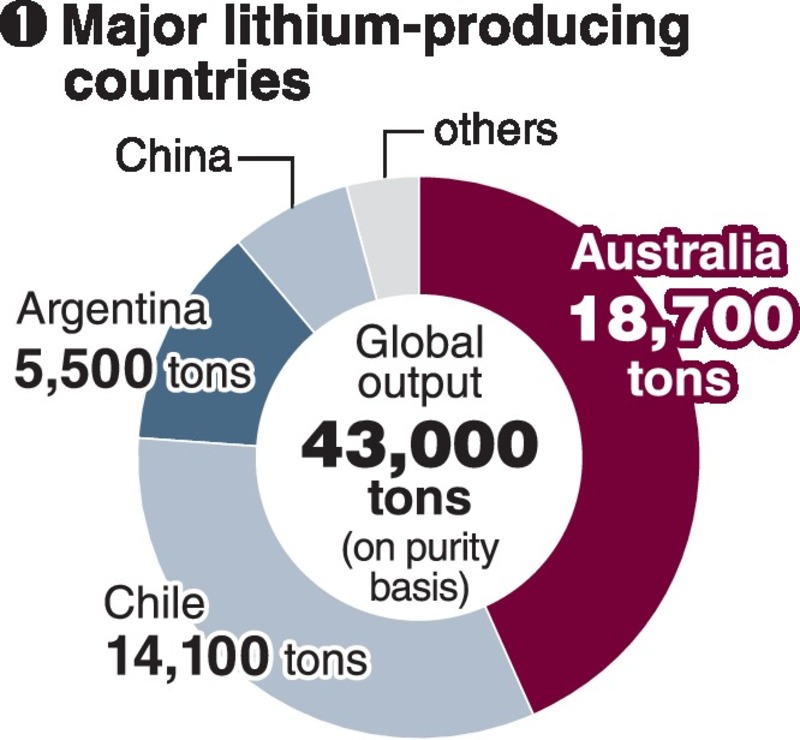
After major Chinese resource development company Tianqi Lithium Corp. acquired a 51 percent stake in another major Australian resource development company and obtained management rights in 2013, they announced in May this year that they have agreed to take a 24 percent stake in a major Chilean resource development company. According to the United States Geological Survey, Australia tops the ranking of the world's lithium-producing countries, followed by Chile, and Tianqi Lithium has a firm foothold in both of these countries (see chart 1).
"Powers in China are using an abundance of funds to buy up resources overseas," said Masaharu Katayama, Toyota Tsusho's head of resource development. "It appears as though they are playing the game by a different set of rules."
China's acquisition offensive is not limited to lithium.
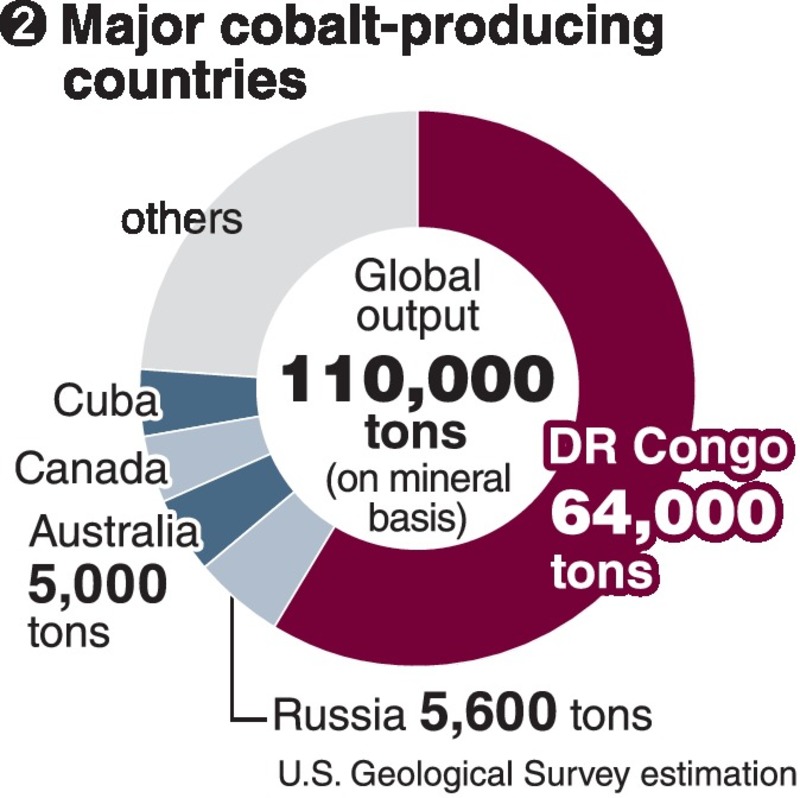
Cobalt is another essential material for producing batteries and 60 percent of global output comes from the Democratic Republic of the Congo in Africa (see chart 2). Here again, it is Chinese companies like Huayou Cobalt Co. and China Molybdenum Co. that are leading the battle to acquire cobalt assets. A Japanese person related to resource development expressed wariness, saying, "China is devoting itself to securing materials used in batteries."
'Strong nation' for EVs
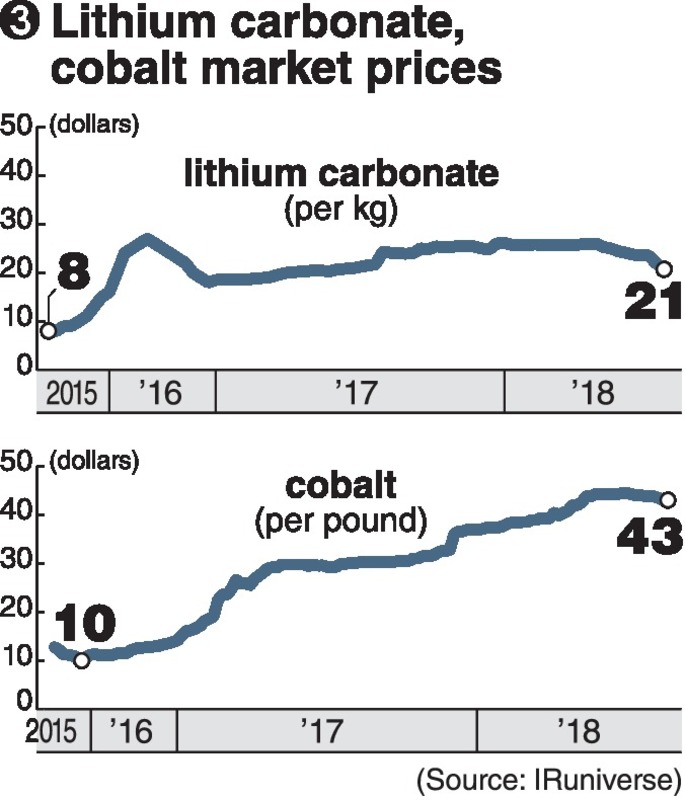
Among their other uses, lithium is also used as an additive in heat-resistant glass while cobalt is used as a pigment. The motive behind the intense competition in gathering resources can be ascribed to the automobile policies in China that see it striving toward becoming a powerhouse for electric vehicles. As a result, the price of lithium and cobalt rose from 2015 to 2017 (see chart 3).
As China has launched a range of supporting measures, such as subsidiary aid to the manufacturers and purchasers of electric vehicles, it surpassed the United States to become the world's largest electric vehicle market in 2015. In 2017, China set a new goal of selling 7 million new energy vehicles, including electric vehicles, annually by 2025. It also announced the introduction of regulations obligating vehicle manufacturers to make and sell a certain quota of new energy vehicles.
Such regulations and ambitious targets that far outstrip Japan's annual volume of new car sales (currently around 5.2 million units) promote the increased production of batteries. As a result, China is pushing resource companies to secure the world's lithium and cobalt supplies.
According to independent researchers IRuniverse, the spot contract price of lithium (lithium carbonate) is currently around 21 dollar per kilogram. That is nearly three times more than in the autumn of 2015, when it was trading in the 8 dollars range. Cobalt is trading at around 43 dollars per pound (453 grams), which is over four times higher than in the autumn of 2015. Yuji Tanamachi, president of IRuniverse, pointed out, "The current environment makes it easy for prices to rise as we are seeing a full-fledged boom in the electric vehicle sector and an influx of speculative money."
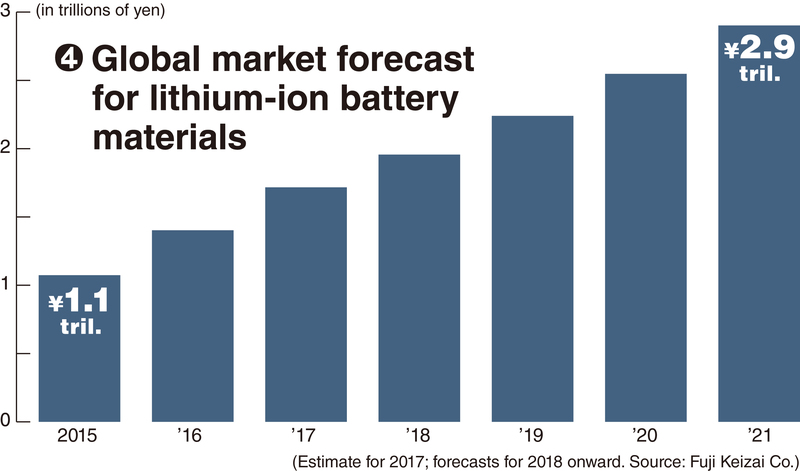
Predictions from Fuji Keizai Co., another research company, indicate that the market for materials for lithium-ion batteries, particularly focused around an increased demand for car batteries, will continue to expand, and by 2021, the market could be triple what it was in 2015, reaching a staggering 2.9 trillion yen (see chart 4). Many experts also believe that the demand will continue to expand.
Three variables
However, there are three variables at play that need to be taken into account when trying to read the future.
The first is the pace at which electric vehicles become commonplace.
Though the world's automobile manufacturers are competing to plan a "shift to electric vehicles," when we read their plans carefully, they often indicate "electrified vehicles" including hybrids.
Electrified vehicles including hybrids run using a combination of a combustion engine and an electric motor, so they can be manufactured with smaller capacity batteries on board than electric vehicles that run purely on motors. As the required size of the battery decreases, the required amount of lithium and cobalt decreases accordingly.
Technological innovation can be cited as a second variable.
Batteries are expensive and are the main reason why the price of electric vehicles remains high. If the prices of various resources rise sharply, manufacturers will simply reduce the use of those particular materials and look for cheaper alternatives, or develop completely new technologies not reliant on such expensive resources. In the case of lithium-ion batteries, research and development looking to reduce the amount of expensive cobalt and replace it with an increased amount of cheaper nickel would surely progress.
There is no guarantee that the current kind of batteries will continue to be the leading kind in the future.
The third variable relates to supply. Resource development companies around the world have announced plans to increase production in anticipation of growing demand. However, high-level knowledge is required to stably produce lithium and other rare metals. People in the field believe that only half of their endeavors are going according to plan. If that is the case, and targets are not being met, that gives rise to the possibility of an increase in battery production being hindered.
Concerning rare earths (see below), which are indispensable for the production of high-tech products, it is still fresh in people's memory that China began limiting exports to Japan in 2010 and this has had a significant impact on production by Japanese companies. More than half of the world's lithium processing facilities are said to be in China. Lagging behind in the contest to gather resources, Japan must also be wary of becoming dependent on China.
Therefore, Japan must establish a suitable supply network for rare materials and devise national strategies to boost competitiveness in the field of future automobiles.
--Rare metals
A general term for metals that are rare either because deposits are extremely scarce or because extracting them is difficult due to technical or financial reasons. The Economy, Trade and Industry Ministry has designated 31 types of metal as rare metals, including lithium, cobalt and others that have demand in industrial applications such as batteries. They are widely used in everyday products, such as automobiles, televisions, personal computers and smartphones.
--Rare earths
Of the 31 designated rare metals, deposits of 17 of them are extremely scarce and they are classified as such. Adding a small amount of these metals to other materials can increase their heat resistance and durability. Well-known examples of rare earths include neodymium, which is used in motors, and cerium, which is used in liquid crystal displays and catalytic converters. China has the most reserves and highest production of rare earths.
Read more from The Japan News at https://japannews.yomiuri.co.jp/