Competition is intensifying among countries involved in the development of flying cars, which for ages have been only the creations of science fiction.
Tickets for one such flying car have already been sold, and there are indications that the vehicle, which could carry up to four persons at a time, will be put into practical use in the mid-2020s. The development race is taking place alongside the formulation of relevant rules for the futuristic vehicles.
--Luxury car prices
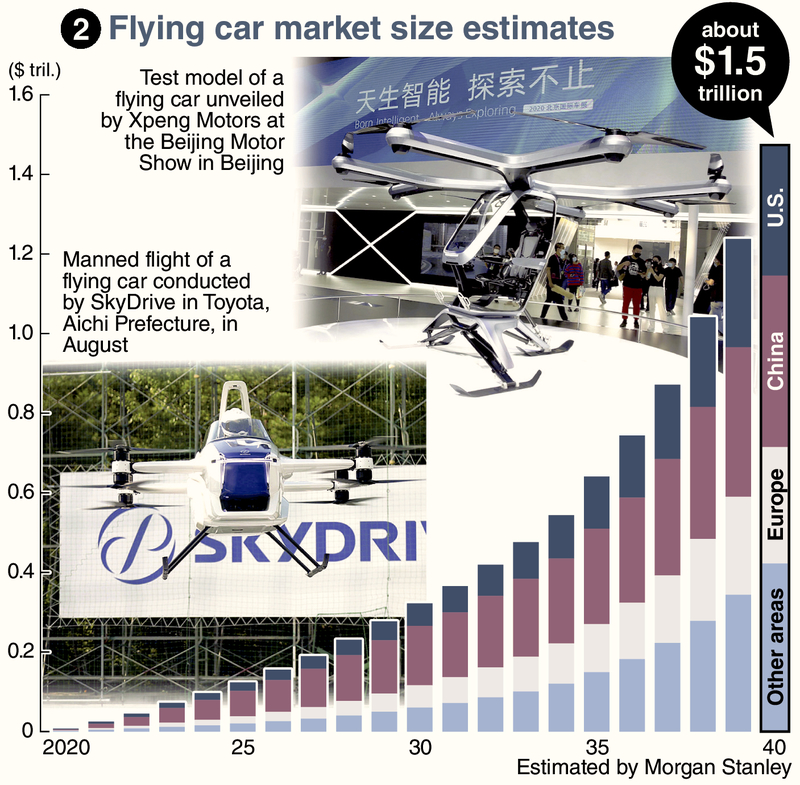
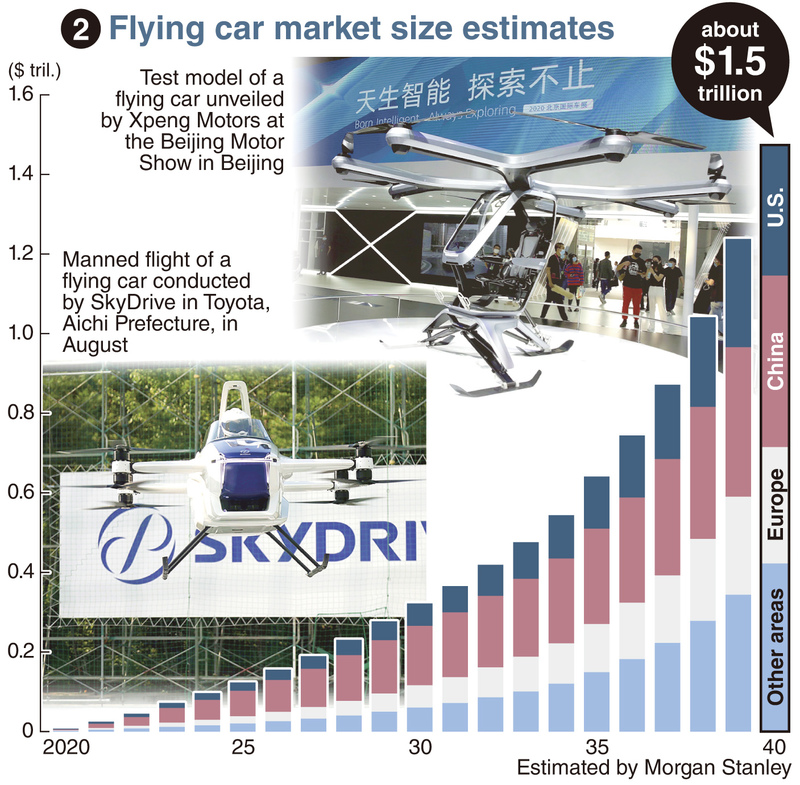
The well-known flying bike scene in front of a full moon in the movie "E.T. The Extra-Terrestrial" has been reproduced with the prototype Kiwigogo T1, made by Chinese upstart electric car manufacturer Xpeng Motors. It was unveiled at the Beijing Motor Show held from Sept. 26 to Oct. 5.
Xpeng chairman and chief executive officer He Xiaopeng said, "We hope that technology will enable us to realize our dream of flying safely, at the price of a luxury car." He said the company made 10,000 test flights of the vehicle, which uses propellers.
There are said to be about 200 companies and organizations around the world engaged in flying car development. Various parties, ranging from major aircraft manufacturers to venture companies, are competing each other for practical applications of the vehicle.
--Advance tickets sell out
In 2016, Uber Technologies, Inc., a major U.S. car dispatch service company, unveiled its flying taxi plan, announcing to the world that it aims to realize the service as a business in Los Angeles and other places in 2023. Working with a manufacturer in car development, Uber will be in charge of transportation.
In January, Uber announced a tie-up with Hyundai Motor Co. of South Korea.
In September, German start-up Volocopter GmbH began accepting bookings for seats on its flying taxi. It was not clear when the cars actually will fly, as the company only said it will be two to three years later, but 1,000 limited tickets for a 15-minute ride priced at 300 euros (about 37,000 yen) sold out.
Chinese start-up EHang Holdings Ltd. has conducted test flights of its aerial vehicle in China, Europe and the United States. The firm has attracted investor attention since its listing on the United States' Nasdaq start-up market in December last year.
In Japan, start-up SkyDrive Inc., founded mostly by former Toyota Motor Corp. employees, is aiming to put its flying car to commercial use in fiscal 2023. The company received an investment of 3.9 billion yen from the Development Bank of Japan and others this summer.
U.S. and European aircraft manufacturing giants Boeing Co. and Airbus S.A.S. are also working on similar in-house projects. As the aviation industry is under social pressure to drastically reduce greenhouse gas emissions, the manufacturers are believed to have launched the projects partly as preparations for the electrification of aircraft in the future.
Since electrified aircraft and cars have similar aspects, automakers are getting involved with providing aircraft manufacturers financial and technical support. Toyota invested about 40 billion yen in U.S. start-up Joby Aviation, and sent in its executives to the company. Porsche AG of Germany likewise has teamed up with Boeing.
Morgan Stanley has predicted that flying cars will become a leading industry and that the economy will grow to about 1.5 trillion dollars (160 trillion yen) in 2040. Provided flying cars become popular in a "bullish scenario," the market is expected to nearly double to 2.9 trillion dollars.
Behind the prospects is the enormous economic losses caused by traffic jams in urban areas around the world.
On the technical front, the ability to fly vehicles safely by remote control has improved. Like electric vehicles, flying cars needs fewer parts, and they would not need trained pilots onboard. They also can be manufactured at lower cost compared with existing aircraft.
Some predict that if flying cars were made on an industrial basis, it will become possible for the public to use flying cars at the same price as taxis.
-- Worries of residents
As long as they fly with people on board, the vehicles need to be certified through strict screenings to prove their safety. Since there is no precedent in the field, there are many challenges needed to be tackled, including the establishment of a pilot licensing system and minimum altitude requirements.
The focus will also be on how to increase the number of places where the cars can take off and land safely.
The European Union Aviation Safety Agency announced in July last year a new guideline for small aircraft certification with flying cars in mind, setting a model for required safety performance.
The U.S. Federal Aviation Administration, on the other hand, is reportedly studying ways to accept such vehicles under the current aviation legislation.
In the United States, the Department of Defense and the National Aeronautics and Space Administration are supporting private-sector efforts, trying to establish safety standards between authorities and companies.
Akinobu Okuda, president of aviation consulting firm Aerospace Kousou Research Institute, Inc., said a new certification system will be required to cover not only the safety of the vehicles, but also communication and control technology to ensure their stable operation since unmanned flights with the vehicles are also envisioned.
In Japan, the Economy, Trade and Industry Ministry and the Land, Infrastructure, Transport and Tourism Ministry are planning to establish relevant rules. With the aim of putting the vehicles into practical use in fiscal 2023, they started working-level discussions with businesses.
Behind moves in Japan, the United States and Europe is, according to an economy ministry official, that they reflected on their having allowed China to take the lead in developing and commercializing drones, leading Chinese firms' accounting for about 70% in the market.
Singapore and Dubai are also open to flying cars.
Takashi Oki, a senior researcher at Mitsubishi Research Institute, said, "As the vehicles are expected to fly at a relatively low altitude, it will be a major hurdle whether they are accepted by residents." According to a survey conducted by the institute in August on about 65,000 people in Japan, about 70% of respondents said they were either worried or opposed to flying cars passing over their heads. Winning the understanding of the public in terms of the safety and convenience of the system will have a major impact on the spread of the vehicles.
While situations are proving tough for the aviation industry because of the spread of the novel coronavirus infection, personal vehicles such as flying cars may become more important in the future.
A lot of attention will be paid to see who will overcome many hurdles and win in the race in the sky.
Read more from The Japan News at https://japannews.yomiuri.co.jp/