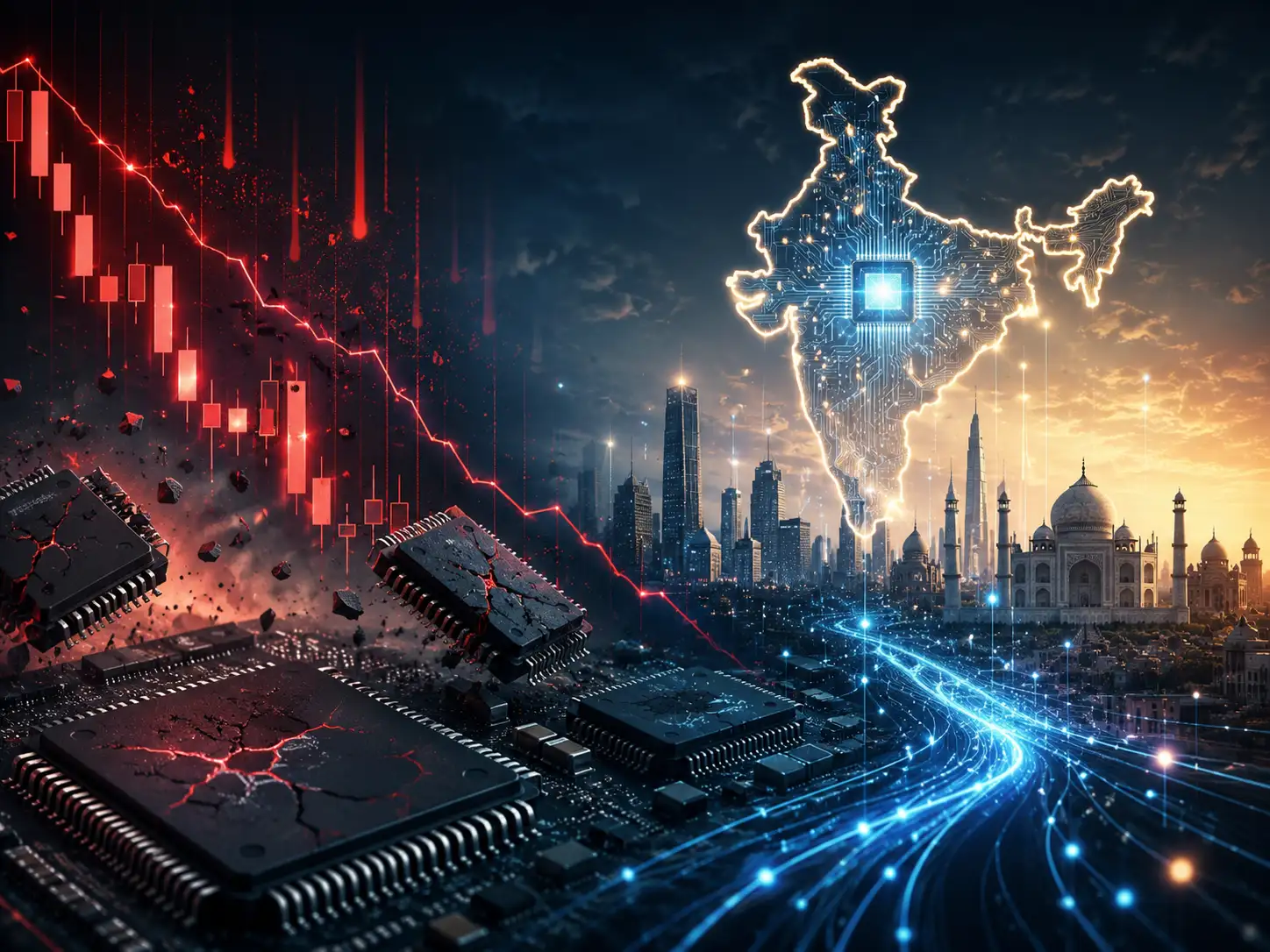
The global artificial intelligence (AI) trade is showing signs of stress after a sharp selloff in some of the biggest market winners of the past year. But in India, investors are still treating AI as a real opportunity. The Indian market is not buying AI mainly through software companies, but is betting on the proxy plays like data centres, power equipment, transformers, cables, cooling systems among others.
Globally, the Nasdaq is close to a 10% correction and the Philadelphia Semiconductor Index, a key gauge for chip stocks, has slipped into a technical bear market. Meanwhile, South Korea's Kospi has crashed 44% from its June peak, becoming the clearest face of the global AI rout after a steep rally.
The fall has spoiled Indian investors plans to bet on the AI trade for long run. Now, should they exit AI-linked trades, or use the correction to enter better-quality names? Analysts say the answer lies somewhere in the middle. The AI theme is not dead, but the easy money phase may be over.
Global AI selloff is a warning
The recent correction has more to do with expectations, positioning and China’s chip ambitions than with a collapse in AI demand. Riddhiman Jain, MD and Head of Investment Strategy and Solutions at Waterfield Advisors, said the trigger was China rather than weakening demand.
Chinese memory chipmaker CXMT raised $8.6 billion in Asia’s biggest IPO this year. Reports that China had started developing its own chip equipment hit ASML’s US-listed shares and raised fears that Chinese companies could weaken the pricing power of global memory chip leaders such as Samsung, SK Hynix and Micron.
Also Read: 'Biggest nightmare': Nithin Kamath warns MTF boom could worsen selloff in small and midcap stocks
That sparked selling in South Korea and the US. But Jain said the data does not yet point to demand falling. DRAM contract prices are still rising 20-30% this quarter, according to analysts tracking memory supply chains.
Part of the money has also rotated into Chinese chip exposure. A China AI semiconductor ETF has gained more than 30% in three months on optimism around CXMT. Some of the selling also appears to be profit-booking after a strong rally, along with cash being raised for the large Chinese IPO.
Still, there are risks. Jain said market concentration, leverage and circular financing can keep volatility high across regions through 2026, even if the larger AI theme remains intact.
That is the key takeaway for India. The theme can survive, but stock prices can still correct sharply when expectations run too far ahead.
India's AI trade is a picks-and-shovels trade
India does not have many listed pure-play AI companies. So the market has built its own AI basket. The most visible beneficiaries are Sterlite Technologies (up 411% YTD), Hitachi Energy India (up 79% YTD), GE Vernova T&D India (up 30% YTD), CG Power (up 30% YTD), ABB India (up 41% YTD), Siemens Energy India (up 25% YTD), Cummins India (up 20% YTD), Kirloskar Oil Engines (up 78% YTD), Netweb Technologies (up 41% YTD), E2E Networks (up 142% YTD), Anant Raj (up 11% YTD), Black Box (up 35% YTD).
These are not all AI companies in the strict sense. But the market is treating them as AI beneficiaries because AI needs large-scale physical infrastructure.
For instance, data centres need electricity, which in turn depend on transformers, transmission systems, cables, cooling equipment, backup power, fibre and server infrastructure. That is why the AI trade in India has moved towards power and data-centre supply chains.
Nomura has specifically named GE Vernova T&D India, CG Power, ABB India, Siemens, Hitachi Energy India and Cummins India as beneficiaries of India’s data-centre buildout.
Jain said India’s AI ecosystem is still an early-stage infrastructure play on power, real estate and policy advantages rather than a direct chip bet. He said India’s data centre capacity is expected to grow from 1.5 GW to 26.3 GW by FY32, while AI compute capacity alone is projected to expand 24 times through 2030.
That makes the opportunity large. But it also makes stock selection more important.
Not all AI plays are improtant
The sharpest India AI trades are also the riskiest. Sterlite Tech, Netweb Technologies, E2E Networks, Hitachi Energy, GE Vernova T&D, CG Power, Kirloskar Oil Engines, Anant Raj, Black Box and Voltamp Transformers have already rallied because the market sees them as direct or near-direct beneficiaries of AI and data-centre capex.
A broader and relatively steadier basket would include ABB India, Siemens, Cummins India, Polycab, KEI Industries and Apar Industries. These companies have wider industrial and infrastructure businesses, so the AI link is only one part of the story.
Sourav Choudhary, MD at Raghunath Capital, said the global correction should be seen as healthy consolidation rather than the start of an AI bubble burst. He said markets had priced in very strong growth expectations, making profit-booking natural after such a sharp rally.
His advice for Indian investors is to focus on quality AI-capex plays rather than react to short-term volatility. Companies with strong balance sheets, steady cash flows and clear execution records are better placed to benefit from the AI cycle.
That means investors should avoid weak companies that add “AI” to their story without having real revenue from the theme. The better trades are those where orders, capacity expansion and cash flows can be tracked.
Valuation will decide returns from here
The AI trade in India is no longer undiscovered. Many of the stocks linked to data centres, power equipment, cables and AI hardware have already seen strong gains. That reduces the margin of safety.
Khushi Mistry, Research Analyst at Bonanza, said the current fall in global AI stocks is more of a valuation reset than the end of the theme. She said investors should avoid chasing AI narratives and focus on companies with tangible exposure such as data centres, engineering R&D, EMS and digital infrastructure, where earnings visibility is stronger.
That is a useful framework. India’s AI opportunity is real, but the trade must be handled with discipline.
Investors can split the theme into three baskets. The first is high-risk, high-reward names such as Netweb Technologies, E2E Networks, Sterlite Tech and Anant Raj. The second is power and grid equipment names such as Hitachi Energy, GE Vernova T&D, CG Power, ABB India, Siemens Energy, Voltamp and Apar. The third is support infrastructure such as Polycab, KEI, Cummins and Kirloskar Oil Engines.
In a global AI unwinding, analysts say the safest approach is to avoid fresh lumpsum buying in stocks that have already doubled or more. Investors can stagger entries, track order books and focus on companies where AI-linked demand is visible in numbers, not just in market stories.
(Disclaimer: Recommendations, suggestions, views and opinions given by the experts are their own. These do not represent the views of Economic Times)