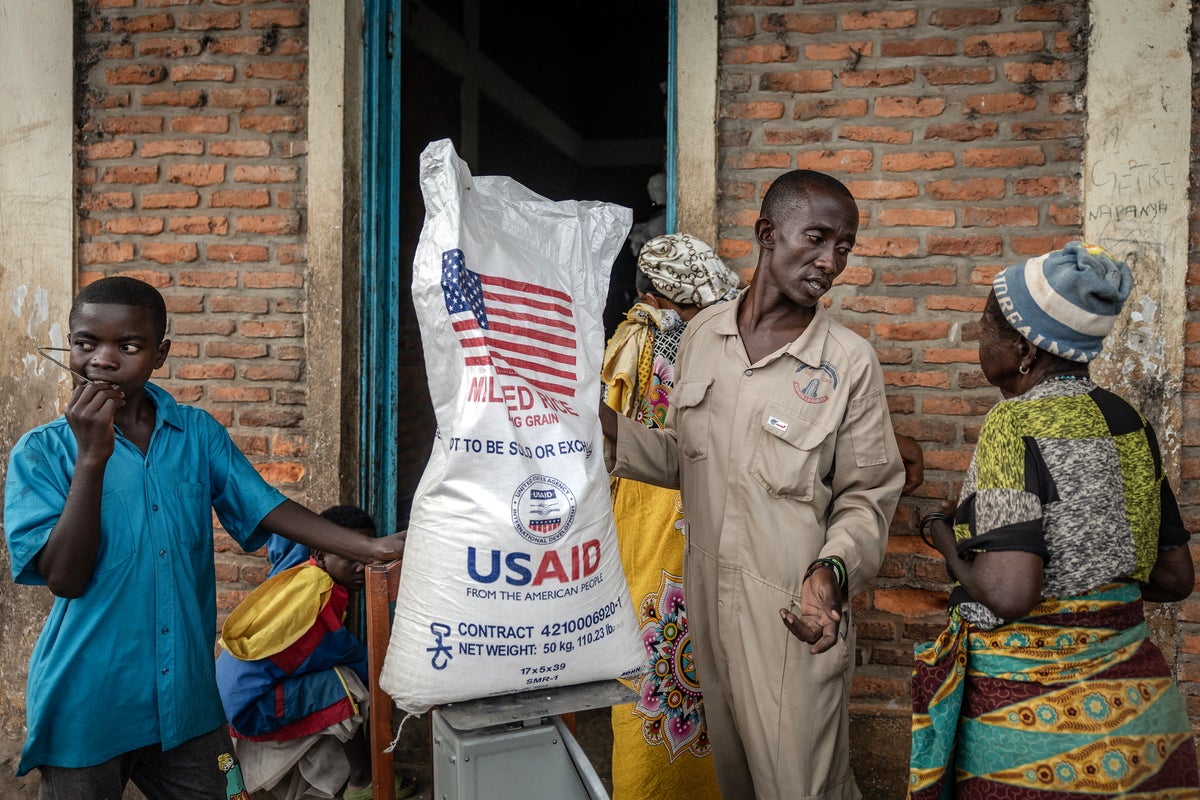
Overseas aid from wealthy countries plummeted by 23 per cent in 2025 compared to 2024, with Germany overtaking the US to become the world’s biggest aid donor for the first time, new figures show.
The data, published by the Paris-based Organisation for Economic Co-operation and Development (OECD), confirms the devastating impact of the closure of the US Agency for International Development (USAID), which previous studies have indicated will contribute to tens of millions of deaths.
Overall aid from the Development Assistance Committee (DAC) – a core group of aid donors comprised of the world’s 34 richest nations – fell by 23.1 per cent to $174.3bn (£129.8bn).
The US alone drove three-quarters (75.1 per cent) of the decline, while major cuts were also reported by other big donors including Germany (17.4 per cent), France (10.9 per cent), the United Kingdom (10.8 per cent), and Japan (5.6 per cent).
The extremely steep decline in funding from the US meant that Germany provided more aid ($29.1bn) than the US ($29bn) for the first time in history.
Bilateral aid fell by 26.4 per cent from the DAC countries, while multilateral aid – which goes to global institutions like the UN – fell by 12.7 per cent.
The UN notably suffered its largest annual decline in funding on record, with a budget cut worth 27 per cent, driven by a 87.2 per cent year-on-year cut that the US has made to its UN budget contribution.
The US also cut its bilateral aid to Ukraine by a massive 91.1 per cent. However, this was offset by other DAC countries and the EU increasing the aid directed towards Ukraine, which ensured that the $44.9bn that Ukraine ultimately received exceeded the bilateral aid that was provided to all the countries of Sub-Saharan Africa.
Overall aid provided to Sub-Saharan Africa fell by 26.3 per cent to $24.5bn, while aid to the world’s least developed countries similarly fell 25.8 per cent to hit $23.5bn.
“Today's figures confirm that we are witnessing the steepest and most widespread contraction in ODA [Official Development Assistance] in a generation,” Mikaela Gavas, managing director for the Center for Global Development Europe, told The Independent.
“With a second consecutive year of decline and the four largest donors all cutting simultaneously for the first time in nearly thirty years, it is a structural shift in how wealthy countries are choosing to engage with the world's poorest.”
Callum Northcote, economic justice lead at Save the Children UK, added: "This is yet another example of the realities now facing the world's children.
“The UK's decision to cut aid has poured fuel on the fire of global decision-making. This will have real world impact for health centres, for schools, for the ability to treat malnutrition and keep children safe – an impact that is becoming clearer as the specifics of the cuts are laid bare.”
The decline of 23.1 per cent follows a decline of 6.1 per cent recorded in 2024 – and the OECD currently projects that foreign aid will decline by a further 5.8 per cent next year.
“Three consecutive years of decline in overseas aid is something we have not seen since 1993 to 1993, during the period of the end of the Cold War,” said María del Pilar Garrido Gonzalo, OECD Director for Development Co-operation, on a webinar held to mark the release of the data.
“These projections do not yet account for the potential impact of the current crisis in the Middle East, which could represent an additional shock after two years of overseas aid cuts,” she added.
Speaking on the same webinar, chair of the DAC Committee Carsten Staur suggested that the sheer number of humanitarian disasters that the world is currently experiencing means that foreign aid should be increasing, not decreasing.
“There are still more than 800 million people living for less than $3 a day – two-thirds of whom live in Sub Saharan Africa – and millions of children still die every year before the age of five for reasons that are easily preventable,” he said.
“There is no substitute for overseas aid in this fundamental endeavour of investing in human relief, in health, education and social protection. Overseas aid remains an essential investment in global solidarity, in viable international partnerships and alliances, and in longer term resilience and security.”
Also on Thursday, the Foreign, Commonwealth and Development Office (FCDO) in the UK revealed details of UK aid spending in 2025, which reflected the government beginning to implement its cut to the UK aid budget from 0.5 to 0.3 per cent of Gross National Income (GNI).
UK aid spend fell by just over £1bn – or 7.4 per cent – to hit £13bn in 2025, the data shows, while aid as a share of GNI fell from 0.5 per cent to 0.43 per cent year-on-year.
Over 18 per cent of the UK aid budget continued to be spent on UK asylum seeker and refugee costs, in a move that was criticised by NGOs.
“Supporting refugees is vital, but this was never the purpose of Official Development Assistance,” said Adrian Lovett, UK executive director of the ONE Campaign. “Spending more than £2 billion of the development budget within the UK shortchanges our international partners and misleads taxpayers about how their money is being used.”
Mikaela Gavas, from the Center for Global Development, added that the UK aid cuts appear to be coming faster than was anticipated when the government first announced its cuts to the aid budget.
“This isn’t about accounting, it's about real choices,” she said. “The UK has already announced a major reduction in aid—from 0.5 to 0.3 per cent of GNI—but these figures show it is happening sooner than expected.
“Over £1 billion less has been spent this year than anticipated. That’s almost the same amount as everything the UK spent on humanitarian aid last year.”
Gideon Rabinowitz, director of advocacy at the NGO network Bond, which represents UK NGOs working in development, pointed out that the UK cuts are set to be the “steepest in the G7”.
“Lifesaving humanitarian programmes, including education provision in Syria and healthcare programmes across Africa, have already been forced to close, and, with even deeper cuts still to be implemented this year and next, the worst consequences are yet to be realised,” he said.
In response to concerns raised in this article, a spokesperson for FCDO said: “National security is the first duty of this government. That is why, to fund an essential increase in defence spending, the Government has taken the hugely difficult decision to reduce the UK Official Development Assistance budget. These statistics reflect those essential decisions.”
This article was produced as part of The Independent’s Rethinking Global Aid project
Data centers create ‘heat islands,’ warming local land by up to 16 degrees
Majority of Americans disapprove of how Trump is handling Iran, poll shows
‘Twists and turns’ in UK-China relationship don’t help us, Xi tells Starmer
Trump disinvites Canada from his ‘Board of Peace’ after Carney’s blistering speech
Mike Johnson aims to ‘calm the situation’ over Trump’s Greenland threats
Bondi Beach attack witness says he ‘stomped’ on shooter’s head