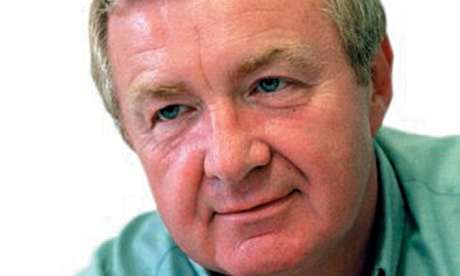
The scale of Glenn Gibbons’s contribution to journalism and football has been apparent by the level of tributes paid towards him in recent days. Gibbons, who appeared in the pages of the Observer and the Guardian, died on Monday, aged 69.
His was a career that had a reach beyond his native Scotland. Gibbons had an unmistakable character; fiery, sharp, routinely argumentative, occasionally dismissive but warm, helpful and erudite. He provided a substantial assistance and influence on those younger sports writers who were wise enough to listen; I would like to consider myself among them. Glenn had that highly useful trait of spotting chancers and charlatans at 100 paces. He would let them know as much. Phone calls from Glenn were never short; they were, though, always entertaining.
Gibbons was a wonderful writer who spanned different eras. His way with words never deserted him, either in person or print. There have not been many with his polemic touch. Until recently, his Scotsman column was required Saturday reading. Glenn had earlier served the Daily Mail and Daily Telegraph. It is a shame that his memoirs and stories were never properly chronicled.
On Friday, the Scottish journalistic legend Hugh McIlvanney gave a glowing and fitting tribute to his old friend at a Glasgow crematorium. McIlvanney recalled a dinner-table occasion in Bordeaux 14 years ago when he and Gibbons were in the company of horse racing royalty. A television commentator had the audacity to turn the conversation towards football. “A team of henchmen carrying nooses couldn’t have offered a more homicidal look than Glenn did at that point,” McIlvanney said.
The sport of kings was one of Gibbons’s true loves. His stepfather was a bookmaker and considerable influence on someone who could add up what figure you were not going to win from a 10-team Saturday accumulator within seconds.
Glenn did not delve into the business of racing tips; he regarded this as cheating.
His knowledge was broad, a matter shaped by an exchange year in the United States in 1959 which suddenly intensified Gibbons’s desire to learn. He did that right until his death; the routine ferocity with which a conversation with Glenn would take place was simply an insight into a wonderfully active mind.
He had keen interests in language, travel, the US itself and a spectrum of sports. He loved golf and, specifically, the Open Championship. In football, his core business over nearly five decades, Gibbons had cause to be dismissive late on. He had, after all, watched Scottish football at its all-conquering domestic peak with the subsequent demise no doubt depressing for so close a witness.
Instead, Gibbons would offer proper historical context without being arrogant.
He had close friendships with Jock Stein and Sir Alex Ferguson. The former Manchester United manager trusted Glenn implicitly; right to the point where his employer, the Scotsman, was the one outlet to print Ferguson’s correct team line-up on the morning of the 1999 Champions League final.
Glenn could be cutting and nobody was spared. A neighbour once pointed out how delighted she was with a present of a hanging basket. “I have always wanted one of these,” she said. Glenn did nothing to hide his bafflement. “If you always wanted one, why didn’t you go out and buy it for yourself?”
On YouTube, footage exists of his last television appearance, ripping the former Celtic director Michael Kelly to shreds on a string of issues dating back to the mid-1990s. Gibbons quotes the late Jim Farry, one-time chief executive of the Scottish FA. “Football will find a way because it always has and always will. It might be different from before, it might have deteriorated but it is still here.”
Glenn Gibbons is not. But his presence and contribution is sure to live on.