The solitary Englishman competing in this week’s French team finals made his mark on the event by an elegant 21-move miniature plus a surprise victory over a former world No3.
France’s national league is the third strongest in the world after the German Bundesliga and the Russian team cup, and its 2015 renewal at the Mediterranean resort of Grau-du-Roi included grandmasters and masters from 26 nations, led by the world top-10 GMs Wesley So and Anish Giri. Bischwiller, a small town near Strasbourg whose squad was sufficiently well financed to field Giri, Germany’s No1, Arkadij Naiditsch, and France’s No2, Etienne Bacrot, won the team title ahead of Clichy.
Glenn Flear was representing Montpellier, where he lives with his wife Christine, a five-times French women’s champion. The 56-year-old, originally from Leicester, had his greatest career success at London 1986 when, competing as a last-minute substitute and outrated by an illustrious field which included Boris Spassky and Nigel Short, he won first prize outright. It was one of the all-time tournament upsets, and as the dates coincided with his planned wedding, he and Christine were married on the mid-event rest day.
Nowadays Flear is best known as author of some instructive endgame books, but he remains an active player and captained England B at the 2015 over-50 world championship.
He is also a shrewd and knowledgeable junior trainer. In 2002 when he coached at the world under-12 championship, England’s David Howell, now British champion, was in medal contention before the final round where he seemed to have a favourable pairing against a little-known Scandinavian. Surprisingly Howell as Black chose 1 Nf3 Nc6 2 c4 e5 3 Nc3 g6. A level game led to a drawn bishop ending, and Howell had to settle for the bronze medal. I was following the play online, could not understand his cautious approach, so telephoned Howell’s father who assured me that this was the coach’s strategy. Flear’s judgment was right. The Scandinavian’s name? Magnus Carlsen.
Flear’s overall performance at the French teams was moderate but redeemed by two fine wins. One was against Andrei Sokolov, who at his peak in the late eighties was ranked world No3 behind Garry Kasparov and Anatoly Karpov.
Sokolov is still a strong opponent, who Flear surprised by the rare Ruy Lopez defence 3…Nge7. It was a psychological challenge since Sokolov has chosen 3…Nge7 several times, while Flear had never played it previously. It led to active piece play where the ex-Russian erred by 20 Nd4? where Rab1 is level. After further mistakes, Flear developed a winning attack and Sokolov resigned in the face of 35 Kh1 Bxb5 36 Rxb5 Qe1+ 37 Kh2 Qg3+ and mates.
Andrei Sokolov v Glenn Flear
1 e4 e5 2 Nf3 Nc6 3 Bb5 Nge7 4 c3 a6 5 Ba4 g6 6 d4 exd4 7 cxd4 b5 8 Bb3 Bg7 9 a4 Bb7 10 d5 Na5 11 Bd2 Nxb3 12 Qxb3 O-O 13 O-O c6 14 Nc3 cxd5 15 Nxd5 Nxd5 16 exd5 Re8 17 Bc3 Bxc3 18 bxc3 Qc8 19 axb5 axb5 20 Nd4? Rxa1 21 Rxa1 Re5 22 d6 Qc5 23 f3 Qxd6 24 Qb4 Qf6 25 h3 Qg5 26 Qd6 Kg7 27 Qxd7? Qe3+ 28 Kh2 Qxc3 29 Ra7 Bd5 30 Nxb5 Qb4 31 Ra1? Qf4+ 32 Kg1 Rg5 33 Rf1 Bc4 34 Rb1 Qe3+ 0-1
Nowadays few games are quick brilliancies as computer skills have improved defensive play. Flear’s 21-move win had some original touches as well as an elegant finish. He found a novel strategy in a conventional e3, Bd3 and Bb2 formation against the 3…b6 Queen’s Indian, as White’s sly 11 Na4! enticed the blunder 12…exd5? (Nxd5 is much better), setting up 13 Nxb6! which paradoxically fatally exposed the black king to the threats from White’s queen, bishop and knight. Black could resist longer by 17…Qf8 18 Qh5 Kh8, but next move it was already too late since if 18…Bf8 19 Ne7+! mates.
Glenn Flear v Nicolas Brunner
1 d4 Nf6 2 c4 e6 3 Nf3 b6 4 e3 Bb7 5 Bd3 d5 6 O-O Nbd7 7 b3 Bd6 8 Nc3 a6 9 Bb2 O-O 10 Rc1 Qe7 11 Na4! c5 12 cxd5 exd5? 13 Nxb6! Nxb6 14 dxc5 Bxc5 15 Bxf6 gxf6 16 Nh4 Rfc8 17 Nf5 Qe6? 18 Qh5 Ba3 19 Qh6 Qxf5 20 Bxf5 Rxc1 21 Bxh7+ 1-0
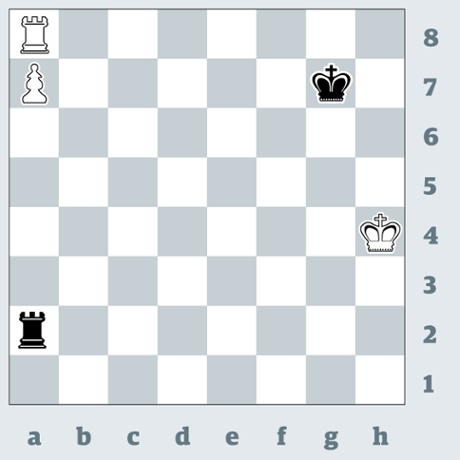
3394 Black chose 1…Kf7! and White quickly replied 2 Rh8?? expecting the standard trick Rxa7? 3 Rh7+ and 4 Rxa7 but found himself tricked after 2…Rh2+! and Rxh8.