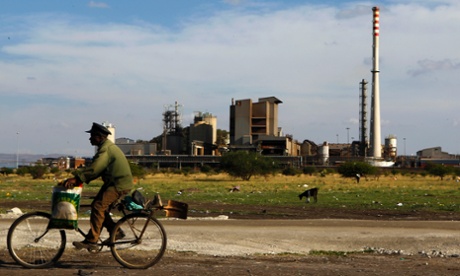
Glencore’s Ivan Glasenberg will trade most things under the sun but here’s one that seems to have defeated him – the 23.9% holding in Lonmin, the mining company that digs for platinum in South Africa, or at least does so when its workers are not on strike.
Glencore’s stake in Lonmin arrived as unwelcome baggage as part of the the former’s takeover of Xstrata in 2013. Glasenberg has never shown great interest in Lonmin, aside from placing a couple of colleagues on its board. One assumes he would have sold the holding if only he could have found a buyer.
He hasn’t, so plan B is to hand the shares to Glencore’s own shareholders. This is an unusual distribution “in specie”. Investors will get a cut of the 23.9% stake in proportion to their holdings in Glencore.
The handout will be received by most investors with little excitement, one suspects. If they really want a direct stake in Lonmin, they can buy in the market today. Some, the market thinks, will dump their stock at an early opportunity, which is why Lonmin’s share price fell 8%.
Even Glasenberg, who owns 8.4% of Glencore, sounded less than enthused by this present to himself. Glencore’s senior managers say they do not currently plan to sell the Lonmin shares they would receive personally – but they didn’t say what they meant by “currently”.
One theory says Glasenberg is having one last go at flushing out a buyer. Worth a try, of course, but it’s hard to see who would put up a hand. Platinum mining is horribly dangerous because of the lack of automation; the platinum price is low and has defied predictions of an uptick in demand; and Lonmin comes with the history of the tragedy at its Marikana mine in 2012 when police shot and killed 34 striking workers.
If you’re an optimist life can’t get much worse for Lonmin. With shares at 158p, maybe some of its new shareholders will view their holdings as a free option on recovery and see what happens.
Nobody, though, will ever share the optimism of Xstrata’s Mick Davis in 2008, who bought the Lonmin stake as part of a failed takeover attempt. He was willing to bid £33 a share. It was a different era for mining, of course. But still: what on earth was Davis thinking?
Electra and the awkward squad
Shareholders in Electra, the private equity investment trust, last year rightly rejected the attempt by Edward Bramson, the activist investor from Sherborne Investors, to storm the boardroom. Bramson, by trying to install a couple of his men on the board, seemed to be trying to gain control by stealth. And his plan to release “at least” £1bn of extra value from Electra was woolly in the extreme.
But Electra’s shareholders still owe Bramson a drink: he seems to have saved them £7m a year in fees.
Electra used to allow Electra Partners, the management firm, to apply an across-the-board management fee of 1.5% on all assets in the portfolio. This even included cash in the bank awaiting investment. That was absurd since the skill in leaving funds on deposit is roughly zero. It will no longer be allowed, Electra has decided. Add a few other tweaks on fees and the net result is this: last year, Electra Partners’ fees would have been £18m, not £25m.
It is evidence, in case it is still needed, that fee structures in the private equity world are often a racket. Charging to “manage” cash is obscene if the princelings are also expecting to collect a generous slice of the winnings when the money is put to work and investments turn out well. At Electra, the success fee for Electra Partners – the “carried interest” – will continue to be 18% once a performance hurdle is cleared.
Roger Yates, Electra’s chairman, says the reform over fees involved “tough and rigorous negotiations”. Well, maybe. But he failed to explain why the board’s toughness only materialised after Bramson turned up with a 20% stake (now increased to 24%). Shareholders should not have to rely on the arrival of the awkward squad to get a fairer deal.
Yates himself can perhaps be excused since he has been in the job less than a year. But his predecessor as chairman, Dame Colette Bowe, now looks a bit of a soft touch. If she disagrees, she can prove her point in her new role as chair of the Banking Standards Review Council, the new body charged with the infinitely harder task of cleaning up the banking industry.
Squeeze for jet set
Times are tougher in the world of Dettol and Durex. Reckitt Benckiser’s chief executive, Rakesh Kapoor, has decided to lead the corporate cost-cutting drive by example. He has decided to fly economy class on flights of under six hours.
It’s easy to sneer, especially as Kapoor can ease any discomfort in the leg department by contemplating his considerable personal rewards (£6.7m last year). But this is a good lead for executives to follow in an age of relentless efficiency exercises. If the directors can’t swallow a small dose of the medicine they dish out, why not? It’s a good question for shareholders to ask at this spring’s annual meetings.
An old investment rule said you should always sell the shares if a company acquired a corporate jet. It would be useful to know if companies perform better when the directors go cattle-class on short-haul flights. One suspects the correlation would be close.