Can art save the natural world? In the 21st century, climate change threatens to destabilise life on planet earth. Artists would love to help. Yet what can they do?
Giuseppe Penone's new installation at London's Whitechapel Gallery, in its series of Bloomberg commissions, is a powerful representation of nature. It may not offer any answers to how humans can reform our relationship with rainforests, oceans and polar bears, but it does offer a moment's reflection on how art can reawaken our sense of connection with the natural world.
Modern art has an ambiguous relationship with nature. It has sometimes rejected sentimentality towards landscape. Futurism celebrated machines and cities. If you compare art in 1815, when John Constable was painting fields and mill ponds, and 1915, when the Italian futurists were hailing mechanised war, you would have called modernism a step back in attitudes to the natural world. Is modern art simply the art of industry and technology, post-natural in its admiration for the machine?
Penone belongs to the arte povera movement which rejected such technocracy in 1960s Italy. At a time when Italy was experiencing its economic "miracle" and industrial cities like Milan were booming, arte povera slowed things down, to dwell on the stuff of life, the materials of the everyday.
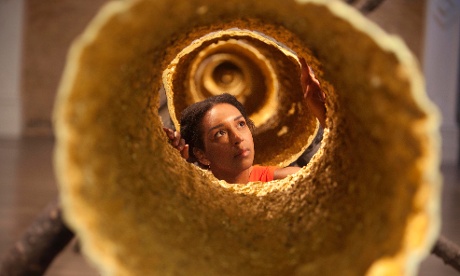
In his installation at the Whitechapel, Giuseppe Penone shows a huge bronze tree, hollowed out and exhibited in sections that rest on their branches like strange insects on spindly legs. You can look through the tree as if it were a telescope. Inside it is covered with gold whose rugged texture reproduces that of tree bark. Penone made the tree by casting a real tree: in the process of lost wax casting, the tree was chopped up, destroyed, to leave its trace in art.
This implicit violence gives the sculpture a melancholy undertow. The result is eerie and magnificent, a gnarled, complex, strange object. Life's ramifications are suggested by proliferating boughs.
Penone stops the rush hour for a moment and reveals the enormous power of the life around us, the magnificence of biology. Art can do this – it can show the natural beauty that is constantly endangered by ruthless human action. Penone's haunting tree may not save the world. But it's a start.