Seven summit finishes, almost 50,000 metres of climbing and a single 40km-long individual time trial are the headlines from the route for the 2026 men's Giro d'Italia.
It begins with three stages in Bulgaria, as already announced, starting on 8 May, before 18 stages from the south to the north of Italy, via Naples, the Apennines, Milan, the Alps and the Dolomites. The 109th Giro finishes in Rome on 31 May.
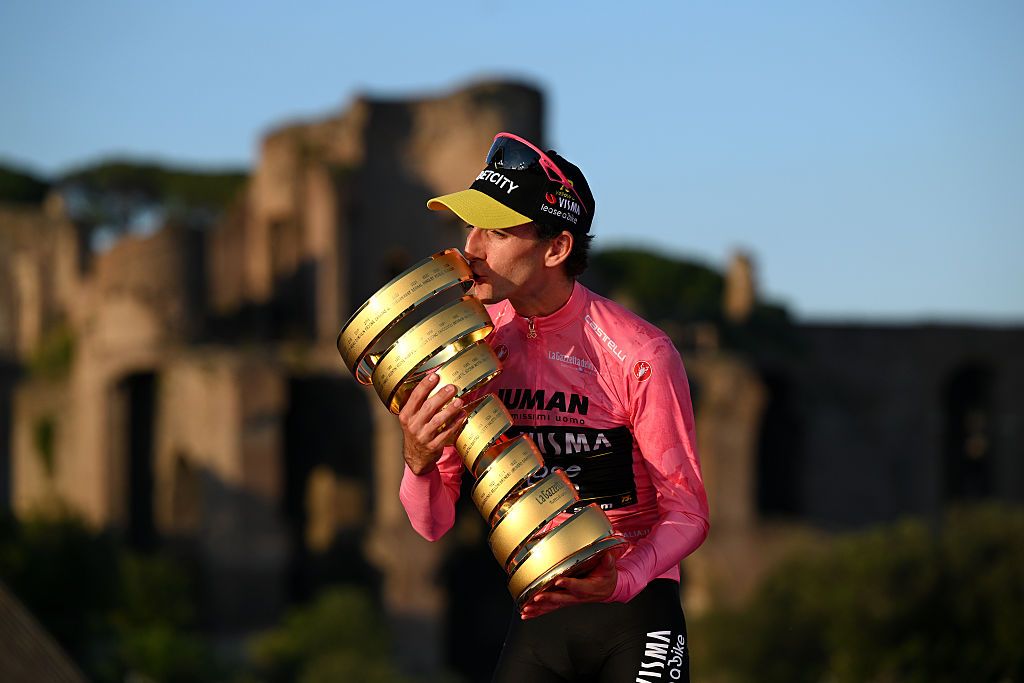
The route was announced on Monday afternoon at an event in Rome, alongside that for the 2026 Giro d'Italia Women. The show was attended by the 2025 men's Giro winner Simon Yates (Visma-Lease a Bike) and the 2025 Giro Women winner Elisa Longo Borghini (UAE Team ADQ).
While there are seven summit finishes over 21 stages, which amounts to 3,459km with 49,150 metres of elevation, there are also eight flat stages for sprints, and seven medium mountain days. There is also the 40.2km individual time trial on the Tuscan coast on stage 10.
Stages seven, eight, and nine look crucial for the general classification, back-to-back days in the mountains to close out the first week.
As ever at the Giro, much of the action is saved for the final week, with stage 16 to Carì in Switzerland looking decisive, before the Queen Stage in the Dolomites on stage 19, with five climbs in just 152km of racing.
The contenders for next May's race are yet to be revealed, with Yates potentially returning, but also perhaps Remco Evenepoel, who will be riding for Red Bull-Bora-Hansgrohe, or Jonas Vingegaard (Visma-Lease a Bike).
Outside of the GC talent, there will likely be a whole host of sprinters and puncheurs looking for stage win success at the Giro, with lots of opportunities for famous victories.
Giro d'Italia 2026 stage table
Stage |
Day |
Start |
Finish |
Distance |
Terrain |
|---|---|---|---|---|---|
1 |
8 May |
Nessebar (Bulgaria) |
Burgas (Bulgaria) |
156km |
Flat |
2 |
9 May |
Burgas (Bulgaria) |
Veliko Tarnovo (Bulgaria) |
220km |
Hilly |
3 |
10 May |
Plovdiv (Bulgaria) |
Sofia (Bulgaria) |
174km |
Flat |
4 |
12 May |
Catanzaro |
Cosenza |
144km |
Flat |
5 |
13 May |
Praia a Mare |
Potenza |
204km |
Hilly |
6 |
14 May |
Paestum |
Napoli |
161km |
Flat |
7 |
15 May |
Formia |
Blockhaus |
246km |
Mountains |
8 |
16 May |
Chieti |
Fermo |
159km |
Medium mountains |
9 |
17 May |
Cervia |
Corno alle Scale |
184km |
Mountains |
10 |
19 May |
Viareggio |
Massa |
40.2km |
ITT |
11 |
20 May |
Porcari |
Chiavari |
178km |
Hilly |
12 |
21 May |
Imperia |
Novi Ligure |
177km |
Flat |
13 |
22 May |
Alessandria |
Verbania |
186km |
Hilly |
14 |
23 May |
Aosta |
Pila |
133km |
Mountains |
15 |
24 May |
Voghera |
Milan |
136km |
Flat |
16 |
26 May |
Bellinzona (Switzerland) |
Carì (Switzerland) |
113km |
Mountains |
17 |
27 May |
Cassano d'Adda |
Andalo |
100km |
Hilly |
18 |
28 May |
Fai della Paganella |
Pieve di Soligo |
166km |
Hilly |
19 |
29 May |
Feltre |
Alleghe |
151km |
Mountains |
20 |
30 May |
Gemona del Friuli |
Piancavallo |
199km |
Mountains |
21 |
31 May |
Rome |
Rome |
131km |
Flat |
Giro d'Italia 2026 route map
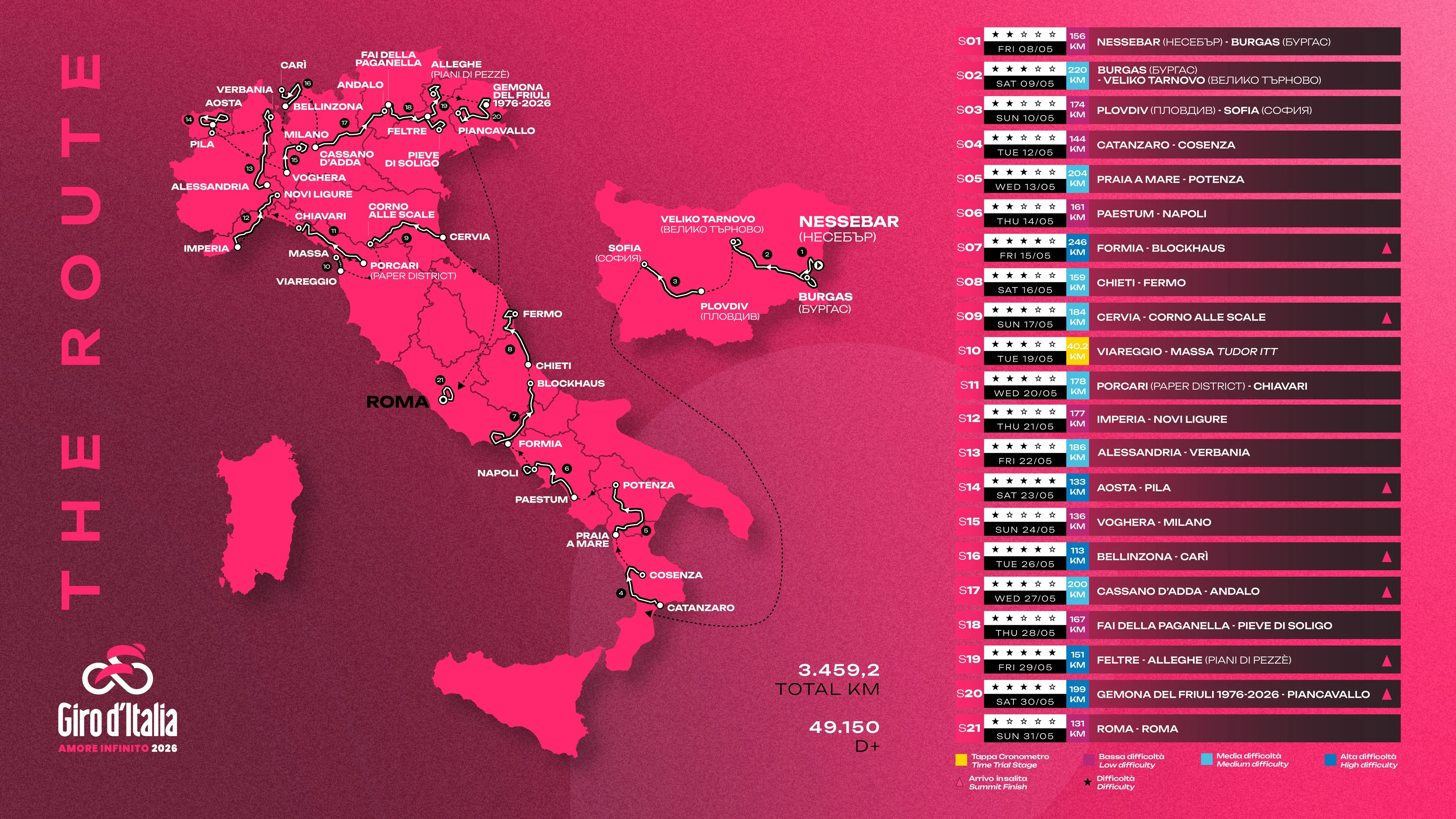
Giro d'Italia 2026 day-by-day summary
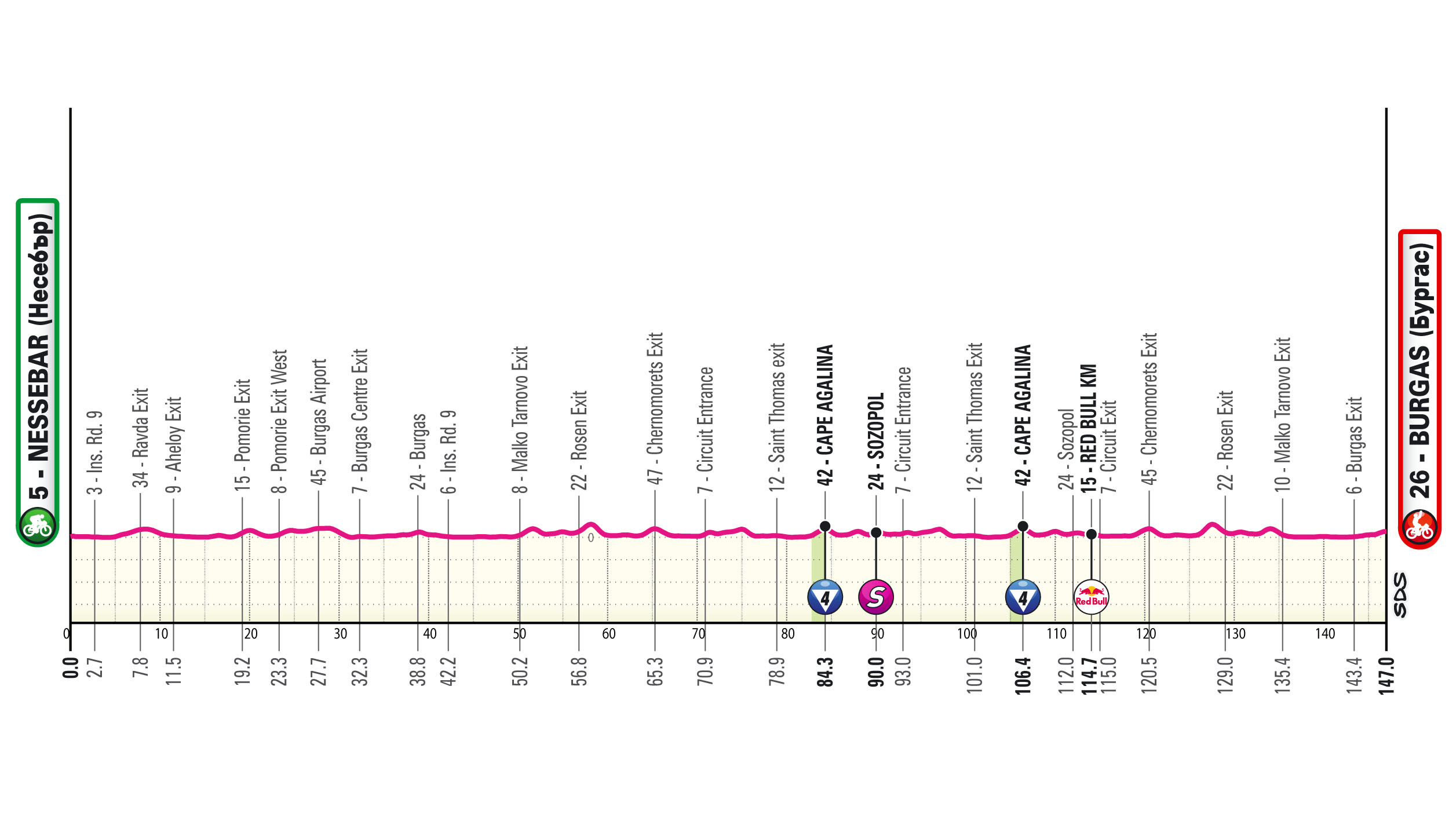
Stage one: Nessebar > Burgas
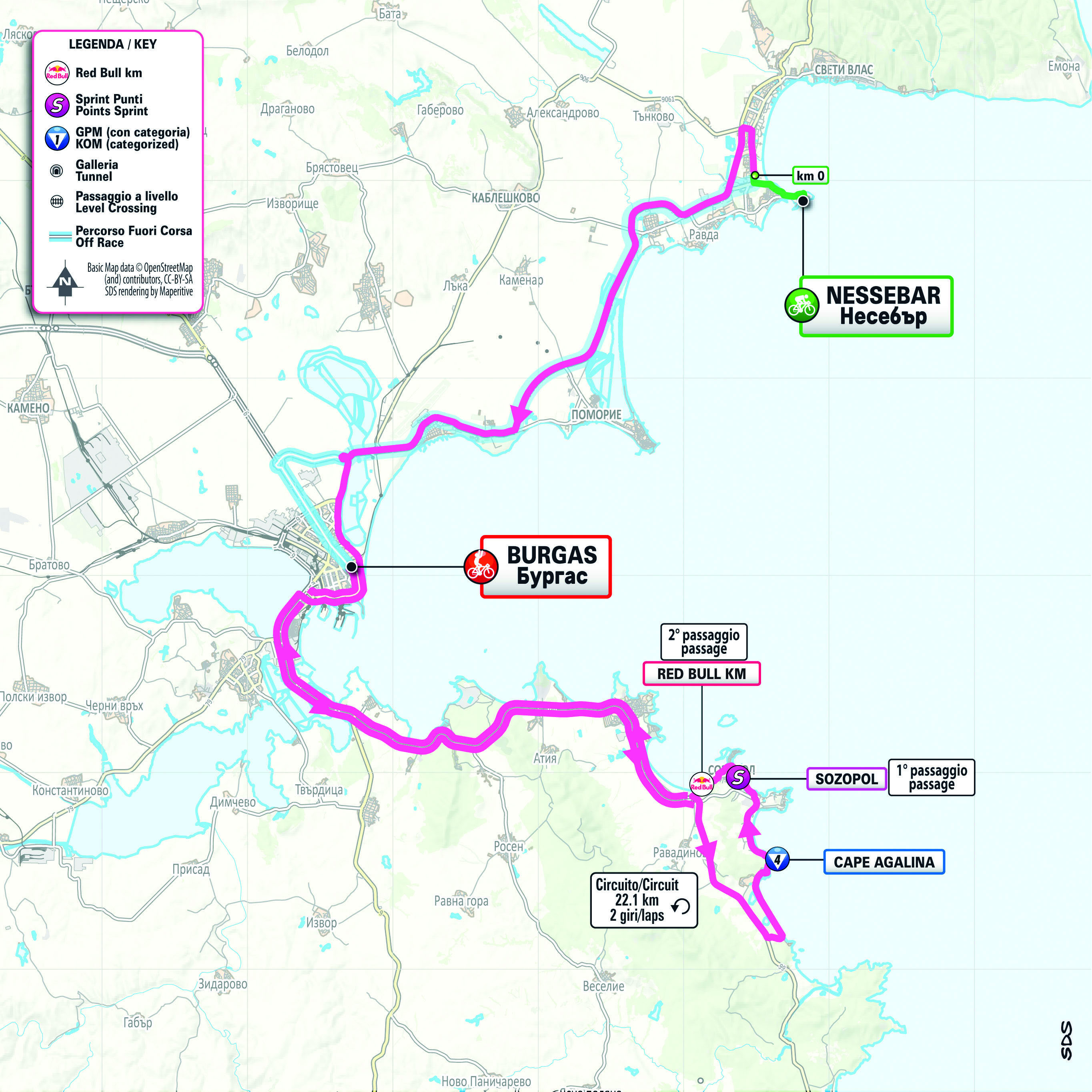
Friday 8 May | 147km | Flat
The Giro d’Italia kicks off the first of three days in Bulgaria with this innocuous outing between two Black Sea cities. The peloton will track the coast from Nessebar past the Burgas finish, before making two passes of a circuit at the far south of the route, featuring the cat-four climb of Cape Agalina both times round.
As the riders turn to head back up the coast, they will encounter the first Red Bull Kilometre of the race, with 6, 4 and 2 bonus seconds on offer. It’s hard to see today ending in anything other than a bunch sprint, and the fastmen will have this stage marked on the calendar – especially as the winner will also get to wear the coveted maglia rosa of GC leader.
Stage 2: Burgas > Veliko Tarnovo
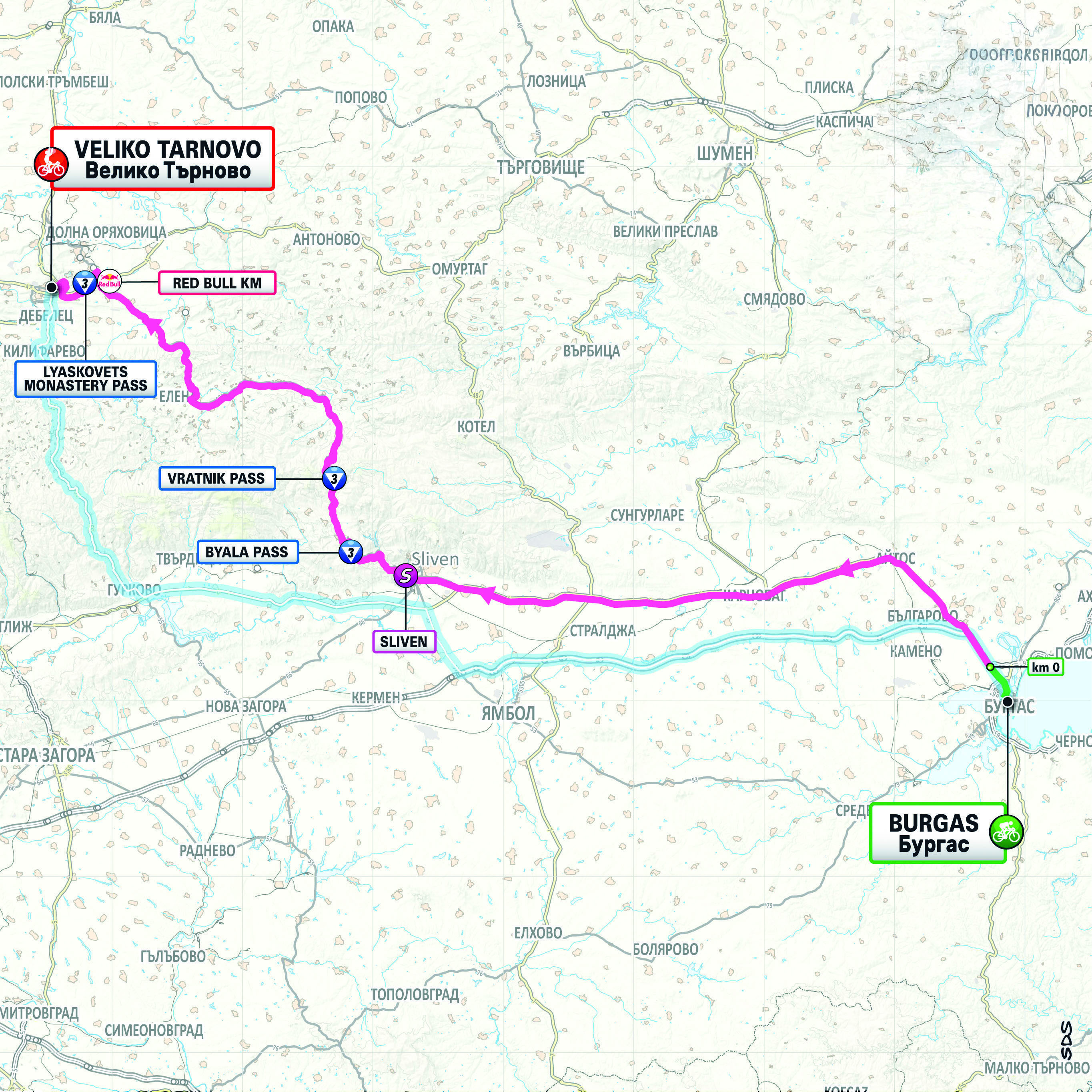
Saturday 9 May | 221km | Hilly
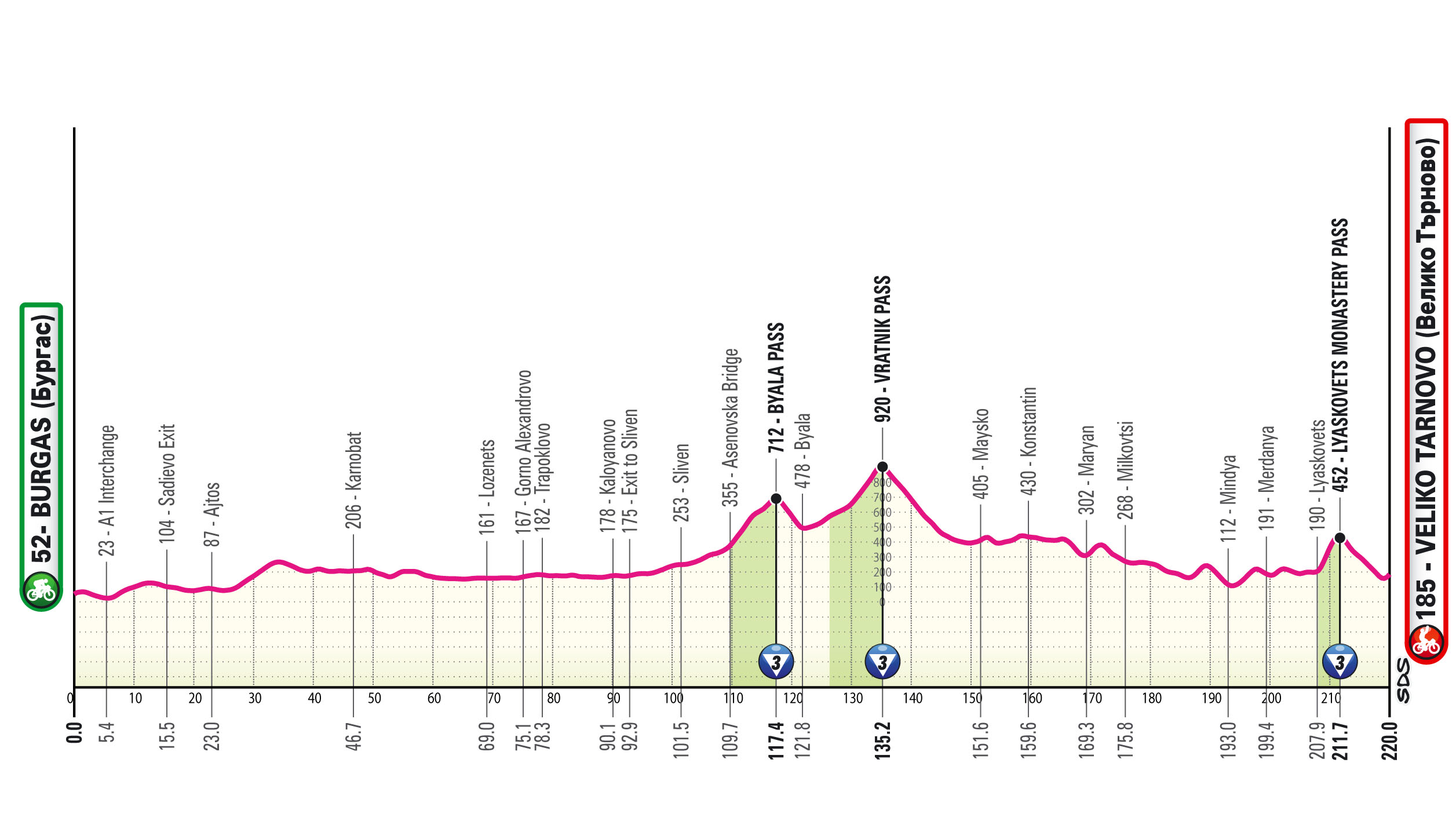
After yesterday’s short, flat acclimatisation, the riders take on a completely different kettle of fish on this second Bulgarian stage. Starting at yesterday’s fi nish town of Burgas, the peloton will head inland over a much longer route – the first of four 200km-plus stages – and it requires them to ride over some sizeable hills to boot. A pair of cat-three climbs come back to back mid-stage, and there’s another around 10km before the fi nish and then a taxing final penultimate kilometre.
This final section could prove the perfect attacking terrain for a stagehunting puncheur. With the maglia rosa potentially up for grabs again after what are likely to be very close time gaps from stage one, it will be keenly fought by anyone who thinks they have half a chance.
STAGE 3: Plovdiv > Sofia
Sunday 10 May | 175km | Hilly
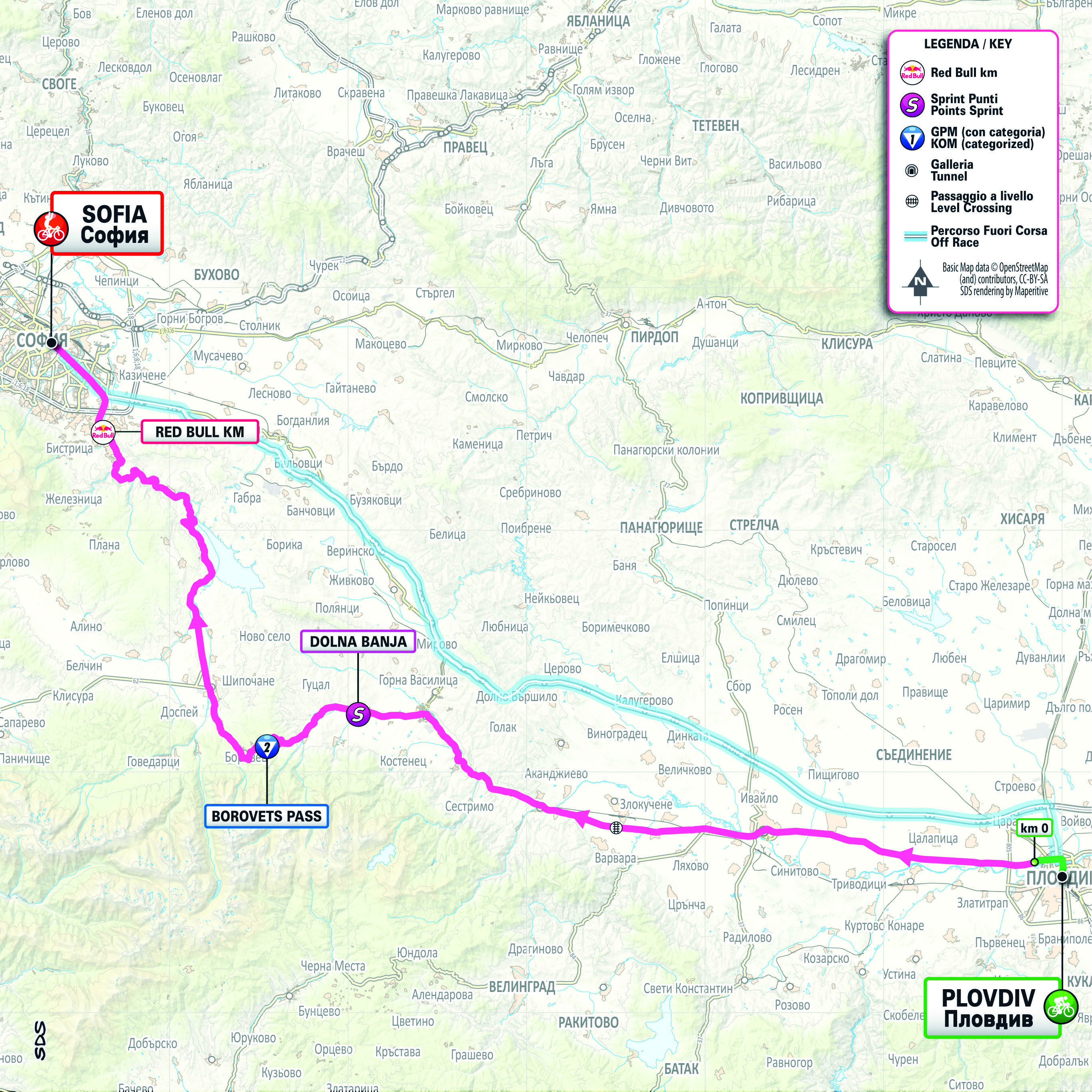
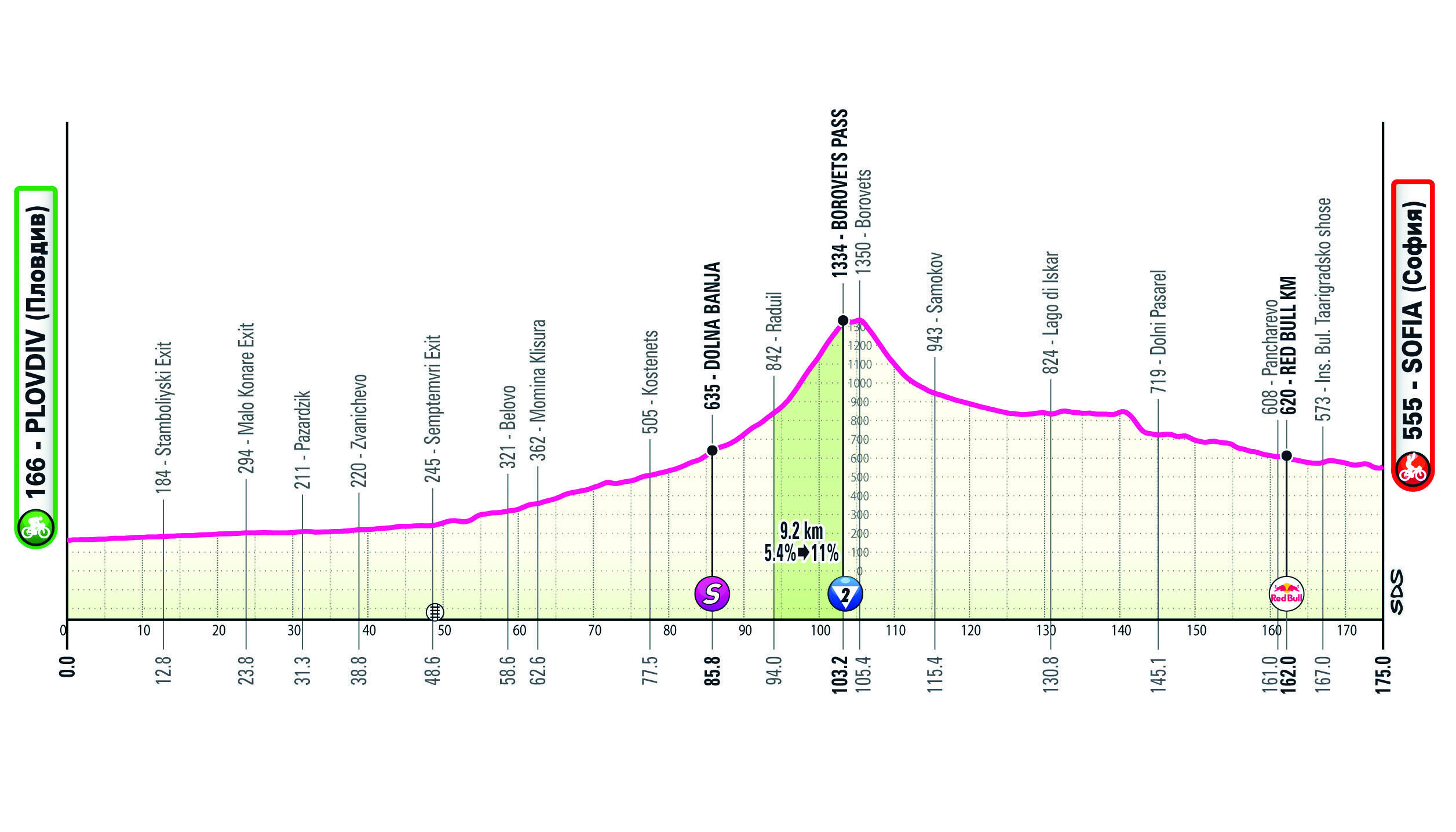
The final stage in Bulgaria before the race transfers to its homeland sees the riders tackle a bona fide mountain ascent midway through. Technically we could call this the first mountain stage of the race, but with a 5.4% average gradient over its 9km length the climb – and with 70 downhill kilometres from its crest to the chequered flag – the Borovets Pass is highly unlikely to play any part in the GC battle. It does feature a section at 11% though, which could offer a good opportunity for an industrious breakaway to get a gap.
With so much distance from the mountain-top to the finish, any fastfinishers who have managed to stay within shouting distance of the front will have ample time to set their teams to work – spurred on by a Red Bull Kilometre with 13km to go.
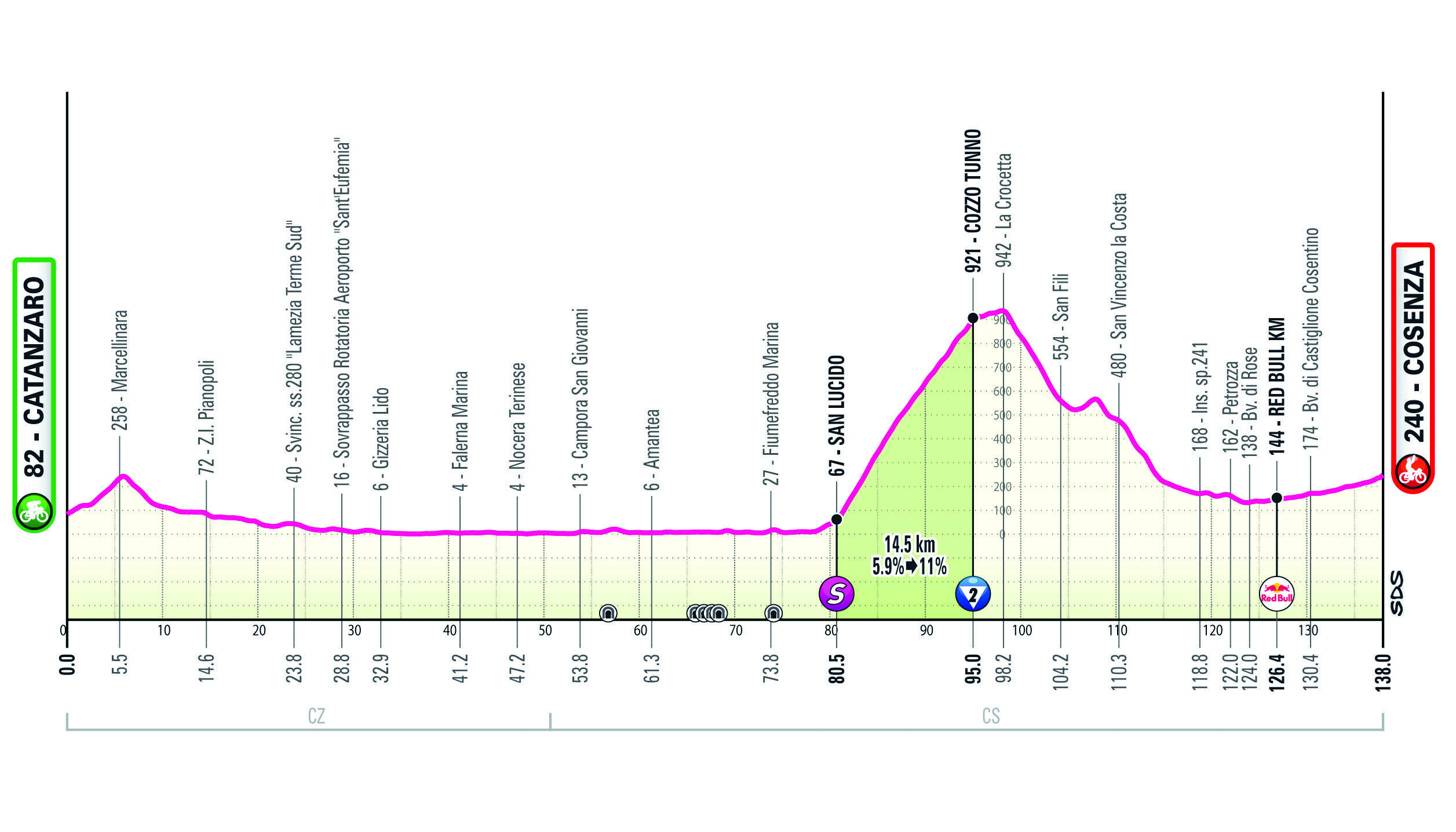
STAGE 4: Catanzaro > Cosenza
Tuesday 12 May | 138km | Hilly
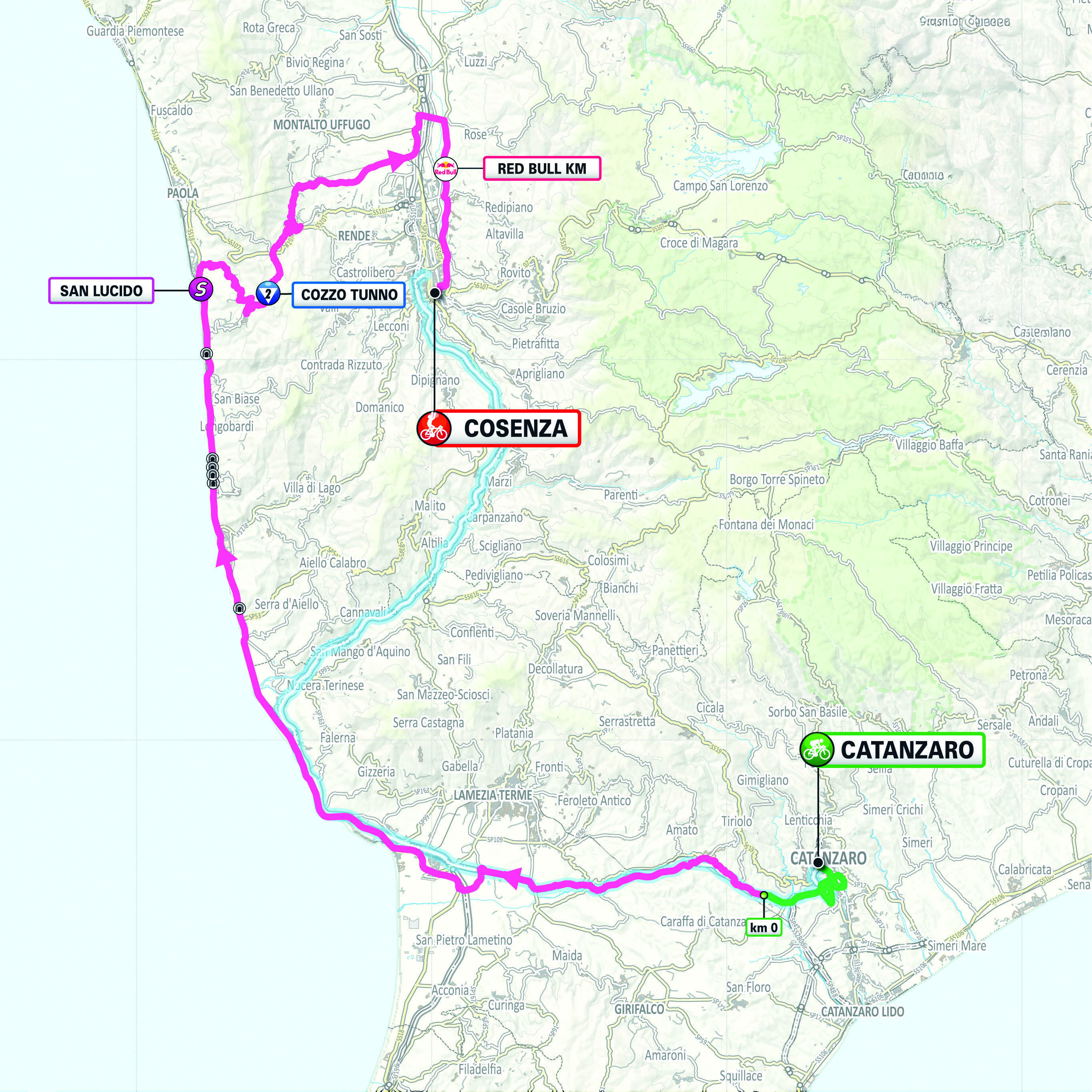
Back now in Italy – on the toe of the ‘boot’ to be more precise – for another flat-cum-mountains day. Beside the fact it traces the coast northward for much of its length, it looks a lot like stage three, with a big climb midstage. This time though, the stakes have been increased, as the riders will crest the Cozzo Tunno with 43km still to ride, rather than 70km like yesterday. The climb is longer but with similar gradients to yesterday’s Borovets Pass, spanning 14.5km at 5.9%, with 11% ramps.
Again, it’s the perfect launchpad for any escapees, and this time the bunch won’t have half as much time on their hands. It will be a committed chase that brings a well-organised breakaway back today. Also as with yesterday, the riders will find an intermediate sprint before the climb and a Red Bull Kilometre near the finish.
STAGE 5: Praia a Mare > Potenza
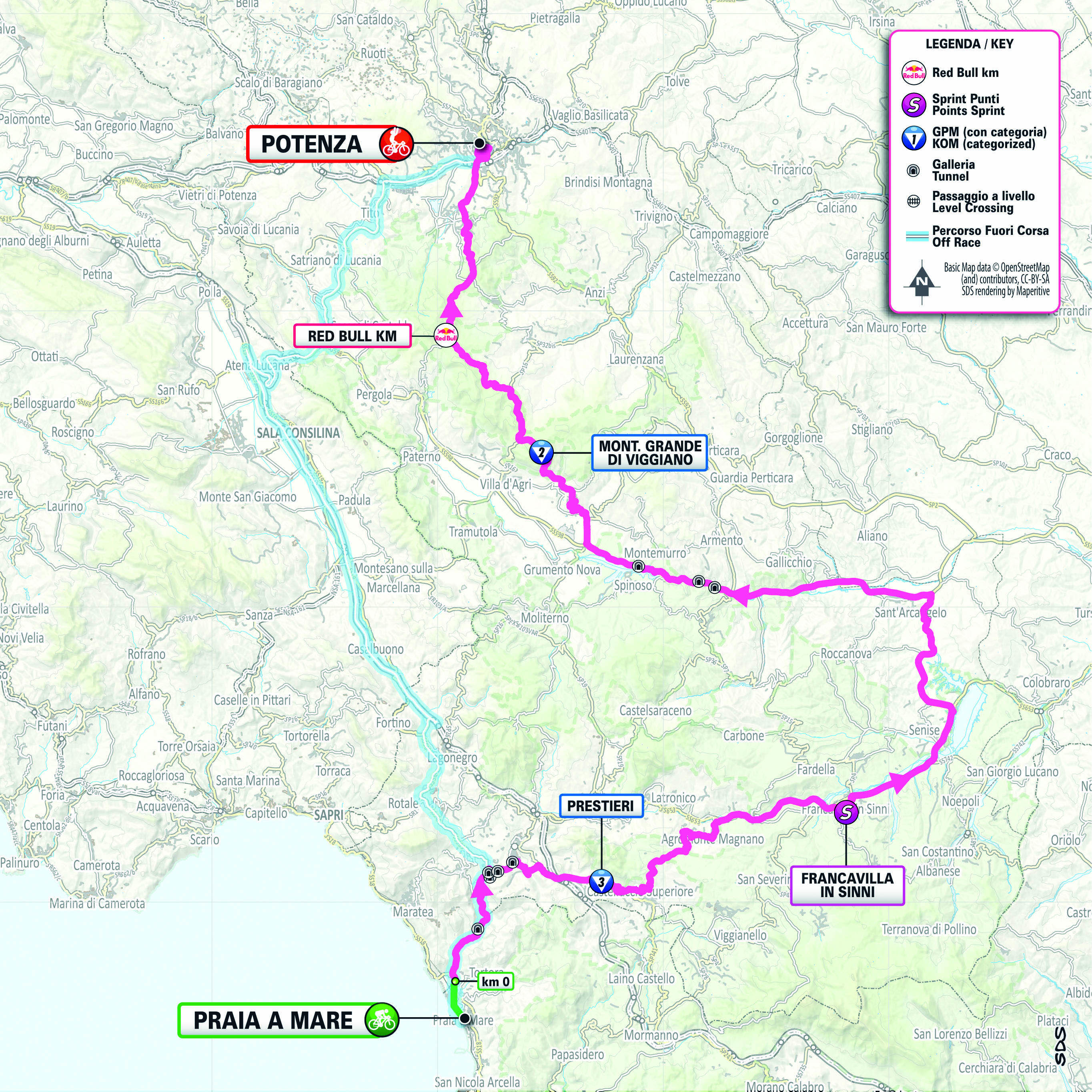
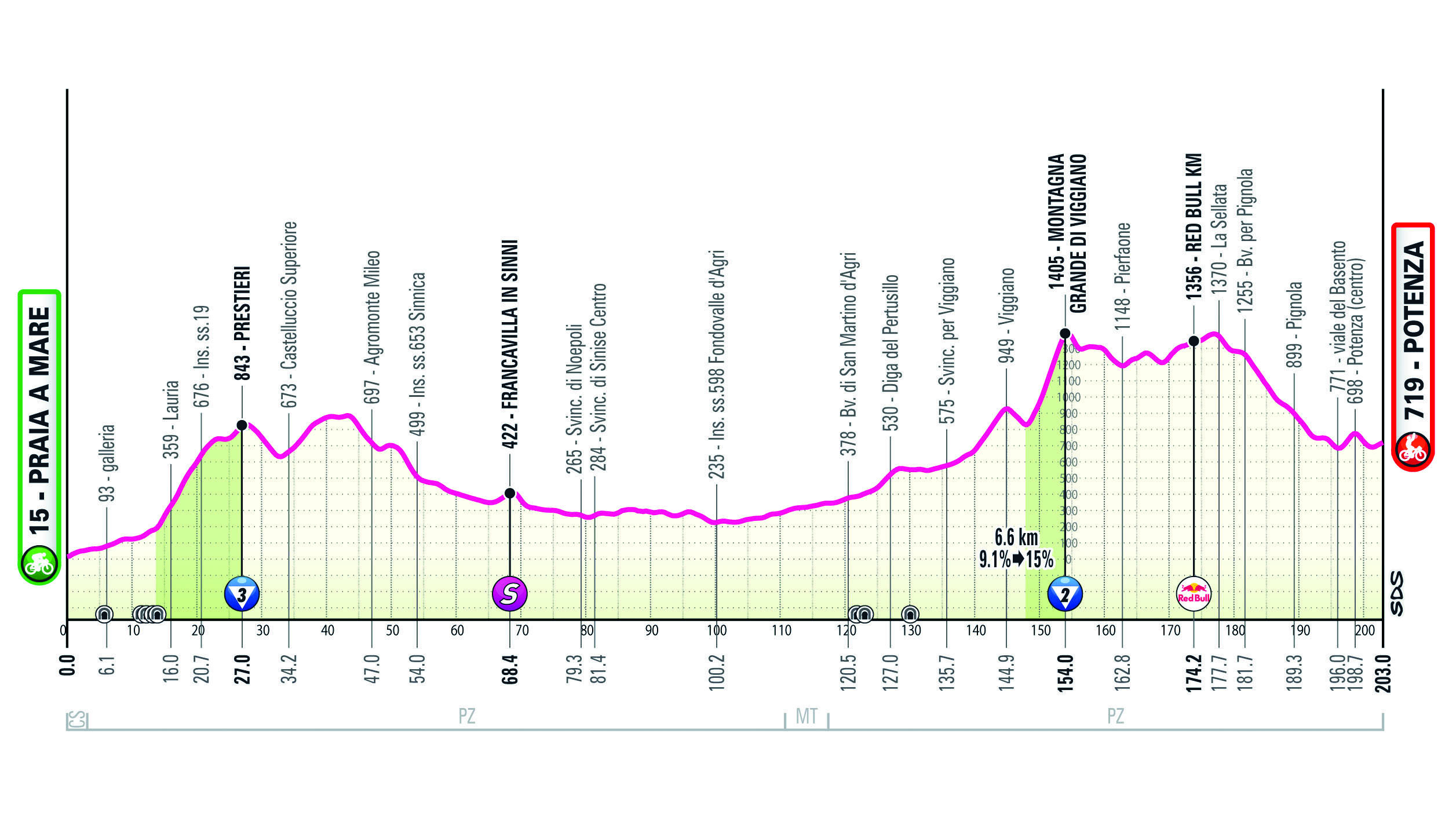
Wednesday 13 May | 203km | Mountains
From the beachside tourist hotspot of Praia a Mare, today’s stage sees the riders head inland and north, on what will be the toughest outing of the race so far.
There’s a real chance we could see the first green shoots of a GC battle begin to form on the slopes of the Montagna Grande di Viggiano – a hard climb up to 1,400m that averages 9.1% over its 6.6km length, and with 15% ramps near the top. It’s far from a straight summit shoot-out though, with 50km remaining once the riders are over the top, plus a Red Bull Kilometre along the way.
The lead-in to the finish is technical and sinuous, rising and falling through the streets of Potenza before opening out into a more straightforward final kilometre.
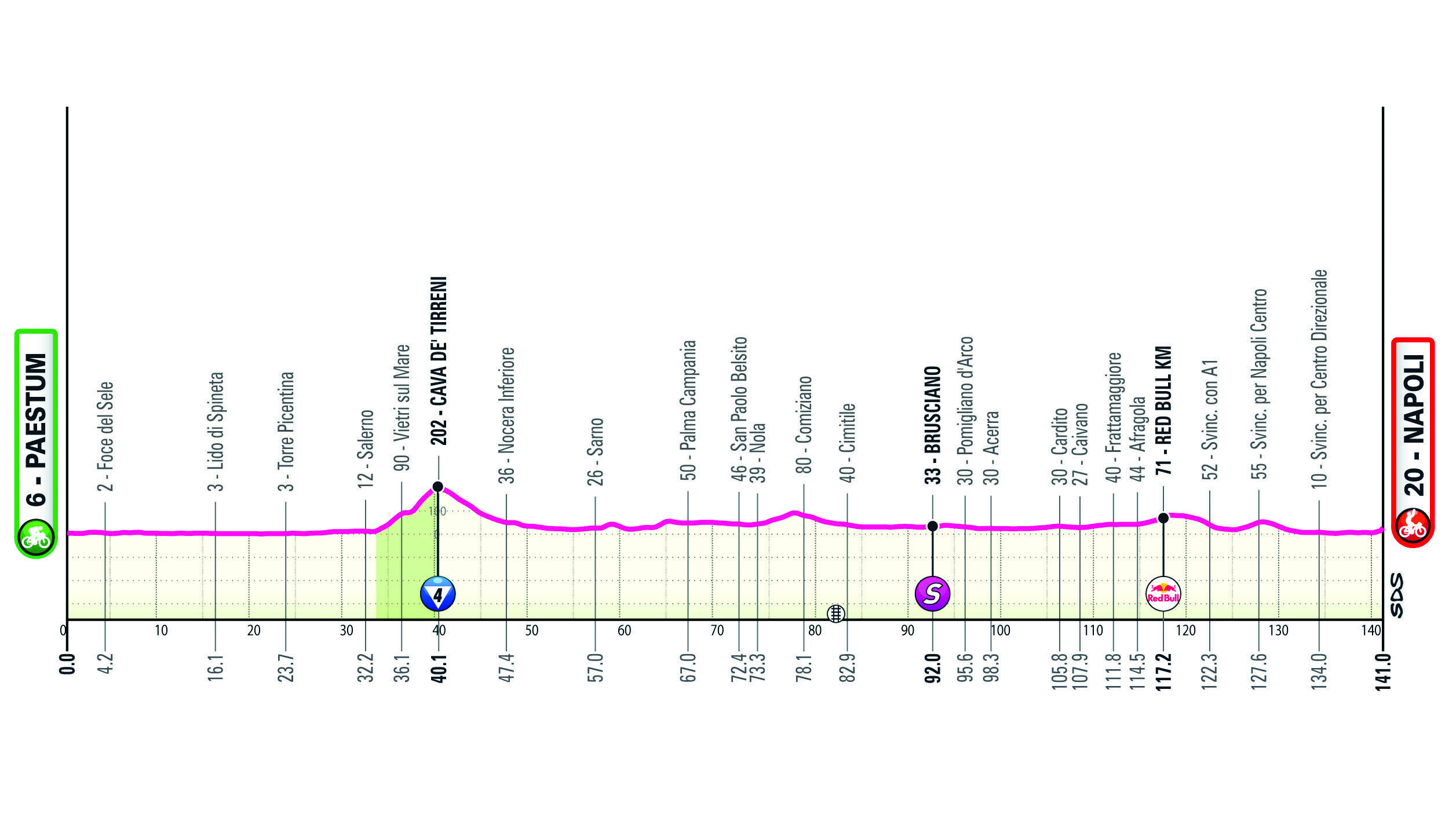
STAGE 6 Paestum > Napoli
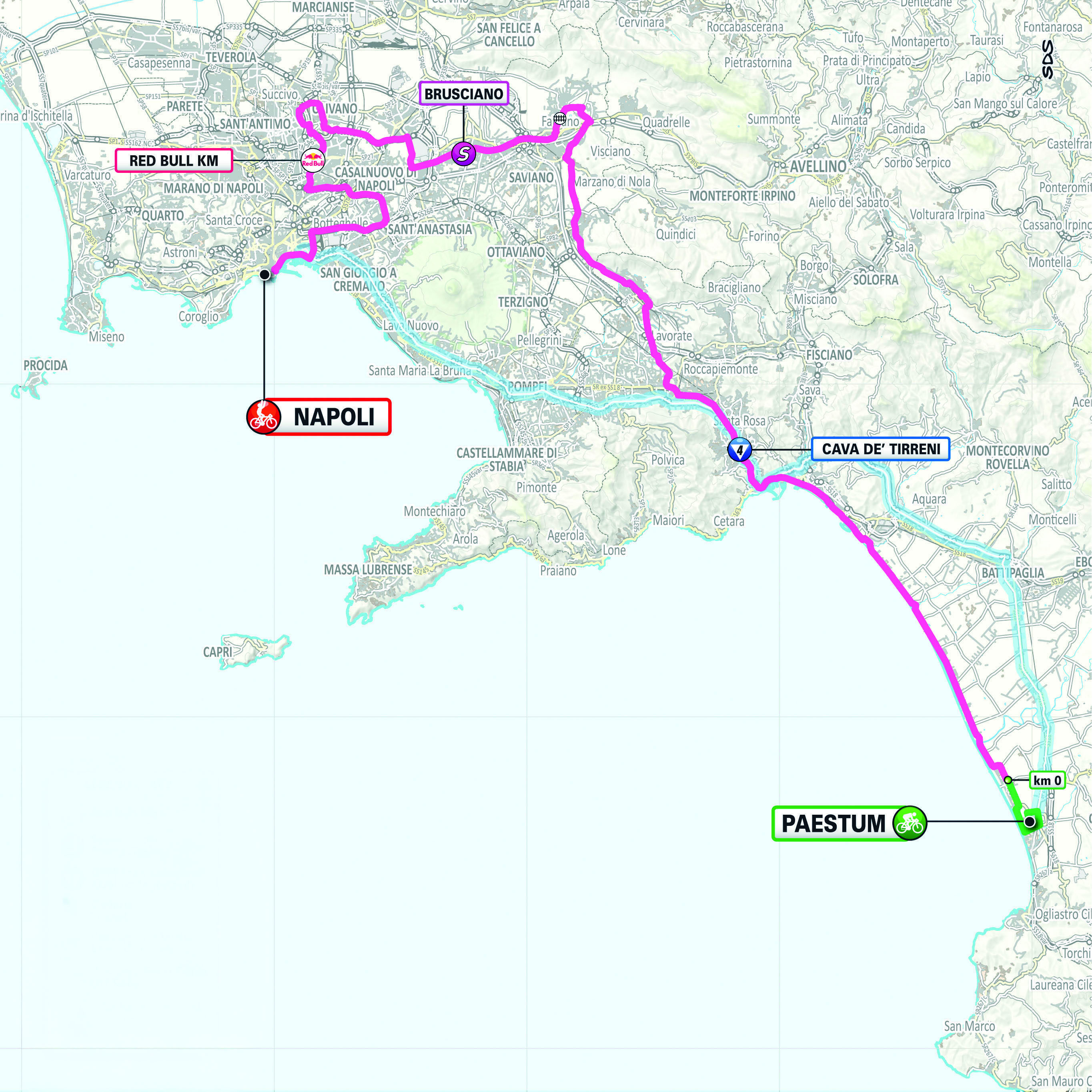
Thursday 14 May | 142km | Flat
After a series of tough stages, the sprinters will have their day again today, unless something goes completely awry. This short outing isn’t completely devoid of hills, but the lone fourth-category climb over the Cava de’ Tirreni comes with 100 flat kilometres still remaining and is unlikely to have any bearing on the final reckoning.
Up until that point the riders will be following the coast. Then it’s over the hill before heading inland and looping past Mount Vesuvius before heading back to coastal Napoli, with the final 70km all urban. While much of the stage is straightforward, the final 650m will require the sprinters to keep their wits about them.
STAGE 7: Formia > Blockhaus
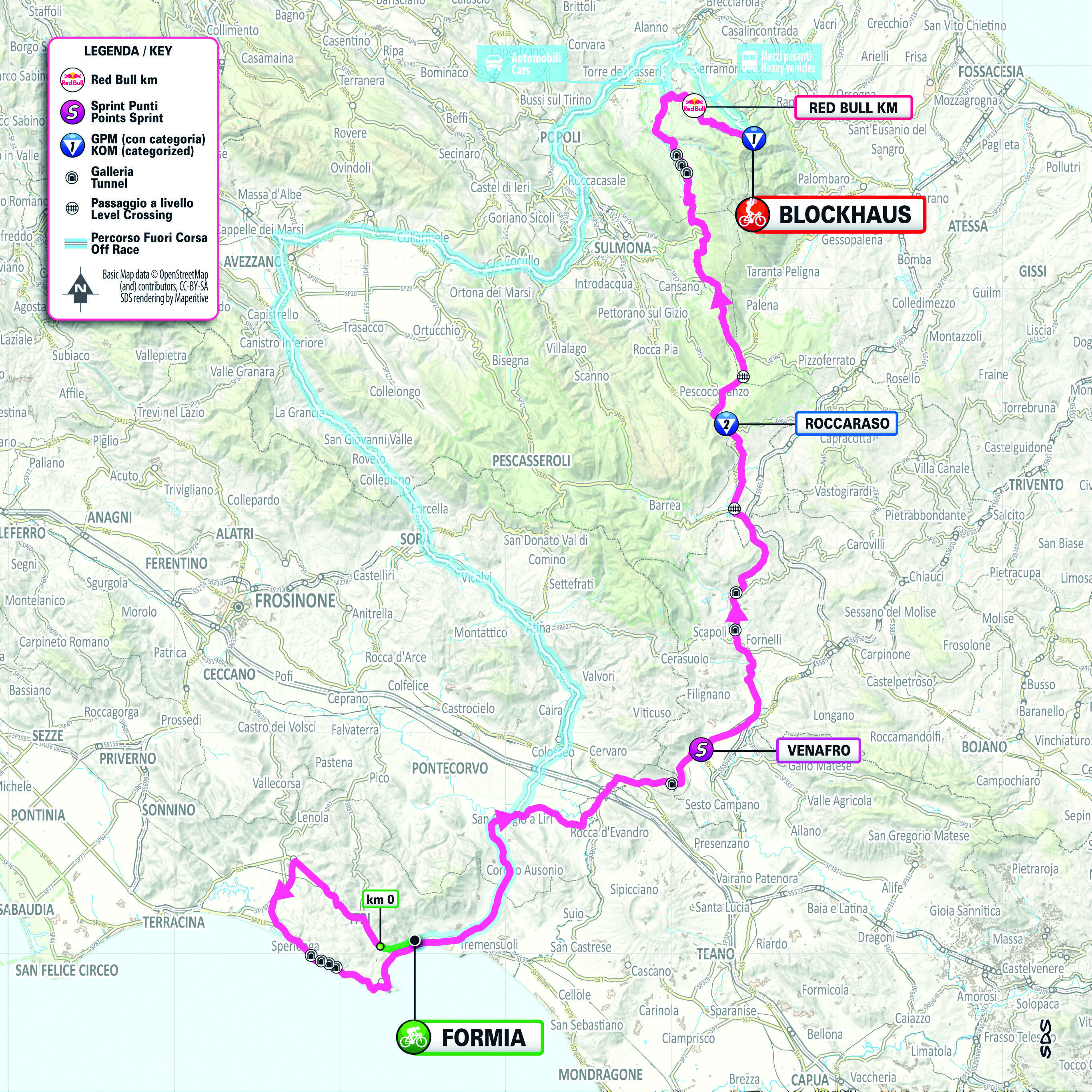
Friday 15 May | 244km | Mountains
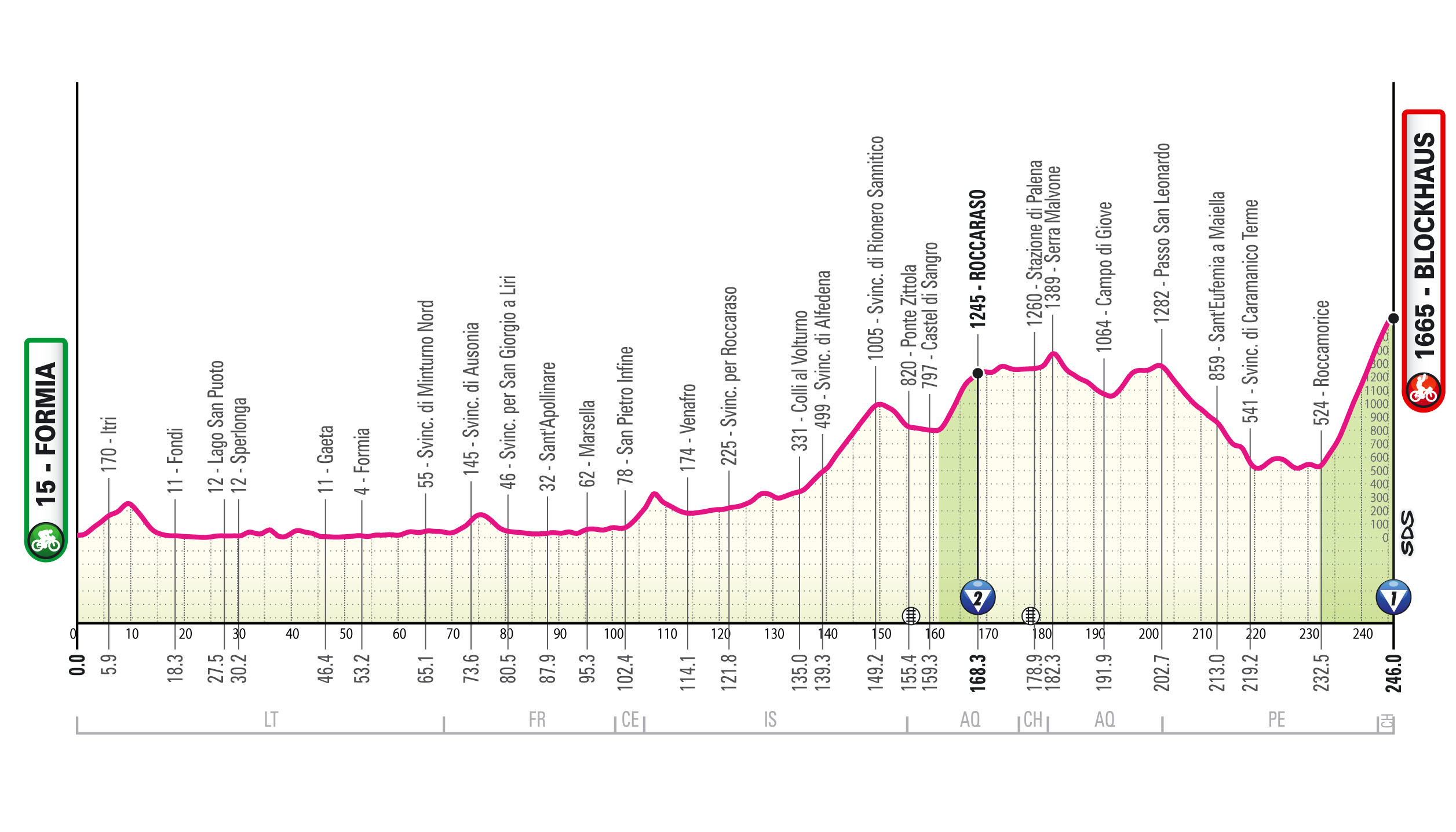
There have been some tough stages in the first week of the Giro d’Italia, so calling it a ‘phoney war’ probably doesn’t do it justice. However, the general classification battle has lain mostly dormant up to now. No longer.
Today’s stage is all about the summit finish on Blockhaus, a 1,665m beast whose slopes span a challenging 13.6km at 8.4%, with a spicy middle section where the gradients touch 14%. At 244km it’s long too – the longest since stage 10 in 2018, a race that ultimately became the last Grand Tour Chris Froome won.
The stage will be the first real target in the maglia rosa bid for several riders, and while the general classification is unlikely to be won today, by the end of the day we should have some idea of who is in possession of the legs they were hoping for, and whose have stayed stubbornly at home.
Beginning in Formia on the Tyrrhenian coast, the stage heads north across the centre of the country to its summit finish a stone’s throw from the Adriatic. The first half is straightforward but lumpy in places, with an intermediate sprint at 112km. Then, after 133km the road rises; first over the unclassified Rionero Sannatico, which climbs 700m in 13km; then comes the 1,245m Roccaraso (6.9km at 6.5%), the only other classified climb of the stage. This is quickly followed by more climbing over the Passo San Leonardo, before a mostly downhill 30km that leads to the day’s main event on Blockhaus.
Named after the 19th century military fort whose ruins still stand atop it, it’s a storied climb, with Jai Hindley (2022) and Neve Bradbury (2024 in the women’s race) the most recent winners. Certainly Hindley will be hoping to be among the front runners once again today.
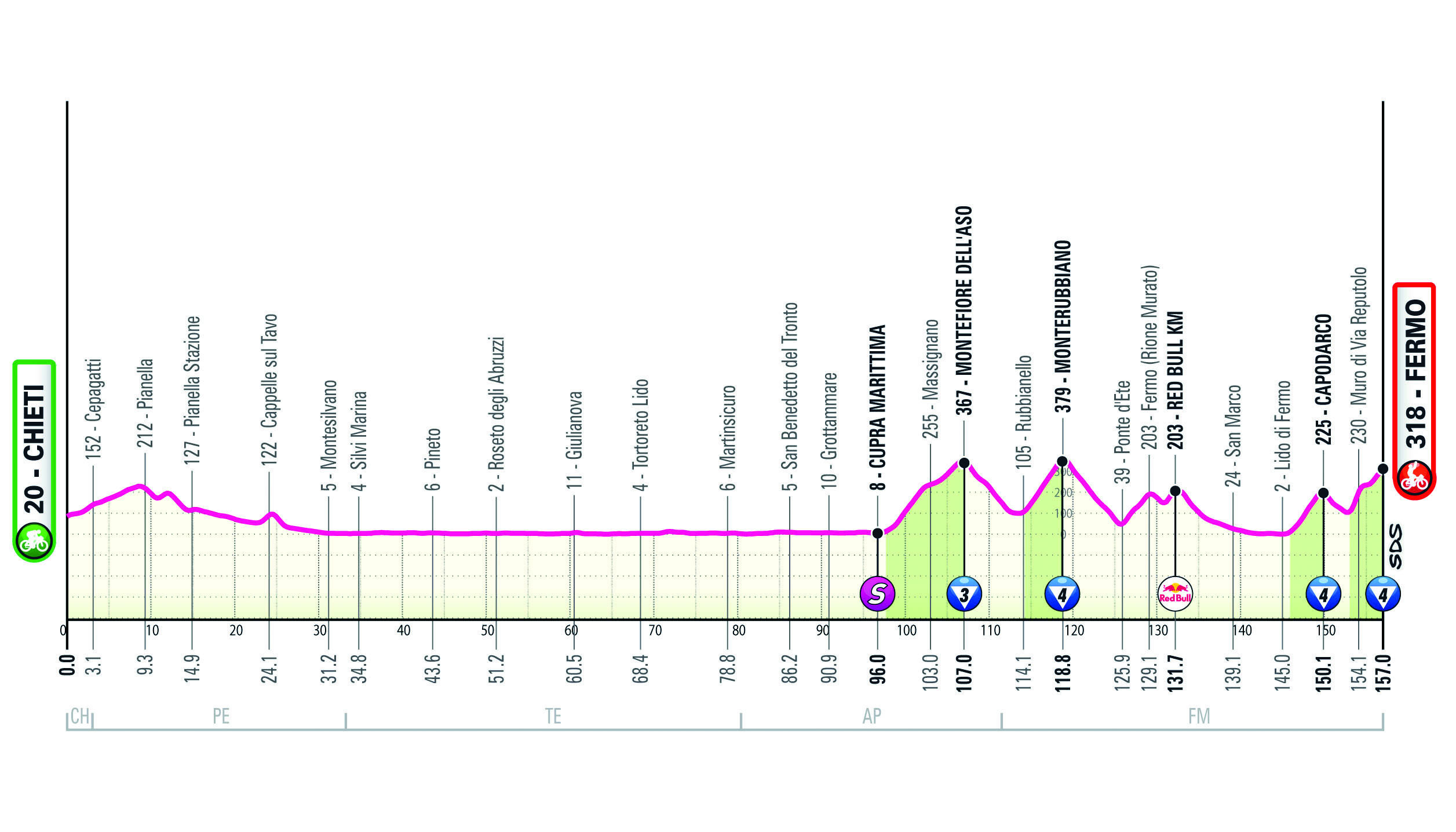
Stage 8: Chieti > Fermo
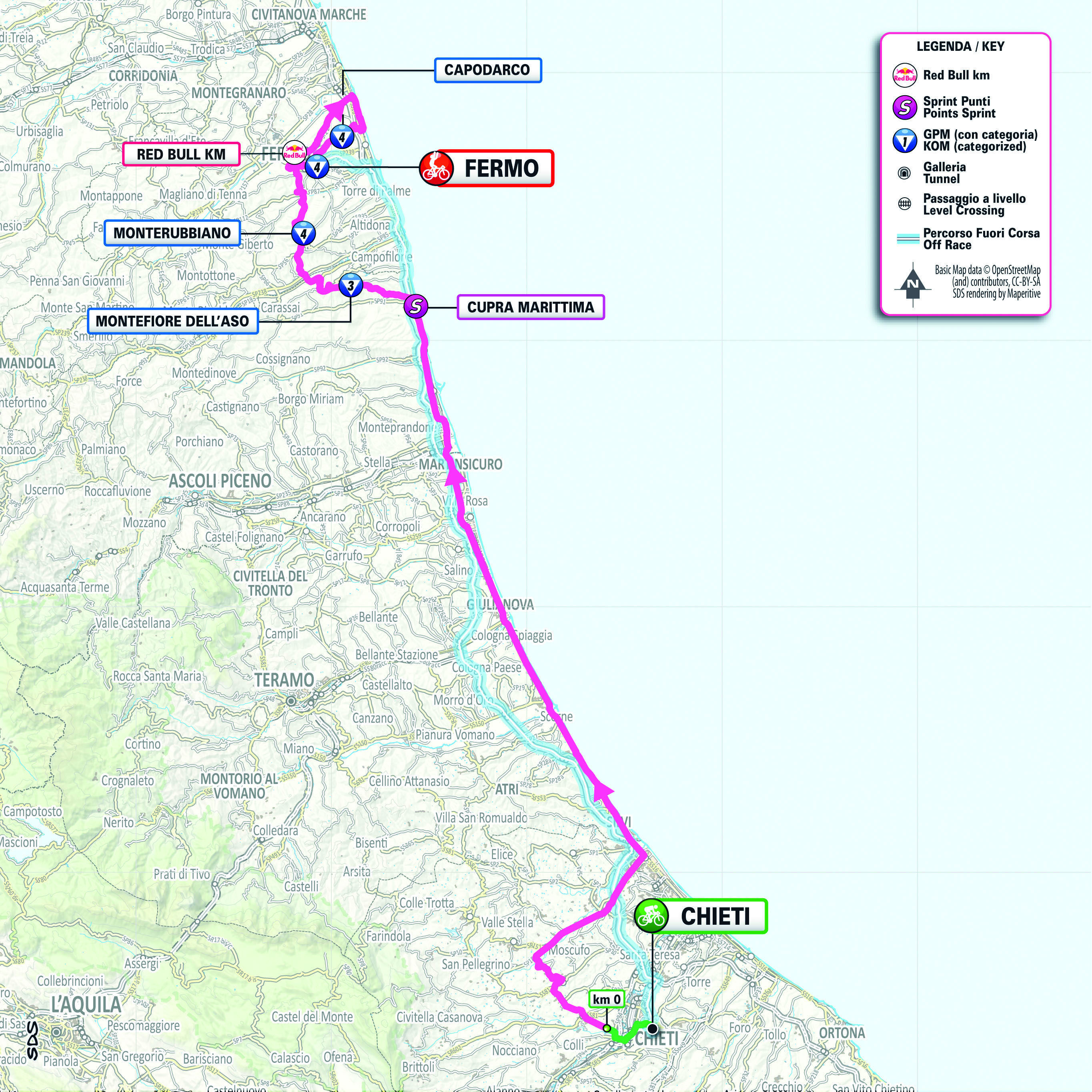
Saturday 16 May | 159km | Hilly
There is no rest today, with a series of short, sharp ‘muri’ climbs dictating the route towards the end of the stage.
This is not as clear-cut a general classification day as the previous day to Blockhaus, but full of threats for those looking to win overall, with four classified climbs inside the final 50km. It won’t be where the race is won, but it might be where the race is lost, if positioning isn’t exactly right.
Expect a fierce fight for the front ahead of each hill. There are even unclassified gradients to worry about, before the final drag up to the finish in Fermo – 3.4km at 6.1% – which will almost certainly decide the identity of the stage winner.
STAGE 9: Cervia > Corno alle Scale
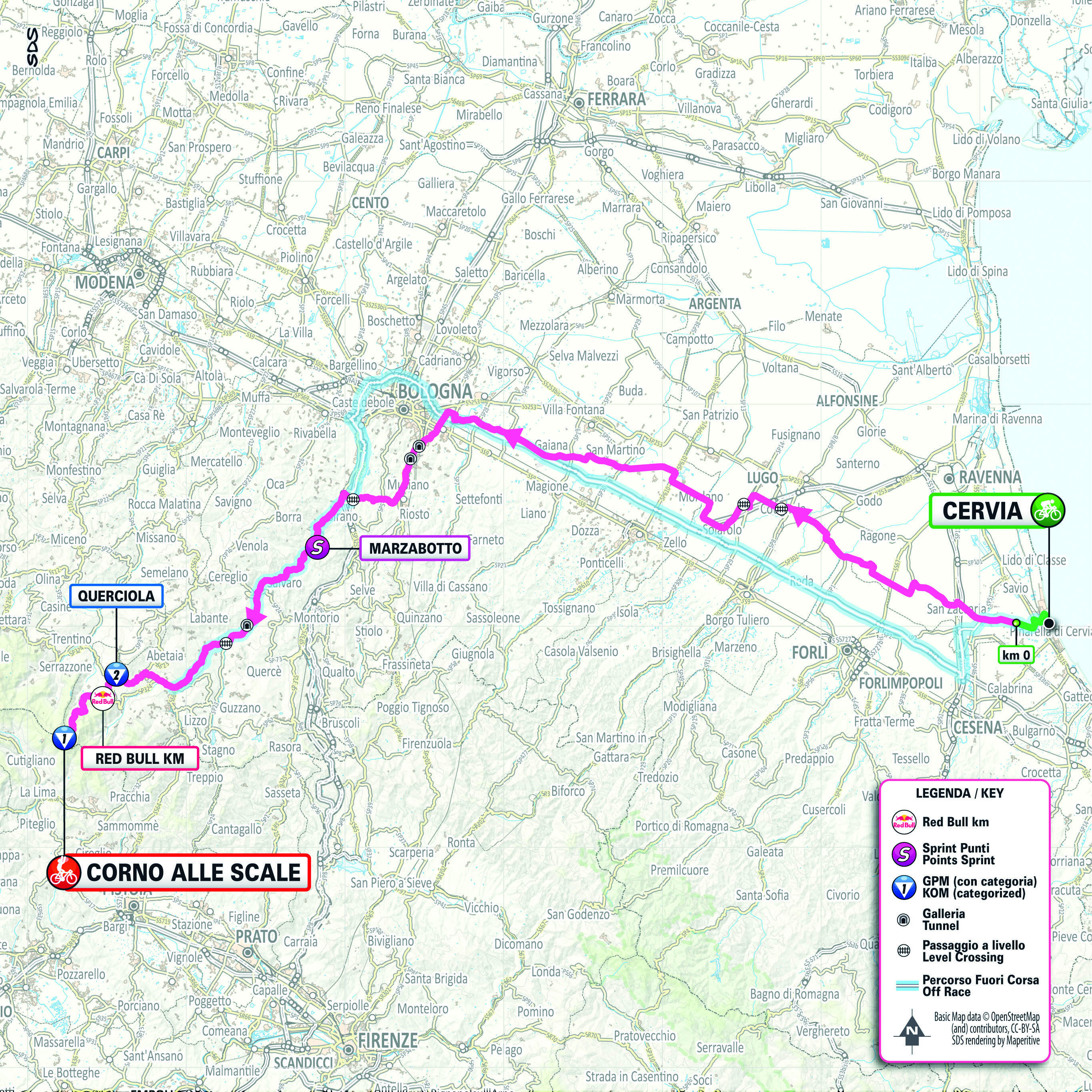
Sunday 17 May | 184km | Mountains
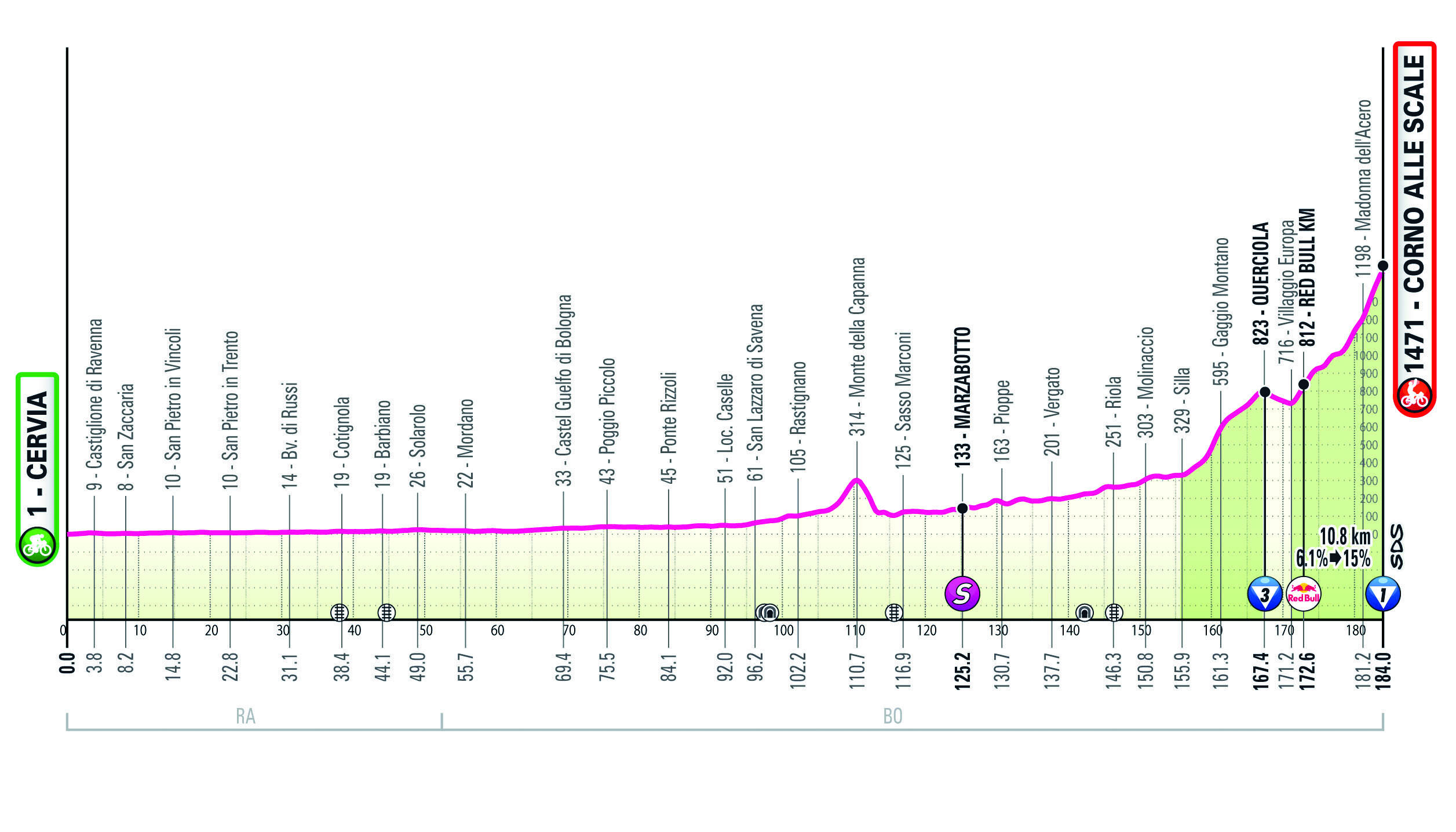
The final stage of the first week comes with a sting in the tail, the climb up to Corno alle Scale, the highest peak in the Bologna Apennines, on the border between Emilia-Romagna and Tuscany.
After a largely flat first 100km, things slowly start to ramp up before there is 2,400m of altitude gain in the final 30km. First there is the climb to Querciola, 9.7km at 4.3%, a third-cat, before the first-cat summit finish itself, 12.8km at 5.9%. It includes ramps of up to 15% inside the final 3km, which could be enough for some favourites to make a move.
With three back-to-back GC days in the legs, there may be fireworks. It’s unlikely to be a day for the breakaway.
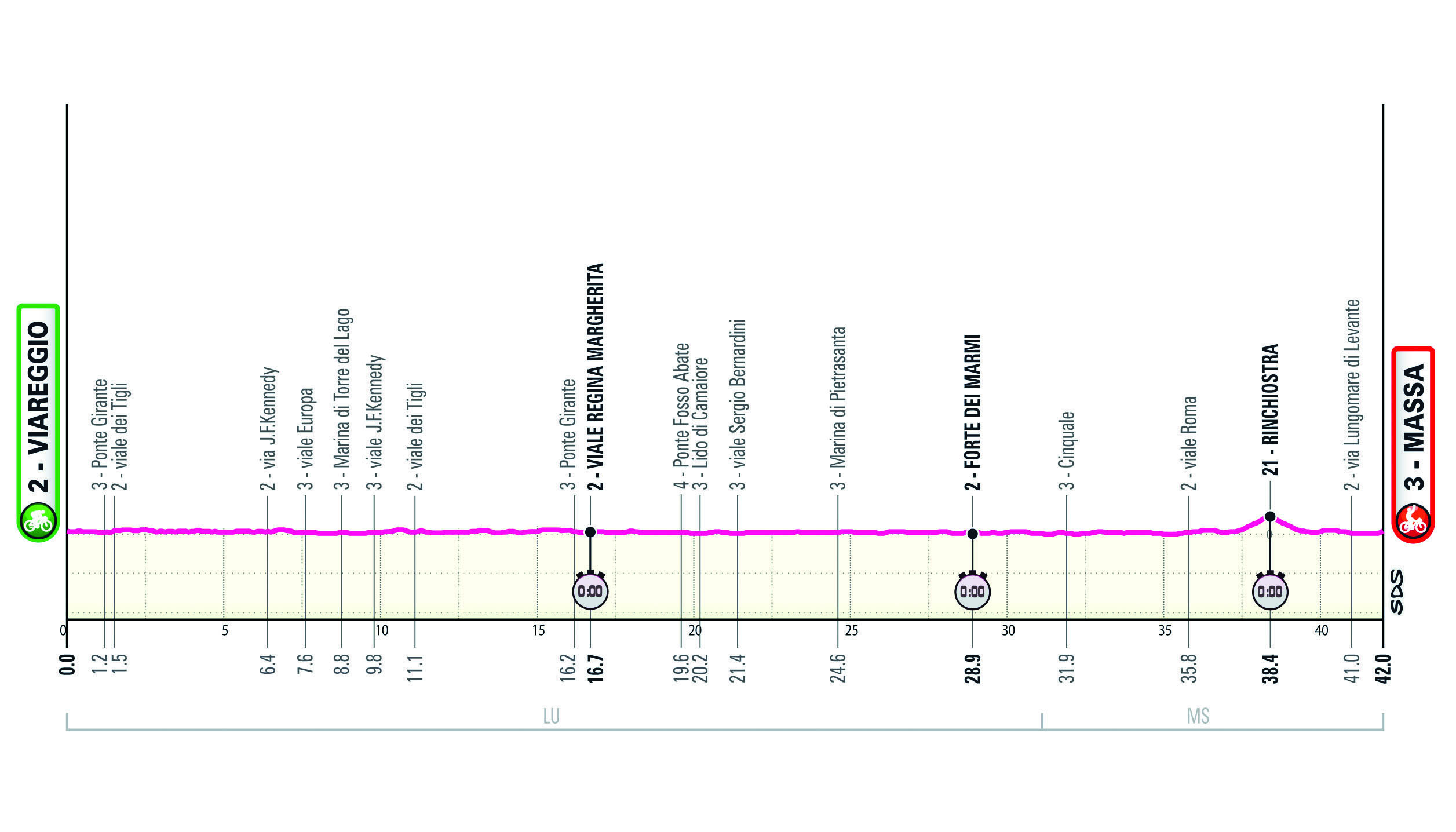
STAGE 10 Viareggio > Massa
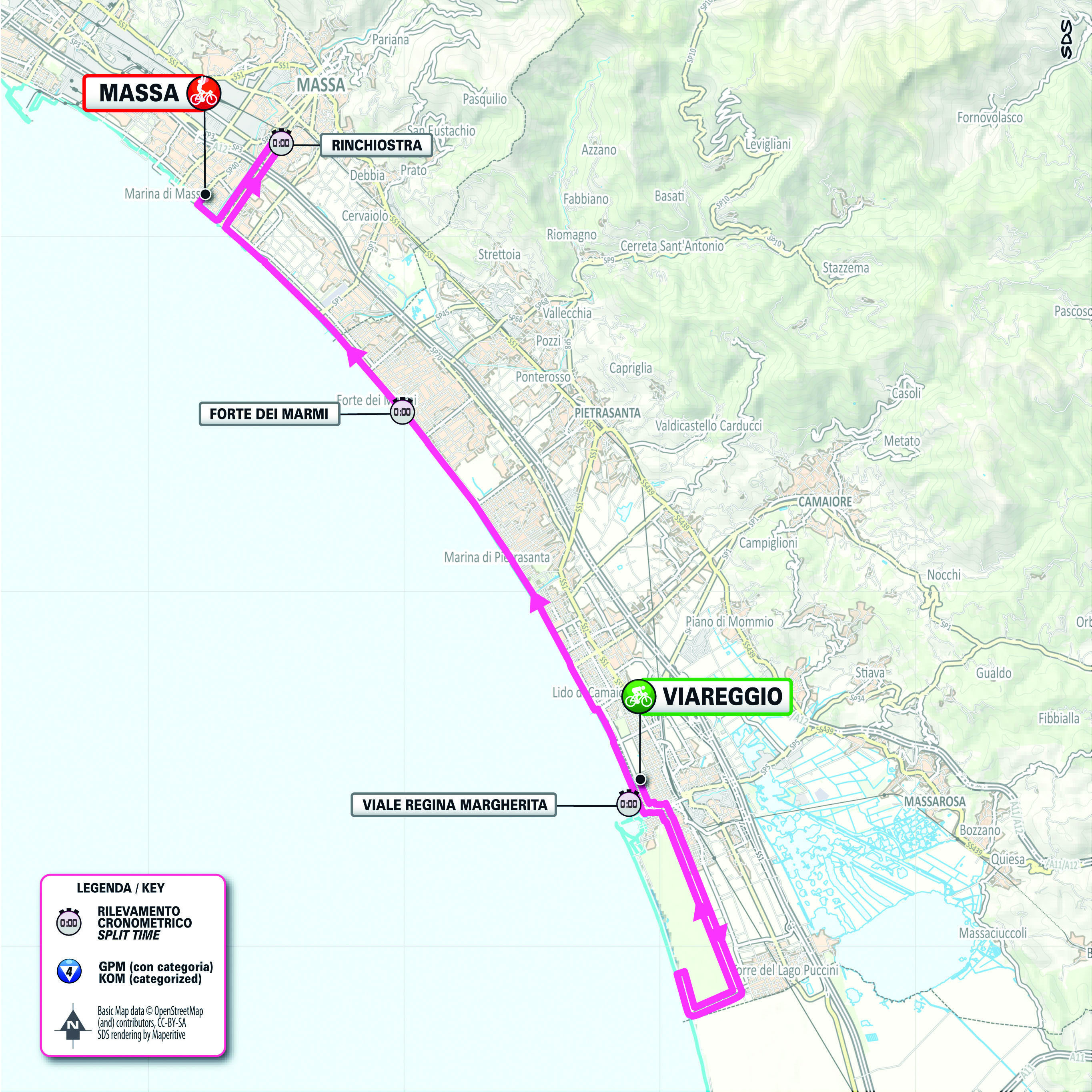
Tuesday 19 May | 40.2km | ITT
The sole time trial of the 2026 Giro d’Italia is this incredibly flat ride along the Ligurian coast, which could be over in just 45 minutes. The day is scheduled to be a fast one, weighted heavily in favour of the pure rouleurs like Filippo Ganna, who will surely be licking his lips at the prospect of a seventh stage win against the clock at his home Grand Tour. There are 11 corners in the first 15km before the race is essentially a straight line up the coast for the next 15km. There are then five more corners in the run-in, but this is not a technically difficult race against the clock.
A flat time trial was surely put in to tempt the TT specialists Remco Evenpoel, Primož Roglič and Jonas Vingegaard to come to the Giro, but it has only succeeded in bringing the latter to Italy. There could be significant time gaps between more complete GC riders and those who are pure climbers. There is still a lot of altitude to be gained after today, though, so the race is hardly a TT expert’s dream. Last year’s long, flat time trial saw two British riders on the podium in Ethan Hayter and Josh Tarling, but this year all eyes will be on Ganna, Vingegaard, Jay Vine and possibly Edoardo Affini.
While the riders might not have time to enjoy their surroundings, fans undoubtedly will, with Viareggio boasting a series of Art Nouveau buildings which date back to the tourism boom of the early 20th century. Massa, meanwhile, is much older, a medieval settlement, dominated by the Malaspina Castle. The town sits between the Apuan Alps and the coast, and also saw a change in its fortunes when the beaches became the place to visit, 100 years ago.
STAGE 11 Porcari > Chiavari
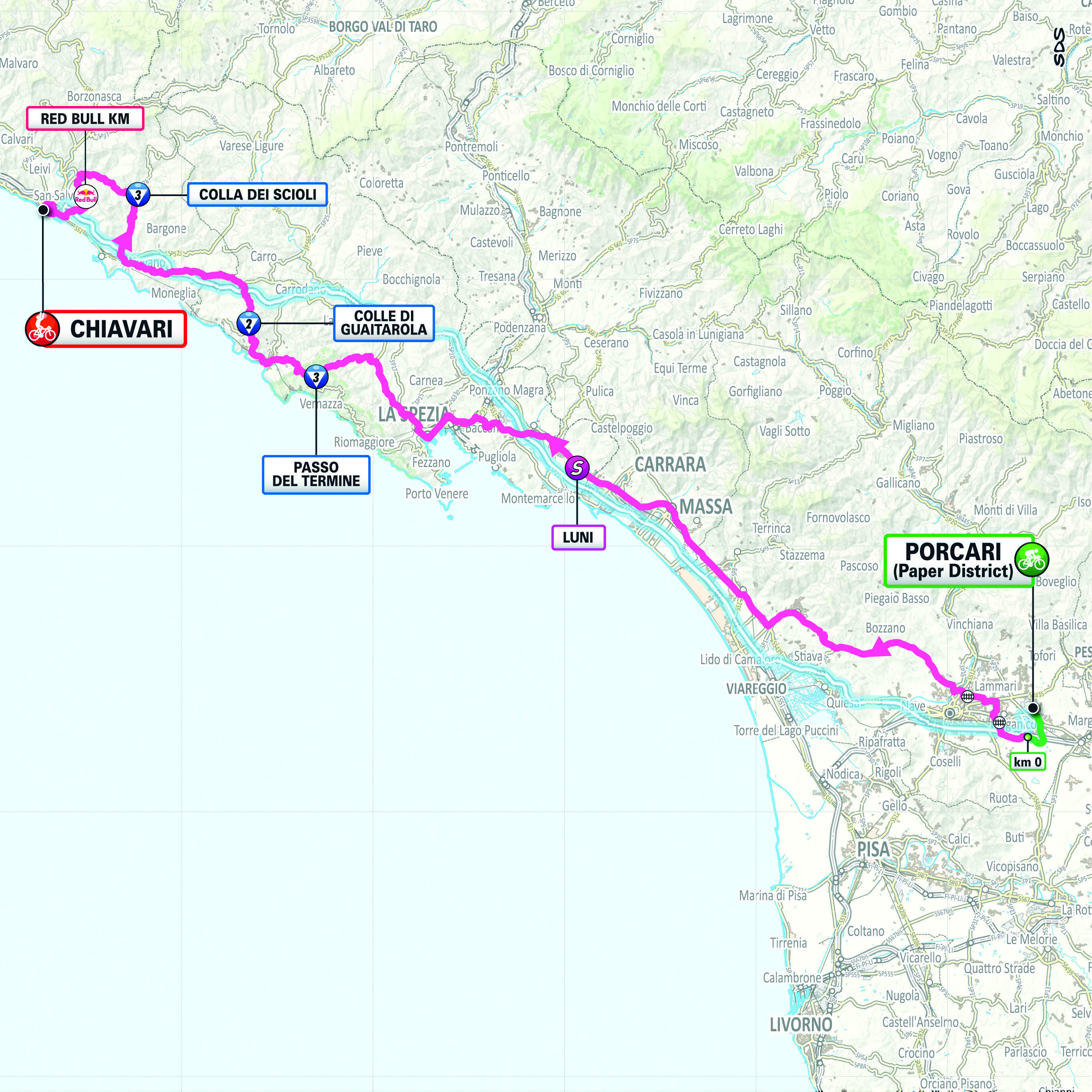
Wednesday 20 May | 178km | Hilly
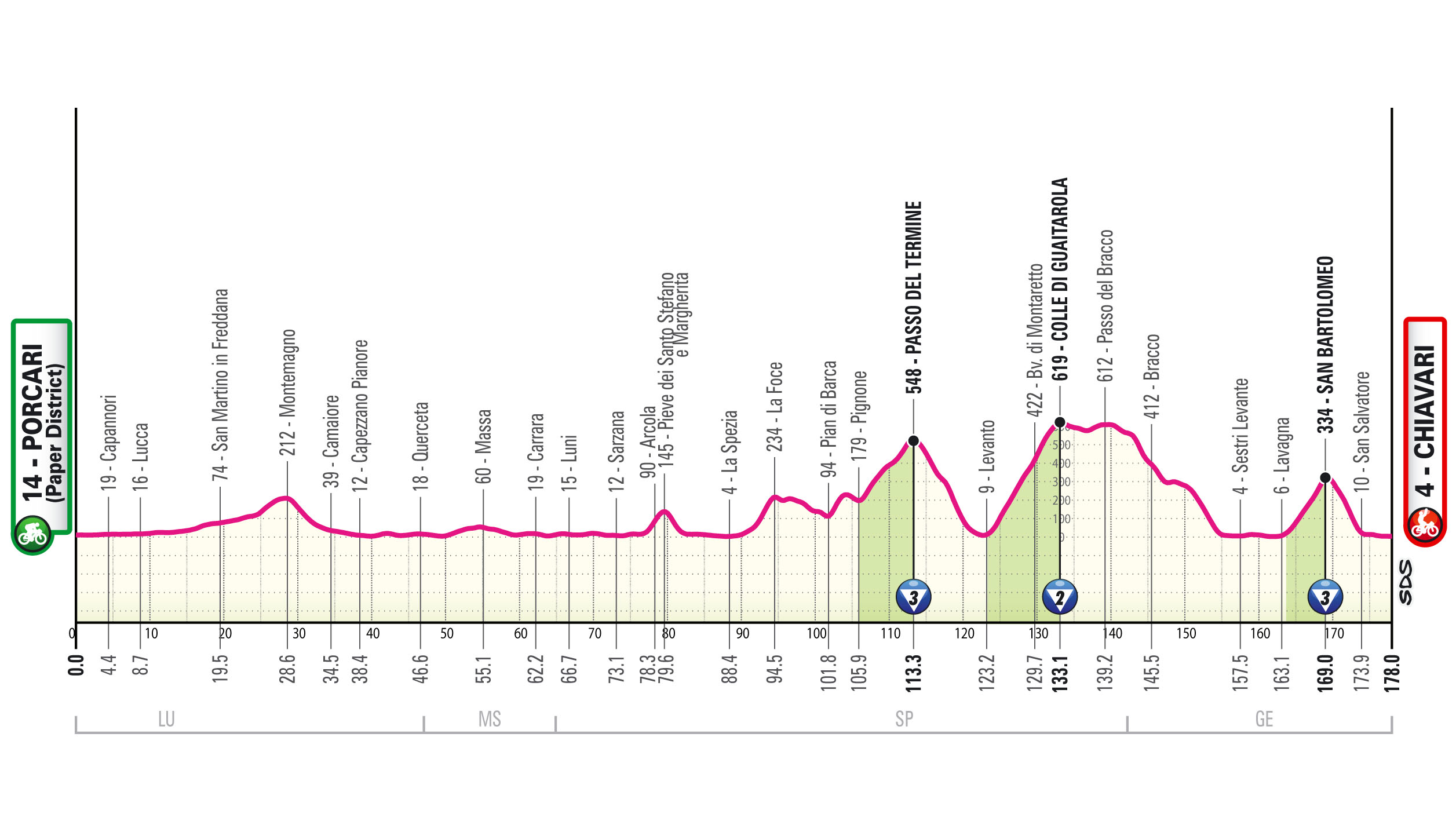
With the flat time trial dispensed with, it’s time for more climbing. Today comprises three classified climbs within the last 78km of the stage, and plenty of road for riders to escape on. It starts at the paper factory of race sponsor Regina before heading north-west up the Ligurian coast again, this time to Chiavari, where riders will be treated to a “regular urban layout and long arcades”, according to the race guide.
The three climbs are the third-category Passo del Termine (7km at 5.1%), the second-category Colle di Guaitarolo (9.7km at 6.3%), and then the third-category San Bartolomeo (4.6km at 6.4%). The descent from this will be crucial, before a fl at run-in to the town, which is surely be where the stage will be decided.
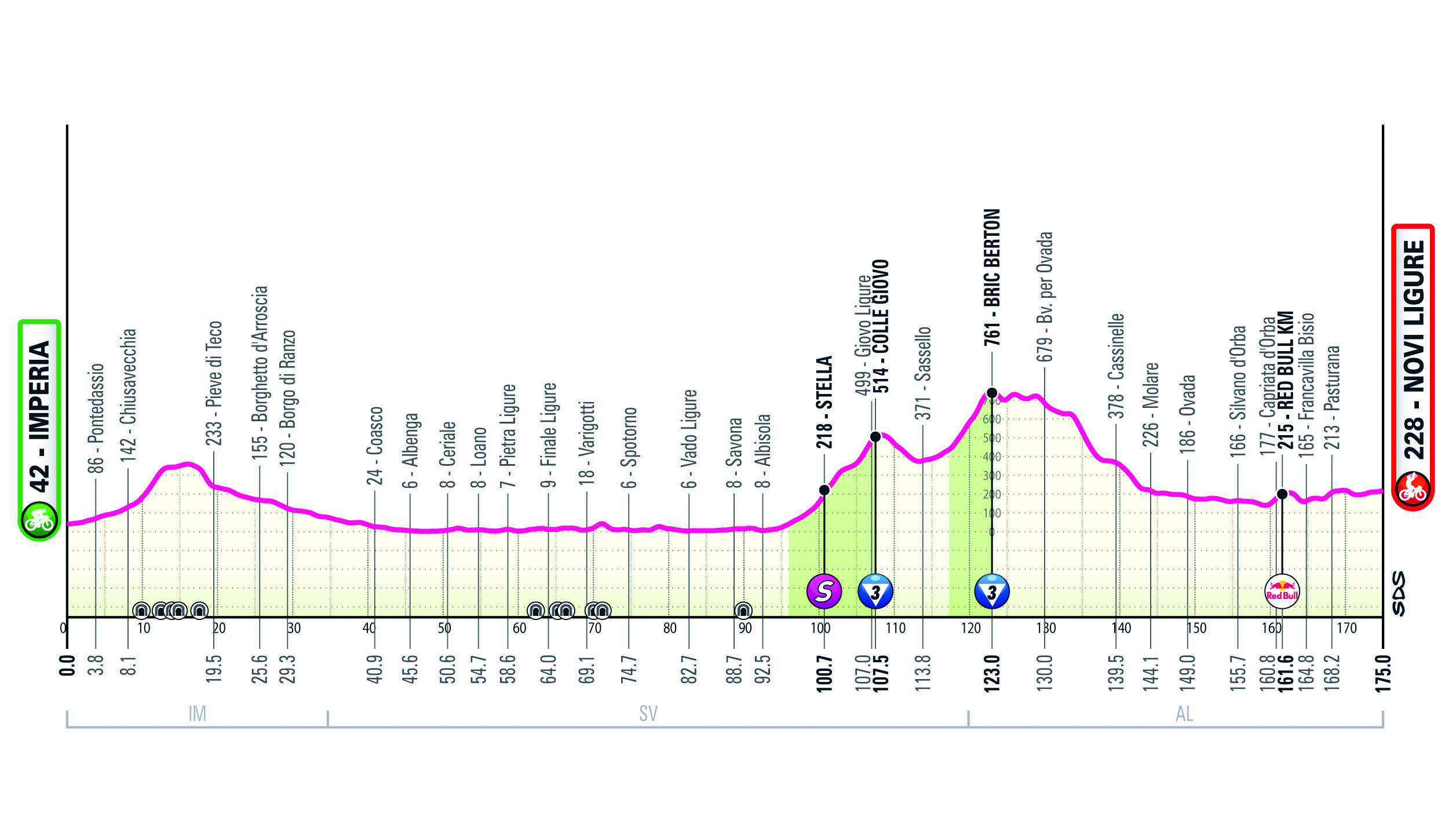
STAGE 12: Imperia > Novi Ligure
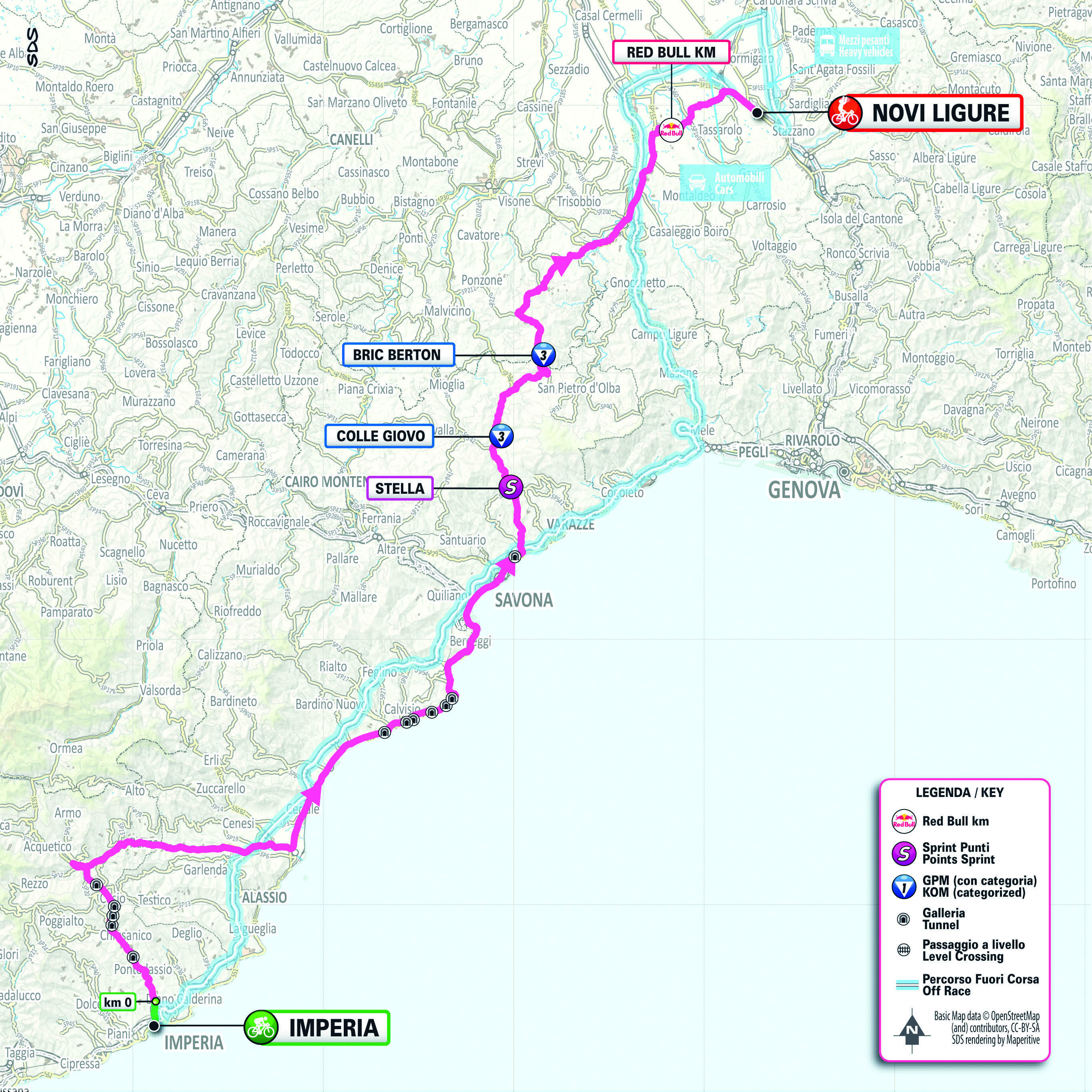
Thursday 21 May | 175km | Hilly
This intriguing-looking stage could go either the way of the sprint teams or the breakaway, with two climbs coming midway through the day, but a largely flat finish to Novi Ligure. It is essentially a reverse Milan-San Remo, starting on the Ligurian coast just east of the Monument’s finale. From here it heads inland, although not quite all the way to Milan.
The two climbs are the third-category Colle Giovo, 7.8km at 4.8%, before the Bric Berton, another third-category, 7.5km at 4.9%. However, the final 50km sees no significant climbing, so if the sprinters are still in the bunch, there will be a fierce fight to reel the front of the race back in and set up the fast men for a chance of victory.
Stage 13: Alessandria > Verbania
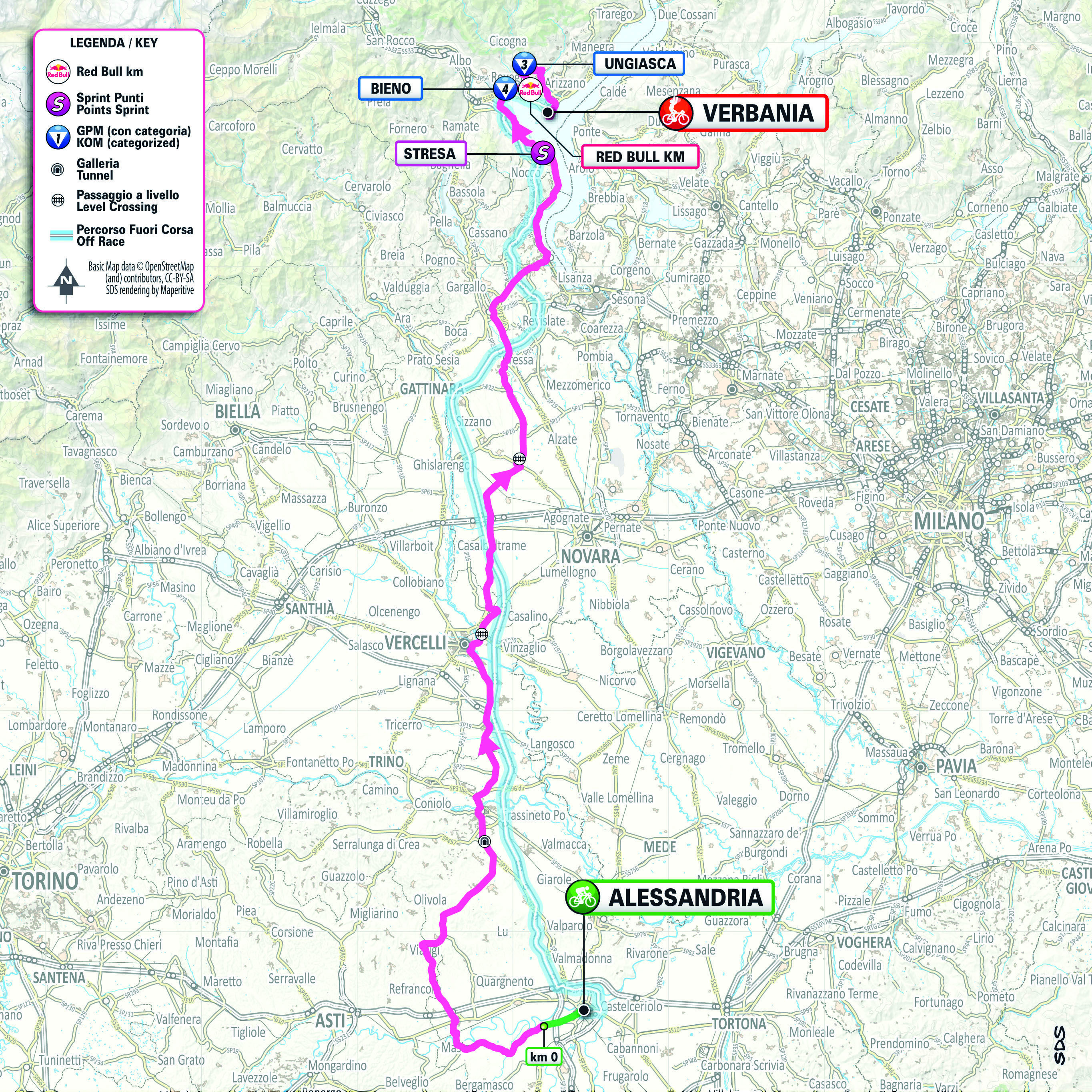
Friday 22 May | 189km | Hilly
This is another difficult day to classify. If it wasn’t for two climbs inside the final 25km, this would be a straight-up bunch sprint day, but there is a surprise waiting for the peloton. This transition day begins on the plains between the Tanaro and Bormida rivers, and ends at the foot of the Alps and almost in Switzerland, almost directly north.
Before the riders get to the finish on the shores of Lake Maggiore, they have to tackle the fourth-category climb of Bien (2.4km at 5.7%) and the third-category Ungiasca (4.7km at 7%). It is on the latter where a rider could sprint away to victory, with the last kilometre at 9%, and a ramp of 13%. These slopes could derail a sprinter’s day and see the victory go to a puncheur.
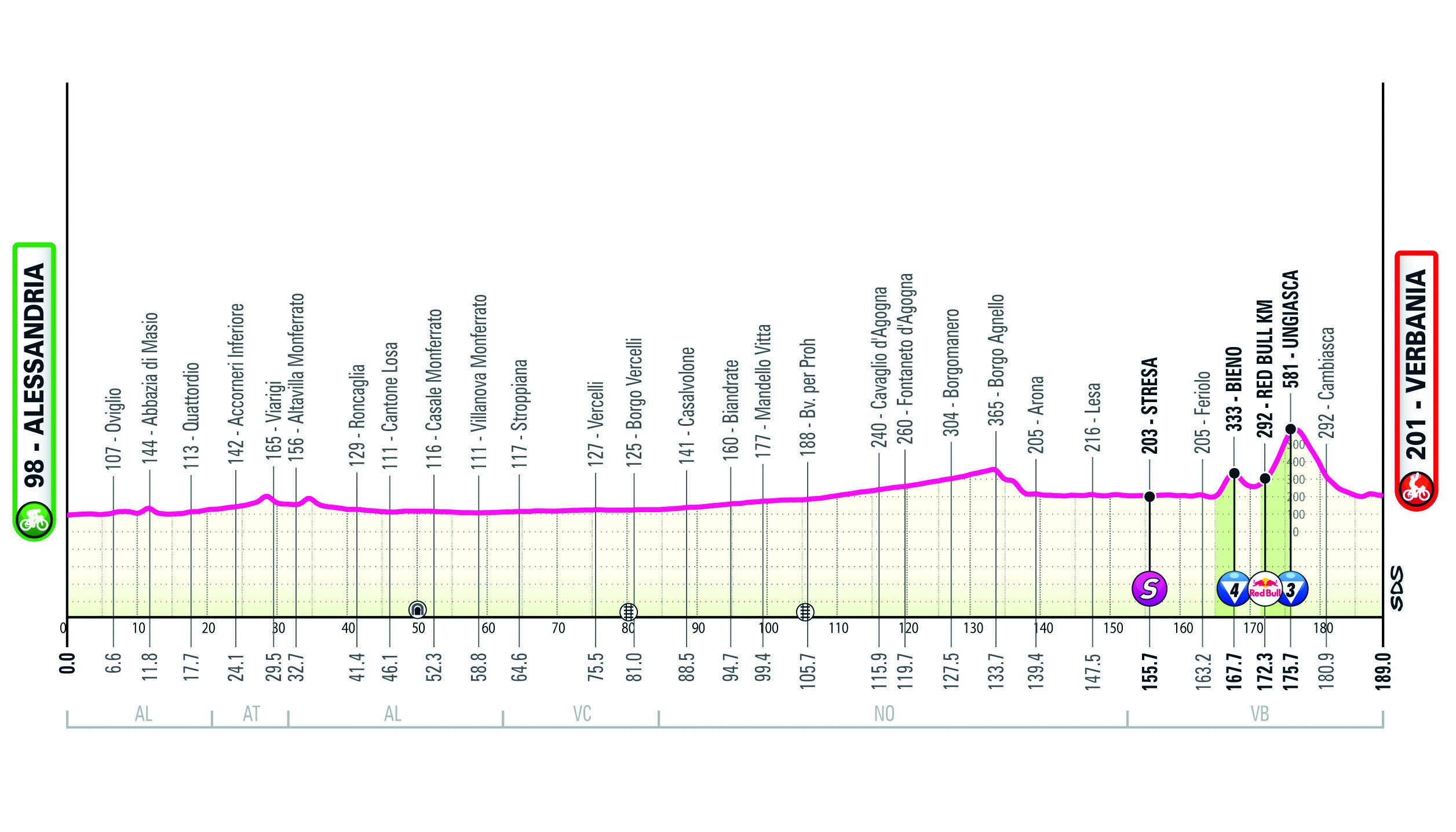
STAGE 14: Aosta > Pila
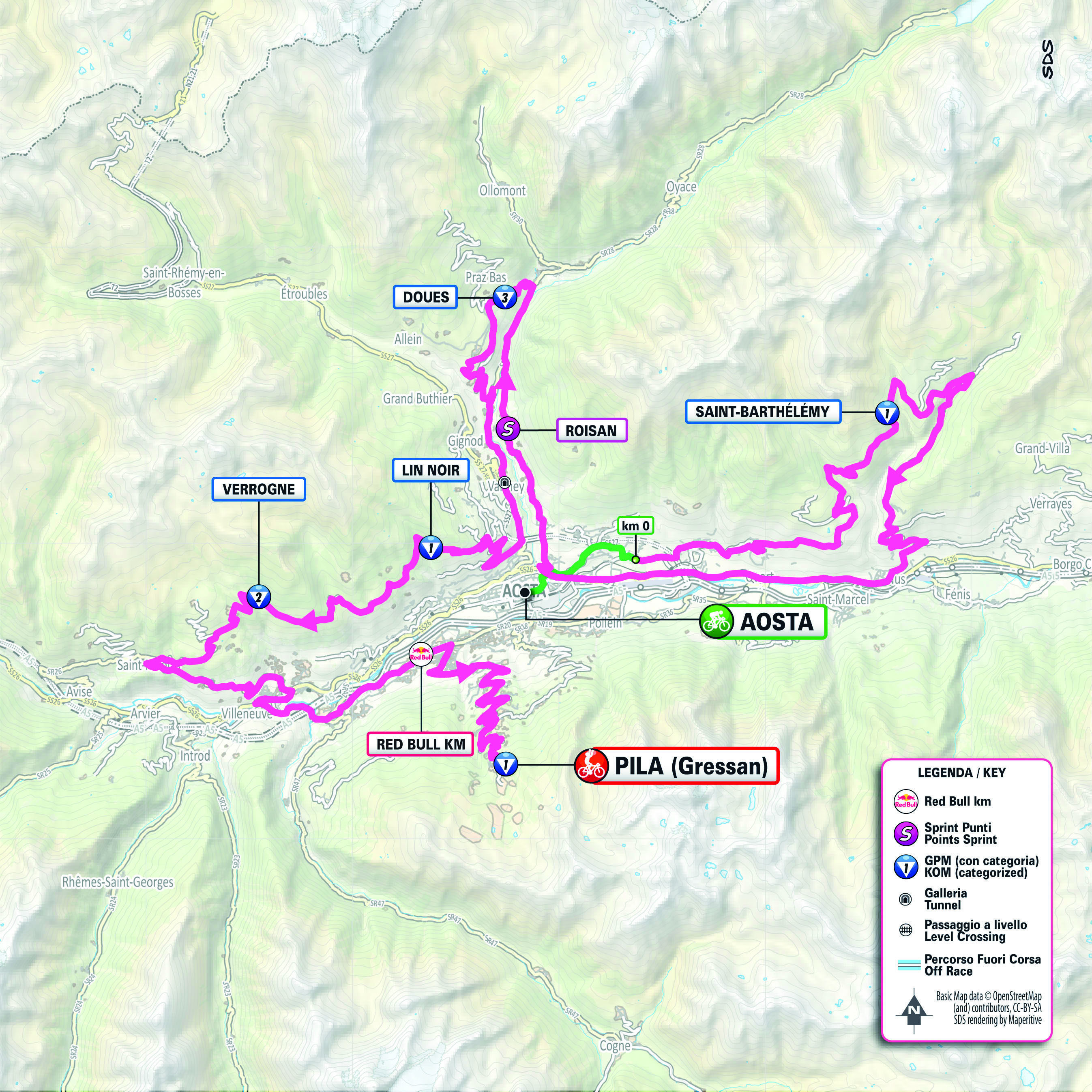
Saturday 23 May | 133km | Mountains
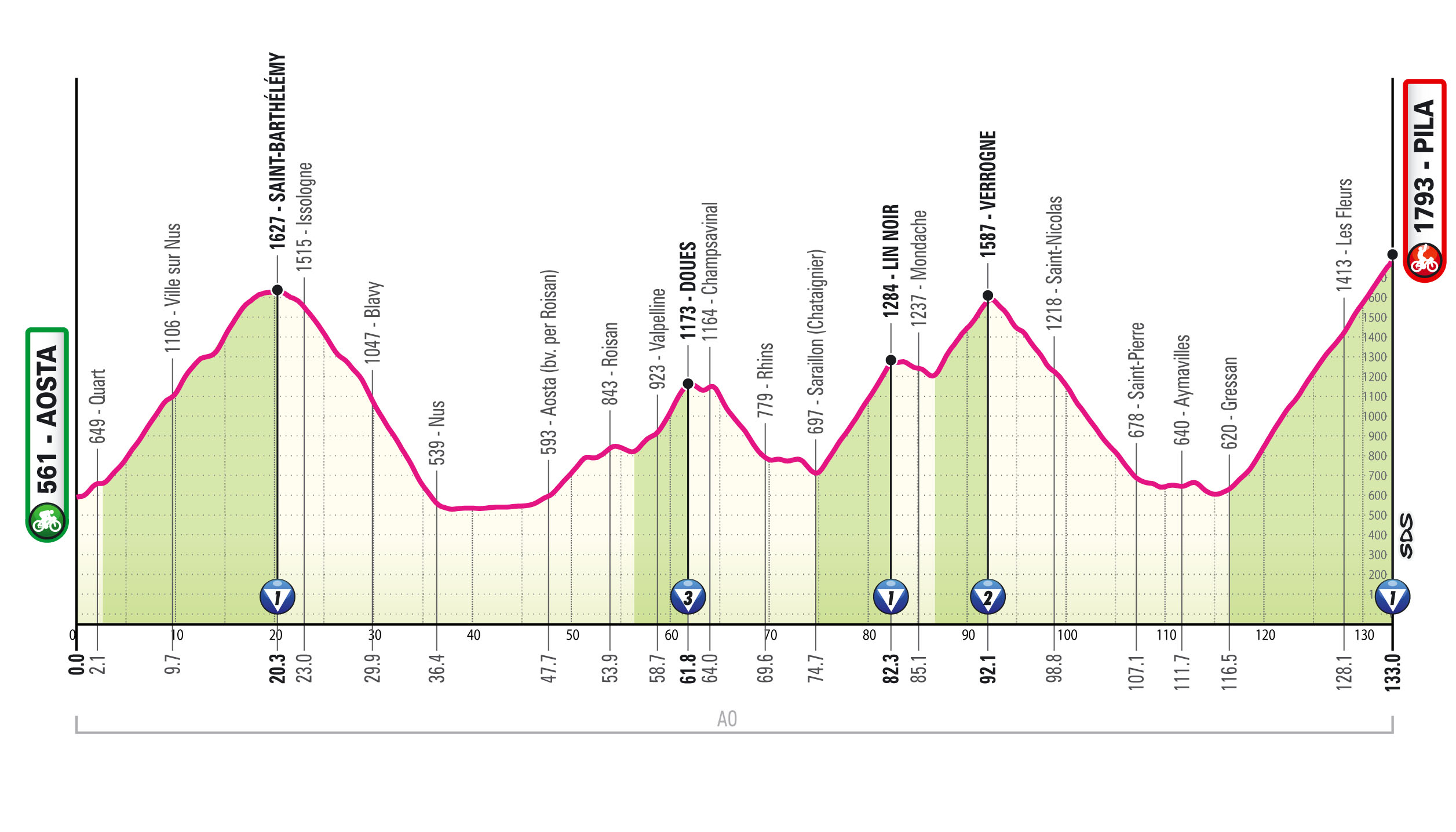
After three relatively easy days at the Giro, it’s the time for the return of high mountains on the third Saturday of the race, in the Val d’Aosta. It might be a short day, but it includes 4,400m of climbing. Straight from kilometre zero is the first-category Saint-Barthélemy, 17.6km at 5.5%, a nice easy warmup.
This is followed by the third-category Doues, 5.5km at 6.5%, the first-category Lin Noir, 7.5km at 7.8%, and the second-category Verrogne, 5.4km at 7.2%. The ramps have grown steeper but the race is not yet over, with the final summit finish in Pila to come, 16.6km at 7.1%. This tough day, with little let-up, could be decisive for the direction of the pink jersey. Fans, meanwhile, can enjoy Fontina DOP cheese, from the valley.
STAGE 15: Voghera > Milano
Sunday 24 May | 157km | Flat
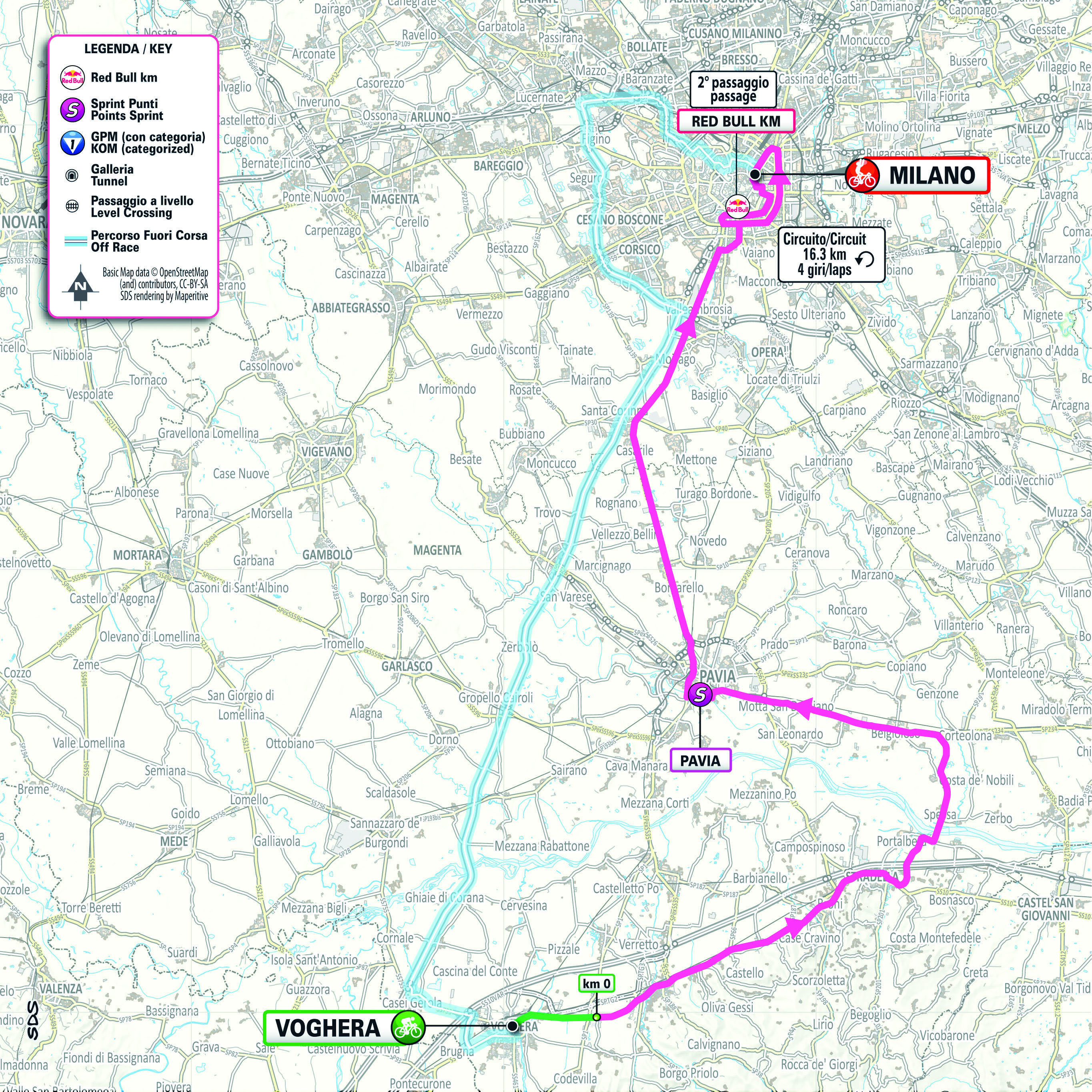
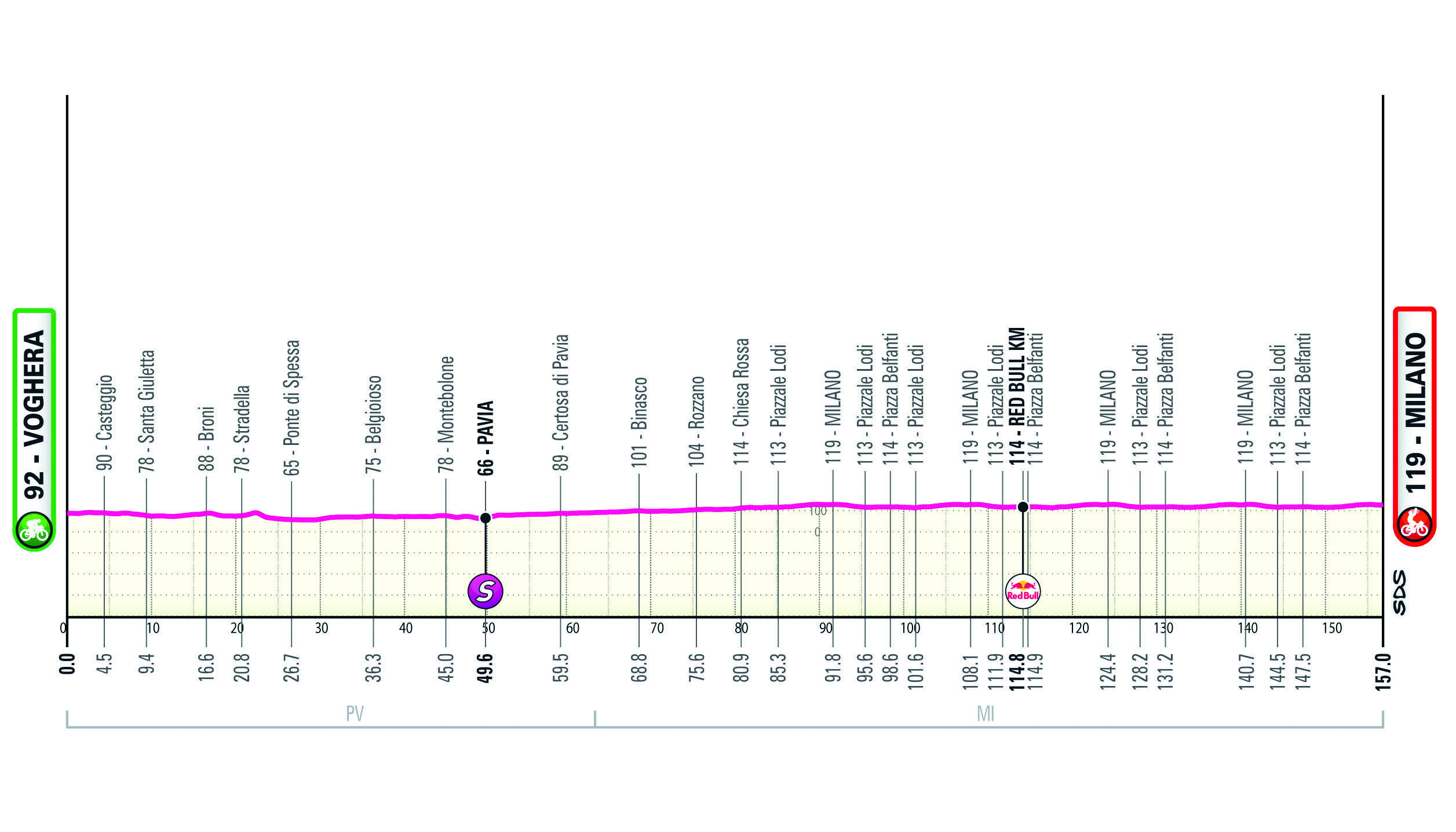
Beginning in Voghera, in south-western Lombardy, this stage is entirely flat. The peloton will head out along wide, straight roads before joining the Milan-San Remo course to Milan. After lapping the final 16.3km circuit four times near the Vigorelli velodrome, the race will end in a fl at-out stretch.
Prepare for a high-speed bunch sprint to finish stage 15’s otherwise more cruisy day. As the annual fi nish of the race until the 1960s, Milan has been honoured by the Giro d’Italia organisers with this stage finish to mark the end of week two.
STAGE 16: Bellinzona > Carì
Tuesday 26 May | 113km | Mountains
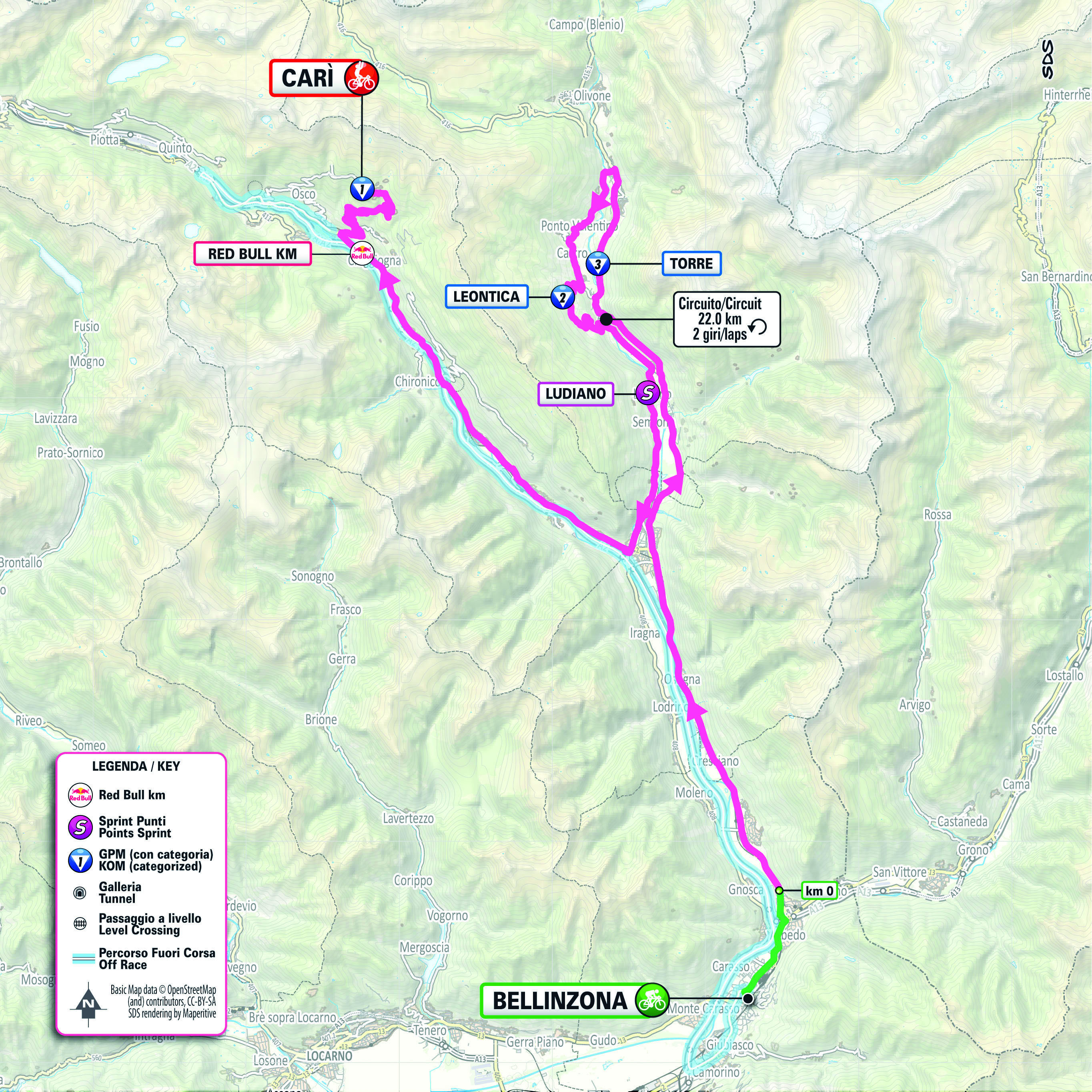
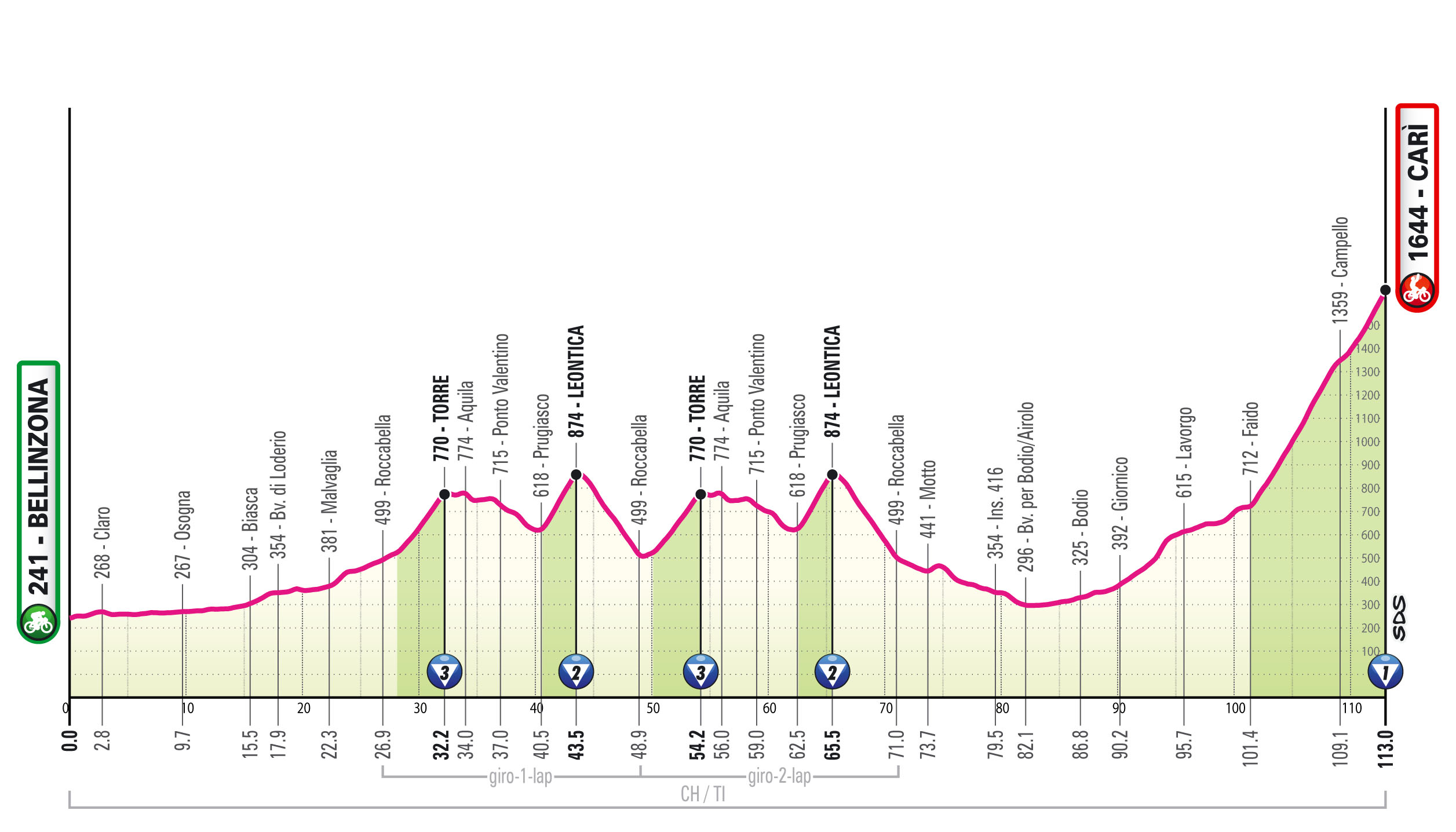
Having had a flat day on Sunday and a rest day on Monday, riders return to the mountains in Switzerland for stage 16. With nearly 3,000m of climbing to cover over the course of the day, riders will first be hit with a repeating 22km circuit that includes two ascents of Leontica. This climb gains 256m over three kilometres at a gradient of 8.5% (maxing out at 14% close to the foot of the climb).
However, the climbing isn’t done after Leontica, as riders head into the Gotthard valley, following the river upstream and on to Faido, where the final climb awaits them. The day, spent entirely in the Swiss mountains, will end in an 11.7km battle uphill at a punishing 7.9% gradient, with 13% ramps in the final kilometre.
STAGE 17: Cassano d’Adda > Andalo
Wednesday 27 May | 202km | Hilly
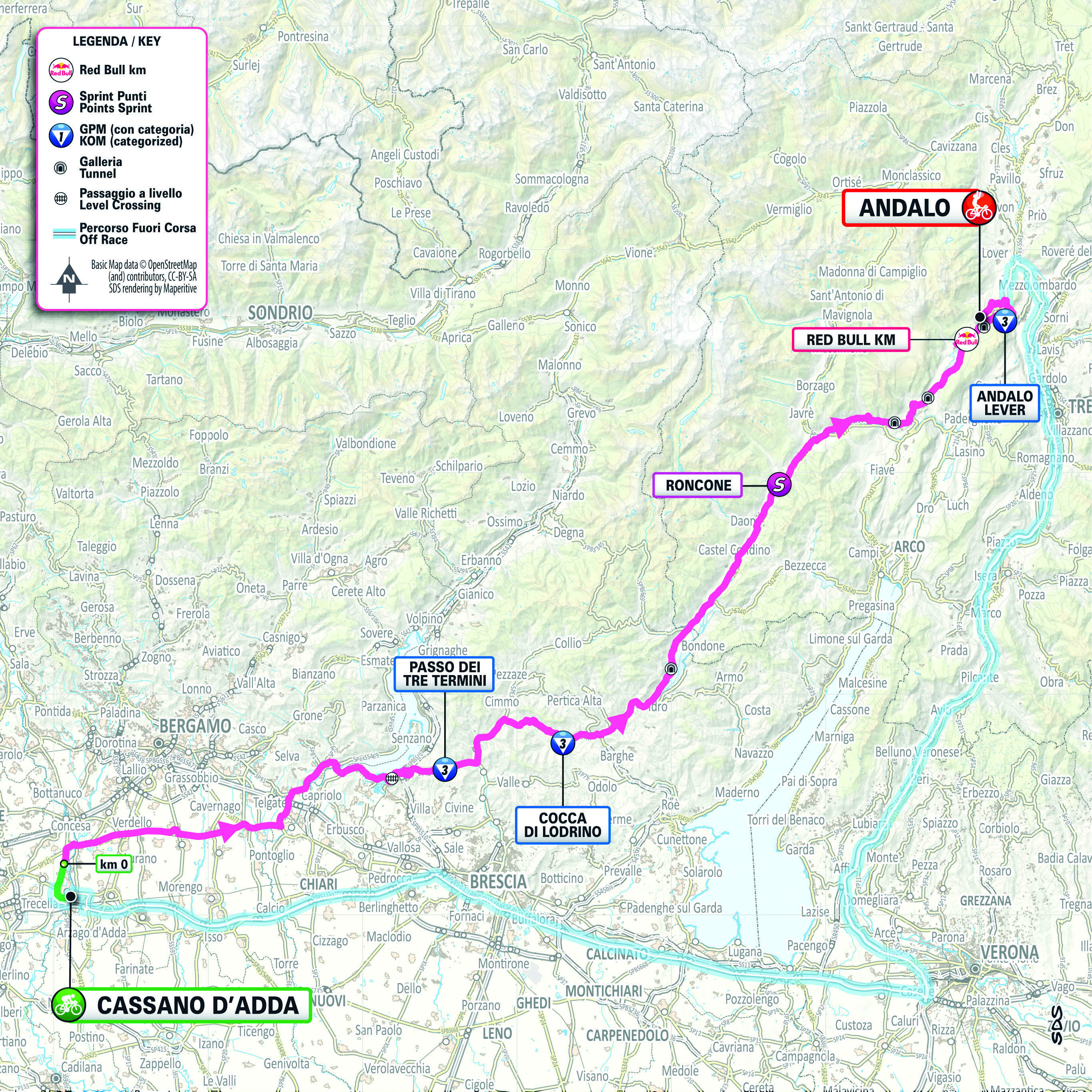
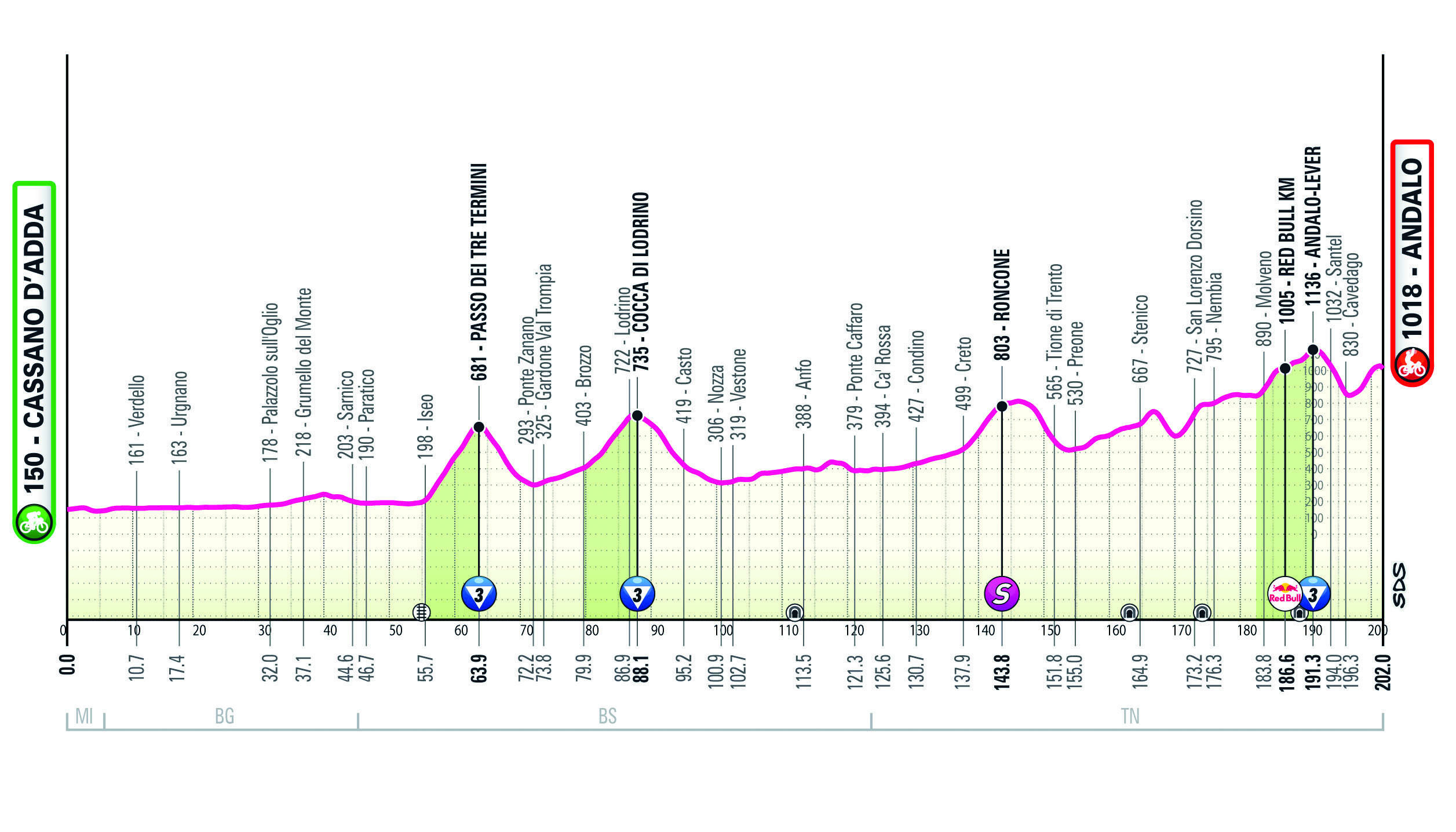
Today’s stage is flat to begin with, as the riders head towards Lake Iseo along the Adda river. The climbs then come in quick succession: the Passo dei Tre Termini (8.2km at 5.9%) followed by the Cocca di Lodrino and onto the Valle del Chiese. The undulating route to Andalo will make it especially appealing to puncheurs and breakaway specialists, who will delight in the multiple chances to eke out gaps.
The next challenge awaiting the peloton is a narrowing road – until a return to business as usual with another two climbs before the stage’s end. At 1,136m above sea level, the final third-category climb to Andalo-Lever could provide a launchpad for victory, before a punchy finale.
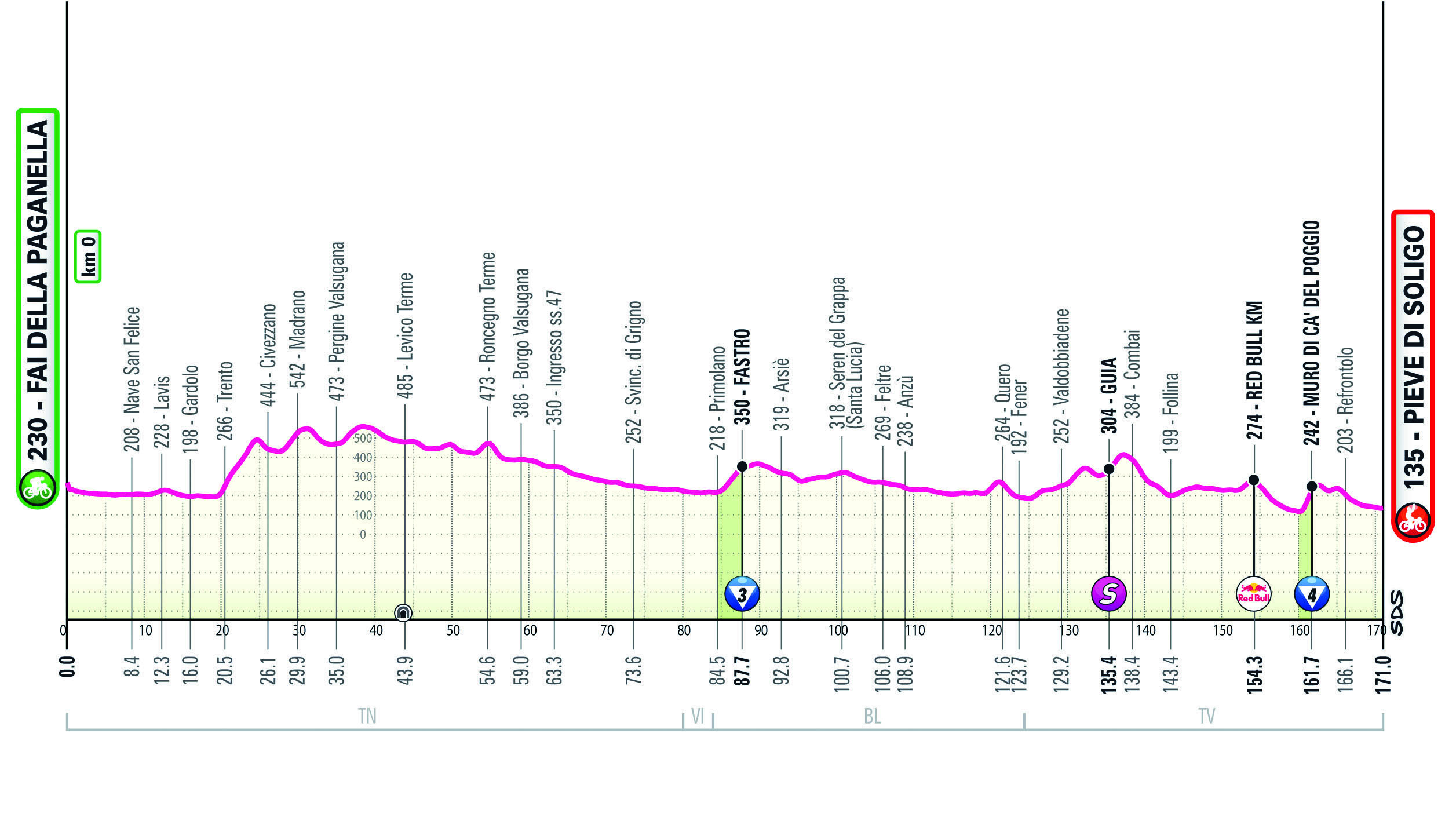
STAGE 18: Fai della Paganella > Pieve di Soligo
Thursday 28 May | 168km | Hilly
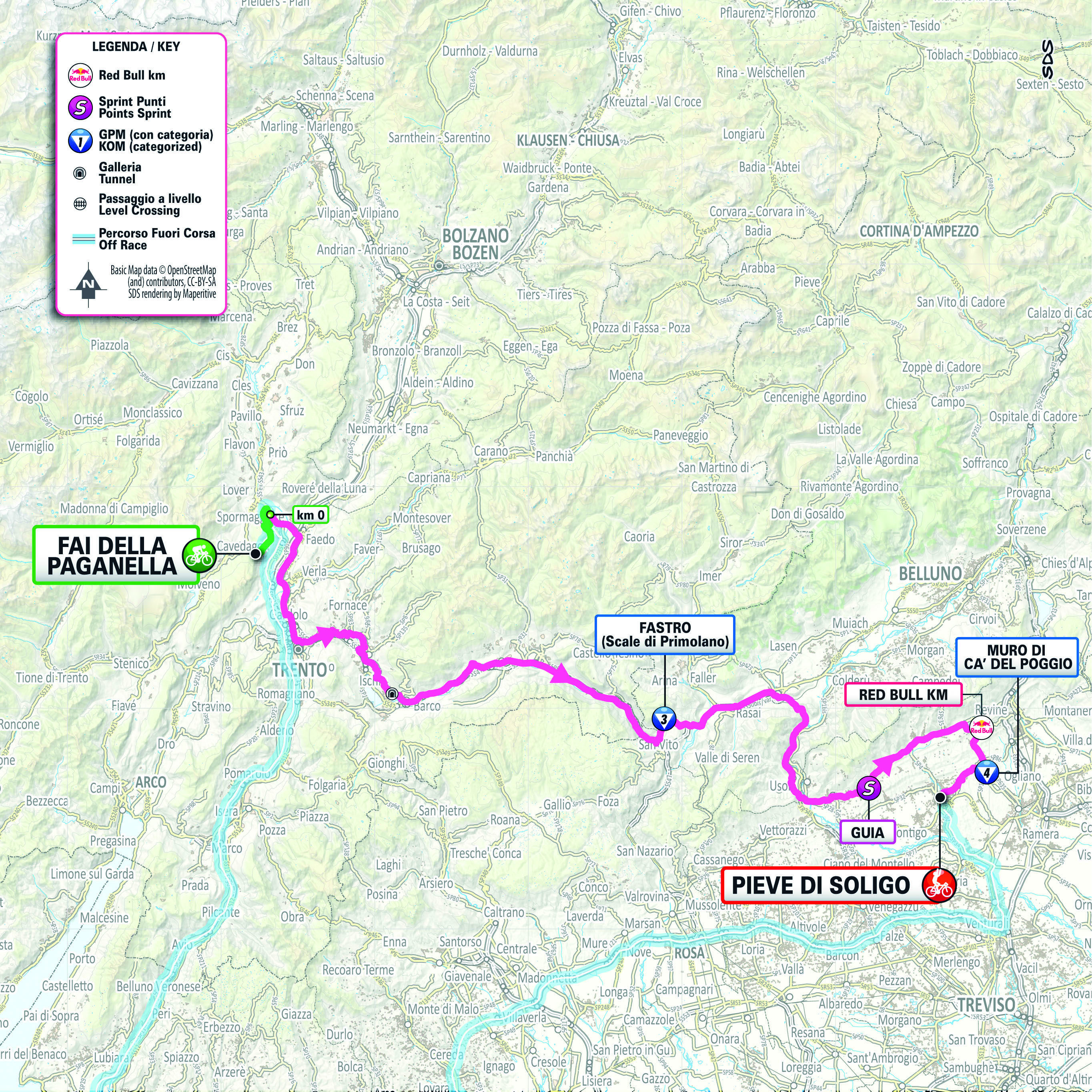
Just like the previous day, stage 18 starts out fl at before riders are forced to ascend the day’s longest climb, over 6.1km at 5%. Unfortunately, it’s not classified, so off ers little reward for the effort spent on the uphill. The day’s first KoM point comes halfway through the stage at Fastro.
This is a stage that looks designed for the sprinters – until the final climb. The only stumbling block for the fastmen on this day of rolling terrain comes towards the stage’s end, at the Muro di Ca’ del Poggio. Rearing up at an average of 12.3% over 1.1km, this brutal ascent comes at just 10km to the finish – and may well prove decisive. Those riders strong enough to crest the Poggio at the head of the group will end the race with a downhill finish into Pieve di Soligo.
STAGE 19: Feltre > Alleghe (Piani di Pezzè)
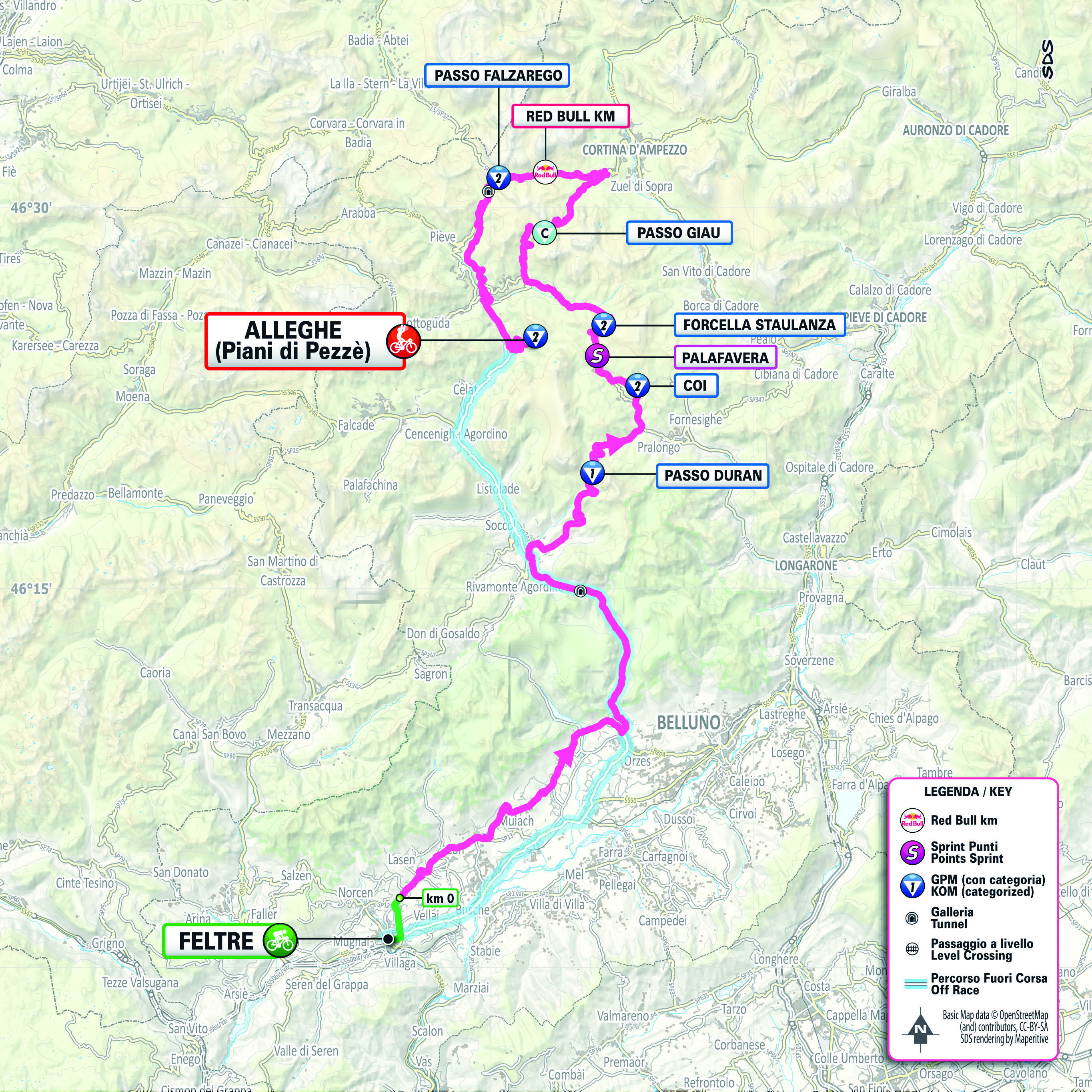
Friday 29 May | 151km | Mountains
After the undulations of yesterday, riders face almost endless elevation on this relentlessly steep stage through the Belluno Dolomites. There are six classified climbs (a category-one and four category-twos) and 5,000m of climbing.
After a flatter first 50km, the first ascent, the category-one Passo Duran sets the scene, rearing 1,000m skywards over 12km, with gradients of up to 14%. The next climb, to Coi, ups the ante even further, to 19%, but is just a category-two. The route tops out on the penultimate pass, Passo Giau, the highest point of this year’s race, Cima Coppi, followed by the category-two Passo Falzarego and a 20km descent towards the finish. The final 5km is uphill, at 10% on average but with 15% stretches and a challenging 11% final 300m, and is another category-two effort.
Besides watching the gravity slowed peloton wend through spellbinding peaks, spectators can enjoy the history-soaked surrounds, with side orders of pastin, polenta, marrone Feltrino (local chestnuts) washed down with glasses of Birra Pedavena.

STAGE 20: Gemona del Friuli > Piancavallo
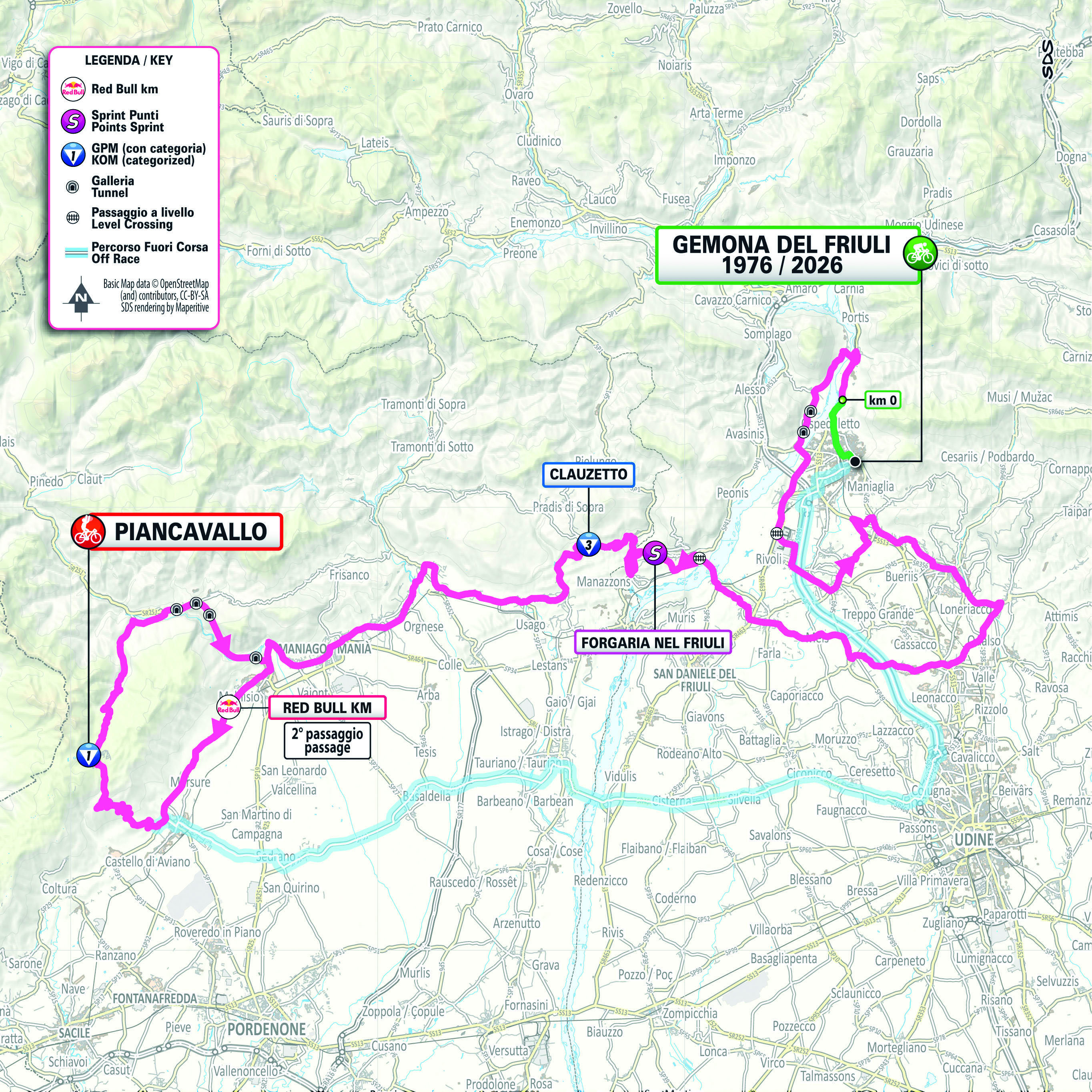
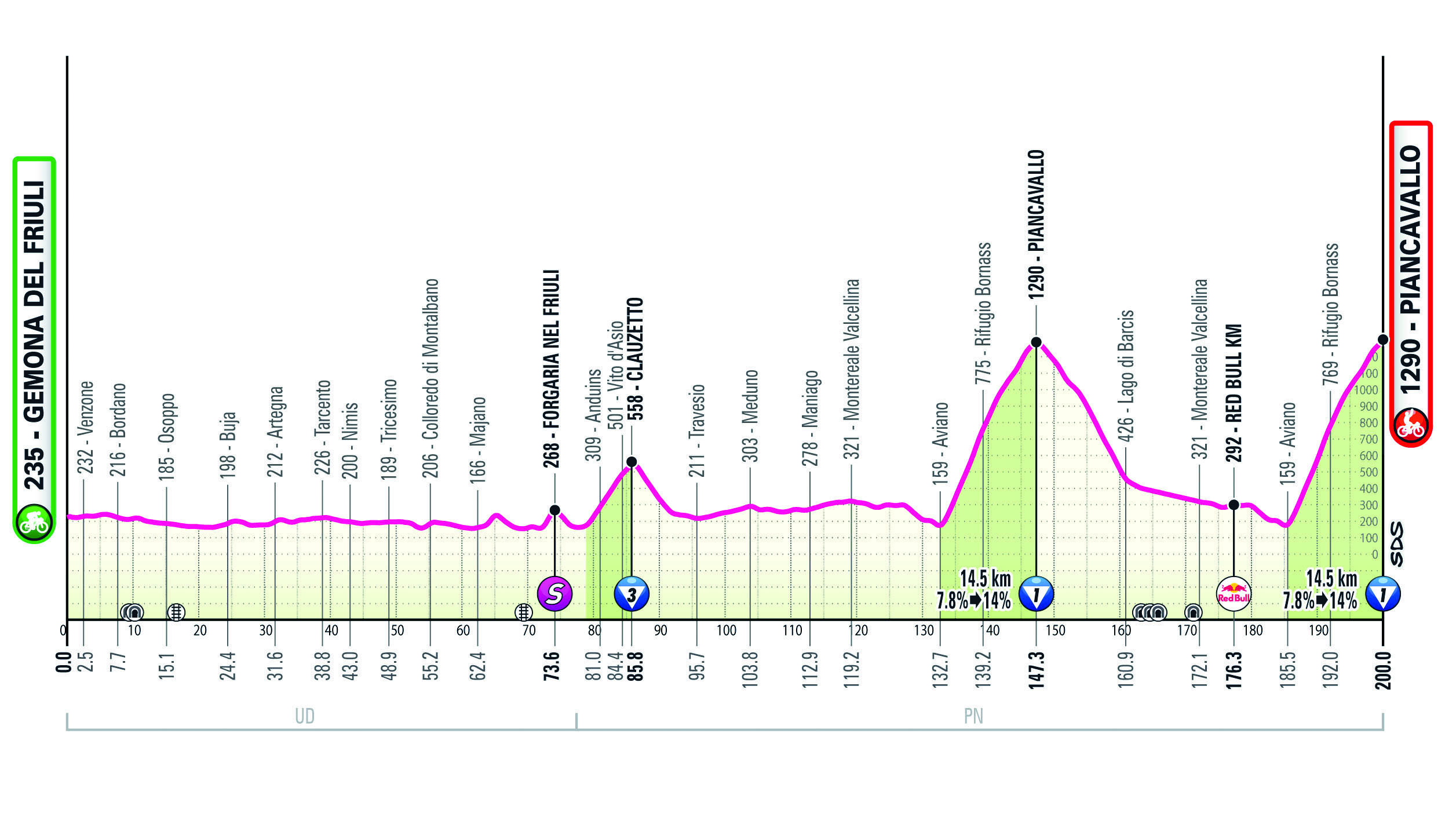
Saturday 30 May | 200km | Mountains
It may not be quite as breathtaking as the previous day, in terms of unrelenting elevation gain, but the last mountain stage of the 2026 race has plenty of ascent. There is 3,750m to climb across the 200km route through the Julian Alps. Most of the climbing comes in the final third of the day, which sees riders embark on a loop that leads them up to the resort of Piancavallo, picturesquely positioned beneath Monte Cavallo, not once, but twice. It promises a wonderful experience for roadside spectators – as they tuck into local latteria turnaria cheese, Pan di Sorc sweetbread and glasses of Friulian grappa – but will be an arduous effort for the riders, coming straight after stage 19’s 5,000m of climbing.
Before all that, though, they will roll out of Gemona del Friuli – a historic and culturally rich medieval town famed for the Cathedral of Santa Maria Assunta, which was devastated by an earthquake 50 years ago – and pedal across the Tagliamento plain, en route to contesting a KoM at Clauzetto, which leads into the Val Cosa. The roads around Gemona are wider than those on the previous mountain stages, and we can expect a fast-paced peloton with plenty of jostling for position as this year’s Corsa Rosa races towards its dramatic denouement.
Anyone attempting a breakaway will need to time it perfectly and keep plenty in the tank. From Aviano, at just under 160m, the last 70km is savage, with the double ascent to 1,290m-high Piancavallo, both category-one, punctuated by a long, fast drop to Lago Barcis, which ends with riders passing through a 4km tunnel. The final climb is brutal: 14.5km back up to the finish line, and with gradients of up to 14%. It’s this ferocious final challenge that makes it such an exciting stage. All that’s left is a race around Rome the following day.
STAGE 21: Rome
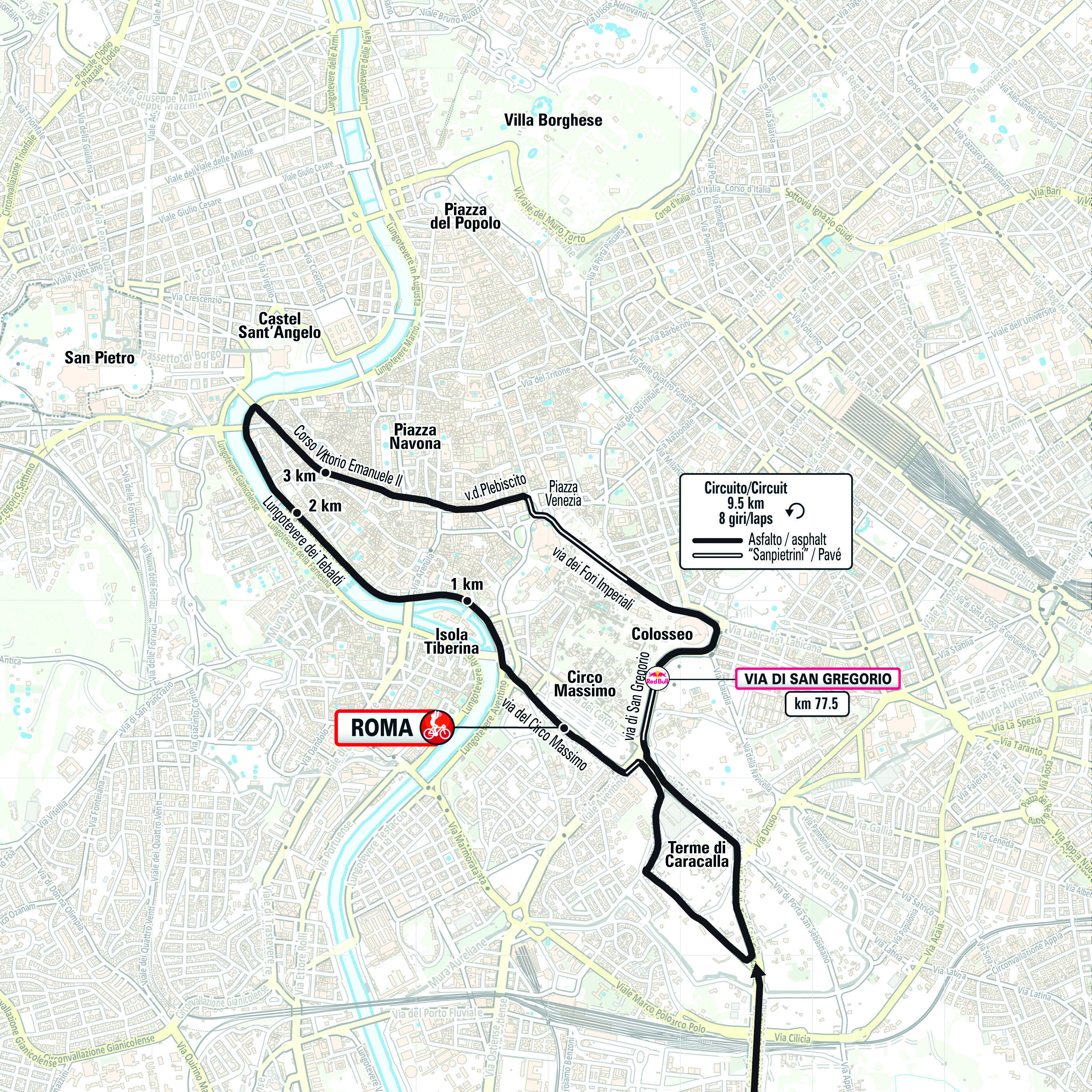
Sunday 31 May | 131km | Flat
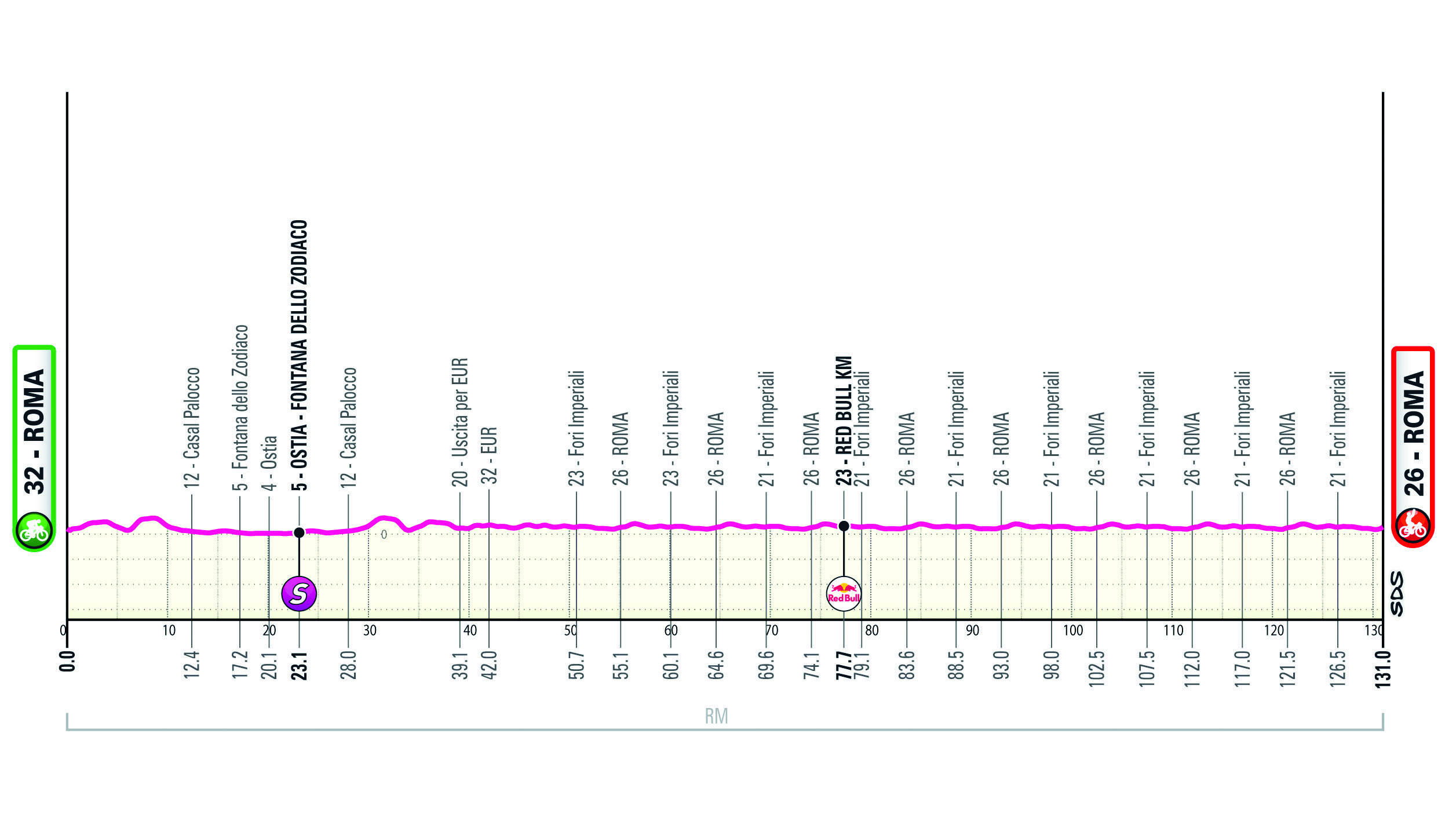
At the Giro, all roads do indeed lead to Rome. And here we are, in the Eternal City, for the climax of the 2026 Corsa Rosa. This final stage is typically split into two parts, the first something of a procession, with the jerseys and GC already decided, and the second a series of circuits with a crowd-pleasing sprint finish.
Riders initially head away from the southern suburbs of the city to the coastal resort of Ostia, briefly looping up and down the coast before retracing their wheeltracks. Returning to the historic city, they race eight times around the final 9.5km circuit, which borders the Vatican City, cycling the wide streets of the ancient metropolis, negotiating everything from technical corners and central reservations to the sanpietrini (short sections of potentially slippery cobbles) before sprinting to the finish along a 350m section of wide asphalt.