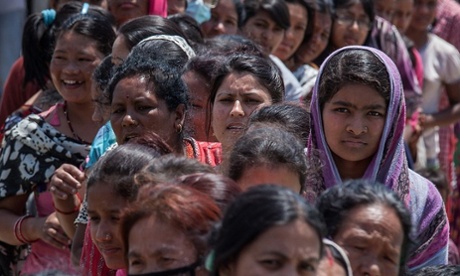
On hearing about the tragic earthquake in Nepal, my first thought was of the girls affected.
While millions of people need help, Plan International is a child rights organisation, so our main concern is the children – especially girls, who are at extreme risk in the wake of natural disasters.
As Plan UK’s gender equality officer, I know that girls are particularly vulnerable because of their lower status in society and even more so in the case of a disaster.
Evidence suggests the discrimination that adolescent girls face in everyday life exacerbates their situation in emergencies.
Even before this enormous disaster, being a girl in Nepal was not easy. Discrimination against women and girls is part of the widely accepted social norms and is maintained within families and communities. Mortality rates among girls are higher than among boys, and girls are less likely to be provided with health care services.
In rural areas in particular, parents don’t see the value in educating girls since this probably won’t increase job opportunities in the future. As a consequence, girls drop out of school early, and 41 per cent of them are married before their 18th birthday. In fact, 10 per cent are married before they turn 15.
Limited economic and educational opportunities, and low cultural status, expose girls and women to forced labour and trafficking. Victims of trafficking are often taken from rural areas within Nepal to the urban centres, as well as to neighbouring countries.
According to Unicef, approximately 50,000 women and girls work in restaurants, dance bars and massage parlours in Kathmandu. About one-third of them are exploited sexually. Between 5,000 and 7,000 Nepali girls are trafficked every year across the border to India, and most of them end up as sex workers in brothels in Mumbai and New Delhi.
It is not difficult to imagine how a disaster such as the earthquake that hit Nepal on Saturday will escalate the already vulnerable conditions of girls. The exploitation and abuse of girls will be easier now that, along with basic services and the destruction of buildings and infrastructure, social protection mechanisms are not functioning, and safe spaces such as homes and schools are not available.
Girls who have lost their families, or are in desperate need of shelter and food, will be even more likely to be discriminated against, sexually abused and trafficked.
In the aftermath of this disaster, providing support and protection to girls will be one of Plan UK’s main objectives. Since the earthquake struck, I have been working with our emergency team to ensure that the design of temporary shelters provides safe environments. Something as seemingly commonplace as ensuring separate male and female lavatories are available and well-lit can go far in avoiding potential assaults.
Our programmes emphasise protection measures, and the safe spaces we create for children, women and girls provide much-needed, gender-specific support. Other measures will include activities on gender-based violence for the affected communities, with specific services offered to victims of sexual abuse. Counselling services will be available for all children, women and girls to support them in dealing with the consequences of the terrible earthquake that has completely destroyed their lives.
Following our report ‘In Double Jeopardy: Adolescent Girls and Disasters’, we’ve been advocating to the humanitarian community to give greater consideration to the conditions of girls in emergencies. One of our core principles is gender equality, and we believe that girls’ rights need to be promoted and protected even more in disaster situations. Girls themselves must be consulted at all stages of disaster preparedness and response.
Supporting girls doesn’t mean neglecting everyone else but making sure that any response adequately acknowledges the differing needs of women, girls, boys and men. This makes every intervention more effective and efficient.
There is no ‘one-size-fits-all’ approach to humanitarian response. The specific needs of each group of the population affected needs to be addressed, and any response methods need to be adequately adapted to fit these needs.
You can find out more about Plan UK’s efforts in Nepal here.
Content on this page is paid for and provided by Girl Effect, a sponsor of the Guardian Global Development Professionals Network.