Food is a powerful point of entry and connection between communities. I grew up in New York, and I’ve always been interested in celebrating cultural differences, especially through food.
When I moved to London to do my Masters in 2010, however, I was struck by the hyperdiversity that sets this city apart. I was living in the East End and as a student, I was often around during the day, and I was mesmerised by the Bangladeshi women I saw everywhere. I’d watch them shopping, and wonder what they were going home to cook – I really wanted to be invited to dinner! I also wanted to see what life was like for them – clearly it wasn’t easy, but I had no way into these communities, and they had no way into ours.
Migrant women so often, due to gender norms and other factors, are cloistered at home, which leads to long-term unemployment and social isolation. I wanted to find a way to create space for these women to be part of London, to give them these women access to the London outside of their communities. I wanted to turn home inside out, giving them the chance to do what they do privately – which is to cook – in the public sphere.
My first idea was to start a restaurant, but without a background in food, that was a bit crazy. So I decided to go down the pop-up route instead. I knew I could get 30 friends in a room to part with £20. I also knew I had the chefs – through volunteering in kitchens all over London I had met all these women who couldn’t get work, but loved cooking. In November 2012, we held our first event at the Hill Station on Telegraph Hill, in Brockley, with a Sri Lankan chef called Tamara, who I had met in a community cafe run by FoodCycle. We then did a second event in Brixton with Roberta, who is Brazilian, and we’ve never stopped since.
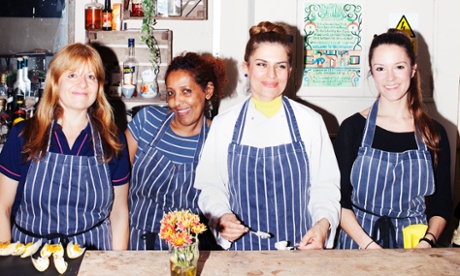
We do a mixture of private and public events, often for arts organizations, such as Tate Modern and the Yard Theatre in Hackney Wick. We have a very careful sourcing policy, with about 85% of our produce coming from local community farms and local small businesses. We have a team of 10 volunteers and at the moment we are working with six chefs; women from Iran, Philippines, Brazil, Ethiopia, Peru and Senegal. We are increasingly focusing on long-term residencies – setting up shop in kitchens that aren’t in use, located in different parts of London, which allows us to recruit locally from very different communities. Ultimately we are looking to open our own training restaurant.
We don’t retrain people – rather, we give a platform to people who are already extraordinarily skilled, formalising those skills in a professional context, and giving them intensive business support. We only recruit women who want to set up their own businesses in food. On a personal level, this is inspired by the story of my Greek godmother, Maria Maroulis, the woman who raised me and taught me how to cook. She migrated from Greece to the US in the 70s and wanted to open her own bakery, but her husband, being a traditional, patriarchal Greek man, wouldn’t let her, saying that wasn’t what women did. So instead of becoming a businesswoman, she became a nanny. Mazí Mas came about as a way to honour her and the many migrant women like her.
They are always the cornerstone of their communities, so this work is a long-term investment, with tremendous benefits down the line. Migrant women are frequently the most concerned about sustainability, food waste etc, because that’s been their experience. So you have these amazing values already built in to whatever businesses these women set up. Food waste, child obesity, social isolation – these are all problems confronting society in general, that we can start to tackle by making quality, home-cooked food accessible and affordable: if you know someone who is cooking good food, you’re going to go there. Mazí Mas means “with us” in Greek and that’s exactly what it’s all about: an invitation to come and eat with us.