Giovanni Battista Moroni, London
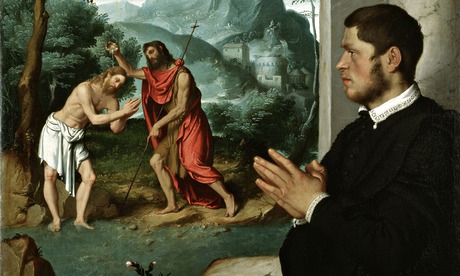
Compared to the average 16th-century Italian portrait painter depicting dukes and princes in static, stagey pomp, Giovanni Battista Moroni’s work is a revelation. His subjects could be people you know of, and if you’d lived in his day, they might well have been. Alongside high society, he painted artisans, intellectuals and state officers. In this survey of 40 masterpieces, they exude personality, with a quizzical raise of an eyebrow, the slightest self-conscious tension or introspective gaze. Often, they seem less like people sitting for their portraits than having been caught unawares. The psychological realism is both stunning and subtle.
Royal Academy, W1, Sat to 25 Jan
SS
Silent Partners, Cambridge
There’s plenty to get creeped out by in this fascinating exhibition laying bare the evolution of the artist’s mannequin, from an essential tool in a painter’s kit to surrealist artwork in its own right. It begins in the Renaissance, when artists pursuing the lifelike first used mannequins as a stand-in for flesh-and-blood models, an irony that runs throughout the show. Nineteenth-century Paris was the epicentre of model-making, with ever more malleable, convincing dummies produced for a surprisingly diverse list of artists, including realist painters such as Courbet. In the 20th century, surrealists such as the photographer Umbo and Salvador Dalí played on their mannequins’ eerie, fetishistic and, at times, downright scary countenance.
Fitzwilliam Museum, to 25 Jan
SS
Chris Dobrowolski, Leeds
Chris Dobrowolski’s art consists of him dreaming up the most quixotic, surreal and disarmingly innocent-spirited adventures – such as racing across an Antarctic wilderness on a sledge constructed out of a large-scale ornamentally moulded gilt picture frame – then acting them out in real life. Sculptural contraptions include a full-size leather upholstered pedal car and a sadly grounded tea-chest aeroplane. There is a touching documentary record of the artist lovingly restoring his family’s 1960s Triumph Herald and driving it all the way to Rome to revisit his father’s old haunts. This theme of artist-as-big-kid also refers to his childhood exposure to Dinky toys, Ladybird books and Meccano becoming formative cultural influences.
& Model, to 13 Dec
RC
(Dis)order: A Compulsion To Collect, Manchester
Four artists bring their collected oddities here. Ian Hamilton Finlay’s print series Blue And Brown Poems suggests a cacophony of abstract utterances; while the ever-inventive Susan Hiller goes in search of the land of the Mexican Tarahumara tribes and documents the landscapes of her pilgrimage in thoroughly spaced-out close-up. On a more nerdish note, Allen Ruppersberg and Torsten Lauschmann go in for outlandish musical creations. Ruppersberg presents a bookcase filled with exactly 1,378 CDs of American music, whereas Lauschmann conjures an electronic orchestra from 40 groaning and whirring vacuum cleaners and sewing machines.
The Holden Gallery, Mon to 12 Dec
RC
William Strang, Edinburgh
Titled Fair Faces, Dark Places, this show of prints and drawings by the late 19th-century Scottish artist harks back to a time when painstaking technical precision could be wielded both to immortalise the living and to give credible life to the farthest reaches of the subconscious. He shifts between graphically meticulous drawings of Thomas Hardy and something altogether darker. Grotesque from 1897 sees the artist turning inwards, offering up gothic compositions featuring monstrous skulls, seductive nudes and amoebic blobs from the beyond.
Scottish National Gallery, to 15 Feb
RC
CRW Nevinson, Birmingham
It’s a historical fact that some artists feed off conflict. Just as Picasso used the dramatic bombing of Spanish innocents in Guernica to fuel his cubist experiments with spatial fragmentation, his British contemporary CRW Nevinson produced his most exciting paintings when inspired by the dynamic devastations of first world war no-man’s land. This exhibition follows Nevinson’s career as the famously mercurial artist shifted from creating official government propaganda through to the anti-war protest of his later, more jaggedly geometric compositions. The artist is as obviously turned on by the illuminating explosion of a star shell as he is repulsed by the pallid makeup of his prostitute in War Profiteer. While one cannot but feel unnerved by his gloating, perhaps feeling uncomfortably ambivalent is the appropriate response to such subject matter.
Barber Institute Of Fine Arts, to 25 Jan
RC
Edward Steichen, Viviane Sassen, London
Fashion photographers Edward Steichen and Viviane Sassen’s work bookends the 20th century. Steichen began as a painter but in the 1920s became the highest-paid photographer of his day through his work for Vanity Fair and Vogue. Sassen’s works for edgy fashion tomes such as Purple and Another Magazine are improvised concoctions of contrasting hues, shapes and lines; it can be hard to spot the clothes. It’s an intriguing vision of fashion photography on the run from itself.
The Photographer’s Gallery, W1, Fri to 18 Jan
SS
Jerwood Open Forest: Semiconductor, nr Farnham
The British artist duo Semiconductor are best-known for tech-geek films that bring hidden aspects of modern life into view with digital wizardry, from invisible soundscapes to geomagnetic storms. Their latest project – part of a new public sculpture initiative from the Jerwood Foundation – sees them transform abstract data into something solid. Throughout this year they’ve witnessed how the carbon dioxide breathed in and out by the trees is tracked. This data has been reimagined in sculptural form and now the fruits of their labour are unveiled. Their orb, which fuses art and science, suggests a micro- and macro-view of the planet: geology up close and the Earth seen from space.
Alice Holt Forest, to 23 Feb
SS