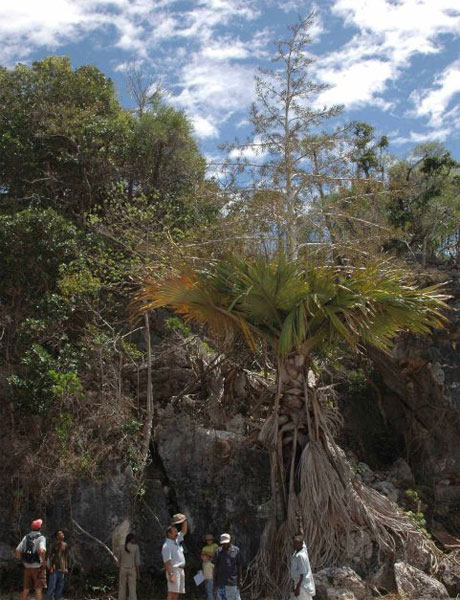
An enormous palm tree that grows to dizzying heights before flowering itself to death has been identified as a new genus by botanists working in Madagascar.
The giant plant, which typically grows to a height of 18m and fans out more than 5m, was discovered by a farmer and his family walking in a remote north western region of the island. The palm is so large it can be seen using Google Earth.
Pictures of the mysterious palm were sent to experts at the Royal Botanic Gardens Kew, who immediately recognised it as a completely new type of palm.
John Drainsfield, a researcher at Kew, asked his student in Madagascar, Mijoro Rakotoarinivo, to send clippings from the palm to London so it could be investigated more thoroughly.
Exciting discovery
"Clearly this was going to be an extremely exciting discovery and I just couldn't wait to examine specimens in detail," said Dr Drainsfield.
Details of the flowers and branches suggested it was a species and genus of palm that had never been described before. Genetic tests on the plant confirmed that it comes from an evolutionary line that was not previously known to exist in Madagascar.
The plant is unusual for its spectacular life cycle. Once it is fully grown, the tip of the stem branches into hundreds of tiny flowers that sap nutrients from the plant so rapidly that it collapses and dies.
Each flower can be pollinated and develop into a fruit that drips with nectar, attracting swarms of insects and birds.
The palm has been named Tahina spectabilis. "Spectabilis" means "blessed" or "to be protected", and Tahina is the daughter of the farmer who discovered the plant.