Construction workers breaking ground on a road-rail terminal in Davinópolis, Maranhão, in northeastern Brazil, did not expect to make history. Nearly 26 feet underground, they hit something that hadn't seen the light of day in 120 million years: the fossilized bones of a dinosaur so large that researchers are still wrapping their heads around it.
Now known as Dasosaurus tocantinensis, the creature is shaping up to be one of the most significant dinosaur discoveries in recent memory, not just for its immense size but also for what it reveals about a world vastly different from the one we live in today.
Meet the giant who crossed continents
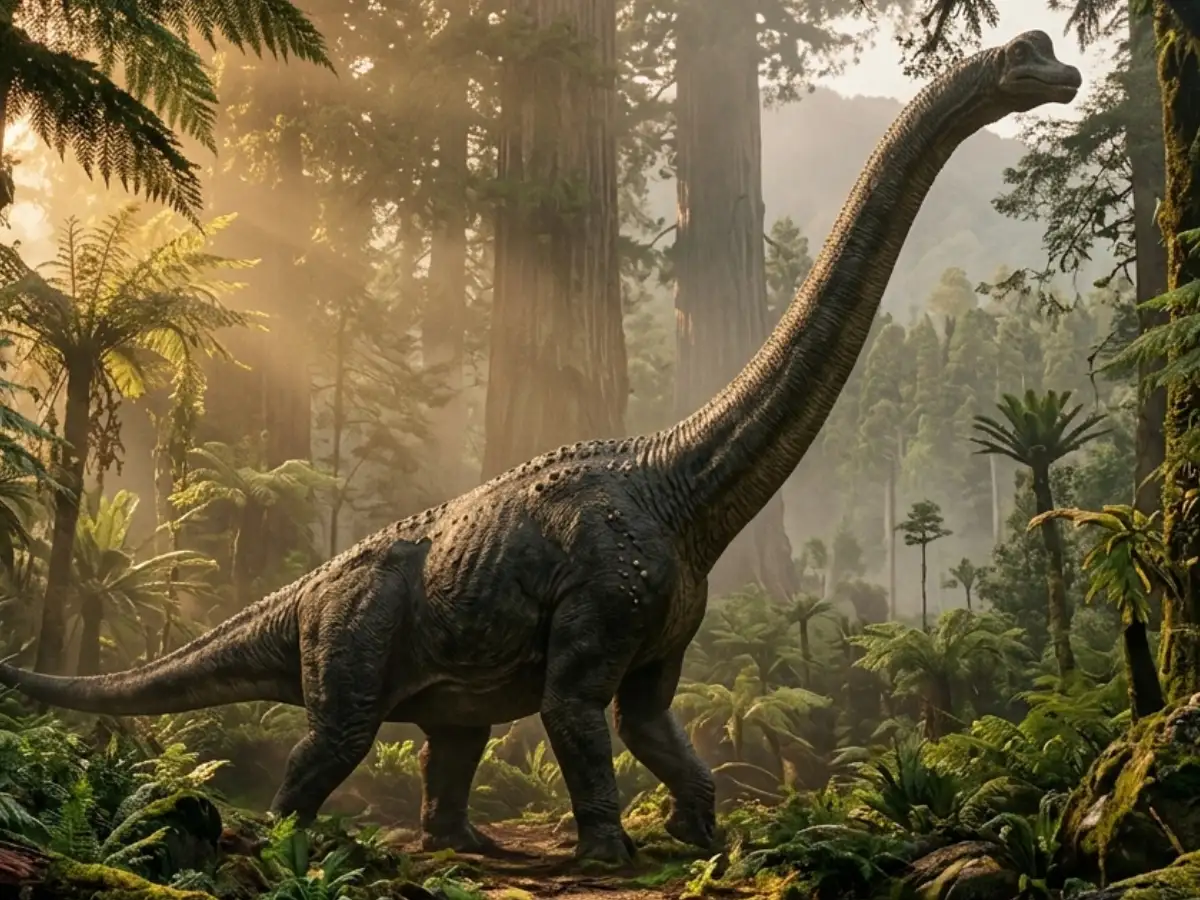
Dasosaurus was a sauropod, the group that brought us the iconic long-necked, plant-eating giants that have captured our imagination since the first Jurassic Park trailer dropped. It measures about 65 feet long (the equivalent of two city buses) and is one of the largest dinosaurs ever discovered in Brazil.
The real surprise isn't the size; it’s where its closest known relative lived. According to a study published in the Journal of Systematic Paleontology, Dasosaurus tocantinensis was about 20 meters long and lived about 120 million years ago. From an evolutionary standpoint, its closest relative was a dinosaur from what is now Spain.
Spain to Brazil. It’s not just a neat coincidence; it’s a prehistoric puzzle with huge implications.
When the world was one
In order to understand how a dinosaur from Brazil relates to a dinosaur from Spain, you need to zoom way out.
Researchers think that the ancestors of Dasosaurus probably migrated to South America via North Africa between 140 and 120 million years ago, when the two territories were still connected as part of the supercontinent Gondwana. Europe at that time was not the continent we know today, but an archipelago of islands. Africa was the stepping stone.
There is more scientific evidence for this story of migration. In a study published in Nature Ecology & Evolution, Gorscak and O’Connor discovered that dinosaur lineages, particularly titanosaurian sauropods, migrated between Europe and Africa during the Cretaceous, supporting the idea that land corridors allowed for repeated cross-continental dispersal long before the Atlantic Ocean had fully opened.
Dasosaurus now fills in an important piece of that puzzle, pushing the story all the way to South America.
What the bones revealed
The fossil was difficult to get to. It was buried deep in dense rock, and researchers had to prepare it carefully before they could study it fully. Much to their surprise, what they found was complete: tail vertebrae, a 1.5-meter femur, ribs, and both arm and leg bones.
Researchers Tito Aureliano and Aline Ghilardi, from the Federal University of Rio Grande do Norte, analyzed the microstructure of the bones and found a growth pattern that is a combination of older sauropods and titanosaurs, suggesting that some traits of bone remodeling evolved earlier than scientists thought.
This is important because it helps to answer one of the most enduring questions in paleontology. How did these animals get so big? Big sauropods had to grow fast: young dinosaurs had to gain weight fast enough to avoid being eaten by predators, and adults had to have skeletons strong enough to hold up bodies that weighed many tonnes without collapsing under their own weight. These bone patterns are early clues as to how that biological engineering really worked.
Discovered by accident, studied with intention
What makes this discovery especially interesting for anyone who appreciates science policy is how it happened. Brazil legally requires environmental and archaeological monitoring during major construction projects, meaning researchers were already on site when the fossils turned up.
Professor Elver Mayer noted that once the depth of the fossil became clear, about eight meters underground, it was evident the material dated to the transition from the Lower to the Upper Cretaceous, around 120 million years ago. From there, specialists across multiple fields were brought in to study the remains, which are now housed at the State Center for Natural History and Archaeology Research in São Luís.
It's a reminder that some of the biggest scientific finds don't happen in labs; they happen when a construction crew hits something unexpected, and the right protocols are in place to take it seriously.
Why it matters now
Dasosaurus is more than just a cool fossil. It is a data point in a long-term effort to understand how life spread across a planet that looked radically different from the one we inhabit, and how the forces of geology, climate, and biology shaped the creatures that walked it.
The Atlantic Ocean is still opening up at a rate of about an inch a year, and finds like this one help us track the deep history of a world that was once much more connected than it is today.