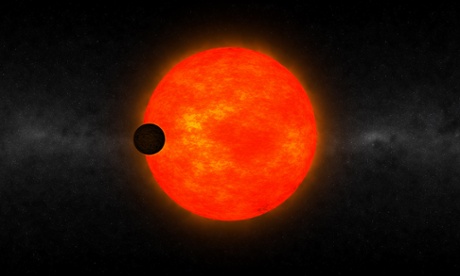
A backyard astronomer in Perth has helped to discover an unusually large exoplanet, the existence of which had puzzled scientists.
Thiam-Guan Tan was enlisted by researchers at the Australian National University (ANU) to help confirm that light measurements indicated the presence of the planet, which orbits a star 500 light years from Earth.
The exoplanet – a planet that orbits a star outside our solar system – rotates very closely around its host star once every three days.
The close proximity of the planet to the star made it impossible to see, but it was detected by the dip in amount of light coming from the star as the planet crossed over.
The ANU’s George Zhou said researchers could not explain the origin of the planet, which was first observed with the university’s telescope at Siding Spring in New South Wales, but suspect it formed much further out from the star and migrated in.
The planet has the mass of Saturn but is similar in size to a much larger planet such as Jupiter.
“It’s intriguing how such a small star could form such a big planet. And because it’s so puffed up we can examine its atmosphere more easily than other planets,” Zhou said.
One of the world’s largest telescopes, the Magellan in Chile, was enlisted to confirm the discovery, but Zhou said Tan’s 30cm diameter telescope, tiny in comparison to those used by professionals, was able to achieve a high precision observation that also played a key role.
With hundreds of thousands of stars to monitor, professional astronomers often called on amateurs to assist, Zhou said.
Tan’s backyard observatory has been credited with the co-discovery of 11 exoplanets, his website says.
The small host star called HATS-6 emits only one twentieth the light of the Earth’s sun. Classed as M-dwarfs, such stars are not well understood as their dimness makes them difficult to study.
More than 1,800 exoplanets have been discovered over the past two decades.