The government aims to raise sales from geographic indication (GI) products to more than 30 billion baht over the next five years, while ramping up linking GI locations to tourism schemes.
GI product sales topped 4 billion baht last year, up from 3.7 billion in 2017.
Thosapone Dansuputra, director-general of the Intellectual Property Department, said the department has been working with all communities to develop unique indigenous products to add value, registering them as GI to boost community revenue.
The department has also been actively promoting existing GI products that have already been registered with and approved by the Commerce Ministry.
GI is a distinctive certificate used to identify a product as originating in the territory of a particular country, region or locality that specific quality, reputation or other characteristics originate from and are unique to. The certification reflects the unique characteristics and quality of products, which in turn boosts market value in developed countries.
Mr Thosapone said Thailand has a bounty of cultural diversity, resources, wisdom and local craftsmanship.
The country has many types of unique products that can be registered as GI goods, including food, fruits and handicrafts.
The department has already approved GI certificates for 103 indigenous products in 67 provinces.
"In a move to increase sales both in the domestic and export markets, the department is persuading communities in every province to submit indigenous products for quality validation, in line with GI guidelines," Mr Thosapone said. "The department is also teaming up with the Tourism Authority of Thailand to develop tourism routes that link GI products with neighbouring countries to generate more income in rural communities."
Mr Thosapone said Thailand has the potential to add hundreds more GI products, given the agricultural and handicraft manufacturing base. Thailand ranks first in Asean in GI items registered and certified locally, while Vietnam is next with 70 GI products.
The department urges governors in each province to set up committees to run GI promotion and control quality to protect GI products.
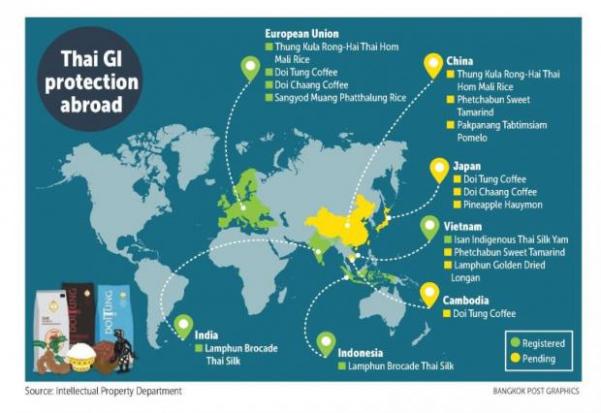
Thailand has GI registration for Thung Kula Rong Hai hom mali rice, Doi Chaang and Doi Tung coffee, and Sangyod Muang Phatthalung Rice in the EU; Lamphun brocade Thai silk in India and Indonesia; and Isan Indigenous Thai Silk Yarn in Vietnam.
Thailand has already filed GI applications for Thung Kula Rong Hai hom mali rice, Phetchabun sweet tamarind and Tubtim Siam Pak Phanang Pomelo in China; Doi Tung and Doi Chaang coffee, and Uttaradit's Hauymon pineapple in Japan; Phetchabun sweet tamarind and Lamphun golden dried longan in Vietnam; and Doi Tung coffee in Cambodia.
There are 16 foreign products registered with GI in Thailand, mostly from Italy, Vietnam and France.
Nine applications are pending for foreign products such as grapes from California, Pisco brandy from Chile, Grana Padano and Asiago cheeses from Italy, and Kobe beef from Japan.
Amnat Tuntrakul, president of the Pineapple Grower Enterprise Group in Muang district in Chiang Rai, a producer of Phulae and Nanglae indigenous pineapples, said the GI certificate has helped raise the prices of the two local products.
Chiang Rai Phulae and Nanglae pineapple were awarded GI certificates from the Commerce Ministry in 2006.
Before the GI registration, Phulae pineapple fetched an average of four baht per kilogramme in 2004. After the registration, prices rose to 10-20 baht per kg, before setting a record of 25 baht per kg during a shortage.
Phulae and Nanglae pineapple are grown mainly in three subdistricts of Muang district: Tha Sud, Nang Lae and Ban Du, which are considered the place of origin for the two fruits.
"The problem with the Phulae pineapple GI is oversupply, as the pineapple is grown outside the three designated subdistricts," Mr Amnat said. "More importantly, their produce is not GI-certified, and that may mislead consumers. Growers in these three subdistricts must realise this problem and cooperate with one another to protect the two unique products, to sustain and strengthen the GI brand in the long term."


.jpg?w=600)