Early one evening Rudyard Kipling found himself in the presence of ghosts. Walking aimlessly beside a railway track just outside Khartoum, he “loafed back in the twi-light escorted by a small boy and an entire brigade of ghosts”. In his Letters of Travel he recounts, quite placidly, that he’d never met a single one of that ghostly crew before, yet knew them “most intimately”. They were not a threat, nor even particularly surprising – rather, they gave the lonely old man consolation as he awaited the night train: “They said it was the evenings that used to depress them the most, too.”
“They” is the title of perhaps the finest ghost story in this fine collection, edited and illustrated by the novelist Audrey Niffenegger and spanning more than 170 years from an 1843 Poe classic to a story published in the New Yorker in 2014. Written by Kipling in 1904, “They” is remarkable for its depth of feeling, and its benevolent ghosts drawn out of the ether by yearning and grief. Kipling’s daughter Josephine had died when hardly more than an infant, her illness brought on by a difficult passage across the Atlantic to join her father. The loss changed him profoundly, and in this story – narrated, as ghost stories so often are, by a version of the author himself – his loving grief finds perfect expression.
A driver encounters a country house of eerie splendour, its yew trees carved into horsemen levelling their lances at the trespasser. The place is overrun with children, who laugh in the lanes, and wave at him from beneath avenues of lindens: they appear so charming, and so willing to love and be loved, that both driver and reader long for their company. Perhaps three or four pages in the diligent reader will understand what the driver does not, but nonetheless Kipling pulls off the great feat of the ghost story, which is to haunt the reader no less than its characters. It is almost impossible to reach the final paragraph without weeping: one feels haunted not only by Kipling’s ghosts, but by his grief.
This is not to say that the book is designed to pitch the reader into gloom. Niffenegger has taken pains to bring together stories showing the full range of the ghost story: we may well weep with Kipling, but 20 minutes previously we will have been roaring at PG Wodehouse’s “Honeysuckle Cottage”, which is as funny than any madcap scheme of Bertie Wooster’s. MR James – a master of the form – delivers a nasty chill in that prissy little voice of his, and Oliver Onions casts writer’s block as part ghost story, part psycho-sexual breakdown. Edith Wharton’s contribution is a pleasing surprise: “The Pomegranate Seed” seems at first barely a ghost story at all, in that this long and meditative tale contains perhaps one recognisably ghostly motif every four or five pages. But it rewards the reader, slowly revealing itself to be a near-perfect example of the kind of story which sits inscrutably between the supernatural and the real.
The great difficulty with bringing together short stories by a range of authors is that competence rubs up against genius, and does itself no favours. Neil Gaiman’s “Click-Clack the Rattlebag” is effective, but its effectiveness seems to be the whole point of the enterprise: there is very little to the tale beside the gleeful shock one feels when thoroughly wrongfooted. One then immediately encounters Kipling’s “They” and Gaiman is all but forgotten. Niffenegger’s own contribution is atmospheric enough, and a warm riposte to that misogynist trope of the mad old cat lady, but if you’re looking to be frightened by felines Edgar Allan Poe’s “The Black Cat” will do a better job.
Inevitably, one feels there are absences: how could one countenance a collection of ghost stories which is not also haunted by Susan Hill, and by Robert Aickman? But there can be only so many pages, and there is enormous pleasure in encountering the less familiar voice. Kelly Link’s story “The Specialist’s Hat” is notable for nodding to a number of venerable ghost story motifs (orphaned twins, an old house with buried secrets and so forth) while maintaining a wry, brisk tone which contrives to make the creepy creepier.
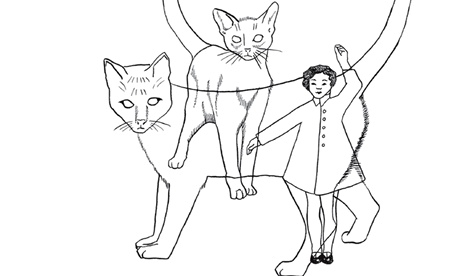
Ghostly is very much an artefact: it pleads the case for the book as object, not digital ephemera. Each story is preceded by a brief explanatory note, which serves to give useful context and should be considered intrinsic to the collection; and though Niffenegger’s successful career in fiction is no great loss to the visual arts, her illustrations are sympathetic, skilful, and in places decidedly unsettling.
This is a collection of a very particular type of ghost story: the western tale, rather cosy in its way, designed to be read by the fireside, offering brief terrors which rarely disturb the reader’s sleep. The tradition of the ghost story is an ancient one, and has not always been conducive to a shudder as the coal spits and someone hands round the port. Pliny the Younger recounts a visit to a “pestilential house” in which a ghost rattles its chains; ghosts in the 11th century Tale of Genji are agonised ravenous souls. Then there are Shakespeare’s ghosts – embodiments of guilt and madness, fit to ruin any Christmas feast.
The ghost story as we think of it now began, it has been argued, in 1815, when a Javanese volcano erupted so violently it triggered a climate change and left Mary Shelley and her companions shivering by the hearth, telling tales to pass the time. And I suspect the cosy terror of the modern ghost story – which this handsome volume so wonderfully exemplifies – could exist only in an age of reason: we’re at liberty to be deliciously chilled, since we do not expect to encounter spectres in the graveyard, still less to become spectral ourselves. Our fear is bearable – even pleasing – because it is generally unbelieving. As the Marquise du Deffand once said: “Do I believe in ghosts? No, but I am afraid of them.”
• Sarah Perry’s After Me Comes the Flood is published by Serpent’s Tail. To order Ghostly for £11.99 (RRP £14.99) go to bookshop.theguardian.com or call 0330 333 6846. Free UK p&p over £10, online orders only. Phone orders min p&p of £1.99.