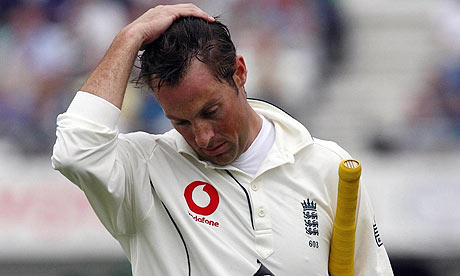
I am glad I didn't try to predict the winner for the William Hill Sports Book of the Year in the last column as I would have left myself, like the Prince Regent in Blackadder the Third, looking "as thick as a whale omelette". Not that the victor, Coming Back to Me by Marcus Trescothick and Peter Hayter, is an unworthy recipient of the award - it is bleakly compelling in its chronicle of the toll a depressive illness takes - but it is exactly the type of book that has never done well in the prize's history.
Ghostwritten memoirs are the pariahs of sports literature and are often judged by critics who have to stifle the urge to squeeze the words "pap" or "vapid" into their reviews. It is as if there is something quintessentially bogus about a book not written by the purported author, that the whole genre is inauthentic - the equivalent of Milli Vanilli cavorting and lip-synching to uglier men's voices.
Having done the job a couple of times, I have a vested interest here and subscribe to the publisher's argument that these books are not fakes. Someone who has a story should not be deprived of telling it by a lack of time, experience or ability to structure it in the traditional format of 90,000 words. The public seem to agree - at the top of the list of the UK's bestselling sports books are such collaborations as Dickie Bird's My Autobiography, written with Keith Lodge, Sir Alex Ferguson and Hugh McIlvanney's Managing My Life and Roy Keane's The Autobiography with Eamon Dunphy.
There have been so many produced with the titles My Autobiography or My Story over the past 10 years that I have started to suspect that it's gone beyond a claim for definitiveness and has become the crudest Amazon search engine optimisation strategy. Pretty soon all autobiographies will just be called "The Book."
There are many examples of formulaic and slap-dash autobiographies out there and I am sure many of us have received them at Christmas with a look of terror in our eyes as they are handed over with that disheartening pleasantry: "You like sport, don't you?" There is a sure-fire way of discovering whether one of these gifts is going to be a waste of time. Turn to the back and if there's a chapter called "The Best XI," with the author's 10 favourite players plus himself because, "hey, I pick the team," it's not going to be particularly rewarding. If there are two chapters, "The Best XI I Played With" and "The Best XI I Played Against," chuck it straight in the bin.
But on the whole the quality has improved significantly as writers of the calibre of McIlvanney, James Lawton and Hunter Davies have brought their talents to bookselling's holy grail; the "3 for 2" table. The volume currently hogging the headlines, William Gallas's La Parole est à la Défense, is written by the French news anchor Christine Kelly, a sure sign of the move upmarket. I wonder if that trend will stop before Emily Maitlis becomes Ledley King's amanuensis and gives the plight of the injury-stricken Tottenham Hotspur captain some gravitas.
There are many pitfalls to the task, the most notable being the temptation to let the subject slip into the anecdotage they have honed on the after-dinner circuit. Then it's all about capturing their voice and after a few weeks spent constantly listening to the tapes of the interviews, it becomes second nature. If you overdo it, however, they can overwhelm your own personality.
As well as getting into their heads they get into yours, and for a short time I carried the extreme self-confidence of Frank McLintock and Norman Whiteside around with me and adopted a sort of jaunty assertiveness that would see me hand back dodgy pints with a flintiness in my eye instead of the usual meek acquiescence. That was a short-lived bonus but the downside was unconsciously affecting the Gorbals tenor of Frank or the Shankill brogue of Norman in conversation until people started giving me funny looks.
But I concede that the ghosted autobiography has swamped the market and the bookshelves have become far more conservative places than a decade ago. It led to the ludicrous situation when five of England's squad rushed into print at the end of the 2006 World Cup and only Steven Gerrard's book flourished. Instead of setting their sights so high, I have often thought that a broader list of subjects with a natural if modest constituency, Brentford's Jamie Bates, say, or Stockport's "player of the century", Kevin Francis, would cost about a 20th of Ashley Cole's advance and easily outsell him.
At least Trescothick's triumph means they would no longer be automatically condemned as second-class books.