Will the three-way tie-up between Nissan Motor Co., Renault SA and Mitsubishi Motors Corp. survive the arrest of Carlos Ghosn, who spearheaded the alliance?
Ghosn was dismissed from the post of chairman of Nissan at an extraordinary board of directors meeting Thursday.
Ever since Nissan and Renault formed a capital tie-up in 1999, Ghosn had been instrumental in deepening the relationship between the two automakers. The addition of Mitsubishi Motors created a three-way alliance that now ranks among the world's top sellers of vehicles globally.
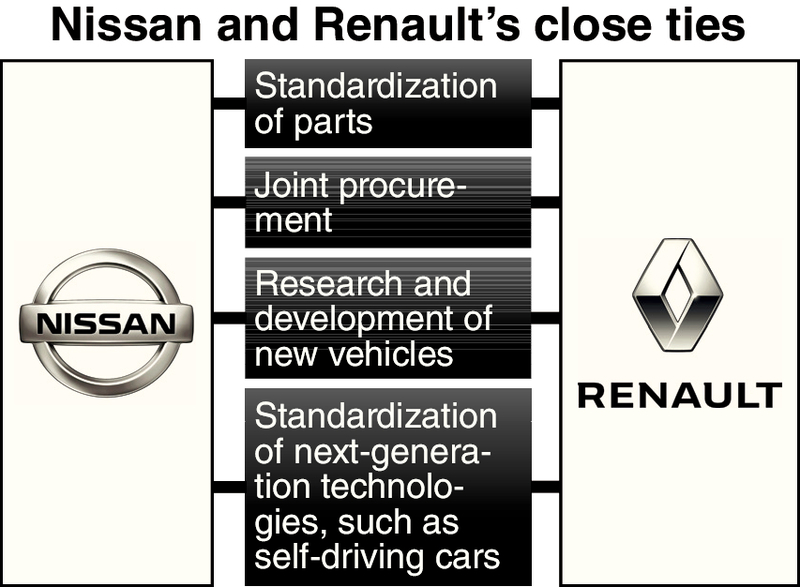
While the automakers have crafted closer ties such as by boosting parts standardization, the strategy of maintaining a three-way partnership will now be in question following Ghosn's arrest due to revelations he instructed his remuneration to be understated in Nissan's annual securities reports for years.
At a press conference held after the release of the midterm business plan in 2017, Ghosn spoke bullishly about the alliance's future prospects.
"This plan will boost the growth and profitability of our member companies," Ghosn said. "We will prove that we will grow."
Ghosn explained that under the plan the three companies would further strengthen their cooperation. Over six years, they would use common platforms for at least 9 million vehicles. He also spoke about joint development of next-generation technologies, such as electric and self-driving vehicles. This plan, Ghosn said, was expected to "double our annual synergies to 10 billion euros" (about 1.28 trillion yen).
It is difficult for automakers, whose specifications for even a single screw differ, to produce good results together, let alone continue a lengthy tie-up.
In one recent case, Suzuki Motor Corp. and German automaker Volkswagen AG formed a capital tie-up in 2010, but they ended their partnership just five years later due to reasons including differences in corporate culture.
Under Ghosn's strong leadership, the three-way alliance has pushed ahead with integration in production, research and development and other fields.
The results have been evident in their vehicle sales. In 2002, Nissan and Renault sold a combined 5.13 million vehicles around the world. In 2017, with Mitsubishi Motors also part of the team, this figure had jumped to 10.6 million units.
Ghosn basked in unswerving admiration of his management skills, which had lifted the three-way alliance to second in terms of global sales behind VW.
Nissan's dilemma
Nissan also is underpinning Renault's business performance. In Renault's consolidated accounts for the period ending in December 2017, about 50 percent of its final profit came from investment gains on equity method from Nissan, in which it holds a 43.4 percent stake. If Renault's ties with Nissan were to weaken, the French automaker's management could suffer a heavy blow.
The French government, which is a major stakeholder in Renault, is concerned that if the tie-up with Nissan is reconsidered, Renault's corporate value could fall because it is supported by the Japanese company.
For that matter, Renault remains an important partner for Nissan, so it will not easily sever ties.
In the auto industry, economies of scale are becoming increasingly important. For example, when an automaker buys steel products in large quantities, it can demand the steelmaker offer a discounted price.
As things stand, Nissan has superior technologies and brand power to Renault. But if the automakers were to split, Nissan would become unable to benefit as much from economies of scale.
Nissan now faces a dilemma: If it attempts to dilute its relationship with Renault, it could find itself alone while locked in fierce competition with major automakers including VW, Toyota Motor Corp. and General Motors Co.
Read more from The Japan News at https://japannews.yomiuri.co.jp/