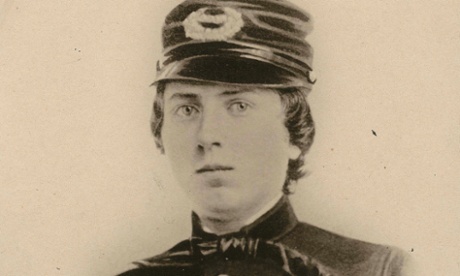
Holding his abdomen together with one arm while Confederate soldiers charged Union lines at Gettysburg, 22-year-old lieutenant Alonzo Cushing commanded his last surviving men to keep firing the cannon he had left at the thousands of enemy soldiers around him. On 6 November, and more than 150 years later, Cushing will receive the Medal of Honor for helping defeat the Confederate army in one of the bloodiest battles of the civil war.
Cushing, who refused a command to fall back by saying “I stay right here and fight it out or die in the attempt,” took wounds to the shoulder and stomach before finally dying from a shot to the head. A cannon volley had killed most of his unit, which then was swarmed by thousands of infantrymen in an assault known as Pickett’s Charge, which the Confederate general Robert E Lee had ordered in a final effort to win the battle and open the north to invasion.
Although hailed by his contemporaries and promoted posthumously, attempts to bring Cushing the military’s highest award struggled for decades; as the terms for the award were originally written, recipients must be honoured within a few years of their service. After the rules changed, Cushing’s name idled in the Capitol while professional and amateur historians – including a 94-year-old Wisconsin woman who campaigned for decades – kept petitioning.
In August, the White House announced that Cushing would be honoured along with Vietnam veterans, army command sergeant Major Bennie G Adkins and army specialist four Donald P Sloat, but before the ceremony Cushing’s name was abruptly dropped from the programme. Apparently unable to find a blood relative or arrange how to deliver the award, the administration postponed it indefinitely.
Finally, last weekend at a history lecture in Fredonia, New York, the town where Cushing grew up, a dentist named Brian Cushing identified himself as the eighth cousin, three times removed, of Alonzo. The Buffalo News reported:
The recently retired dentist said his father told him about the family history and he knew there was some evidence.
“But I didn’t really think much about it until recently, when I read in the Buffalo News about how they were searching for a family member” to present the medal to, he said.
“I plan to call the Pentagon this week and explain the family history and provide whatever documentation that I can,” he said.
The Buffalo News reported in September on the difficulty in tracing Cushing’s relatives – or even his home town, as two had claim to him:
At the moment, the [medal] presentation depends on a search for relatives by historians on behalf of two communities – Fredonia and Delafield, Wis. Both claim Cushing as their native son.
According to the White House, the army has also located two other Cushing cousins, Frederic Stevens Sater and Frederic Cushing Stevens III, who will also be at the ceremony.
Cushing, who died without children and whose brothers also served in the Union military (one, “the Custer of Arizona”, died fighting Native Americans in 1871) will be the 64th soldier to receive the medal for action at Gettysburg.
President Obama has awarded the medal to 24 veterans of Vietnam, Korea and the second world war, as well as six to veterans of Iraq and Afghanistan. Critics say bureaucracy, partisan politics and lethargy at the Pentagon contribute to the slow process of awarding medals to veterans.