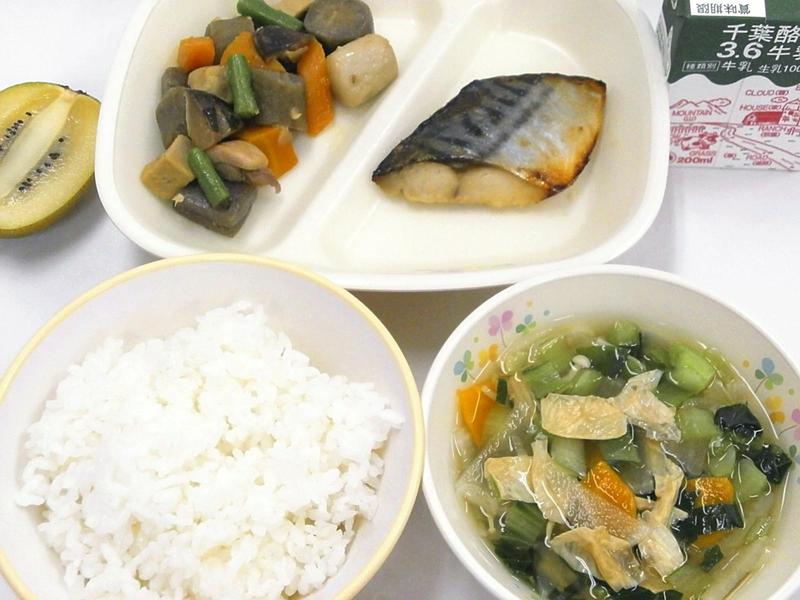
Fish is a major feature of washoku. However, it seems to be avoided both in home cooking and in school lunches, partly due to the time and effort needed to cook fish.
A mother with two daughters at an elementary school in Higashi-Osaka, Osaka Prefecture, said: "Fish is only served about three times a month at school. I heard that many children leave it uneaten."
The city uses criteria indicated in the past by the Education, Culture, Sports, Science and Technology Ministry to determine the type and amount of food for the standard amount of nutrients required for school lunches.
According to the criteria, third and fourth graders of elementary school need 16 grams of seafood per meal. The city's average intake in the 2017 school year was 9.67 grams. In contrast, these students consumed 31.32 grams of meat, more than twice the 15 grams as per the criteria.
Many local governments still use the criteria today. Although there are no national statistics, consumption of seafood at Tokyo schools in May 2018 averaged 14.9 grams.
"Many nutritionists and nutrition teachers think that fish are difficult to deal with," said Osamu Baba, a professor at Tokyo University of Marine Science and Technology.
The professor pointed out that the reason is students are at risk of swallowing fish bones, time and care is needed to cook fish, and the amount of fish delivered and prices are more affected by changes in catches than meat.
"Reduced access to fish both at home and school could lead to a decline in our food culture," Baba said.
The difficulty of preparing school lunches with fish also depends on whether they are cooked at each school or at a central kitchen that prepares meals for multiple schools at the same time.
"In urban areas with many children, especially when school lunches are cooked at a central kitchen, large amounts of food have to be prepared and delivered in a short time," said Hiroichi Kozakai, a representative of Maruko Suisan, a company that supplies marine products for school lunches in Tokyo. "It's difficult to serve typical fish dishes [in washoku] such as grilled or simmered ones."
Some local governments, meanwhile, are taking advantage of their proximity to the sea to serve fish. Kindergartens through junior high schools in Minami-Boso, Chiba Prefecture, serve fish as main dishes two or three times a week.
Since the schools in the city started serving rice five days a week in 2011, their menus have become washoku-based, and the number of fish dishes has increased.
"At first, students complained that it was difficult to eat fish and it didn't taste good, and there were a notable amount of leftovers," said Mari Ito, a nutrition teacher at Chikura Junior High School. "We explored the reasons why students don't eat fish, instead of not serving it just because they didn't eat it."
The school then bought fresh fish and took a creative approach in seasoning, such as adding curry flavor. Teachers also taught students about the nutrients in fish.
The amounts of leftovers gradually decreased.
"Some students said they wanted to eat more fish and asked their parents to cook the same dishes at home," Ito said.
Seaweed is also an important ingredient in Japanese cuisine. Riken Vitamin Co. provides dietary education classes using wakame in various areas of Japan.
The food manufacturer visited Daini Kasai Elementary School in Edogawa Ward, Tokyo, in mid-June. Its class for fifth graders featured a 2-meter-long unprocessed piece of wakame, and children touched the seaweed or watched it change color when soaked in hot water.
That day, the school's lunch also contained wakame dishes, such as a salad using its stems and tempura that contained mekabu roots. After gaining a better understanding of the seaweed, the children seemed to enjoy the meal.
"Sushi restaurants using conveyor belts are popular among families, and many children come to like fish because of school lunches or food education events," Baba said. "Marine products are one of the few food resources that Japan can self-supply. Society as a whole must continue efforts not to lose this important element of our food culture."
Read more from The Japan News at https://japannews.yomiuri.co.jp/