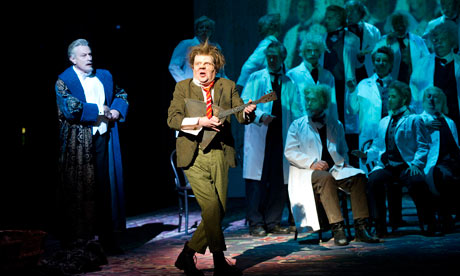
There's already a healthy debate going on in response to Alex Ross's article. Some of the comments agree with him that music has a particular problem, or suggest that John Cage et al really are the equivalent of the emperor's new clothes; others – rightly, in my view – exhort the naysayers to "open your mind, experience the new, and you may find that you enjoy music a good deal more". But where are the thousands of Promsgoers who cheered Berg's Three Pieces for Orchestra to the rafters when Simon Rattle played it in September? Or the other thousands who have already been to Raskatov's A Dog's Heart at ENO in the last week? Or the yet other thousands who rapturously enjoyed Berio's Sinfonia a few weeks ago with the London Symphony Orchestra at the Barbican, or who saw Matthew Herbert with the London Sinfonietta, and the Guardian, last Saturday?
Thing is, I think in this country we've developed a greater love for some parts of the 20th and 21st century, in particular the repertoires of a harder-edged European modernism, than has happened over the pond: if Berg's century-old masterpiece can still empty a few rows at Lincoln Centre, that doesn't happen at the Royal Albert Hall. That's in part because our orchestras have a longer history of changing the repertoire and bringing whole communities of listeners with them. What Esa-Pekka Salonen was doing in Los Angeles in the 90s, Simon Rattle had long been doing in Birmingham and the rest of Britain throughout the 80s, connecting the repertoires of what Ross describes as a "gilded cage" with the contemporary, and crucially, showing audiences that there was nothing to be scared of in 20th-century music.
In the orchestral scene in London today, with Salonen at the Philharmonia, Vladimir Jurowski at the London Philharmonic, some adventurous programmes at the LSO, and the BBC Symphony Orchestra's continual advocacy of today's music, that model of programming is now a commonplace. The surprise would be if new and new-ish music weren't part of these orchestras' programmes. Ross is definitely right that we need to let the classical masters out of the cult of "consoling beauty" that we have created for them, by connecting them with the present. But my hunch is that it's slowly happening – even if the process needs to speed up. He suggests that it's taken a century to get used to Berg's Three Pieces. At that rate, mainstream orchestras will only just be getting Stockhausen and Xenakis by about 2050. We shouldn't have to wait that long.