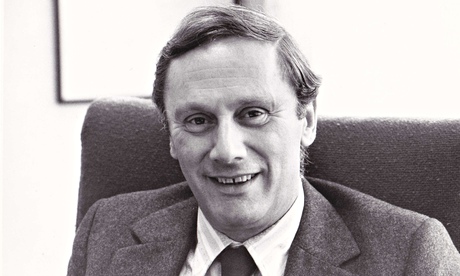
Two key newspaper managers saved the Guardian from oblivion in the late 1960s and 70s. One was Peter Gibbings, hired from the Observer after a bid to merge the Guardian and the Times had been defeated; the other was the advertising director Gibbings himself hired to help save the day – Gerry Taylor, who has died aged 90. Gibbings and Taylor were a formidable rescue act. And since most of the paper’s problems, once it had left its Manchester headquarters and moved to become a full national paper, stemmed from a lack of advertising, Gerry was no junior partner.
He was not a professional newspaper executive. On the contrary, a revolutionary move, he was an ad man – a renowned mad man from the helter-skelter competitive world of the 60s, media director of the mighty Ogilvy and Mather agency: and well used to daunting challenges.
Gerry was born in London, the youngest of four children. His mother, Julia (nee Lesser), was Polish; his father, Alec, who died when Gerry was eight, came from Riga in Latvia. The Hampstead Gerry and his two brothers and sister grew up in was a spare, strenuous place. He had five years at Harrow Weald grammar school from 1936 to 1941, then served in the RAF until 1949. For a few years, after demob, he trained in insurance, but along came a 1953 chance with Ogilvy and Mather, where he stayed, and rose, for 14 years.
His signing for the Guardian helped bring the struggling paper a prize beyond price. The Guardian that had cast aside its Manchester roots and moved to begin London printing in 1961 had a great international reputation – one that Laurence Scott, its chairman, thought could be sustained only by building a truly national advertising base. But the paper that arrived for nightly production in Gray’s Inn Road looked somehow austere, worthy and liberal to the hardened advertising agencies of the metropolis. It seemed to wear walking boots and anoraks. It had nothing to do with the burgeoning, intoxicatingly profitable world of the Beatles and Carnaby Street.
Gerry changed all that; first as a charismatic symbol of change himself, then as its dynamo. Even for a man of his optimism and energy, though, it was a daunting job. The Guardian, used to the more sedate rhythm of regional publication, was geared and manned to receive requests for advertising, not to go out and fight to get it. There had to be a proper, talented London ad staff. There had to be a strategy. Gerry made two initial choices, tapping two streams of revenue hitherto left underdeveloped. One was what would today be called native advertising – “special reports” on nations and industries around the world; the other, crucially, was classified job advertising. The Guardian, Gerry discovered, had huge readership strengths. It was read intensively in schools, universities and in the public services. How could those strengths be turned into survival?
His first answer was the linking of job advertising and special editorial coverage of Education Guardian in 1972. Nothing, however, brought instant success. It was a long, slow grind. The paper had changed fundamentally on Gibbings’s urgings in 1968. It was better organised, more balanced, more comprehensive in coverage. But it was still barely hanging on to London life, still teetering on the edge between success and failure as its losses exceeded the Manchester Evening News’s ability to make balancing profits. The question of ignominious retreat to Manchester was live and anxious.
When I succeeded Alastair Hetherington as editor in 1975, Laurence Scott was gone, Gibbings had moved to become group chairman and Gerry was Guardian managing director. Guardian finances were still so parlous that Hetherington had had to announce the closure of live composition in the Manchester office, with the loss of scores of jobs. I was the new boy standing on the burning deck of union agreement and Gerry was more than a conventional MD. He was a rock. I had to run down Manchester production till a cut-off date, settle the future of dozens of journalists north and south and prepare to move the London editorial offices from Gray’s Inn Road to Farringdon Road as our lease ran out, maintaining publication over a single weekend.
And when all this was done, we had somehow to secure recovery after a 1976 where, time and again, board meetings fretted over how were going to pay the next month’s wage bill. To which the answer was simple enough: by selling more copies and much more advertising.
It should be said that, as managing director, Gerry was always his own ad director, too. Delegation: vestigial. He had a door knocked through from his office into the advertising director’s area, so that he could bound through unheralded and unbidden. Ad directors came and went on a regular basis. (“In a year he’ll thank me,” Gerry would say consolingly, as yet another victim departed.) But the growth in classified advertising – through Education Guardian, to Society Tomorrow and Media Guardian - was phenomenal. So, initially helped by the Times’s long strike, was a circulation briefly topping 520,000 – leaving a returned Times far behind.
Gerry believed utterly in the power of advertising – which meant marketing the Guardian. We seemed to switch agencies almost as often as we switched ad directors. But the campaigns that emerged – in particular the long series of personality testimonials that Jeremy Bullmore provided from J Walter Thompson – revolutionised the way the paper was seen. We were not some dishevelled friend from the north any longer. We were fully national, a paper reborn and throwing down deep London roots.
Gerry was 60 now. He could move on in triumph, job done – and he did, to help another struggling media cause via the Radio Marketing Bureau before retiring quietly to an Oxfordshire village with his wife, Audrey. Even then, he could seldom relax. He worked for Citizens Advice. He was always busy and funny and indestructible – a friend to journalists and good journalism, a diminutive, funny, fast, furious life force. And, after all the false starts and slammed doors, he also left the paper with a fine advertising director and then managing director: Caroline Marland, a supreme telephone sales operator he spotted and promoted, who built a department filled with talented women.
Everyone has their special memory of him. Mine, in 1976, came when he stayed at my home after another wearying union negotiation. I’d told my six-year-old daughters that “the boss” was upstairs in the guest bedroom. But down he came for breakfast dressed in nothing but a sheet cum toga, playing Roman emperor. My daughters laughed and scratched their heads. What kind of boss was this? Well, one of the mad men to remember and cherish.
Audrey, whom he married in 1951, died in 2008. Gerry is survived by a daughter, Jane, and two grandsons, Christopher and Luke.
• Gerald Peter Taylor, newspaper executive, born 13 March 1925; died 8 April 2015