To recap: European Commission president Jean-Claude Juncker and Greek prime minister Alexis Tsipras met in Brussels today and called on European governments to show solidarity with Greece. Tsipras later said that his meetings had gone well (“today was a positive day”).
Juncker said:
I’m totally excluding a failure. I don’t want a failure. I would like Europeans to go together. This is not a time for division. This is a time for coming together.
His comments came after German finance minister Wolfgang Schäuble told an Austrian broadcaster on Thursday night that the lack of progress was increasing the chances of an accidental Greek exit from the euro - a “Grexident”.
As the responsibility, the possibility to decide what happens only lies with Greece, and because we don’t exactly know what those in charge in Greece are doing, we can’t rule out.
Have a good weekend. We’ll be back next week.
The euro is now down more than 1% against the dollar at $1.05230.
Tsipras just tweeted:
Joint statement earlier today in Brussels with @JunckerEU http://t.co/d0Qnf8vsxB #Greece #ChangeEurope
— Alexis Tsipras (@tsipras_eu) March 13, 2015
It appears that Tsipras’ meetings in Brussels have gone well. As we reported earlier, the Greek prime minister has been meeting with the European Commission’s president Jean-Claude Juncker and European parliament president Martin Schulz. Tsipras expressed satisfaction with the meetings, saying “today was a positive day”.
Tsipras has also briefed Syriza MEP Manolis Glezos on the work of his government.
Glezos admitted that there were different views on certain issues but was hopeful that they would be resolved. “I have never been against the government, neither am I now,” he said, Reuters reported, adding that he trusted the “government of the people” and the prime minister.
He also said that the two men had not talked about the issue of German reparations and that it would be discussed in time.
Tsipras, for his part, said they had a meaningful discussion. He acknowledged that “we are in a critical period” but added optimistically
We will succeed in living up to the expectations of the Greek society, the popular mandate and our oath to honour these fights and give popular sovereignty, independence and prosperity back to our country.
Earlier, Greece’s statistics service ELSTAT published its first estimate for GDP growth last year. It reckons the Greek economy grew by 0.8% in 2014, better than the 0.6% expected by Athens and its international lenders. A second estimate is due on 9 October.
Over in Greece, the central government missed its budget surplus target in the first two months of the year because of a shortfall in tax revenues. The figure is not the one monitored by the troika of international lenders, but nonetheless indicates the (lack of) progress in the country’s attempts to get its finances back on track.
The surplus came in at €1.2bn, below the €1.4bn target set out in Greece’s latest budget. Tax revenues totalled €7.3bn, nearly 14% below the targeted €8.5bn, the finance ministry said.
Brent crude drops below $57 a barrel after oil glut comments from IEA
As just mentioned, Brent crude has dropped below $57 a barrel, and is currently trading down 63 cents at $56.45, a fall of 1.1%. Oil prices fell after the International Energy Agency said a global oil glut was building, with US oil output showing no signs of slowing. US crude lost almost a dollar, a fall of over 2%, to $46.06.
The IEA said:
US supply so far shows precious little sign of slowing down. Quite to the contrary, it continues to defy expectations.
Barbara Lambrecht, analyst at Commerzbank in Frankfurt, predicted:
The market will be more balanced in the second half, but there is still a massive oversupply in the first half. We still expect oil prices to fall in the coming weeks due to rising inventories.
US stockpiles climbed last week to hit the highest level for this time of year in more than 80 years.
FTSE 100 index on track for biggest weekly fall so far this year
Pulling away from the all-time high hit at the start of the month, Britain’s top share index has slipped 0.2% to 6744.70 and looks set to notch up its biggest weekly fall so far this year due to a drop in utility stocks and commodity-related shares. The FTSE 100 index hit a record high of 6974.26 points on 2 March.
Utility shares, such as SSE and British Gas owner Centrica, were hit by the Labour party’s pledge to bring down energy costs for consumers before the year is out if it wins the UK election on 7 May. Ed Miliband wants the energy regulator to use a proposed legal power to enforce an additional cut in annual fuel bills estimated to be worth £100 per household. Here is the story in full.
With Brent crude oil dropping below $57 a barrel, energy stocks such as BG and Royal Dutch Shell also fell.
Germany’s Dax, meanwhile, is on course to post its ninth weekly rise in a row. The weak euro has benefit car manufacturers that rely on exports such as Volkswagen.
Updated
Merkel spokesman: no private feud with Greece
Following a week of heightened tension between the two countries, a spokesman for German chancellor Angela Merkel dismissed the idea of a feud with Greece.
Steffen Seibert told reporters in Berlin that Merkel’s goal remained to keep Greece in the eurozone, and that responsibility for finding a solution to Greece’s problems rested with the eurozone as a whole.
I neither see a private feud nor do I view the whole issue of Greece and how it solves its problems as a bilateral German-Greek topic.
Russia cuts interest rates
The Russian central bank has cut its key lending rate for a second time this year.
Rates were cut to 14% from 15% as the bank signalled it is more concerned about a recession than high inflation.
The Central Bank of Russia said a slow economy - hit by the slump in oil prices and western sanctions imposed over Ukraine - should start to limit inflation.
It is forecasting a fall in GDP of 3.5% to 4% in 2015, and expects inflation to fall to about 9% in a year’s time. Russian inflation is currently 16.7%.
Updated
Man of the moment Yanis Varoufakis has been photographed at his home in Athens for a piece in French magazine Paris Match.
The Greek finance minister is pictured with his wife Danae Stratou. Take a look at the gallery of pics here.
Mr & Mrs Varoufakis lifestyle photo op for @ParisMatch. White wine socialism under the Acropolis. pic.twitter.com/8q6lkMeYfk
— Yannis Koutsomitis (@YanniKouts) March 12, 2015
Pounds hits 20-month low against dollar
The pound is down 0.3% against the dollar, at a 20-month low of $1.4834.
It is roughly flat against the euro at €1.3998.
Housebuilding fall drives surprise decline in UK construction output

The Office for National Statistics has published some weak numbers on UK construction output.
It fell unexpectedly by 2.6% in January, sharply below economists’ expectations of a 1.2% rise. It was the biggest drop since November 2013 and followed a 0.6% increase in December.
Housebuilding declined by 5% over the month, while commercial building such as offices and shops was down 6.6% and new infrastructure work fell by 2.7%.
A poor performance in January meant construction output fell by 3.1% on annual basis. Economists polled by Reuters had predicted a 2.2% increase.
Chris Williamson, chief economist at Markit:
Official data indicated a steep downturn in UK construction activity at the start of the year, following a worryingly sharp decline in the fourth quarter of last year.
However, while there are signs that the sector is set to see a tougher year in 2015 compared to last year, survey data and corporate earnings suggest growth is merely slowing rather than collapsing.
Tsipras: Greece's problem is Europe's problem
The Greek PM said the problems facing Greece are the eurozone’s problems and its partners in the single currency bloc should send a message of solidarity to his country.
Speaking in Brussels, Tsipras said:
Greece has already started fulfilling its commitments mentioned in the Eurogroup decision of 20 Feb so we are doing our part and we expect our partners to do their own.
And I’m very optimistic ... that we will find a solution because I strongly believe that this is our common interest. I believe that there is no Greek problem, there is a European problem.
Now is the time to give a message of hope to the Greek people, not only implement, implement, implement and obligations, obligations, obligations.
The message that the European institutions will give help and solidarity with particular rates, in order to over come this very bad situation at the social level.
Because we are pro-European and we want to go on together in a common future, I believe that at the end of the day we will solve all these misunderstandings and we will go on with this honest compromise that we did on the 20th February.
Our intention is to implement this decision in a constructive way, in a way that will help Greece to overcome the crisis and Europe to overcome the crisis.
Greek PM meets EC boss Juncker in Brussels

The Greek Prime Minister Alexis Tsipras is in Brussels today to meet the European Commission’s President Jean-Claude Juncker.
The pair will attempt to make some progress on a way forward for Greece, after eurozone finance ministers rejected Athens’ reform proposals on Monday.
Juncker said he was ready to make “proposals” to overcome the differences between Greece and its eurozone partners.
I’m not satisfied with the developments in recent weeks. I don’t think we have made sufficient progress.
I’m totally excluding a failure. I don’t want a failure. I would like Europeans to go together. This is not a time for division. This is a time for coming together.
Tsipras said he was optimistic the political will existed to find a solution soon.
Poll shows German public support for Greece is waning
A new poll by the German TV channel ZDF shows that the German public are losing patience in Greece, with a growing number in favour of a Greek exit from the euro.
Asked whether Greece should stay in the euro, 52% said no, down from 41% in February.
Germans losing faith in #Greece: 52% say Greece shld leave the #euro (40% in Feb) vs 40% who say shld stay http://t.co/gLGme2pDns ~@ZDFheute
— Yannis Koutsomitis (@YanniKouts) March 13, 2015
Euro falls against the dollar
The euro is down against the dollar this morning after regaining some ground yesterday.
It is currently trading at $1.0606, down 0.3%.
Michael Hewson, chief market analyst at CMC Markets UK, considers the impact currency volatility having on equities.
Having seen European markets reap the benefits of a weaker euro this week, yesterday’s rebound in the single currency prompted a little bit of a pause in upward momentum in European stocks and a slightly weaker session, though it won’t be enough to prevent the DAX posting its ninth successive positive week in succession.
The FTSE100, on the other hand will probably post its second successive negative week in a row, such are the currency divergences being played out in global markets at the moment.
The weaker US dollar [on Thursday] on the other hand helped US markets regain some of their recently lost mojo as both the Dow and S&P500 pulled back strongly, helped by a disappointing February retail sales report.
European markets rise
European markets have opened higher this morning, with Germany’s DAX on course to post its ninth weekly rise in a row.
- FTSE 100: +0.02% at 6,762.30
- France’s CAC: +0.1% at 4,990.18
- Germany’s DAX: -+0.3% at 11,828.44
- Spain’s IBEX: +0.5% at 11,070.3
- Italy’s FTSE MIB: +0.2% at 22,848.04
Schäuble - whose relationship with Greek counterpart Yanis Varoufakis appears to go from bad to worse - made a few other points in his interview with Austrian TV.
- Greece needs to fulfil its obligations otherwise there will be no further payments under the current bailout programme
- Europe is ready to help Greece, but Greece must help itself
- The problem cannot be solved by making others scapegoats
Schäuble & Varoufakis should take a 6 week break from statements about Greece & Germany. Not kidding.
— Yannis Koutsomitis (@YanniKouts) March 12, 2015
Schaeuble not ruling out Grexit anymore - http://t.co/8ckMQqZOf2 pic.twitter.com/CZV4MeWQGv
— enikos_en (@enikos_en) March 13, 2015
#Germany's Schäuble says can't rule out '#Grexident.' Investors see #Grexit risk at 37%. http://t.co/AS6b5RseVV pic.twitter.com/Y6yWPV1ubr
— Holger Zschaepitz (@Schuldensuehner) March 13, 2015
Schäuble: we can't rule out a 'Grexident'
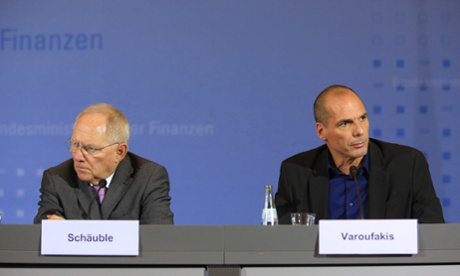
Good morning, and welcome to our rolling coverage of the world economy, the financial markets, the eurozone and business.
The hours tick on and the hostile words grow louder but still there is no agreement on Greece’s reform proposals.
Wolfgang Schäuble, Germany’s frank and outspoken finance minister, says the lack of progress is increasing the chances of an accidental Greek exit from the euro - a “Grexident”.
He also said the onus was on Greece to help itself.
Asked by the Austrian broadcaster ORF about the prospect of a Grexident, Schäuble said:
As the responsibility, the possibility to decide what happens only lies with Greece, and because we don’t exactly know what those in charge in Greece are doing, we can’t rule out.
Updated