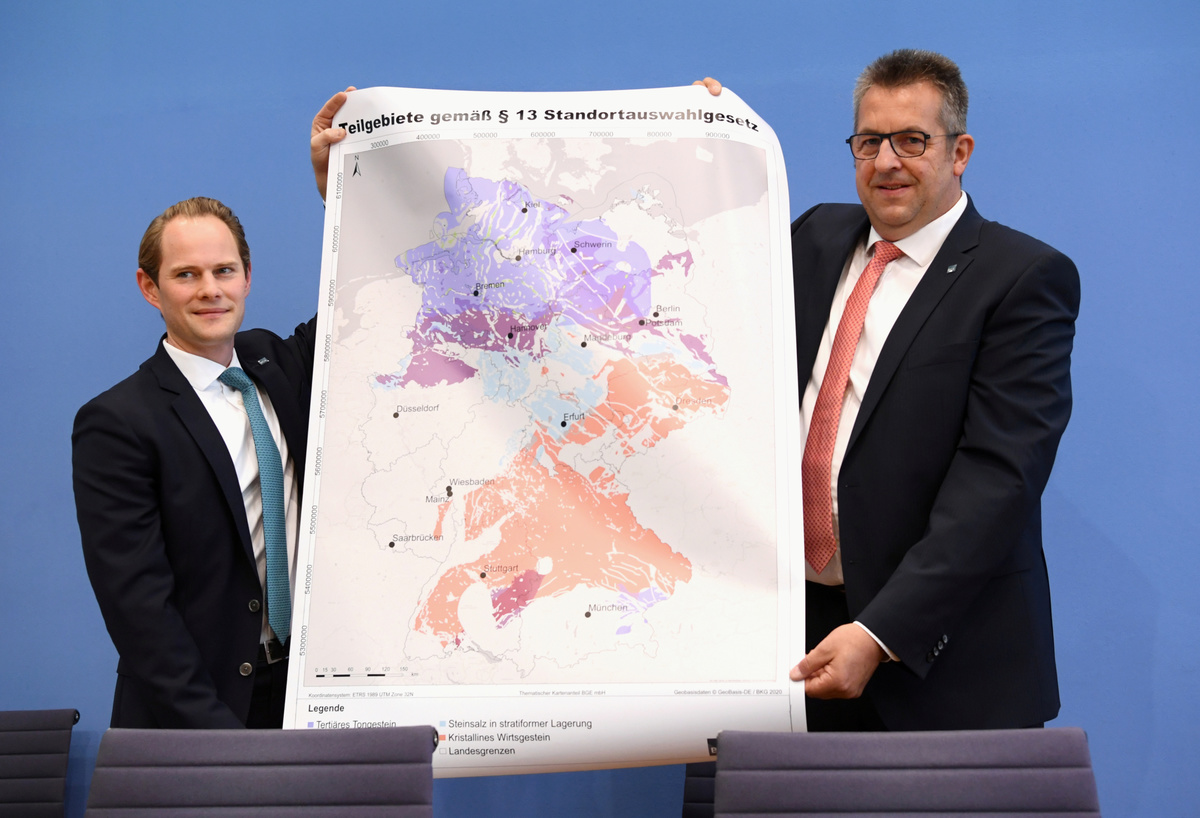
Germany on Monday published a list of potential storage sites for radioactive waste as part of its plans to exit nuclear power, dropping the Gorleben salt dome in Lower Saxony from the running.
The 444-page list of sites, to be assessed by 2031 for use from 2050 to hold waste currently in interim storage at nuclear plants, was published by Germany's Federal Agency for Final Storage (BGE).
Some 90 locations, including parts of Lower Saxony, Bavaria, Baden Wuerttemberg and eastern German states, have been found to be potentially suitable after BGE undertook preliminary mapping that revealed 54% of German territory could be satisfactory.

It eliminated Gorleben, confirming a Reuters report.
Taking three years, the process identified salt, clay and crystalline, above all granite, formations, stressing the criteria were science-based, without political influence.
No location was predetermined, said Stefan Studt, head of BGE's managing board, at a news conference.
"Any region in today's list would take a long, long time to become the actual final space," he said.
Germany had been on a course to exit nuclear power since 2000 but hastened the plan, now set for 2022, following the Fukushima nuclear disaster in 2011.
Gorleben, which became the focus of anti-nuclear protests in the 1970s, failed on three points related to retention, hydrochemical and overall geological qualities, so that it could not be ruled out that aquifers may come into contact with salt, said Steffen Kanitz, a BGE board member.

Nuclear utilities E.ON, RWE and EnBW have to date also spent hundreds of millions of euros on the search for suitable locations. [POWER/DE]
As "not-in-my-backyard" (NIMBY) attitudes are developing, states such as Bavaria have said they will be unhappy to be targeted.
They fear not only the real risks of radioactive waste but also the battle with vociferous antinuclear groups.

(Reporting by Markus Wacket and Vera Eckert, editing by Jason Neely and Ed Osmond)