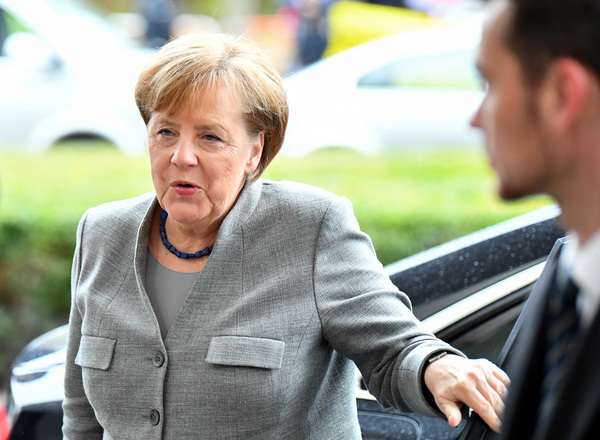
BERLIN � Germany's Social Democrats voted to join Chancellor Angela Merkel's next government, clearing the last hurdle to her fourth term and restoring a sense of political stability.
The SPD approved a coalition agreement with Merkel's Christian Democrat-led bloc Sunday morning that effectively ends more than five months of political stalemate.
The chancellor can expect to be re-inaugurated by mid-March, allowing her to move ahead with priorities such as working with French President Emmanuel Macron to strengthen the euro zone and coordinating on a united European front against Chinese encroachment.
"We now have clarity," said Olaf Scholz, the interim Social Democratic chairman. "The SPD will join the next government."
While the impasse in Berlin hasn't dented Germany's economic boom, it's held back policy making since Merkel won a national election in September with her bloc's worst result since 1949. That weakness, and the arrival of a far-right party in parliament, reflect a changing political landscape that almost derailed Merkel's bid to extend her 12 years in office.
With a resumption of the "grand coalition" government now assured, the SPD's choice for finance minister will be among the most-watched decisions ahead. Scholz, the mayor of Hamburg and a centrist Social Democrat, is viewed as the front-runner for a post the party wrested from Merkel in the coalition deal sealed in February. The Social Democrats plan to announce their Cabinet nominations on March 12.
Fending off a youthful grass-roots revolt against staying in government allows the Social Democrats to be Merkel's junior partner for the third time in the grand coalition of Germany's two biggest parties. It's a sign that the political center, while diminished, is holding after the longest coalition-building talks since World War II.
Merkel, reduced to acting chancellor for months, has said she'll serve a full term until the next scheduled election in 2021. Even so, she's begun preparing the Christian Democratic Union for her eventual departure.
Last week, Merkel named an ideological ally and successful state election campaigner, Annegret Kramp-Karrenbauer, to a senior party post. Responding to conservative critics who blame the chancellor for the party's electoral decline, Merkel also nominated a group of younger leaders for Cabinet positions.
The Social Democrat ballot was both the final hurdle and the last option for a Merkel-led majority government after the pro-market Free Democrats, a CDU ally in the past, scuttled a first set of coalition talks. That breakdown, and turmoil in the SPD after its worst postwar election result, made it unusually difficult to build a government alliance.
����
(Mariajose Vera and Patrick Donahue contributed to this report.)