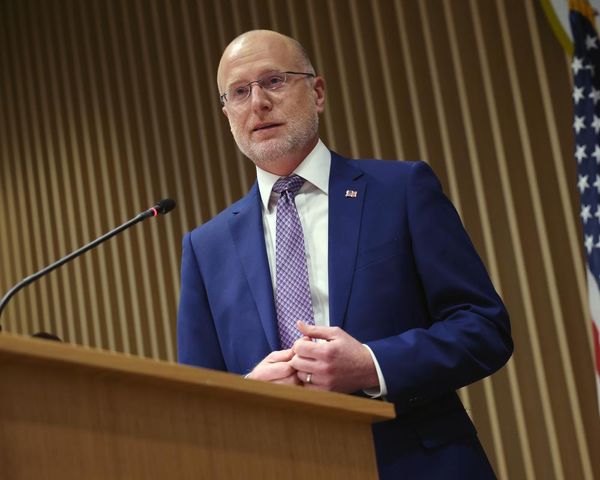
Germany’s new health minister, Karl Lauterbach, has warned that the country has insufficient vaccine doses to keep the population’s Covid defences up over the winter, especially with the predicted rise of the Omicron variant.
Lauterbach said Germany was very low on stocks and was rationing its distribution of the German-developed BioNTech/Pfizer vaccine to vaccine centres and doctors’ practices across the country, to 1.2m doses next week, 800,000 the following week between Christmas and the new year, and another 1.2m the week after.
“But this is far less than the amounts which doctors are asking for every week,” he said, adding that Germany was scraping the barrel of its reserves and could do with more than twice the amount it currently had. “The campaign has to roll … but there is literally no more than this there.”
He rejected claims he was blaming his predecessors in the government of Angela Merkel for underordering supplies of the vaccine, and said the shortfall was due to the Covid situation suddenly worsening.
A record 1.5m doses were administered on Wednesday, bringing to 70% the proportion of people now at least double vaccinated, and to almost 28% the proportion who have received a booster jab.
The Delta variant makes up about 90% of German infections, but the more infectious Omicron has been detected in hundreds of cases and is expected to have spread widely by next month.
Lauterbach, an epidemiologist who as the health spokesperson for the Social Democrats was an active and much relied upon commentator on the pandemic before taking over as health minister this month, said he was seeking “as an emergency” to buy millions of unused vaccine stocks from eastern European countries, including Bulgaria, Romania and Poland.
His ministry has confirmed reports that it plans to spend €2.2bn on 80m BioNTech doses via official EU procurement channels, and to buy a further 12m doses directly, to ensure “that we can start the new year in a sensible manner”. In addition Moderna has agreed to deliver an extra 35m doses of its vaccine to Germany ahead of schedule.
Several eastern European countries have vaccine stocks that are in danger of becoming out of date if they are not used, owing to vaccine hesitancy.
The finance minister, Christian Lindner, said the funds to cover the costs had been released “so that the vaccine campaign can continue next year with higher intensity”.
Lauterbach repeatedly stressed he was not claiming, as some media and opposition politicians had claimed, that his predecessor, Jens Spahn, had underordered vaccines and had not kept a proper inventory of stocks. The CDU has accused Lauterbach of using false data and creating or exaggerating an apparent problem in order to benefit from the relief that is likely to be triggered if sufficient stocks are obtained.
Lauterbach instead praised Spahn’s efforts and saying the “massive increase in speed” of the Omicron variant together with efforts to dampen the Delta variant were behind his drive to “turbo boost” the vaccine campaign.
He faced fierce scrutiny over the issue during his first press conference with Lothar Wieler, the head of the government’s disease control agency, the Robert Koch Institute (RKI), on Thursday afternoon.
Press conferences with the health minister, previously Spahn, and Wieler, often held on a weekly basis, have been the main official source of communication on the pandemic since it began.
Lauterbach said speaking to Sajid Javid, his British counterpart, that morning had increased his sense of urgency, “as in Britain the spread of Omicron is worse”. He said he was “working feverishly” to increase stocks and was basing his decisions on his own first-hand experience as a doctor who had administered vaccines while an MP before becoming health minister, knowing that more stocks had to be ordered than would be needed.
Wieler urged Germans to limit their festive gatherings to a small circle so as not to make Christmas “a festival for the virus” and to help stop the “rollercoaster we’ve been on for two years”.
The RKI registered 56,677 new infections on Thursday morning, about 14,000 less than a week ago, and 522 deaths over the previous 24 hours. The seven-day incidence rate per 100,000 people remains high has fallen to 340, from 422 a week ago, an improvement put down to an increase in restrictions.
Many venues, non-essential shops and cultural events broadly speaking require visitors to show a digital vaccine certificate or proof that they have recovered from Covid-19, and proof of a negative lateral flow test. The measures have been tightened regionally according to how widespread the disease is in particular areas. The wearing of medical masks has been mandatory in public places since January.
About 14% of German adults remain unvaccinated, leading to calls for a vaccine mandate in the new year. However, health officials have said any mandate would have to be accompanied by having sufficient vaccine stocks. Lauterbach said: “If the vaccine mandate comes, Germany will have enough vaccine.”