During his two-day visit to Tashkent, German President Frank-Walter Steinmeier told Euronews the changes he has witnessed in Uzbekistan over the past two decades have created new opportunities for deeper cooperation between Germany and the EU and Central Asia.
Steinmeier said relations between Europe and Central Asia have become significantly closer since he first advocated a stronger German focus on the region as foreign minister in 2006.
“I am very grateful that during my career, during the last 20 years I was able to contribute to closer relations between our two countries, Uzbekistan and Germany, and to the relations between the European Union and Central Asia,” he told Euronews.
“It wasn't that easy in the beginning, but now, in the meanwhile, this visit and exchange with your political leader proves that it has become closer. I think all the foundations, all the basis to closer cooperation, being in economic, business, or in cultural exchange, are great now.”
His visit to the Uzbek capital is part of a broader Asia tour that also included Indonesia and the Philippines.
“We have partners here,” Steinmeier said during his visit. “And we can strengthen political and economic ties with confidence.”
Political dialogue and economic cooperation
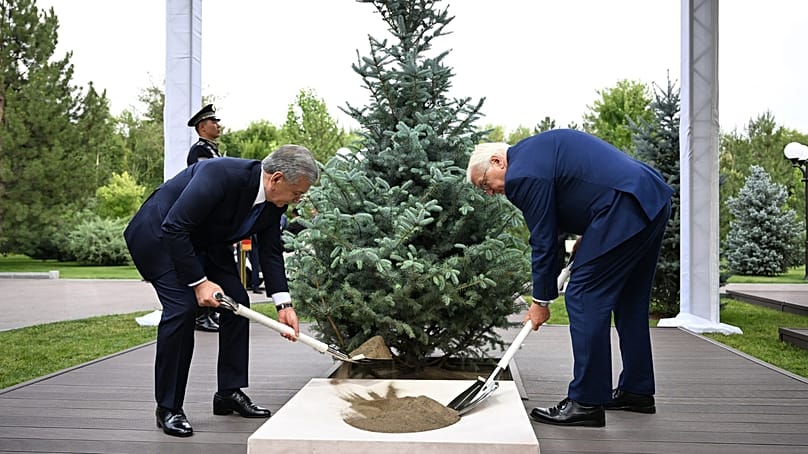
During talks at the Kuksaroy residence, Uzbek President Shavkat Mirziyoyev and Steinmeier discussed political dialogue, trade, investment, education, transport connectivity and cooperation through the Central Asia–Germany platform.
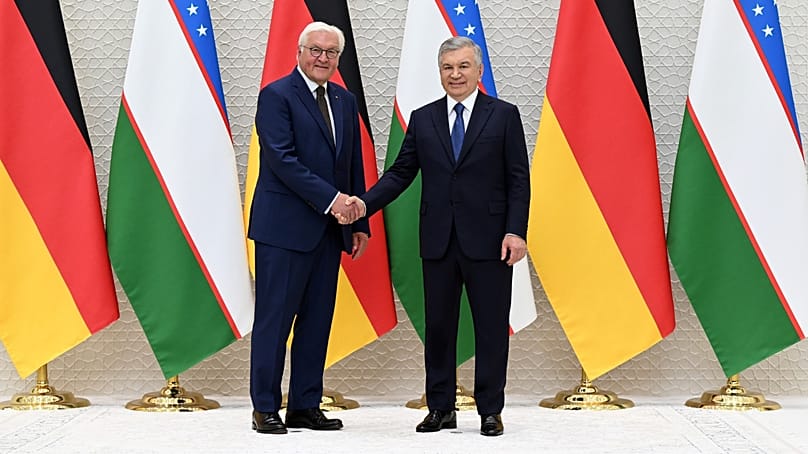
The two leaders reaffirmed their intention to deepen cooperation across a range of sectors, including industry, energy, logistics, mining, agriculture, healthcare and education.
Mirziyoyev highlighted Steinmeier’s long-standing contribution to the development of relations between Germany, the European Union and Central Asia, while both sides expressed satisfaction with the growing intensity of bilateral contacts.
The leaders also agreed to prepare a comprehensive roadmap to implement the agreements reached during the visit.
Trade, investment and new projects
Germany remains one of Uzbekistan’s most important economic partners in Europe.
According to figures released during the visit, bilateral trade exceeded $1.4 billion (approximately €1.21 billion) last year and has increased by a further 5% since the beginning of this year. German investment in Uzbekistan’s economy has reached approximately $2 billion (approximately €1.73 billion).
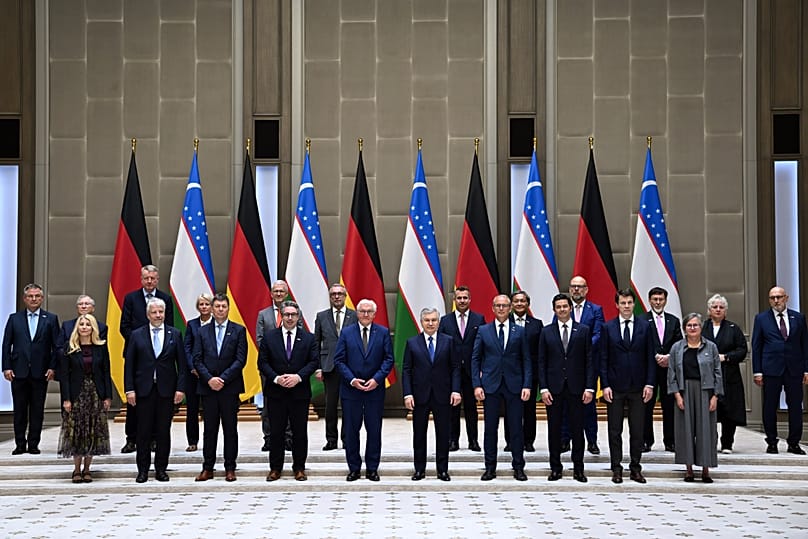
The two sides also highlighted the outcomes of the Days of German Economy and the 10th meeting of the German-Uzbek Business Council, held in Tashkent in May, where investment and trade agreements worth more than $1 billion (around €870 million) were signed.
Steinmeier said German business interest in Uzbekistan continues to grow.
“German technology is well known and recognised here,” he said during remarks in Tashkent.
The German president welcomed a number of new projects involving German companies, including investment in manufacturing, logistics and workforce development.
He also spoke of Volkswagen's plans and Henkel's new investment initiatives as examples of expanding economic cooperation.
Germany looks to Uzbekistan's workforce
Labour emerged as another important theme during the visit, as Germany recently signed a migration and mobility agreement with Uzbekistan designed to facilitate the recruitment of qualified specialists for the German labour market.
The issue has gained prominence as Germany seeks to address labour shortages in several sectors, while Uzbekistan’s population continues to grow.
Steinmeier noted that interest in Germany remains strong among young Uzbeks.
More than 400,000 people are currently learning German in Uzbekistan, while more than 2,000 Uzbek students are studying at German universities.
An agreement was also signed last week to establish an Uzbek-German University of Applied Sciences in Samarkand, a project both sides see as an important step in expanding educational cooperation.
The leaders supported plans to hold a second Forum of Universities and a third Uzbek-German Medical Forum in Tashkent.
Beyond politics and business, Steinmeier visited the Centre for Islamic Civilisation in Tashkent, where he viewed exhibits dedicated to the pre-Islamic and Islamic history of Central Asia.
Describing the institution as a centre for learning and research, he said cultural and people-to-people ties would remain an important part of the relationship between Germany and Uzbekistan.