Germany’s spokesman adds that Merkel, Hollande and Tsipras agreed to stay in close contact, and also agreed that Greece should keep negotiating with her creditors.
So, friendly negotiations, but no indication of a major breakthrough...
One more development.... there are reports that Alexis Tsipras will meet Jean-Claude Juncker on Friday, after the EU summit.
"Friendly and constructive" the Germans say of #Greece talks in #Riga. But stick to completing current bailout. https://t.co/z1n0whe3Z8
— Alastair Macdonald (@macdonaldrtr) May 21, 2015
A late newsflash from Riga -- a German government spokesman has said tonight’s talks centred on finding a successful completion to the current Greek aid programme, which runs out at the end of June.
Spokesman: Merkel-Hollande-Tsipras talks focused on successful completion of bailout http://t.co/HaUG92vay2
— ForexLive (@ForexLive) May 21, 2015
The meeting between Tsipras, Merkel and Hollande lasted more than two hours. The trio didn’t speak to reporters as they left, alas.
Greek media say #Tsipras, Merkel, Hollande meeting ended #RigaSummit
— Daphne Papadopoulou (@daphnenews) May 21, 2015
The French government has kindly provided some photos too.
En marge du Sommet du Partenariat Oriental à Riga, @fhollande s'est entretenu avec A.Merkel et A.Tsipras #Riga2015 pic.twitter.com/jxmG6DMhhf
— Élysée (@Elysee) May 21, 2015
Here’s an official photo of tonight’s talks:

Updated
The New York stock market just hit a new closing high, suggesting Wall Street remains unperturbed by events in the eurozone.
US equities closed slightly higher on the day: DJIA +1, S&P 500 +5. New record high for the S&P 500! ^MW
— FOREX.com (@FOREXcom) May 21, 2015
The eagerly awaited meeting between the leaders of Germany, France and Greece is getting underway.
Even though this photo is blurry, you can make out Angela Merkel’s jacket....
Everybody in da house #Merkel-#Hollande- @atsipras about to begin #Greece #EUSummit pic.twitter.com/jzB5B9keXz
— Nektaria Stamouli (@nstamouli) May 21, 2015
European Union foreign policy chief Federica Mogherini has arrived, straight from a visit to the Middle East to discuss issues including a two-state solution for Palestine.
In Riga for the Eastern Partnership Summit
— Federica Mogherini (@FedericaMog) May 21, 2015
Leaders arrive in Riga, amid hopes of Greek progress
A quick recap:
EU leaders have arrived in Riga for a two-day summit on Eastern European partnership, but with Greece’s debt crisis looming over them.
Angela Merkel, Francois Hollande and Alexis Tsipras will hold informal talks tonight, after a working dinner taking place now.
#EaP #Summit: Roundtable Dinner for the HoSG and head of delegations @eucopresident @eu2015lv http://t.co/q9I6ljwIRB pic.twitter.com/iv6kpH5yad
— EU Council TV News (@EUCouncilTVNews) May 21, 2015
Sources have told us that a new four-month Greek bailout extension will be discussed. One said:
“A very senior German official speaking in the most measured of ways and with a great deal of forethought described this as a possible outcome that was now very seriously being discussed,”
“It would be entirely logical. If it doesn’t happen we’re looking at a scenario like Cyprus with capital controls and banks closed....as close as you can get to euro exit.”.
Francois Hollande has fuelled the optimism tonight, saying that the three-way talks could help reach a deal.
Hollande said:
With Tsipras we want to find solutions to restore confidence and release the funds that have been planned,”
“So it will be a friendly talk, but a talk in which we have to be able to draft solutions.”
But there are also reports that Greece’s optimism is not shared by its creditors, and that progress still needs to be made on issues such as pensions, labour market reform and VAT rates.
Alexis Tsipras certainly looked happy when he arrived at tonight’s working dinner -- I guess travelling in a military transport jet must be quite invigorating....

Hollande: Three-way talks could help reach a deal
France’s president has suggested tonight that talks between Alexis Tsipras, Angela Merkel and himself could help reach a deal.
Bloomberg has the details:
French President Francois Hollande opened the prospect of striking a political deal with Prime Minister Alexis Tsipras that unlocks bailout aid for Greece within days.
Speaking before a summit of European Union leaders in Riga, Latvia, Hollande said that a meeting he and German Chancellor Angela Merkel will hold with Tsipras later on Thursday will help pave the way for an accord to be hammered out by finance ministers at the end of May or early June.
“With Tsipras we want to find solutions to restore confidence and release the funds that have been planned,” Hollande told reporters. “So it will be a friendly talk, but a talk in which we have to be able to draft solutions.”
Hollande says 3-way talks with Tsipras and Merkel will pave way for Greek deal http://t.co/FrTirIPuhR pic.twitter.com/MAb7zSgfOW
— Bloomberg Business (@business) May 21, 2015
Updated
Interesting rumour, that would make sense if a compromise is being hammered out in the days ahead...
#Greece | @protothema reports of a meeting of Tsipras, Dijsselbloem, Juncker & Draghi late next week in Brussels.
— Yannis Koutsomitis (@YanniKouts) May 21, 2015
Is Greece’s government, once again, too optimistic about a deal? Greek journalist Giannis Papageorgiou is hearing as much:
Gov is optimistic about an agreement on #Greece. But what I am learning from #Brusselsgroup, #berlin and #WashingtonDC are quite different
— Giannis Papageorgiou (@Papageorgiou_J) May 21, 2015
Council president Donald Turk arrived in a ‘let’s get down to business’ mood:

France’s president is here....

...although he didn’t look as cheery as his Italian counterpart.

German chancellor Angela Merkel has arrived for the working dinner, followed by that informal meeting with Alexis Tsipras.

The Riga Summit, says European Council president Donald Tusk, is an opportunity for the EU to build stronger ties with the countries to its East, and to reiterate its opposition to conflict in the region:
I have come to #RigaSummit with 3 simple, clear messages pic.twitter.com/A8iCHcINVg
— Donald Tusk (@eucopresident) May 21, 2015
1: EU stays the course & is as committed to #EaP as ever despite intimidation, aggression & even war
— Donald Tusk (@eucopresident) May 21, 2015
2: EU wants to advance relations with all 6 #EaP countries. This means tailored cooperation, increasing resilience & state-building
— Donald Tusk (@eucopresident) May 21, 2015
3: EU is a trusted #EaP partner for the long haul. #RigaSummit not about giant steps forward but concrete progress step-by-step
— Donald Tusk (@eucopresident) May 21, 2015
We’re used to seeing Alexis Tsipras travel in economy class - but today he switched to a military flight to reach Riga.
PM's office releases photos of Tsipras trip to Riga on military transport plane #Greece pic.twitter.com/KdLGvw5qpd
— Derek Gatopoulos (@dgatopoulos) May 21, 2015
No frills for Mr Tsipras - but at least he got plenty of legroom.
More arrivals. And Ukraine’s President Petro Poroshenko (left) got a warm-looking welcome from Latvia’s president, Andris Berzins.

As we covered earlier, leaders will be discussing how to end conflict in the region, such as the military action in Eastern Ukraine.
European markets edge higher
Ahead of tonight’s summit in Riga, European markets moved higher - just - amid uncertainty whether or not Greece would be offered a bailout extension. Eurozone data earlier was mixed, while UK retail sales were better than expected - which boosted the pound - while US confidence and housing figures were disappointing. The final scores showed:
- The FTSE 100 finished 6.21 points or 0.09% higher at 7013.47
- Germany’s Dax is up 0.14% at 11,864.59
- France’s Cac closed 0.26% better at 5146.70
- Spain’s Ibex ended up 0.18% at 11,595.4
- The Athens market added 0.63% to 845.73
- Italy’s FTSE MIB was an exception, down 0.14% at 23,739.69
On Wall Street the Dow Jones Industrial Average is currently 12 points or 0.07% higher.
Updated
Arrival in Riga, Latvia for the Summit #euco #Greece pic.twitter.com/EjDEQcCHNV
— Alexis Tsipras (@tsipras_eu) May 21, 2015
And they’re starting to arrive in Riga for tonight’s summit:


Updated
Tsipras arrives in Riga for EU summit, talks with Merkel, Hollande http://t.co/qBaLCvQPWm
— Kathimerini English (@ekathimerini) May 21, 2015
Updated
The disappointing eurozone consumer confidence figures may not be as disappointing as all that, say analysts. Howard Archer at IHS Economics said:
Eurozone consumer confidence eased back for a second month running in May. This follows on from the purchasing managers reporting that overall manufacturing and services expansion slowed for a second month running (and at a slightly faster rate) in May according to the purchasing managers.
This will likely fuel concern that the eurozone’s recovery is starting to flag as the recent stimulus it has received is diluted by a recent firming in the euro, oil prices and bond yields from very low levels.
However, it needs to be borne in mind that while eurozone consumer confidence dipped for a second month in May, it was nevertheless at its third highest level since August 2007 and well above its long-term norm. The May/April drops should also be seen in the context that Eurozone consumer confidence index had seen substantial overall improvement over the four months through to March.
Teunis Brosens at ING Bank said:
In this afternoon’s instalment of the ongoing run of disappointing eurozone data, we bring you consumer sentiment. According to a flash estimate of consumer confidence by the European Commission, sentiment fell to -5.5 in May. Gains made in the previous two months have now been erased. The further deterioration in sentiment is probably partly explained by the fact that rising oil prices are felt at the pump: average €95 fuel prices reached €1.49 in May, up 4 cents from April and 17 cents from January lows. Financial market turmoil may also have hurt confidence.
But even after this correction, eurozone consumers remain upbeat, with sentiment still well above its long term average of -12.5. This leaves scope for retail sales to rebound after their disappointing setback in March.
Consumer confidence conveys essentially the same message as this morning’s PMI-numbers: sentiment among both businesses and consumers is no longer ecstatic, but still quite good. Barring a Greek accident, the economic outlook for the Eurozone remains brighter than it has ever been in recent years, with scope for further gains in both consumption and business investment.
In the US, the latest figures have also come in below forecasts:
Philadelphia Fed Business Outlook (May) 6.7 versus 8.0 expected, previous 7.5
— Sigma Squawk (@SigmaSquawk) May 21, 2015
US Existing Home Sales (Apr) 5.04 Mln versus 5.23 Mln expected, previous 5.19 Mln revised to 5.21 Mln
— Sigma Squawk (@SigmaSquawk) May 21, 2015
Perhaps this is no surprise, with increasing talk about a Greek default and exit from the euro, but eurozone consumer confidence came in much worse than expected this month.
The confidence index fell to -5.5 from -4.6 the previous month, and analysts forecasts of -4.8.
MISS: EZ Consumer Confidence (May A): -5.5 v -4.8e v -4.6 prev #eur
— Mike van Dulken (@Accendo_Mike) May 21, 2015
The European Central Bank believes its QE bond buying programme is working as it intended, according to the minutes of its last meeting released earlier, and concerns about the scarcity of supply of suitable bonds were exaggerated. Carsten Brzeski on ING Bank sums up the bank’s comments:
The just released minutes of the ECB, officially known as the account of the last ECB meeting, did not provide any new crucial information. In fact, the minutes confirmed the ECB’s positive stance on economic developments, while at the same time stressing that all positivity was conditional on the full implementation of QE.
The minutes also showed that permanent inner conflict the ECB is fighting with. On the one hand, the ECB acknowledges and sometimes celebrates the positive impact from QE, while on the other hand it keeps on hammering on the need for structural reforms.
In the minutes, quite some time was dedicated on the fact that “a strong signal needed to be sent to euro-area governments urging them to press ahead with structural reforms and to take measures to improve the business environment”. A tricky balancing act as the positive impact from QE could clearly reduce reform efforts.
The minutes did not show any tapering debate within the Governing Council. However, the minutes at least reflected the start of the debate on QE flexibility which reached its climax earlier this week. According to the ECB, scarcity concerns about the supply of government bonds were exaggerated. Moreover, the ECB already discussed flexibility of QE, according to the minutes.
All in all, there are at least three important take-aways from the ECB minutes: tapering was not discussed, the positive economic outlook was conditional on the full implementation of QE and the ECB will concentrate on inflation trends, not on single inflation data points. Altogether a strong confirmation of the ECB’s determination to continue with QE, not half-heartedly but with full conviction.
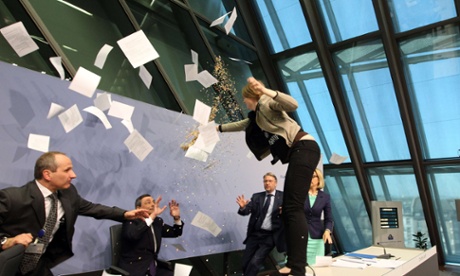
Of course, it was what happened at the press conference after the meeting which attracted a lot of the attention:
Insiders: Greek bailout extension to be discussed in Riga
The Guardian has learned that a four-month extension of Greece’s current bailout is on the table, and will probably be discussed by Angela Merkel and Alexis Tsipras tonight.
And despite Schäuble’s caution, the idea of giving Greece some leeway to draw up reforms is apparently being “very seriously” considered.
Helena Smith, our correspondent in Athens, reports:
Well-placed German officials with intimate knowledge of the state of negotiations – and the various scenarios on offer – are saying the prospect of Athens being given “a four-month breather” that would allow it to drum up a detailed list of reforms is now being studied seriously.
Moreover, it is likely to be the focus of tonight’s meeting between the German chancellor Angela Merkel and Alexis Tsipras her Greek counterpart.
One insider revealed:
“A very senior German official speaking in the most measured of ways and with a great deal of forethought described this as a possible outcome that was now very seriously being discussed,”
“It would be entirely logical. If it doesn’t happen we’re looking at a scenario like Cyprus with capital controls and banks closed....as close as you can get to euro exit.”.
With Greece’s debt repayment schedule being so heavy this year – it owes €6.2bn to the ECB in July and August alone – 2015 offers the one window of opportunity to force Tsipras’ hand.
In exchange for tiding the debt-stricken country over, Tsipras’s anti-austerity government would have to produce a compelling and comprehensive package that would persuade creditors Athens was finally determined to get down to the business of reform.
Our source says:
“The big challenge is that it doesn’t look like a repetition of the extension we had in February. It would have to look a lot different because it is that solution that got us to where we are today. There’s only one point in creating a financial bridge like this and that is if the European side genuinely believes it will lead to reform.”

But experts are saying after four months of seemingly stalled negotiations the gap-stop solution makes eminent sense - not least because it gives the leftist-led government enough time to either hold a referendum or call fresh elections, polls that the governing Syriza party would almost certainly win hands down.
Both scenarios would allow Tsipras to deal with militants in his party and move to the centre stage offering clarity to a political landscape blighted by Syriza’s two seemingly incompatible aims: to ensure Greece stays in the euro zone while at the same time eradicating austerity.
“This scenario makes sense because it would provide sufficient time for Greece to hold a referendum or election both of which would ease Syriza’s position,” said Kevin Featherstone, who heads the Hellenic Observatory at the London School of Economics.
“It’s the one scenario that brings the two of them [Merkel and Tsipras] together and I have no doubt they will be talking about it [tonight].”.
In many ways the solution would also be a bonanza for Europe’s first anti-austerity leader because it would offer him the chance to emerge as the leader of the entire centre left. The alternative is a place in the history books as the prime minister that oversaw Greece’s crash out of the euro and the chaos that would inevitably ensue.
“It depends on who he [Tsipras] wants to be,” said professor Featherstone.
“He still has to make the choice between staying in the euro zone and enforcing the necessary concessions or alleviating the suffering from austerity and leaving the euro zone.”
Any deal would almost certainly acknowledge his government’s desire to alleviate social hardship, Featherstone added. “In all likelihood it will have fewer reforms and allow Tsipras to claim that he tried his best.”
As we wrote this morning, Eurasia Group also predicts that a deal will be reached next month
But there’s no doubt that Tsipras is under pressure from his radical faction.
Earlier today MEP Manolis Glezos, a legendary figure for leftists, called on Greeks to take to the streets and described both the EU and IMF as “sadistic”.
“Now is the time to show that we have kept the ideology of resistance,” said the 92-year-old, who shot to fame tearing down the Swastika from the Acropolis during Greece’s brutal German occupation, adding:
“We owe it to the generations that are coming to pour onto the streets to prove to the profiteers that we have no more blood to give … and to say to our government that we are with it as long as it doesn’t take a step back. Now is the time to show to all that we have preserved the memory of freedom.”
Updated
Journalist are already arriving in the Latvian capital:
Surprise at #EasternSummit in #Riga: they named already a street after chancellor #Merkel! pic.twitter.com/ds6YLjuCPt
— Dirk Hoeren (@DirkHoeren) May 21, 2015

The Eastern Partnership summit in Riga is due to kick off at 8pm local time (6pm BST) with an informal working dinner at the House of the Blackheads.
The official welcoming ceremonies begin tomorrow at 9am (7am BST).
Discussions will then take place on building closer ties between the EU and Armenia, Azerbaijan, Belarus, Georgia, the Republic of Moldova and Ukraine.
Press conferences are then scheduled from 1.45pm, or 11.45am BST.
So Friday could be a busy morning, with Greece’s bailout talks and Britain’s attempts to renegotiate its EU membership also looming over the event.
Schäuble: Optimism isn't justified

Germany’s finance minister has cautioned that a Greek breakthrough is not imminent.
In an interview just published with Reuters, Wolfgang Schäuble stuck to his position that progress between officials from Greece and its creditors remains slow.
Schäuble argued:
“What I know from discussions with the three institutions does not back up the optimism arising from announcements from Athens.
There is not yet any substance to the mere announcement that we are closer to an agreement. This is still within the realms of atmosphere.”
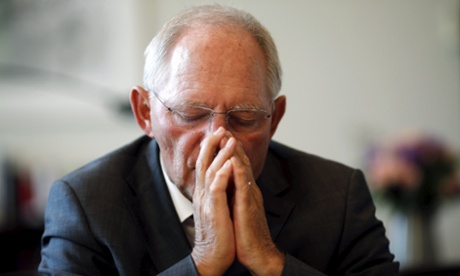
The interview took place yesterday; a time when Greek spokesmen were warning that the country would miss its next repayment to the IMF, on June 5, without a deal.
Asked if Greece could default, Schäuble warned “I can’t rule anything out in any case.”
Here’s a handy chart showing how Greece could reach a deal -- and all the different ways it could go wrong:
Scenarios for #Greece in one chart. (via Barclays) pic.twitter.com/oTkRJ8muBw
— Holger Zschaepitz (@Schuldensuehner) May 21, 2015
The European Commission has refused to comment on last night’s report that a bailout extension is being worked on. Our focus is to conclude the current review as fast as possible, it says.
Day 92: EU won't confirm or deny bailout extension programme - 'working to conclude current review as swiftly as possible'
— Danny Kemp (@dannyctkemp) May 21, 2015
Eurasia Group: Greece could get a short-term deal in June
Mujtaba Rahman, practice head at Eurasia Group, has predicted that Greece and her creditors will reach a short-term deal by early next month.
In a new research note, Rahman suggests that officials will hammer out a short-term financing deal to cover Greece’s immediate needs.
We remain of the view a short term financing deal that avoids these risks is likely. This will now probably happen in the first week of June. Moreover, we think this agreement will not fundamentally jeopardise the integrity of the governing coalition.
This will be more likely, though not inevitable, in the context of a third bailout which could be subject to a referendum in September/October.
A Staff-Level Agreement would allow the European Central Bank to raise the limit on how much Greek government debt its banks can own -- a crucial source of short-term funding.
If a deal is reached, Alexis Tsipras would face a rebellion from the more hard-line members of his party. But Rahman believes that Syriza hold back from mass defections.
Critically, we think it unlikely Tsipras will lose his parliamentary majority (meaning the number of defections will be less than 12 MP’s). Our belief is substantiated by the latest polls, which once again show Greek voters’ growing dissatisfaction with the negotiating strategy of the government.
Updated
Table settings are being shuffled in Riga....
#EU official says #Merkel no longer sitting next to @atsipras at #Riga summit dinner tonight.
— Peter Spiegel (@SpiegelPeter) May 21, 2015

Angela Merkel has addressed the German parliament this morning, before heading to Latvia for the EU summit tonight.
The Riga meeting is officially called the Eastern Partnership summit, and will include discussions on conflict resolution in the region.
Merkel geared up this by telling MPs in the Bundestag that Russia’s involvement in eastern Ukraine was unacceptable.
The chancellor said:
We see the G7 as a community of values. And that means working together for freedom, democracy, and for the rule of law. That means respecting the laws of nations and the territorial integrity of nations.”
Russia’s actions in Ukraine are not compatible with that. A return to the G8 format is not imaginable as long as Russia doesn’t act according to those basic values.”
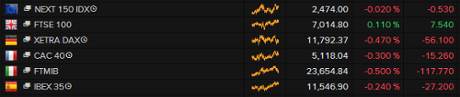
Shares are inching higher on the Athens stock market this mornings, on hopes that Alexis Tsipras can make some progress in his talks with Angela Merkel and Francois Hollande tonight.
The main Athens index is up 0.5% this morning, outperforming the rest of Europe.
The French and German markets are both down, after this morning’s PMI data showed a slowdown in Germany and another contraction in the French factory sector.
Brenda Kelly, head analyst at London Capital Group, says European investors have been digesting the minutes of the last Federal Reserve meeting, published on Wednesday evening.
‘Last night’s Fed minutes all but ruled out a rate hike in June owing to the weakness of first quarterly growth and the lack of inflation.
More recent weak macro data from the US would also imply that even this set of minutes is out-of-date and the market is now pricing in rate hike for early 2016. No surprises were to be found within the minutes.
US investment management giant BlackRock remains pretty confident that Greece and her creditors will reach a deal in time:
*BLACKROCK SEES 20-25% CHANCE OF GREECE LEAVING EURO AREA
— Dealingroom (@Dealingroom_EN) May 21, 2015
The jump in UK retail sales suggests Britain’s drop into negative inflation last month is not the start of a deflationary spiral:
Retail sales up 4.7% year on year - well ahead of consensus. #NotWhatADeflationarySlideLooksLike
— Duncan Weldon (@DuncanWeldon) May 21, 2015
UK retail sales have just smashed forecasts, sending the pound jumping.
Sales were up by 4.7% year-on-year in April, jumping by 1.2% month-on-month.
It was driven by more demand for clothes, textiles and footwear - suggesting shoppers were lured into buying summer outfits by the warm weather last month.
Go the UK! retail sales in April 2015 are estimated to have increased by 4.7% compared with April 2014. #GBP #GDP
— Shaun Richards (@notayesmansecon) May 21, 2015
*U.K. APRIL CLOTHES SALES RISE 5.2%, MOST IN FOUR YEARS - t-shirts, shorts and flippie-floppies
— World First (@World_First) May 21, 2015
The news sent sterling is up almost 1% against the US dollar, to $1.5623.
The ONS also reported that average store prices (including petrol stations) fell for the 10th consecutive month, down 3.2% compared with April 2014.
So as prices drop, people buy more stuff, as Mario Draghi once put it.
Dr Nick Spiro, managing director at Spiro Sovereign Strategy, is concerned by today’s PMI surveys from the Big Two European nations:
It’s bad enough that France is struggling to recover, but even more concerning that Germany’s economy continues to slow - and fairly significantly at that, with the composite PMI falling from 54.1 to 52.8.
Although still expanding, growth in the services and manufacturing sectors has lost considerable momentum. This suggests that economic weakness in the first quarter of this year has extended deep into the second.
Back in the UK, Tesco has suggested that it could potentially claw back the seven-figure payment handed to its former CEO, Phil Clarke.
Tesco’s annual report, released this morning, contained this snippet:
On termination of employment, in accordance with the terms of his contract, Philip Clarke was entitled to receive a termination payment of £1,217,000... Should it be determined in the future that there was gross misconduct the Company will seek recovery of the termination payment.
Shortly after Clarke left, Tesco shocked the City by admitting it had overstated profits due to mis-accounting the way it dealt with suppliers, prompting the suspension of several senior staff.
More on fastFT:
Tesco says may recover £1.2m payoff for ex-CEO http://t.co/NqQmRhSTE0
— fastFT (@fastFT) May 21, 2015
Europe’s jobs crisis may finally be easing.
Firms are hiring staff at the fastest pace since 2011, the early days of the eurocrisis, according to Markit’s PMI survey.
#Eurozone hiring picks up: PMIs show employment rising at the fastest rate for 4 years in May pic.twitter.com/ZH5jfBqBWN ~@WilliamsonChris
— Yannis Koutsomitis (@YanniKouts) May 21, 2015
Eurozone periphery outperforms the core
Germany and France are now being outpaced by the rest of the eurozone, according to Markit’s monthly healthcheck of the region.
Companies across the euro periphery are enjoying their best quarter since the credit crunch struck the global economy, with job creation and growth surging.
But they were dragged back by the ‘core’ countries of Germany and France (as covered earlier in the blog).
That pulled the overall Flash Eurozone PMI Composite Output Index down to a three month low of 53.4, down from 53.9 in April.
The core is the periphery. The periphery is the core. pic.twitter.com/xHgIw71Ctg
— grodaeu (@grodaeu) May 21, 2015
Chris Williamson, chief economist at Markit, says the eurozone’s recovery lost some of its vigour in May, with growth slowing slightly for a second successive month.
“The survey results suggest the German economy is on course for a reasonable expansion of 0.4% in the second quarter, but France is likely to struggle to see growth exceed 0.3%. However, it’s outside of these two ‘core’ countries where the main action appears to be, with the rest of the region enjoying its best quarter of economic growth and job creation for almost eight years.”
Greek PM Alexis Tsipras will meet with Francois Hollande in Riga tonight as well as Angela Merkel, in an attempt to reach a political solution to the crisis.
That’s via the Kathimerini newspaper, which adds:
Tsipras is hoping that his meeting with Merkel and Hollande will result in some kind of political gesture that will help the pace and direction of deliberations with the institutions. The Greek leader is expected to tell his counterparts that his government has made as many concessions as it can and that the lenders now have to find a way to move closer to Greece.
Sources said the premier will stress that the agreement will have to show that there has been a change in Greece’s policy mix.
Not a good morning for the economy of #Germany as Markit composite #PMI falls to 52.8 with both services and manufacturing growth slowing
— Shaun Richards (@notayesmansecon) May 21, 2015
Growth across Germany’s companies has slowed to a five-month low, adding to concerns that Europe’s largest member is coming off the boil.
The German Composite Output Index calculated by Markit has fallen to 52.8, down from 54.1 in April. Firms reported weak demand, and rising cost pressures.
And export orders grew at the slowest rate in three months.
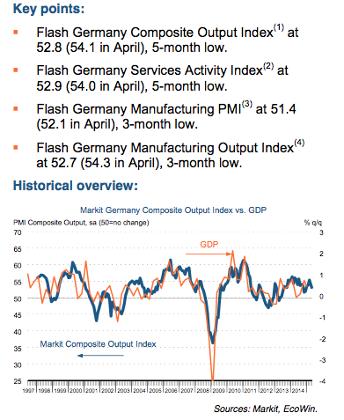
This suggests that Germany’s economic growth may not pick up significantly this quarter, after slowing to just 0.3% in the first quaeter.
Oliver Kolodseike, Economist at Markit, says:
“While the survey data are consistent with further GDP growth heading into the middle of the year, it looks as if this rate of expansion of the German economy will remain sluggish in the months ahead.
German PMIs on strike. https://t.co/9KO53SDY6q
— Frederik Ducrozet (@fwred) May 21, 2015
France’s economy is strengthening this month, although its factories are still finding conditions quite tough.
That’s the verdict from Markit’s latest assessment of the eurozone’ second largest economy. Its Flash France Composite Output Index rose to 51.0, up from 50.6, showing growth picking up [50 is the cut-off point between expansion and contraction].
Firms reported a rise in new business, and in job creation.
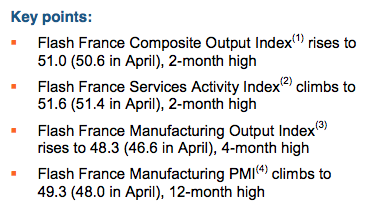
Jack Kennedy, Senior Economist at Markit, explains:
“The French private sector posted further modest output growth in May, suggesting that economic expansion is being maintained through the second quarter.
The service sector remained the driver of growth, offsetting another contraction in manufacturing.”

The two-day Riga summit which begins tonight is also David Cameron’s first meeting with fellow leaders since winning the general election.
He’ll be pushing his campaign to renegotiate Britain’s relationship with the rest of the EU, before an in-out vote in 2016 or 2017.
According to The Times, Cameron also wants Europe to stop referring to the euro as the single currency(!) He wants a new legally binding commitment that recognises that Europe is home to multiple currencies, removing the implicit assumption that all EU members will eventually join the euro.
One source said:
The British have asked the EU to accept an architecture that demonstrably shows the UK is never heading to the same destination and has a different category of membership, otherwise the UK will end up outside the EU.
More here: Drop the term ‘single currency’ or we’re out, Cameron tells EU (£)
Updated
Süddeutsche Zeitung: Eurozone could extend Greece's bailout until autumn
Is the eurozone considering throwing Greece a lifeline by extending its existing bailout over the summer?
German newspaper Süddeutsche Zeitung claimed last night that EU policymakers are considering extending the existing programme until the autumn.
Under the plan, Athens would get almost €4bn of aid in return for reforming its VAT system, but could delay modernising its labour market and pension system until the autumn.
Here’s the story:
EU erwägt Verlängerung der Griechenland-Hilfe
We’ve not had any official confirmation, or denial yet - but I suspect it’s only a matter of hours.
Such a plan would be consistent with the Muddle-Through strategy that has prevailed through the crisis:
At risk of looking silly in a few days - a Greek deal feels close. Tide over till Autumn with classic Euro-fudge on pensions/labour market?
— Duncan Weldon (@DuncanWeldon) May 20, 2015
One immediate problem - €4bn isn’t enough to cover Greece’s repayments to the ECB this summer, which add up to around €6.7bn
The Agenda: Merkel and Tsipras to meet tonight

Good morning, and welcome to our rolling coverage of the world economy, the financial markets, the eurozone and business.
With time running short for Greece, could a meeting of European leaders in Riga tonight provide the spark for a deal with creditors and avert default?
Greek PM Alexis Tsipras will meet with German chancellor Angela Merkel, after dinner, on the sidelines of the EU summit in the Latvian capital which begins tonight.
And Athens insiders hope the discussion might help to break the deadlock that threatens to leave Greece perilously short of funds to meet €1.5bn of IMF repayments in June.
Greek spokesman Gavriel Sakellarides told us last night that:
“We know that decisive decisions ultimately are taken at the level of finance ministers in the Eurogroup but at this critical moment a meeting between Tsipras and Merkel can only be helpful.”
The two leaders will discuss Greece’s liquidity crisis – last night, the European Central Bank agreed to provide another €200m of emergency help.
Greece and her lenders are still divided over three key issues; VAT rates, pension payments, and deregulating the labour market.
Tsipras’s task is to persuade fellow leaders that Greece must break with austerity.
As Sakellarides put it:
“The persistence of the architects of this regime and their insistence of keeping the country on the same track, is simply irrational. We want to stop the vicious cycle of debt and recession. Its not about stubbornness. Its about preserving Greece and its people.”
Last night, finance minister Yanis Varoufakis warned that Greece would choose to pay pensions rather than repaying the IMF, if it ran out of funds next month.
@yanisvaroufakis tells #c4news "If we can pay the IMF and pensions and salaries, then we shall, if not, Greece faces difficult choices."
— Thom Walker (@thompwalker) May 20, 2015
Also coming up today....
Flash estimates for private sector growth in France, Germany and the eurozone are released this morning, between 8am and 9am BST. That will show whether the Greek crisis is hitting demand and business confidence.
Then its UK Retail Sales data at 9.30am BST: a weak performance might fuel concerns over consumer confidence
And Europe’s stock markets are expected to dip again, as the Greek crisis looms:
Here’s the opening calls:
-
FTSE 7004 -3 points
-
DAX 11830 -18
-
CAC 5124 -9
-
IBEX 11524 -50
-
MIB 23715 -58
We’ll be tracking all the main events through the day.