Summary
Here are the major developments in the aftermath and investigation of the Germanwings crash in the French Alps that killed 150 people.
-
Co-pilot Andreas Lubitz drove the plane into the “fatal descent” that preceded the crash, a French prosecutor and the Lufthansa chief said, adding that Lubitz had locked the captain out of the cockpit. “It was a voluntary action,” said the prosecutor, Brice Robin. The intention was “to destroy the aircraft”, he said.
- Lubitz deployed a five-minute override when captain Patrick Sonderheimer tried to re-enter the cockpit after briefly leaving, thwarting Sonderheimer’s attempt to punch in an emergency number that would open the door.
- At least four airliners, including easyJet and Norwegian Air Shuttle, announced they would adopt new cockpit rules. Unlike many US carriers, European companies generally do not require two people in the cockpit at all times. Lufthansa does not voluntarily implement such a protocol.
- Twenty-seven-year-old Andreas Lubitz, a German who had been flying for the company since September 2013, was qualified, trusted and showed no signs of physical or psychological distress before the crash, Lufthansa CEO Carsten Spohr said. “You can never exclude such an individual event,” he said. “No system in the world could manage to do that.”
- Lufthansa revealed that Lubitz’s training in 2009 had been briefly interrupted, but was resumed after “his suitability as a candidate was re-established”. Asked about the reason for the interruption, Spohr said he was not allowed to say.
- Spohr said the company was in complete shock. It was “beyond our worst nightmare”, he said. “It leaves us absolutely speechless. I would not have been able to imagine that the situation would have got even worse.”
- Relatives of the victims arrived in the hamlet near the crash site in the Alps as work continued to recover and identify remains, an effort that could last weeks. The second black box – the flight’s data recorder – has not been found yet.
Updated
Germanwings continues to have “full faith in our pilots”, the company says in a new statement in line with comments by Lufthansa executives earlier today. The statement also reiterates that Andreas Lubitz appears responsible for the deaths of 150 people.
“We are horrified to discover today that the aircraft that crashed in the south of France appears to have been crashed deliberately – probably by the co-pilot of flight 4U9525. Based on audio taken from the voice recorder, the French authorities have come to the conclusion that after the aircraft had reached cruising altitude, the captain left the cockpit for a short time and was then unable to re-enter.
“It appears that the co-pilot, who had stayed in the cockpit, prevented the captain from re-entering by fully locking the cockpit door in order to then initiate the fatal descent. All Germanwings and Lufthansa employees are deeply shocked. We could never have imagined that a tragedy like this could occur within our company.
“Yet even after this terrible event, we have full faith in our pilots. They remain the best in the world; this event is an extremely tragic isolated incident.
“We share in the sadness, shock and incomprehension of the bereaved families and friends and that of millions of other people.”
In the German town of Haltern, home to 16 students and two teachers killed in the crash, shock and anger has set in with the “nightmare” of the day’s revelations, the AFP reports.
“Personally, I’m stunned, angry, speechless and deeply shocked by the latest news,” said Bodo Klimpel, mayor of the small northwestern town of Haltern where the students went to school.
“I’m asking myself when this nightmare will end,” Klimpel told a televised news conference after investigators said they believed the 28-year-old co-pilot of the Germanwings jet, Andreas Lubitz, had deliberately slammed a jet into the French Alps, killing himself and the other 149 people on board.
“It’s bad enough for the families to learn of the death of loved ones in an accident. But when it’s clear that an individual may possibly have deliberately caused the accident, it takes on an even worse dimension,” Klimpel said.
“I don’t think we can even begin to imagine it.”
The FAA, the US aviation authority, has released a Q&A about cockpit safety and pilot health screening for US airliners, excerpted below.
“What are US rules that apply when pilots leave the cockpit? US airlines have to develop procedures that the FAA approves. Those procedures include a requirement that, when one of the pilots exits the cockpit for any reason, another qualified crew member must lock the door and remain on the flight deck until the pilot returns to his or her station.
“What kind of psychological screening does the FAA require for pilots? US scheduled airline pilots must have a first class medical certificate. The pilot must renew the certificate every year if the pilot is under 40 years old, every six months if the pilot is 40 years old or older.
“FAA medical requirements for pilots: Airline pilots undergo a medical exam with an FAA-approved physician every six or twelve months depending on the pilot’s age. The FAA does not release pilot medical records, including the results of any pilot’s medical testing, because medical information is covered by privacy laws. …
“The AME will typically ask questions about psychological condition as part of his/her assessment, and the AME can defer any examination when he or she believes additional psychological testing may be indicated. … The pilot must self-disclose the information requested and give explanations to all yes answers. The AME will use this self-disclosure to ask additional questions about mental health issues.The AME can order additional psychological testing. …
“Additionally, if the FAA receives information from another source that a pilot may have a mental health issue, the FAA’s Office of Aerospace Medicine can direct the pilot to provide specific documentation and/or a psychiatric and psychological evaluation from a mental health care professional in order to make a determination about the pilot’s suitability for certification.”
You can read more about FAA medical regulations here, and about the rules that apply to cockpit doors here.
Updated
There is some disagreement about the age of Andreas Lubitz, the co-pilot who by all appearances deliberately crashed the Airbus 320, killing himself and 149 others.
French prosecutor Brice Robin saying earlier today that he was 28 but Düsseldorf authorities saying he was 27, according to the local newspaper Suddeutsche Zeitung.
German media have meanwhile identified the captain as Patrick Sonderheimer. A Lufthansa colleague has told Europe1, a French website, that Sonderheimer was “one of the best”.
Updated
As at least four airliners implement the “rule of two” people in the cockpit at all times, my colleague Holly Watt examines European and American air safety rules in the wake of the Germanwings crash.
The US Federal Aviation Authority said in a statement: “US airlines have to develop procedures that the FAA approves. Those procedures include a requirement that, when one of the pilots exits the cockpit for any reason, another qualified crew member must lock the door and remain on the flight deck until the pilot returns to his or her station. A qualified crew member could be a flight attendant or a relief pilot serving as part of the crew.”
The UK’s Civil Aviation Authority said it was “co-ordinating closely” with the European aviation agency in the aftermath of the Flight 0525 crash, after it emerged that the 27-year-old pilot Andreas Lubitz apparently deliberately crashed an Airbus plane, killing everyone on board.
French officials said Lubitz appeared to have locked his fellow pilot out of the cockpit and deliberately crashed the plane.

According to rules set out by the European Aviation Safety Agency, pilots must remain at their “assigned station” throughout the flight, “unless absence is necessary for the performance of duties in connection with the operation or for physiological needs”.
At this point, one pilot can leave the cockpit provided “at least one suitably qualified pilot remains at the controls of the aircraft at all times”.
American airlines have different systems for minimising the risk to pilots while flying, which often involve using food carts as makeshift barricades.
“Every airline in the United States has procedures designed to ensure that there is never a situation where a pilot is left alone in the cockpit,” said a representative for the Air Line Pilots Association in America.
EasyJet, Norwegian Air Shuttle, Air Transat and Air Canada announced new rules on Thursday. You can read the full piece here.
Half the 150 people killed in the crash of Germanwings Flight 4U9525 were German, Lufthansa has confirmed, up from an earlier estimate of 72.
The German victims include 16 teenage students and their two teachers and two opera singers, one with her husband and infant child. Fifty Spanish nationals were on board, junior security minister Francisco Martinez has said. There were also at least three British nationals, three Americans, two Australians, two Argentines, two Mexicans, two Colombians, two Venezuelans, a Chilean, Belgian, Dane and Dutch person.
Kazakhstan has said that three of its citizens were killed in the crash, as were two Moroccans, two Iranians and an Israeli.
German police have begun to search the home of Andreas Lubitz for any hint of what caused the co-pilot – qualified, trusted and showing no signs of psychological distress – to crash a plane and kill himself and 149 others. Although by appearances fit for duty, one gap in the the man’s story suggests something wrong, my colleagues Ian Traynor and Louise Osborne report.
Lubitz had taken a break of several months from his pilot training. Carston Spohr, Lufthansa’s chief executive, said there was nothing unusual about this but that he could not and “may not” give the reason for this for reasons of medical confidentiality.
The Lufthansa boss said the interruption in the training occurred six years ago. A journalist from Der Spiegel, reporting from Montabaur, cited acquaintances as saying that the break in 2009 was because of stress – “because of burnout or depression.”
Spohr said Lubitz was judged fit to resume the training scheme a few months later and then passed all the medical, psychological, and flying tests.
The interior ministry in Berlin ran security and intelligence checks on both pilots on Tuesday, said Thomas de Maiziere, minister in charge. The data bases were scoured.
“There is no indication of any kind of terrorist background,” he said.
Lubitz apparently lived in the small town of Montabaur with his parents, but also had an apartment in Dusseldorf. At his parents’ house in Montabaur on Thursday, the curtains were drawn and four police cars were parked outside.
German chancellor Angela Merkel has urged people not to jump to conclusions before investigators can do their work, and even friends and families of the victims have expressed reservations through their shock.
Ulrich Wessel, head teacher of the school, told the AFP that although he feels “angry, perplexed, stunned,” he did not want to hypothesize whether Lubitz was suffering from depression or another condition: “We don’t know whether he was psychologically ill, and whether he was in a position to gauge the consequences of his decision. That would be speculation.”
Updated
Air Canada is changing its rules to require two people in the cockpit at all times, AP reports.
Spokesman Peter Fitzpatrick says the airliner is implementing the new rules “without delay” but did not disclose the company’s former policy.
The FAA has not yet responded to the Guardian’s queries about its rules or recommendations regarding cockpit security, but my colleague Amanda Holpuch (@holpuch) spoke with Aaron Karp, a senior editor at Air Transport World, who is combing FAA regulations looking for a rule.
Karp said that it is standard airline policy to require two people in the cockpit.
“The impression I am getting is that it is just something that most US airlines implemented for domestic flights, it may have been something that the FAA recommends, but I’m not sure there is a list of rules and regulations that says this has to be the case,” Karp said.
He thinks airlines implement this practice so that someone knows what is going on in case their is a medical emergency in the cockpit.
Summary
Here are the key developments in the aftermath of the Germanwings crash.
-
The co-pilot forced the plane into the descent that led to the disaster, the Marseille public prosecutor said, after locking the captain out of the cockpit. “It was a voluntary action,” said the prosecutor, Brice Robin. The intention was “to destroy the aircraft”.
- The co-pilot deployed a five-minute override when the captain tried to re-enter the cockpit after briefly leaving, thwarting the captain’s attempt to punch in an emergency number that would open the door.
- Unlike many US carriers, European airliners generally do not require two people in the cockpit at all times. Lufthansa does not voluntarily implement such a protocol, and the company said that it was not aware of any of its competitors that have such a procedure. EasyJet and Fly Norwegian announced they would adopt new rules.
- The co-pilot was named as 28-year-old Andreas Lubitz, who had been flying for Germanwings since September 2013 after being trained with Lufthansa at its facility in Bremen and in the US. He had clocked up a total of 630 hours in the air.
- Lufthansa revealed that Lubitz’s training in 2009 had been briefly interrupted, but was resumed after “his suitability as a candidate was re-established”. Asked about the reason for the interruption, the CEO, Carsten Spohr, said he was not allowed to say.
- Spohr said the company was in complete shock. It was “beyond our worst nightmare”, he said. “It leaves us absolutely speechless. I wouldn’t not have been able to imagine that the situation would have got even worse.”
- Relatives of the victims arrived in the hamlet near the crash site in the Alps as work continues in retrieving remains and their identification, which may last weeks. The second black box has not been found yet.
Updated
Effective tomorrow EasyJet will require two crew members in the cockpit at all times, the airliner has said in a statement, following rule changes by Fly Norwegian and likely preceding more announcements from other companies in the coming days.
“EasyJet can confirm that, with effect from tomorrow Friday 27 March, it will change its procedure which will mean that two crew members will be in the cockpit at all times. This decision has been taken in consultation with the Civil Aviation Authority,” the statement reads.
“The safety and security of its passengers and crew is the airline’s highest priority.”
.@Fly_Norwegian Air Shuttle says in wake of #4U9525 it's speeding up rule changes so there's always 2 ppl in cockpit: pic.twitter.com/33FGxvHTzw
— Alexander Smith (@AlexSmithNBC) March 26, 2015
Around 150 relatives flown to Marseille were met by psychologists and support teams, and then taken to Seyne-les-Alpes, the Guardian’s Angelique Chrisafis (@achrisafis), reports from the scene.
In the fields surrounding the holiday centre, looking up onto the staggering view of snowy mountain tops was the closest the families would be able to get to the site of the tragedy, where remains were still being located scattered across the craggy mountainside. The crash site, tucked behind the mountain peaks, was not visible except from helicopters. Officials said the airspace had been closed to all but army recovery teams and families could not fly over.
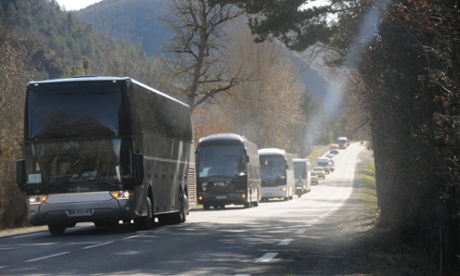
The families’ visit seemed all the more poignant to villagers because relatives did not yet have any identified remains and faced a long wait for any repatriation or funerals.
The work of recovering and identifying remains is likely to take weeks, if not months, officials said.
International forensics teams were working with mountain gendarmes but accessing the craggy slopes to locate the dispersed remains often involved absaling down by rope to inspect the debris in detail. One forensics expert told the local paper La Provence that the biggest body-part was “no bigger than a briefcase”. French media has described the plane wreckage as being “reduced to confetti”. DNA had been collected from relatives in order to aid in identification, as well as dental records.
“Hundreds of villagers in the valley have come forward to offer beds for the families,” the mayor of Seyne-les-Alpes has said, but most of the families will leave the village before nightfall to return home.
You can read the full piece on the families’ arrival and town’s shock here.
Updated
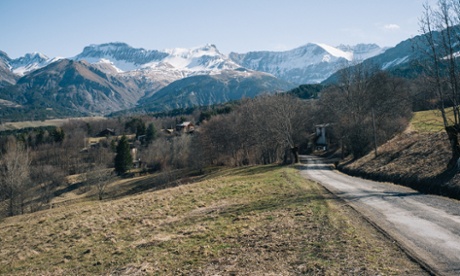
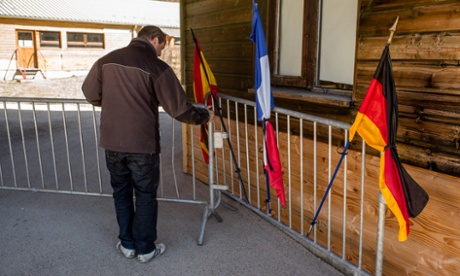
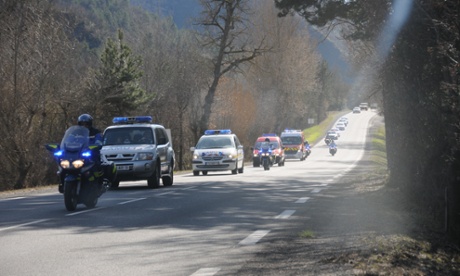
“I saw debris scattered over a wide area, small fragments of the plane, each no bigger than a book. I was shocked that there was so little left,” a local mountain guide has told the Guardian’s Angelique Chrisafis (@achrisafis), reporting from the mountain village of Seyne-les-Alpes near the site of the crash.
“It’s unthinkable,” said Guy Brunet, the village butcher and a mountain-climber and hunter. “Imagine if he had done this only 150 metres before, the plane could have hit the village. It would have been absolute carnage.”
Jean-Louis Bietrix, a mountain guide and local councillor in nearby Prads-Haute-Bléone, who had led the first gendarme teams onto the site of the crash shortly after the Barcelona to Dusseldorf flight went down, said: “This new element must make it so much worse for the families, it really adds to their grief. I think it will be so much harder now.”
Guy Derbez, who was mayor of Seyne-les-Alpes in the 1970s and 80s, said the latest revelations about the co-pilot’s deliberate act had left locals confused and struggling for explanations. He hoped the truth would emerge in the coming days. “A suicide that also took 149 people to their deaths seems hard to conceive.”
“If he wanted to kill, then it must be seen as an attack in itself. Nothing happens gratuitously when there are 150 deaths,” he said.
Updated
Robert Tansill Oliver, father of an American victim, speaks about the loss of his 37-year old son.
Oliver’s son, Robert Oliver Calvo, was born in Barcelona but was an American citizen. He worked for the Barcelona-based clothing company Desigual.
Lubitz had passed all the psychological and physical tests required for training, Lufthansa chief executive Cartsen Spohr has said, as anecdotes and small details of the co-pilot believed responsible for the crash emerge.
A neighbour of Lubitz told Germany’s daily newspaper Bild that he hadn’t known the co-pilot, but had seen him when he was out jogging.
“He always seemed very polite and always said hello and I said hello back, but we never got into a conversation,” he said.
Asked about Lubitz’s family, the neighbor said there wasn’t a strong sense of neighbourliness in the area. However, he added that he refused to believe the news before it was proven 100 percent. “I can’t believe that anyone would have the heart to commit such a selfish act.”
You can read our profile of Lubitz here.
In Berlin, Merkel says that the background to the crash was still unclear, Louise Osborne reports.
“It is and remains important that further inquiries take place and that every aspect is further investigated,” Merkel said.
Investigators are likely to delve into Lubitz’s personal life to uncover any clues about his mental state. “The very first thing the aviation authorities and investigators will do is go through his personal background and look at his professional life, in terms of his relationships, finances, flying record and medical record,” the aviation psychologist Robert Bor said.
“They will also be interviewing pilots he has flown with over the last few weeks to see if there is anything about his behaviour, attitude or professional conduct that could be potentially relevant here.
“It’s an extremely rare thing for a pilot to crash his own plane.”
You can read a profile of Lubitz by Louise Osborne and Luke Harding here.
“This is an unbearable tragedy … this information leaves us without words,” German chancellor Angela Merkel has said.
“What I want to say today is that this is a crime against all the victims and families involved,” she continued.
Reporting on the crash site, ABC’s Hamish Macdonald says the commander in charge of recovery operations has just briefed reporters.
“I won’t do any description of what my guys saw on the ground. It is not a show. We have to respect the victims,” the commander said. His team “arrived and felt a sense of cold. … The mission is not easy but they are soldiers.”
Macdonald reports that between 250 and 300 family members have arrived at the site, and have been asked to provide DNA samples to assist in identifying the victims. “Some want to stay for several days but most will be leaving tonight,” he tweets.
There will be a mass in honor of the victims on Saturday morning at Notre Dame du Bourg Cathedral in Bourg, in Digne #Germanwings
— Hamish Macdonald (@hamishNews) March 26, 2015
Andreas Lubitz left few clues online as to why the 28-year-old co-pilot might have crashed the plane, my colleague Luke Harding reports.
Lubitz’s now-deleted Facebook suggests that he was an average enough young man – interested in flying and gadgets, as befits a pilot, as well as electronic music, discos and ten-pin bowling.
He liked include Lufthansa and LFT Bremen, one of five Lufthansa facilities around the world offering pilot training, and linked to the airbus A320 technical site and to Beechcraft Bonanza, a page dedicated to an American six-seater light aircraft. There is a mention of Alexander Gerst, the German astronaut who last year blasted off to the international space station.
Much of Lubitz’s social life appears to have taken place in the nearby city of Koblenz. There are links to a climbing wall located in a forest, a Burger King branch, a local bowling alley, Pinup, and one of Koblenz’s nightclub’s, the Agostea Nachtarena. Lubitz hints that his favourite music acts is Paul Kalkbrenner, a German electronic producer, and David Guetta, a French DJ turned record producer.
The pilot also appears to have had a sense of humour. One website on Lubitz’s Facebook profile is “Wenn Männer Allein Sind” or “When Men are Alone” – not a place for lonely singles but a humorous website which includes videos of men fooling about with chainsaws on frozen lakes, or haplessly looking after babies.
Updated
Summary
Here are the key developments in the aftermath of the Germanwings crash.
- The co-pilot forced the plane into the descent that led to the disaster, the Marseille public prosecutor said, after locking out the captain from the cockpit. “It was a voluntary action,” said the prosecutor, Brice Robin. The intention was “to destroy the aircraft”.
- The co-pilot deployed a five-minute override when the captain, who had left the cockpit briefly, tried to re-enter by punching in an emergency number into the door.
- Unlike in the US, European regulations do not require two people in the cockpit at all times. Lufthansa does not voluntarily implement such a protocol, and the company said that it was not aware of any of its competitors that have such a procedure.
- The co-pilot was named as 28-year-old Andreas Lubitz, who had been flying for Germanwings since September 2013 after being trained with Lufthansa at its facility in Bremen and in the US. He had clocked up a total of 630 hours in the air.
- Lufthansa revealed that Lubitz’s training in 2009 had been briefly interrupted, but was resumed after “his suitability as a candidate was re-established”. Asked about the reason for the interruption, the CEO, Carsten Spohr, said he was not allowed to say.
- Spohr said the company was in complete shock. It was “beyond our worst nightmare”, he said. “It leaves us absolutely speechless. I wouldn’t not have been able to imagine that the situation would have got even worse.
- Relatives of the victims arrived in the hamlet near the crash site in the Alps as work continues in retrieving remains and their identification. This may last at least until the end of next week. The second black box has not been found yet.
Updated
A Spiegel reporter, Matthias Gebauer, is tweeting that friends of Lubitz said he had burnout or depression in 2009 and had to take time out from his pilot training. During the Lufthansa press conference there were questions as to why Lubitz interrupted his training, but there were no definitive answers.
freunde von #4U9525 co-pilot berichten, andreas lubitz habe 2009 auszeit von flugausbildung wg burnout-syndrom oder depression genommen
— Matthias Gebauer (@gebauerspon) March 26, 2015
The question of suicide arose during today’s press conferences, although Brice Robin, the French prosecutor said: “When you commit suicide, you die alone. With 150 on the plane, I wouldn’t call that suicide.”
There have been other cases where the pilots appear to have deliberately crashed their planes. The Aviation Safety Network site cites the case of Egypt Air Flight 990, a Boeing 767, which crashed in 1999, 30 minutes after taking off from New York JFK, killing 217 people. During the investigation it was suggested that the accident was caused by a deliberate act by the relief first officer. However, the suggestions of a deliberate act were heavily disputed by Egyptian authorities.
Updated
Le Figaro website has a few details on Lubitz via RTL radio. He was a member of a private flight club, LSC Westerwald, and was a running enthusiast.
A resident of Montabaur who knew the pilot, said: “He was completely normal. He was very happy to have his job. He was satisfied and happy. He had attained his dream of having become a professional pilot after being an amateur. He had no problems. I did not think he could do such a thing.”
Lufthansa press conference summary
Heres a summary of the Lufthansa press conference, largely given by the company chief executive, Carsten Spohr.
- Lufthansa confirmed that co-pilot Andreas Lubitz appeared to have prevented the captain from re-entering the cabin after a toilet break, and placed the Airbus A320 into the dive that resulted in the crash that killed all 150 on board.
- Spohr said the company was in complete shock. It was “beyond our worst nightmare”, he told reporters in Cologne. “It leaves us absolutely speechless,” he said. “I wouldn’t not have been able to imagine that the situation would have got even worse.”
- Spohr said that despite the disaster, Lufthansa had full confidence in its training and pilot screening procedures. These would nevertheless be reviewed, he said.
- Unlike in the US, European regulations do not provide for two people to be in the cockpit at all times, Spohr said. Lufthansa does not voluntarily implement such a protocol, and Spohr said that he is not aware of any of the company’s competitors that have such a procedure.
- Spohr said that it appears the captain punched in the emergency number into the cockpit door to gain entry, but the co-pilot deployed the five-minute over-ride. He said that, irrespective of all the sophisticated safety devices, “you can never exclude such an individual event”, adding “no system in the world could manage to do that”.
- Asked about the theory that the co-pilot killed himself, he demurred. “We can only speculate what might have been the motivation of the co-pilot. In a company that prides itself on its safety record, this is a shock. We select cockpit personnel carefully.”
Updated
Spohr is asked by NBC news whether there are any regulations that require a flight attendant to be the cabin if one of the pilots leaves - a question that was addressed earlier. In English, he acknowledges that US federal regulators require a second member of the flight crew to be in the cockpit. says unlike the US, no flight attendant is required to be in the cockpit when one of the pilots leaves it. Asked about speculation about suicide, he demurs.

Spohr says that, despite the crash, he has confidence in the screening and training procedures of Lufthansa and Germanwings pilots. He insists training procedures are sound, but they will nevertheless be re-examined.
A correction to the name of the company spokesman: it is Carsten Spohr, the chief executive of Lufthansa, the parent company of Germanwings, not Thomas Winkelmann, the chief executive of Germanwings.
Spohr is asked whether Germanwings or Lufthansa protocols provide for a second member of the flight crew to be in the cockpit if one of the pilots leaves. He says that the company does not have such a protocol, that European regulations do not require it, and that he is not aware of any of the company’s competitors that have such a procedure.
Asked by the New York Times whether the pilot did anything wrong by leaving the cockpit, Spohr said that he did not.
Updated
Spohr said earlier that there was an interruption to Lubitz’s training. Responding to a question, He says he can’t shed any light on this and adds that it will be have to be investigated. In response to a question about people’s fears of planes after the crash, he insists that flying is the safest mode of transport.
Updated
Spohr addresses the issue of cockpit safety. “What has happened here is a tragic individual event,” he says. “We are trying to deal with an enigma.” No systems could prevent such an event, he says.
He acknowledges that, in response to terror threats, cockpit doors have been reinforced such that they cannot be opened even “by weapons”. The doors can only be opened by pilots using a code that all air crew know off by heart. But this can be over-ridden from the cockpit. So even if the pilot entered the code in the door from the outside, the co-pilot would have been able to press a button that deployed a five-minute over-ride.
Updated
The co-pilot started training in 2008, first worked as a flight attendant. Spohr said there was nothing unusual in the results of Lubitz’s training. “This is by far the most terrible event in the company’s history,” he says.
Updated
Lufthansa press conference
The Lufthansa/Germanwings press conference in Cologne has started. Carsten Spohr, the chief executive of Lufthansa, parent company of Germanwings, confirms what we learned from the Marseille prosecutor earlier, that the co-pilot appears to have prevented the pilot from re-entering the cockpit. “It leaves us absolutely speechless,” the spokesman says.
I can only repeat what I have said over the last few days. We are really deeply shocked and I wouldn’t not have been able to imagine that the situation would have got even worse.
Updated
Reaction from Germanwings to the shocking news from Marseille.
We are shaken by the upsetting statements of the French authorities. 1/3
— Germanwings (@germanwings) March 26, 2015
The German transport minister, speaking at a press conference in Berlin, describes the Marseille revelations as shocking. He says the theory of a deliberate crash is plausible.
The Spanish prime minister, Mariano Rajoy has expressed his distress at the revelations from Marseille.
Conmocionado por los últimos datos facilitados por los investigadores. De nuevo nuestro abrazo emocionado a las familias. MR
— Mariano Rajoy Brey (@marianorajoy) March 26, 2015

We are now waiting for a Lufthansa press conference in about 15 minutes.
Co-pilot Andreas Lubitz – what we know
Andreas Lubitz, 28, from the small town of Montabaur in Rhineland-Palatinate, was named during a press conference on Thursday as the co-pilot of Germanwings flight 4U9525, writes Louise Osborne in Berlin.
A first officer, Lubitz had been flying for Germanwings since September 2013 after being trained with the airline’s parent company Lufthansa at its facility in Bremen. He had clocked up a total of 630 hours in the air.
Members of the Luftsportclub Westerwald, a flying club, of which Lubitz had been a member since he was a teenager in Montabaur, said it had been his dream to fly.
“Andreas became a member of the association and wanted his dream of flying to be realised. He began in the gliding school and made it to become a pilot,” read a statement on the club’s website.
Meanwhile, Lubitz was also described by neighbours as being friendly and pursuing his dreams “with vigour”. One told the local newspaper, the Rhein Zeitung that he had kept fit through running, “How often we saw him jogging past our house.”

Kim Willsher, in Paris for the Guardian, has filed a first news report on the dramatic Marseilles press conference. Here are the opening few paragraphs.
The co-pilot of the Airbus A320 that crashed on Tuesday, killing 150 people, appears to have deliberately flown the plane into a mountain after locking the flight commander out of the cockpit.
During the last eight minutes of the flight, the co-pilot “voluntarily” carried out actions that led to the destruction of the aircraft, Brice Robin, a French public prosecutor, said at a press conference in Marseille.
Robin said the co-pilot could be heard breathing right up until the point of impact, suggesting he had not lost consciousness. However, he failed to respond to increasingly desperate calls from the commander trying to break down the cockpit door, or to air traffic controllers.
The Marseille public prosecutor is giving a press conference on the latest developments in the investigation into Tuesday’s plane crash.
Robin named the co-pilot as 28-year-old Andreas Lubitz and outlined the last moments of the doomed plane in a chilling account of his actions.
“For the first 20 minutes of the flight, the pilots spoke in a normal way, you could say cheerful and courteous,” Robin said. “We heard the flight commander prepare the briefing for landing at Düsseldorf and the response of the co-pilot seemed laconic. Then we heard the commander ask the co-pilot to take the controls.
“We heard at the same time the sound of a seat being pushed back and the sound of a door closing.”
Robin said it was assumed that the flight commander needed to go to “satisfy natural needs” – in other words, use the toilet.
Updated
Summary of prosecutor's press conference
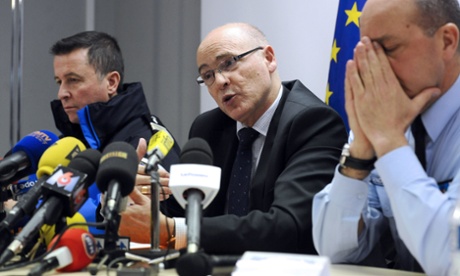
Here are the main points of the press conference held by the Marseille public prosecutor, Brice Robin.
- The co-pilot of the Germanwings jet that crashed in the French Alps deliberately forced the plane into the descent that led to the disaster, the prosecutor said. He pressed a button that accelerated the Airbus A320’s descent when alone in the cockpit. “It was a voluntary action,” Robin said.
- The co-pilot – named by the prosecutor as Andreas Lubitz, 28, a German citizen – was alone because the pilot had gone to the toilet. When he returned, the co-pilot refused to open the door. “The intention was to destroy this plane,” he said.
- Lubitz was breathing normally at the point of impact, the prosecutor reveals. He said nothing during the final descent, which lasted about 10 minutes. “Absolute silence inside the cockpit. Nothing, no word during the last 10 minutes.”
- There was no indication that Lubitz’s actions amounted to terrorism, Robin said. But he stopped short of declaring it suicide, saying only that was a “legitimate” question to ask.
- Cries could be heard just before the impact, the prosecutor said. “The death would have been sudden, immediate.”
- Air traffic controllers attempted to contact the plane in the last few minutes before the crash but received no reply from the cockpit.
- Robin said he had briefed the families of the dead.
Updated
*Update: This “The Aviation Business Gazette” page appears to be fake and in a surreal twist the site itself appears to be an invented publication with several identical pages owned by a private domain user, Newsweek reports.
The FAA database in question only shows that Lubitz held a private pilot (foreign based) license, only valid with his German pilot license number.This was confirmed by an FAA spokesperson, who said: “He only has a private pilot certificate, he does not have any honours or awards to his name given by the FAA.”
Original post:
The Aviation Business Gazette has this information on Lubitz.
The Federal Aviation Administration (FAA) is recognizing Andreas Guenter Lubitz with inclusion in the prestigious FAA Airmen Certification Database.
The database, which appears on the agency’s website at www.faa.gov, names Lubitz and other certified pilots who have met or exceeded the high educational, licensing and medical standards established by the FAA.
(This post was corrected at 12.40pm ET.)
Updated
The recovery of the bodies will go on probably until the end of next week. The family of the co-pilot have left Marseille and returned to Germany.
Updated
Co-pilot named as 28-year-old Andreas Lubitz
The prosecutor names the co-pilot is named as Andreas Lubitz, a 28-year-old German citizen.
He again rules out a terrorist motive for Lubitz’s actions. “There is no element that indicates this is a terrorist action.” Robin stops short of saying that it was an attempt by the co-pilot to kill himself – but he appears to be leaning towards that conclusion. “I can’t call this a suicide, but it is a legitimate question to ask.”
There was no contact between Marseille control tower and the plane, despite numerous efforts to contact the plane in the last few minutes.
Robin hints at the ordeal of the passengers. He said that, shortly before the impact, cries could be picked up by the cockpit voice recorder. “Death was sudden and immediate,” says Robin.
Updated
This from Reuters on this very dramatic press conference.
The co-pilot of a Germanwings jet that went down in the French Alps, killing 150 people, appears to have crashed the plane deliberately, a Marseille prosecutor said on Thursday.
The German citizen, left in sole control of the Airbus A320 after the captain left the cockpit, refused to re-open the door and pressed a button that sent the jet into its fatal descent, the prosecutor told a news conference carried on live television.
Robin does not know ethnicity of co-pilot, says he was German. “We do not have sentiment that there was panic (in cockpit) as he was breathing normally.” He is requesting as much information as possible on co-pilot.
Co-pilot not known as terrorist
“I think he refused to open the door and turned the button to get down the plane. It was a voluntary action on the part of the co-pilot... He is not known as a terrorist, absolutely not.”
“Absolute silence inside the cockpit. Nothing, no word during the last 10 minutes.”
Robin declines to call the co-pilot’s action a suicide. “He had no reason to disable contact with other planes,” says Robin. His breathing was normal, Robin repeats. “We could hear the cries minutes before the plane crashed.”
Co-pilot did not utter a single word
The co-pilot is German, says Robin. “He was breathing normally, he did not utter a single word” after the pilot left the cabin.
'The intention was to destroy this plane'
Robin says most plausible interpretation is that co-pilot refused to open the door to the pilot and he took the plane down. “The intention was to destroy this plane”.
Marseille prosecutor says co-pilot put plane into a dive
The co-pilot of the doomed Germanwings A320 “deliberately” put the aircraft into a dive and was alive until the moment of impact, said the Marseilles prosecutor Brice Robin, citing a transcript of the last 30 minutes of the cockpit voice recorder.
The first 20 minutes of conversation between the pilot and co-pilot was amicable, then the co-pilot took over when the pilot left to make a “natural call”.
At this point, the co-pilot accelerated the plane’s descent using the keys of the monitoring system. The prosecutor described it as a “deliberate” action.
In the remaining 10 minutes there are a number of appeals by the pilot to get access to the cockpit but there was no access, the prosecutor said. The pilot knocks on the door but there is not response. There is the sound of breathing from the co-pilot until impact.
Updated
A briefing by the Marseille prosecutor is about to start.
Only one pilot was in cockpit at time of crash
This just in from Reuters.
A German state prosecutor confirmed on Thursday that only one of the two Germanwings pilots was in the cockpit when a flight to Duesseldorf from Barcelona crashed in the French Alps this week.
”One was in the cockpit and the other wasn’t,” Christoph Kumpa at the prosecutors’ office in Duesseldorf told Reuters by telephone, adding that the information came from investigators in France.
Prosecutors from both countries are looking into the cause of the accident.Kumpa said he did not know whether it was the captain or the co-pilot who was in the cockpit. Neither Germanwings or parent company Lufthansa has released the identity of the two pilots.
Emmanuel Mistrali, an Air France pilot, tells Le Monde it is possible to lock yourself in in the cockpit.
The goal since 9/11 is to prevent access to the cabin by a terrorist or a sick person. The door is armoured. There is emergency access through a digital code, when the crew can’t get a reply from the pilots in case of sickness. This code triggers an alarm in the cockpit: if the pilots do not reply, the door opens. But the digital code can be neutralised by the pilots.
This is a safety video about the reinforced cockpit door on an Airbus, made in response to 2001 regulations designed to make cockpits more secure. The video, released by Airbus Group in 2002, explains the step-by-step procedure to operate the reinforced cockpit door.
One of the officials leading the emergency teams has told Le Figaro that today’s two goals will be to retrieve human remains and continue the search for the second black box, the data recorder. The voice recorder was found yesterday, giving rise to those reports that one of the pilots was locked out.
As we await today’s briefings, the first grieving relatives should be arriving near the crash site. Angelique Chrisafis is in Le Vernet and has sent this report.
In Le Vernet, a tiny hamlet of mountain homes that is the nearest inhabited point to the crash site of the Germanwings flight 4U9525, villagers were preparing for the arrival of families wanting to contemplate the Alpine landscape where their loved ones died.
From a field in front of a holiday centre, locals came to watch gendarme helicopters fly over snow-capped peaks and beyond into the area where the debris lay. The crash site, tucked behind the mountain peaks, is not visible except from helicopters.
This field, looking up on to the staggering view of snowy mountain tops, is the closest families will be able to get to the site of the tragedy, where remains were still being located scattered across the craggy rock-face.
Jean-Louis Bietrix, a mountain guide and local councillor in nearby Prads-Haute-Bléone, had guided the first mountain gendarme teams to the crash site shortly after the flight went down on Tuesday.
“It’s a very difficult, steep terrain of rock with no trees and no paths,” he said.
You can read her despatch in full here.
In a dramatic development, reports emerged overnight that one pilot left the cockpit before the plane’s descent and could not get back in. The information came from a cockpit voice recorder recovered from the Germanwings flight 4U9525 that crashed on Tuesday, killing all 150 on board.
A senior military official involved in the investigation told the New York Times that there was a “very smooth, very cool” conversation between the two pilots during the early part of the flight from Barcelona to Düsseldorf.
Later in the recording, the audio reportedly suggests that one of the pilots left the cockpit and could not re-enter. The audio gives no indication of the condition of the pilot who remained in the cockpit.
“The guy outside is knocking lightly on the door and there is no answer,” the investigator told the New York Times. “And then he hits the door stronger and no answer. There is never an answer.
“You can hear he is trying to smash the door down.”
There are two scheduled briefings on Thursday, one in Marseille by a French prosecutor and one by Lufthansa.