The New York Times is reporting that there remains considerable uncertainty about the precise nature and severity of Andreas Lubitz’s psychiatric condition:
“A German hospital said it had evaluated Mr. Lubitz twice in the past two months but added that he had not been there for assessment or treatment of depression.”
Lufthansa has offered to pay up to €50,000 in immediate financial assistance per passenger on the crashed plane of its subsidiary Germanwings, a spokeswoman told Reuters on Friday.
Summary
Here are the latest updates on the investigation of the Germanwings crash in the French Alps that killed 150 people.
- Investigators searching the Düsseldorf apartment of Andreas Lubitz have found evidence he hid an illness from his employers, prosecutors said. The evidence is a torn-up doctor’s note, signing him off work on the day of the crash. Germanwings said they received no medical note from Lubitz for the day of the crash.
- Dr Hans-Werner Teichmüller, president of the Deutsche Fliegerarztverband, an association of German doctors who carry out examinations on pilots and flight crew, has expressed shock at the co-pilot’s alleged actions. He said: “It’s utterly irresponsible that he flew even though he had a certificate saying he was not ready to work … Everything he did was highly criminal.”
- Düsseldorf University hospital has denied that Lubitz was treated for depression there, though he was given a “diagnostic evaluation” on 10 March.
- Mental health experts have cautioned against blanket assumptions for people with depression, or any other illness. Mind says there will be pilots with experience of depression who have flown safely for decades, and assessments should be made on a case by case basis.
- The father of one of the three American victims, Robert Oliver Calvo, said he feels sad for Lubitz’s parents and has no anger towards their son.
- Multiple European airlines have announced the immediate introduction of new rules for the cockpit that require requirement there to be two authorised people in the cockpit at all times. The European Aviation Safety Agency has also send a directive encouraging airlines to adopt these rules.
- Colonel Patrick Touron, deputy director of the Institute for Criminal Research at the National Gendarmerie, confirmed that the team has identified remains that are now being examined. French police said that they have recovered between 400 and 600 pieces of remains from the 150 people who died in Tuesday’s disaster. Not one intact body has been found.
Luke Harding has the latest from Lubitz’s hometown of Montabaur, Germany, where his neighbors are condemning those who have rushed to judge the 27-year-old.
For a year before embarking on a career as a pilot, Andreas Lubitz worked in his local branch of Burger King, serving up french fries. The restaurant – on a busy A3 junction – is a few kilometres outside the small German city of Montabaur where Lubitz grew up. The branch manager, Detlef Aldolf, described Lubitz on Friday as dependable and inconspicuous. He earned €400 (£290) a month, he said, and quit his part-time job to join Lufthansa.
In 2009, however, Aldolf said Lubitz abruptly reappeared. Lufthansa had sent him on a training course, initially in Bremen and then in Phoenix, Arizona, in the US. “I asked him how it was. He replied: ‘Too much stress. I’m going to take a break’,” Aldolf said. The manager added that Lubitz didn’t formulate this stress as depression. But, he said, the future pilot seemed overwhelmed.
Michael Bloomfield, a research fellow in psychiatry at Imperial College London, writes for The Guardian about what could account for the steady breathing heard from the cockpit in the final minutes before the plane crashed.
Clearly we need to wait for investigations to be concluded, but it may be possible to deduce critical clues to Lubitz’s state of mind by listening to his breathing, which could reflect his physiological and psychological state in those final moments. Simply put, despite knowing the command to descend the plane would result in his and everyone else’s death, despite the pilot attempting to bang the door down, despite the alarms from the computers, despite seeing the mountains become dangerously close, and ultimately despite hearing the screams from those on board – was Lubitz calm or panic-stricken?
The father of one of the three American victims, Robert Oliver Calvo, said he feels sad for the parents of co-pilot Andreas Lubitz, who is said to have deliberately crashed the plane.
Updated
Lufthansa, the parent company of Germanwings, may have to pay claims into hundreds of millions of pounds, reports Jon Henley.
“To avoid paying unlimited compensation, they have to show the crash was not due to negligence, omission or a wrongful act either by them, or by their servants or agents,” said Clive Garner, head of aviation law at legal firm Irwin Mitchell, which has represented passengers’ families in similar cases.
“We should be cautious, of course. But in reality, based on what we know at this point, they are not going to be able to establish that. Whether it was a deliberate act or negligence, they’re going to be liable for a large sum of money.”
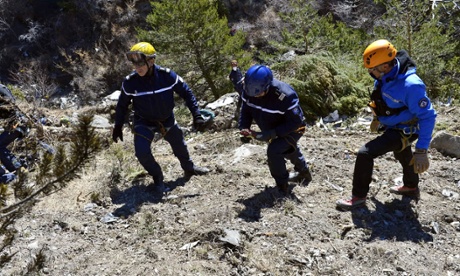
Investigators are taking DNA samples from victims’ families as they work to identify remains from the crash. The key is to select tissue with the least amount of DNA degradation, such as deep muscle tissue in the torso. If that is not available, investigators will typically seek skeletal tissue or dental records.
Forensic analysts explained the process to The Guardian in July 2014, after Malaysian Airlines Flight 17 was shot down over Ukraine.
If reference samples are not available, investigators can collect DNA samples from relatives, ideally parents or children who share half of each other’s DNA. Although entire families were killed in the crash, DNA can also be collected from relatives.
“When you start getting out to aunts and uncles and cousins and grandparents, you actually want probably three or four or five people to be able to make a good statistical argument that you’ve got a positive ID because you’re going to be sharing less and less DNA,” Dr David Foran said.
Nooreen Akhtar, a University of Aberdeen research training fellow, wrote for The Conversation about how the portrayal of Lubitz’s mental health issues effects pilots and professionals in other industries.
Will other airline pilots now fear for their jobs if they have been open about any prior struggles with low mood and depression? Will others now avoid seeking treatment?
These worries will not be limited to the world of aviation. What about doctors, chief executives or teachers. The latest statistics show that one in four of us will experience a mental health problem this year. So does this mean that 25% of pilots are at risk of committing similar acts to Lubitz?
The European Aviation Safety Agency has recommended that airline companies require at least two authorized people to be in the cockpit at all times. Two low-cost European carriers – easyJet and Norwegian Air Shuttle – have already announced that they would implement such a rule immediately, as Holly Watt reported earlier today.
This advisory, however, calls on all airlines to reassess the regulations they currently have in place. The air authority’s full statement:
The Agency recommends operators to reassess the safety and security risks associated with flight crew members leaving the flight crew compartment due to operational or physiological needs during non-critical phases of flight. Based on this assessment, operators are recommended to implement procedures requiring at least two persons authorised in accordance with CAT.GEN.MPA.135 to be in the flight crew compartment at all times, or other equivalent mitigating measures to address risks identified by the operator’s revised assessment. Any additional risks stemming from the introduction of such procedures or measures should be assessed and mitigated. National Aviation Authorities should ensure that operators under their oversight are aware of the content of this SIB.
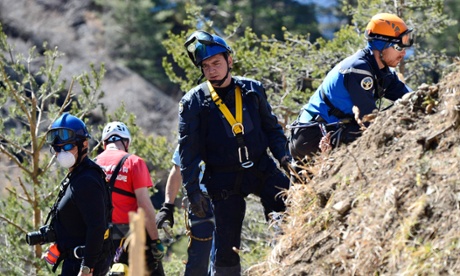
Kim Willsher in Paris has more on the identification process being used on the remains.
DNA samples are also being taken from objects provided by the victims’ families that could help with identification. Jewellery and other personal objects are being collected and photographed to help in the identification process.
Kim Willsher in Paris has an update on the difficult task of recovering the remains.
Colonel Patrick Touron, deputy director of the Institute for Criminal Research at the National Gendarmerie, gave a press conference near the crash zone.
“We have sent out an urgent medical-legal team to start identification and we have a team working on the site to recuperate the bodies, parts of bodies or biological matter, depending on the circumstances, so we can proceed with the identification of the victims,” Touron said.
“The air disaster was so devastating that we have not found a single body intact. We have found parts of bodies and biological matter that are currently undergoing post mortem examinations.”
Summary
- Investigators searching the Düsseldorf apartment of Andreas Lubitz have found evidence he hid an illness from his employers, prosecutors said. The evidence is a torn-up doctor’s note, signing him off work on the day of the crash. Germanwings said they received no medical note from Lubitz for the day of the crash.
- Dr Hans-Werner Teichmüller, president of the Deutsche Fliegerarztverband, an association of German doctors who carry out examinations on pilots and flight crew, has expressed shock at the co-pilot’s alleged actions. He said: “It’s utterly irresponsible that he flew even though he had a certificate saying he was not ready to work … Everything he did was highly criminal.”
- Düsseldorf University hospital has denied that Lubitz was treated for depression there, though he was given a “diagnostic evaluation” on 10 March.
- Mental health experts have cautioned against blanket assumptions for people with depression, or any other illness. Mind says there will be pilots with experience of depression who have flown safely for decades, and assessments should be made on a case by case basis.
- Lufthansa and other German airlines have announced the immediate introduction of new rules for the cockpit. There will now be a requirement for there to be two authorised people in the cockpit at all times.
- French police at the crash site say so far they have recovered between 400 and 600 pieces of remains from the 150 people who died in Tuesday’s disaster. Not one intact body has been found.
Updated
Britta Englisch, a Germanwings passenger, has posted a message on the airline’s Facebook page thanking the pilot for a highly personal message of reassurance. The Press Association has the story.
In the post, she said she boarded the flight from Hamburg to Cologne in Germany with mixed feelings.
“But then the captain did not only personally say hello to every passenger but gave a speech before take-off,” she wrote. “Not from the cockpit, but from the cabin. About how he and the crew had been affected by the tragedy. About how the crew feel strange as well, but all of them were there voluntarily. And about how he has a family too, the crew have families too, and that he will do anything to make sure he will arrive back with them in the evening. It was completely quiet. And then the whole plane applauded. I would like to thank this captain. For understanding what we all thought. And for making me feel good about the flight.”
The latest from Ben Knight in Berlin.
The Düsseldorf hospital mentioned by the Tagesspiegel newspaper has now put out a statement denying Lubitz was treated for depression there, though he was given a “diagnostic evaluation” on March 10. They said they would not give out any further details, but that reports that he was treated for depression are false.
Germanwings: 'No medical note presented'
Luke Harding has emailed from Montabaur on a new statement from Germanwings in which they say they were not aware of Lubitz’s sicknote.
“Media reports say that the co-pilot on FU 9525 had a sicknote for the day of the accident. Germanwings would like to clarify that no medical note was presented to the firm for this day.”
Updated
More from Ben Knight in Berlin:
The federal aviation office (LBA), Germany’s civil aviation office that administers pilots’ licences, has reportedly asked Lufthansa for Andreas Lubitz’s files, and said it would pass them on to the French investigators. “Anyone with a license must report to an approved aviation doctor once a year and receive a suitability certificate,” a spokesman said on news channel NTV’s website. He also said the widely-reported SIC (“Specific Regular Medical Examination”) mark on Lubitz’s file could pertain to any medical problem.
He adds that several German media outlets have reported on the nature of Lubitz’s illness, with different information:
-
Süddeutsche Zeitung says he had received treatment from several different psychiatrists, and that the sicknote in question was written by a neurologist/psychiatrist in the Rhineland. It also says the note wrote him off sick for some length of time.
- Berlin’s Tagesspiegel says he had been treated for depression at a hospital in Düsseldorf.
-
Bild is saying his training was interrupted for 18 months in 2009, and that he had been diagnosed with “severe depression.”
Updated
Pete Etchells, a lecturer in biological psychology at Bath Spa University, writes in the Guardian that way in which the UK press covered the news that Germanwings pilot Andreas Lubitz may have had depression is “abhorrent”.
He writes:
The only thing that we can be certain of at the moment is that an awful tragedy has happened that will have affected thousands of people. But making rushed and baseless claims about why it might have happened doesn’t do anybody any favours. If anything, it runs the risk of making it less likely that people coping with depression will want to speak up about their illness. We can, and should, be doing better than this.
Claims about Andreas Lubitz's mental health only serve to stigmatise depression | Pete Etchells http://t.co/TeyihkWn15
— Alexandra Topping (@LexyTopping) March 27, 2015
Updated
Dr Ali Haggett, Research Fellow, Centre for Medical History, University of Exeter, has said that it was “premature” to comment on the mental health of Andreas Lubitz.
However, if it is confirmed that he had a history of mental illness and depression, what we do know is that disclosure and help-seeking is a significant problem for men and that, in the UK for example, 75% of suicides are in men. These statistics have remained relatively stable since the beginning of the twentieth century, and indicate that there is something very wrong with our ability to detect and treat mental health issues in men.
She goes on to say that men “often find it difficult to recognise symptoms of depression” and if they do recognise something is wrong men find it harder to seek help.
This is a complex problem, but is in part bound up with our western model of masculinity, which promotes strength and coping – both attributes that are threatened by the unfortunate association with mental illness and ‘weakness’. Disclosure is also complicated in occupations where it would affect a person’s fitness to practice (for example, the medical profession – where there has been consistently a higher level of drug and alcohol abuse and mental illness than in the general population). We know that men are more likely to self-medicate with alcohol and to present with psychosomatic or physical symptoms, which are less-obviously ‘psychological’ and may not be identified by the medical profession as having an emotional cause.
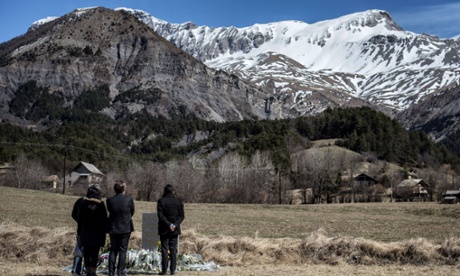
A monument to the victims of Germanwings flight 4U 9525 in Vernet has been covered in flowers

Dr Sarah Bailey, Senior Lecturer, Department of Pharmacy & Pharmacology, University of Bath, has said that it is damaging to speculate about a person’s mental health. She said:
We cannot comment on this co-pilots history - we know nothing about him and speculation about a person’s mental health is always damaging to that individual’s family and to others. We run the risk of stigmatizing people with depression.
We know that depression is an illness that occurs in episodes, and tends to recur. Depression is estimated to affect 1 in 6 adults in the UK. It is very common. When people are able to recognize their symptoms and access the right treatment then it is possible to lead a full life, including holding down a responsible job.
I am not aware that there are any studies linking suicide to mass death, it is presumably a very rare occurrence.
Lufthansa, together with other German airlines, has announced the immediate introduction of new rules for the cockpit. There will now be a requirement for there to be two authorised people in the cockpit at all times.
This from Ben Knight:
German airlines have introduced the two-person cockpit rule with immediate effect. The German Aviation Association (BDL), which represents the airline industry, released a statement saying that the airlines had voluntarily agreed to introduce the rule “following the tragic accident in France.”
Two authorised members of the flight crew must now be in the cockpit at all times. The BDL’s statement said the measure had been taken in coordination with the German transport ministry and the federal aviation office.
Lufthansa Group entwickelt Sicherheitsstrukturen weiter. Airlines der Lufthansa Group mit „Zwei-Personen-Regel“ http://t.co/OLxYwlMBKS
— Germanwings (@germanwings) March 27, 2015
My colleague Ben Knight in Berlin has been talking to the head of the Deutsche Fliegerarztverband, the German aviation doctors association who said it was “utterly irresponsible” to fly after a doctor had given him a certificate saying he was not fit for work.
Dr. Hans-Werner Teichmüller, president of the Deutsche Fliegerarztverband, an association of German doctors who carry out examinations on pilots and flight crew, expressed total shock at the co-pilot’s alleged actions.
“It’s horrible, it’s becoming more and more incomprehensible,” Teichmüller told the Guardian. “It’s utterly irresponsible that he flew even though he had a certificate saying he was not ready to work, and was therefore unfit to fly. Everything he did was highly criminal.”
He also talked about proposals, much-discussed in the German media in recent days, of introducing more thorough psychological tests for pilots.
“A standardised process that all budding pilots have to go through could very likely be introduced,” he said. “But a pilot that intends to do something like this could be skilful enough to pass as a well-structured person, even if they were in danger of suicide. Even with an examination process you wouldn’t have 100-percent safety.”
According to its website, the Fliegerarztverband is dedicated to standardising medical examinations for flight crews and air-traffic controllers based on the latest medical research. It also provides advice for doctors who examine pilots.
But Teichmüller said that his association had yet to begin discussing new measures. “The issue is still so new and charged - but what we could do is start referring pilots to psychiatric tests every five or six years for example,” he said. “But I think that’s something that lawmakers have to regulate.”
“We live in a society where if something like this happens, there have to be new discussions immediately,” he added. “The probability that something like this will happen again soon is not very high, thank God. I think the other measure being discussed, that two people always have to sit in the cockpit, I think that’s much better.”
Mind, the mental health group, has echoed the Royal College of Psychiatrists in cautioning against blanket judgements on depression. It makes the point that pilots with depression have flown safely for years.
Clearly assessment of all pilots’ physical and mental health is entirely appropriate - but assumptions about risk shouldn’t be made across the board for people with depression, or any other illness. There will be pilots with experience of depression who have flown safely for decades, and assessments should be made on a case by case basis.
Today’s headlines risk adding to the stigma surrounding mental health problems, which millions of people experience each year, and we would encourage the media to report this issue responsibly.
The Royal College of Psychiatrists have issued a statement about the GermanWings plane crash, urging caution around the discussion of co-pilot Lubitz’ depression.
Professor Sir Simon Wessely, President of the Royal College of Psychiatrists, said:
The loss of the GermanWings Airbus is a ghastly horror. Until the facts are established, we should be careful not to rush judgements. Should it be the case that one pilot had a history of depression, we must bear in mind that so do several million people in this country.
It is also true that depression is usually treatable. The biggest barrier to people getting help is stigma and fear of disclosure. In this country we have seen a recent fall in stigma, an increase in willingness to be open about depression and most important of all, to seek help.
We do not yet know what might be the lessons of the loss of the Airbus, but we caution against hasty decisions that might make it more, not less, difficult for people with depression to receive appropriate treatment. This will not help sufferers, families or the public.
My colleague Ben Knight in Germany has translated the main points of the statement from the German Prosecutors office. It reads:
Düsseldorf prosecutors’ press release on search of house:
The measures have not led to the discovery of a so-called suicide note or a confession. There are also no indications of a political or religious background to the incident.
But medical documents were found that indicate an ongoing illness and suitable medical treatment. Torn-up current medical certificates - also pertaining to the day of the act - were found, supporting, after preliminary examination, the assumption that the deceased hid his illness from his employer and his professional circles. Investigations as well as the assessment of the medical treatment documents will take some days. As soon as reliable findings emerge, we will inform relatives and the public.
The BBC are reporting that prosecutors found a torn-up sicknote that signed Andreas Lubitz off work on the day of the Alps crash.
The story states:
Alps crash co-pilot Andreas Lubitz hid the details of an existing illness from his employers, German prosecutors say.
They said there was no evidence of a political or religious motive to his actions, and no suicide note was found.
Duesseldorf prosecutors did not say what illness Mr Lubitz had.
But German media have said Mr Lubitz’s internal documents suggested he suffered depression and required ongoing assessment.
Mr Lubitz and 149 passengers and crew died when Germanwings flight 4U 9525 crashed in the French Alps on Tuesday.
Data from the plane’s voice recorder suggest Mr Lubitz purposely started a descent as the pilot was locked out of the cockpit.
In their statement, prosecutors said they seized medical documents from the Mr Lubitz’s home indicated “an existing illness and appropriate medical treatment”.
But “the fact that, among the documents found, there were sicknotes - torn-up, current and for the day of the crash - leads to the provisional assessment that the deceased was hiding his illness from his employer”, the report states.
Prosecutors found torn-up sick note that signed Andreas Lubitz off work on day of Alps crash http://t.co/4xPQFhvsuo pic.twitter.com/pRWqCPSF7J
— BBC Breaking News (@BBCBreaking) March 27, 2015
Updated
The Associated Press are also reporting that German prosecutors have found no sign of any political or religious motives for the Germanwings crash
BREAKING: German prosecutors: No evidence of political, religious background to Germanwings crash.
— The Associated Press (@AP) March 27, 2015
German prosecutors have said that no suicide note or claim of responsibility was found in the house of Germanwings co-pilot Lubitz.
BREAKING: German prosecutors: No suicide note or claim of responsibility from co-pilot found.
— The Associated Press (@AP) March 27, 2015
Breaking News
The Associated Press are reporting that Germanwings co-pilot Andreas Lubitz had hidden an illness from his employers.
BREAKING: German prosecutors: Indications Germanwings co-pilot hid illness from employers.
— The Associated Press (@AP) March 27, 2015
that https://twitter.com/AP/status/581421940155523072
CCTV NEWS, the English news channel of China Central Television, is reporting that china’s Civil Aviation Administration is looking to tighten rules requiring at least two crew members in the cock pit during flights.
China’s Civil Aviation Administration seeks tightened inspections on rule requiring at least 2 crew members in the cockpit during flights.
— CCTVNEWS (@cctvnews) March 27, 2015
CNN has an informative video about the safety history of the A320 Airbus.
In its history there have been:
- 12 deadly crashes
- 980 deaths on the planes or on the ground.
The Independent is reporting that pilots from around the world are urging people not to jump to conclusions about Germanwings co-pilot Andreas Lubitz.
Pilots are defending #Germanwings co-pilot Andreas Lubitz http://t.co/19DePGLPLZ pic.twitter.com/rrJY8zjX3B
— The Independent (@Independent) March 27, 2015
The Independent reports that Vereinigung Cockpit, known in English as the German Airline Pilots Association, said it was too quick to draw conclusions before the recovery of the second black box.
The flight data recorder contains detailed information about the plane’s operations and altitude to accompany audio from the cockpit.
Ilja Schulz, President of the association, said:
We should not rush to conclusions based upon limited data.
The reasons that led to this tragic accident will only be determined after all data sources have been thoroughly examined.
AFP have posted these pictures of investigators working on the crash site of the Germanwings Airbus A320.
Investigators working on crash site of the #Germanwings Airbus A320. Photo Anne-Christine Poujoulat #AFP pic.twitter.com/BfN4VUpfKs
— AFP Photo Department (@AFPphoto) March 27, 2015
Here is an extract from the latest Guardian story from my colleagues Luke Harding and Kim Willsher, which focuses on fresh revelations about the history of co-pilot Andreas Lubitz:
The investigation into Tuesday’s crash of the Germanwings plane that killed 150 people is focusing on the background of the co-pilot, who appears to have deliberately downed the plane in a rocky ravine in the French Alps.
Airlines around the world have scrambled to introduce rules to ensure two crew members are always in the cockpit, after investigators said first officer Andreas Lubitz locked the flight commander out of the cockpit before deliberately crashing the plane.
Live Germanwings crash: report that co-pilot Lubitz had suffered ‘personal life crisis’ - rolling updates
French prosecutor says co-pilot crashed plane deliberately as relatives of victims arrive in village near the crash site in French Alps
Investigators are looking into the background of Lubitz, who was 27, for clues as to why he may have wanted to take his own life - and to kill 149 other people as he did so.
On Thursday, Lufthansa’s chief executive, Carsten Spohr, revealed that Lubitz had interrupted his training in 2009, but refused to say why. He would only say that Lubitz was eventually cleared to return to work, after passing fitness and psychological tests.
On Friday however, the German newspaper Bild said that the Lufthansa flight school in Phoenix, Arizona had designated Lubitz at the time as “not suitable for flying”.
The newspaper said he spent a year-and-a-half receiving psychiatric treatment. Several times he was forced to repeat his flying classes because of depression, before he successfully finished his training. In 2009 he was diagnosed with a “severe depressive episode”, Bild reported.
He was given “special regular medical examination” by a doctor as well as the coding “SIC”. This coding also appeared on his pilot’s licence.
Citing police sources, Bild said the investigation is examining whether Lubitz had been suffering from a “personal life crisis”. He is said to have had a relationship crisis with his girlfriend and to have suffered emotional problems. The local Westerwälder newspaper said Lubitz and his girlfriend had been together for seven years and were living in a flat in Düsseldorf.
Lufthansa has yet to respond to the claims. Bild, Germany’s best-selling newspaper, is normally – though not always – a reliable source of news, and has an extensive network of sources.
Aviation consultant Gideon Ewers speaking on Sky, is questioning the French prosecutors “speculative” assertions in yesterday’s press conference. Any such information should only have been given after a complete technical investigation, he added.
I’m saying we have an incomplete picture. It ridiculous to make these accusations at this stage of an investigation.
Here is Reuters’ take on the background of Andreas Lubitz:
The pilot who appears to have deliberately crashed a plane carrying 149 others into the French Alps received psychiatric treatment for a “serious depressive episode” six years ago, German tabloid Bild reported on Friday.
Prosecutors in France, after listening to the cockpit voice recorders, offered no motive for why Andreas Lubitz, 27, would take the controls of the Airbus A320, lock the captain out of the cockpit and deliberately set it veering down from cruising altitude at 3,000 feet per minute.
Citing internal documents and Lufthansa sources, Bild said Lubitz spent a total of one and a half years in psychiatric treatment and that the relevant documents would be passed to French investigators once they had been examined by German authorities.
Lufthansa Chief Executive Carsten Spohr told a news conference on Thursday that Lubitz had taken a break during his training six years ago, but did not explain why and said he had passed all tests to be fit to fly.
“Six years ago there was a lengthy interruption in his training. After he was cleared again, he resumed training. He passed all the subsequent tests and checks with flying colors. His flying abilities were flawless,” Spohr said.
Good morning, this is Alexandra Topping taking over the Germanwings crash liveblog in London
Summary
Here’s what we currently know about the investigation into the Germanwings crash and Andreas Lubitz, the co-pilot who deliberately steered the plane into the Alps, killing all 150 people on board:
-
Investigators in Germany have been searching the Düsseldorf home of Andreas Lubitz, as well as a house in the town of Montabaur belonging to his parents, where he is believed to have spent much of his time. Officers removed several items from the property,including computers, and what one investigator said “may be a very significant clue”.
- A report in German newspaper Bild Zeitung claims Lubitz was forced to pause his training to be a pilot six years ago because he was suffering from “psychological problems”. Bild said the Lufthansa flight school in Phoenix, Arizona, designated Lubitz at the time as “not suitable for flying”.
None of this confirmed. But Bild is citing police sources and is generally - though not always - reliable. If true, v bad for Lufthansa
— Luke Harding (@lukeharding1968) March 27, 2015
- Attention had already focused on Lubitz’s mental health after Lufthansa revealed that Lubitz’s training in 2009 had been briefly interrupted. Friends of the pilot have reportedly said the break was because he was suffering from “burn-out syndrome or depression”.Others, however, said he showed no sign of unhappiness or stress.
- Twenty-seven-year-old Lubitz, a German who had been flying for the company since September 2013, was qualified, trusted and showed no signs of physical or psychological distress before the crash, Lufthansa CEO Carsten Spohr said. “You can never exclude such an individual event,” he said. “No system in the world could manage to do that.”
- But many airlines have said they will be now adopting a two-person cockpit rule. You can read a list here. The Canadian government ordered all national airlines to adopt the policy immediately. In Australia, prime minister Tony Abbott said airlines there would be reviewing their practices. Lufthansa, owners of subsidiary airline Germanwings, said it had no current plans to introduce such a rule.
- Aviation lawyers said Lufthansa and its subsidiary Germanwings could face huge legal liabilities “well above the typical ceiling in airline crashes” over the crash.

Updated
The Guardian’s Luke Harding, our former Berlin correspondent, reports a potentially alarming development coming out of the German newspaper Bild Zeitung.
There is no way of confirming this independently at the moment but the paper claims Lubitz stopped his training to be a pilot six years ago because he was suffering from “psychological problems”.
On Thursday Lufthansa’s chief executive Carsten Spohr declined to give details of his medical history.
The newspaper, however, said that the Lufthansa flight school in Phoenix designated Lubitz at the time as “not suitable for flying”.
He spent a year-and-a-half receiving psychiatric treatment, it said. Several times he was forced to repeat his flying classes because of depression, before he successfully finished his training. In 2009 he was diagnosed with a “severe depressive episode”, Bild reported.
He was given “special regular medical examination” by a doctor as well as the coding “SIC”. This coding also appeared on his pilot’s license.
Citing police sources, Bild said the investigation is examining whether Lubitz had been suffering from a “personal life crisis”.
Investigators will be trying to piece together the life of Andreas Lubitz, looking for a motive for his actions. Last night they could be seen removing items from his apartment in Dusseldorf as well as his parents home in Montabaur. The picture below clearly shows a computer being removed.

The New York Times, which yesterday broke the story that one of the pilots had been locked out the cockpit, also looks at pilot psychology.
A different piece here - but it makes for interesting reading.
The part of a pilot’s life that had to be utterly consistent was the routine of operating the aircraft. Personality was not supposed to be an issue in the cockpit.
The subject of mental health screening for pilots has been widely discussed following the crash. We reported this earlier.
AP has now filed a report interrogating this further, talking to US pilots about their experiences of screening.
In the US the Federal Aviation Administration requires that pilots receive a physical exam from a flight surgeon annually or every six months depending upon the pilot’s age.
The International Civil Aviation Organisation, a UN agency that sets global aviation standards, also requires that pilots receive a periodic medical exam including a mental assessment.
Technically, doctors are supposed to probe for mental problems, but pilots said Thursday that’s usually not how it works.
“There really is no mental health vetting,” said John Gadzinski, a captain with a major US airline and former Navy pilot. In 29 years of physicals from flight surgeons he’s never once been asked about his mental health, he said.
Bob Kudwa, a former American Airlines pilot and executive who maintains his commercial pilot’s license, said: “They check your eyes, your ears, your heart all the things that start going bad when you get older. But they don’t do anything for your head, no.”
There also is no confidential reporting, Gadzinski said. “If you had a mental health issue, you certainly wouldn’t tell your flight surgeon about that because it goes right to the FAA,” he said.
Pilots are also required to disclose existing psychological conditions and medications on health forms, Gadzinski said.
“Is this really the best way? Ask the guy who is mentally ill if he’s mentally ill and if he says ‘no’ then, hey, we’re good to go?” he said.
Europe has a single standard for pilot medical exams. “These medical assessments are done by doctors with a specialty in aviation health. ... They know what to look for, physically and mentally,” said Richard Taylor, a spokesman for the United Kingdom’s Civil Aviation Authority.
Summary
Here’s the latest on the investigation into the Germanwings crash and Andreas Lubitz, the co-pilot who deliberately steered the plane into the Alps, killing all 150 people on board:
-
Investigators in Germany have been searching the Düsseldorf home of Andreas Lubitz, as well as a house in the town of Montabaur belonging to his parents, where he is believed to have spent much of his time. Officers removed several items from the property, including computers, and what one investigator said “may be a very significant clue”.

- Attention has been focused on Lubitz’s mental health after Lufthansa revealed that Lubitz’s training in 2009 had been briefly interrupted. Friends of the pilot have reportedly said the break was because he was suffering from “burn-out syndrome or depression”. Others, however, said he showed no sign of unhappiness or stress.
- Twenty-seven-year-old Lubitz, a German who had been flying for the company since September 2013, was qualified, trusted and showed no signs of physical or psychological distress before the crash, Lufthansa CEO Carsten Spohr said. “You can never exclude such an individual event,” he said. “No system in the world could manage to do that.”

- But many airlines have said they will be now adopting a two-person cockpit rule. You can read a list here. The Canadian government ordered all national airlines to adopt the policy immediately. In Australia, prime minister Tony Abbott said airlines there would be reviewing their practices. Lufthansa, owners of subsidiary airline Germanwings, said it had no current plans to introduce such a rule.
- Aviation lawyers said Lufthansa and its subsidiary Germanwings could face huge legal liabilities “well above the typical ceiling in airline crashes” over the crash.
Tributes to the victims – in pictures


Andreas Lubitz carried out part of his pilot training in Arizona, ABC News reports.
He attended the Airline Training Center Arizona, owned by Lufthansa, in 2008.
Peter Ruecker, a member of the same flying club as Lubitz in Germany, told the Associated Press that the latter had talked to him about training in the US:
He seemed very happy that he got the job, beforehand he had training in the United States for three years, and we met him here again when he returned to renew his licence and we talked for some time.
He told us about how it was in America, how he did his training there, and he seemed to be very open and happy that he made it that far.

Updated
Friday’s front pages of some UK newspapers have already attracted some criticism on Twitter for their apparent lack of sensitivity in reporting the possible motivations of Andreas Lubitz in piloting the plane into the mountainside:
@S_Dockery I don't think the British papers have on the whole dealt with the issue of depression very sensitively though
— Josie Ensor (@Josiensor) March 26, 2015
Whatever is the cause of the #Germanwings tragedy, it is not 'depression'. All of you rely on people with depression every single day.
— Jack of Kent (@JackofKent) March 26, 2015
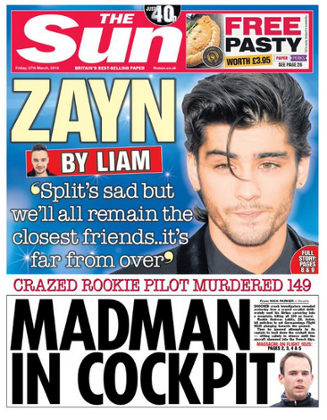
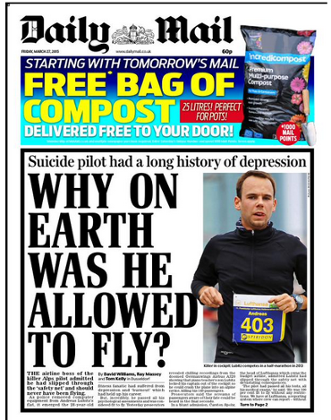
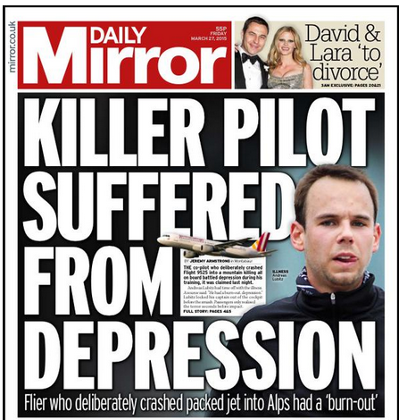
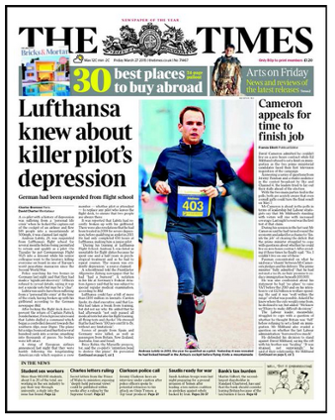
Here are some of the front pages in question; all images are courtesy of the BBC’s @hendopolis.
A reminder of what we know at this point about Lubitz’s mental health:
Lubitz had taken a break of several months from his pilot training. Carsten Spohr, Lufthansa’s chief executive, said there was nothing unusual about this but that he could not and “may not” give the reason for this for reasons of medical confidentiality.
The Lufthansa boss said the interruption in the training occurred six years ago. A journalist from Der Spiegel, reporting from Montabaur, cited acquaintances as saying that the break in 2009 was down to stress – “because of burnout or depression”.
Spohr said Lubitz was judged fit to resume the training scheme a few months later and then passed all the medical, psychological and flying tests. He went on to clock up 630 flight hours.
Spohr said Lubitz was “100% fit for flying”, but did not explain why he took a break of several months from his pilot training six years ago.
“We can only speculate what might have been the motivation of the co-pilot,” Spohr said.
Updated
Passengers flying since the revelations yesterday that the Germanwings co-pilot deliberately took down the plane can be forgiven for feeling apprehensive. This report from Bloomberg is telling of how pilots themselves are attempting to assuage fears:
An Air Berlin Plc pilot took it upon himself to tell passengers that he’d always have a second person in the cockpit during a German domestic flight from Stuttgart to Berlin, according to a Bloomberg reporter on the service.
“I guess you all boarded with a queasy feeling today,” the captain said. “I for myself decided to change procedures today. There will always be a second person in the cockpit.”
Airlines adopting two-person cockpit rule: round-up
An update on the airlines that have said they will also adopt the policy of having two people in the cockpit at all times:
Have changed their policy
- Monarch (UK)
- easyJet (UK)
- Virgin Atlantic (UK)
- Thomas Cook (UK)
- Air Canada (Canada)
- Westjet (Canada)
- Air Transat (Canada)
- Norwegian Air Shuttle (Norway)
- Air Berlin (Germany)
Already had a two-person rule
- Ryanair (Ireland)
- Aer Lingus (Ireland)
- Jet2 (UK)
- Flybe (UK)
- Porter (Canada)
-
The “rule of two” is routine for US carriers.
No current plan to change policy
- Lufthansa (Germany) – owners of subsidiary airline Germanwings.
- Air France-KLM Group (France/Netherlands) said it was “following developments … with keen attention”.
- In Australia, the federal government in in talks with domestic airlines to decide whether such a rule needs to be implemented.
No comment
- British Airways (UK) said it did not discuss “issues of security”.
We will update this list if more airlines adapt their procedures today.
The Canadian government has said that all Canadian airlines must have two crew members in the cockpit at all times following the Germanwings crash.
The order came from transport minister Lisa Raitt; I’ve taken her quotes from the Toronto Star:
In light of the reports this morning … I am issuing an order to require two members on the flight deck at all times on Canadian planes.
This order is seeking to fill a gap that is in the rules. Currently, there is not the requirement to have two members.
All we’re saying is that you have to have two crew members in the flight deck at all times. It doesn’t matter who it’s going to be. It could be a flight attendant, it could be a customer service person, but they have to be members of the cabin crew .
We are following this situation in Europe very closely. And I’ve asked my officials to take a look at all of our policies and procedures here in Canada that may be applicable to ensure that there is safety for the travelling public.
Airlines Air Canada, Westjet and Air Transat said they would adopt the new policy. Regional carrier Porter said this had always been its rule.
In the wake of the shocking revelation that Andreas Lubitz deliberately steered the plane into a mountain, several airlines have announced that they will implement a two-person cockpit rule:
Norwegian Air Shuttle was one of the first to announce the rule. “When one person leaves the cockpit, two people will now have to be there,” said Thomas Hesthammer, flight operations director for the budget operator. “We have been discussing this for a long time, but this development has accelerated things.”
The Canadian charter airline Air Transat also said it would be introducing the rule, while easyJet was the first airline in the UK to announce it would implement the rule from Friday. “The safety and security of its passengers and crew is the airline’s highest priority,” an easyJet spokesperson said.
US airlines have tended to take this precaution even before Tuesday’s accident.
But aviation journalist John Walton warns that there is more to cockpit security than this:
It seems clear many airlines are moving to two-person flight deck procedures after #4U9525. Simple fix and has merit, but not a panacea.
— John Walton (@thatjohn) March 26, 2015
The principal purpose of a 2-person flight deck rule, FYI, is so the second person can unlock the door to the other pilot. #4U9525
— John Walton (@thatjohn) March 27, 2015
He points out that a “rogue” pilot intent on bringing down a plane might still be able to prevent the door from opening. And he explains on this blog:
Under the strengthened cockpit door protocols put in place after the attacks of September 11, the door can be opened only at the discretion of flight crew on the flight deck …
As security expert Bruce Schneier explains, there were truly only two things that improved aviation safety in the post-9/11 world: ‘the reinforcement of cockpit doors, and the fact that passengers know now to resist hijackers’.
After Germanwings flight 9525 — as well as past questions raised by SilkAir 185, Egyptair 990, Royal Air Maroc 630, LAM 470 and other flights — is it time to revisit whether the security provided by passenger resistance might be enough, or whether adequate checks and balances have been built into flight deck security?
The Daily Mail quotes a spokesman for investigators involved in the search of Lubitz’s home in Düsseldorf, from which a computer and laptop were reportedly taken by officers:
We wanted to search to see if we could find something that would explain what happened.
We have found something which will now be taken for tests. We cannot say what it is at the moment but it may be very significant clue to what has happened. We hope it may give some explanations.
We have some more photos from the police operation to search the home of Andreas Lubitz in Düsseldorf:


Investigators have also searched the Montabaur home of Lubitz’s parents and have removed bags of items from the property:

Aviation lawyers: pilots alone in cockpit 'a known risk'
Lufthansa and its subsidiary Germanwings could face huge legal liabilities “well above the typical ceiling in airline crashes” over Tuesday’s crash, Reuters reports, citing aviation lawyers:
A lot will depend on whether the airline can defend itself against negligence claims given that prosecutors said on Thursday that a young German co-pilot locked himself alone in the cockpit of the Airbus A320 and set it on course to crash, killing all 144 passengers and six crew members.
An international agreement generally limits airline liability to around US$157,400 (£105,000, AU$200,000) for each passenger who dies in a crash if families do not sue, but if families want to pursue compensation for greater damages, they can file lawsuits.
Lawyers who have represented families in past airline disasters told Reuters on Thursday that potential lawsuits could focus on whether Germanwings properly screened the co-pilot before and during his employment, and on whether the airline should have had a policy requiring two or more people in cockpits at all times during a flight.
Justin Green, a partner at the law firm Kreindler & Kreindler in New York, said passengers’ families would be justified in asking why Andreas Lubitz was allowed to be alone in the cockpit.
Pilots may temporarily leave the cockpit at certain times and in certain circumstances, such as while the aircraft is cruising, according to German aviation law.
Even if the practice was allowed, though, “this has been a known risk,” Green said. He noted that some investigators believed that pilots intentionally downed a SilkAir aircraft in 1997 and an EgyptAir aircraft in 1999.
“This idea that one pilot could murder everyone on board and kill himself is something that’s happened before and something that everyone knew about,” Green said.
Lufthansa will abide by international agreements dictating liability, its chief executive Carsten Spohr said. “Honestly, it’s one of my smaller worries,” he told journalists on Thursday. “We will be able to meet the financial liabilities. Our first priority is to help the families where we can.”
Under an international agreement known as the Montreal Convention of 1999, an airline generally cannot escape liability for a passenger death.
For each death, a carrier can be liable for up to 113,100 special drawing rights, a reserve asset created by the International Monetary Fund. On Tuesday, the amount was equal to about $157,400, or $22.7m for 144 passengers.
The potential lawsuits for additional damages could be filed in any of several jurisdictions, including Germany, where Germanwings is based, and a number of different home countries of the passengers, such as Spain.
Passengers’ families are limited to claiming provable damages, which vary depending on the jurisdiction but may include loss of support and pain and suffering, the lawyers said.
Bruce Ottley, co-director of the International Aviation Law Institute at DePaul University College of Law, said he was sceptical that Germanwings would need to pay above the Montreal Convention limit unless there is evidence the airline knew in advance the co-pilot was at risk.
But Ottley said airlines choose to settle legal claims in the vast majority of crashes, so the issues may never go to a judge or jury. “Very rarely do these things ever, ever go to trial,” he said.
For Germanwings to limit its liability, it would have to establish that it and its employees and agents were not in any way at fault or that the accident had been caused solely by the fault of a third party, said Clive Garner, a partner at the law firm Irwin Mitchell in London. The firm has represented passengers’ families in other aviation accidents, including a crash in Nepal in 2012.
“Given this scenario and what we know at the moment, Germanwings would be unlikely to be able to establish a relevant defence,” Garner wrote in an email.
A $6.5m claim for the loss of the plane itself was paid on Wednesday, insurance industry sources said.
Germany’s Allianz is the lead insurer in the case, sharing the financial burden of the loss with other insurance companies.
Updated
Spanish newspaper El Pais also leads its Friday edition with the questions over why Lubitz forced the plane to descend:
Investigan la razón por la que el copiloto estrelló el avión; Arabia Saudí bombardea Yemen... http://t.co/iNlxYJigcv pic.twitter.com/mKfECtdr5j
— EL PAIS (@el_pais) March 26, 2015
Luke Harding adds these observations after scouring the local press:
According to Der Spiegel, citing friends of the pilot, Lubitz broke off his training because he was suffering from “burn-out syndrome or depression”.
Neighbours, however, said he showed no sign of unhappiness or stress. One friend quoted by the local Rhein-Zeitung newspaper posted on a social network: “Only yesterday we talked about what we could do after you got back. Every day you made me laugh …”
Others described Lubitz as a “completely inconspicuous” young man who could be often seen jogging round the neighbourhood.
Every spring between 2010 and 2013 he took part in the Lufthansa half marathon in Frankfurt, clocking up a time on his last run of 1 hour and 37 minutes. When not jogging he wore jeans, rather than his pilot’s uniform.
Updated
Meanwhile this was the scene earlier in Montabaur outside the home of Lubitz’s parents.

The papers have been rolling off the presses in Europe. Bild, the popular German tabloid has a different image of Lubitz.
BILD: Der Amok-Pilot #tomorrowspaperstoday pic.twitter.com/Y2wPeaVpq8
— Neil Henderson (@hendopolis) March 26, 2015
Updated
Our correspondent Luke Harding is in Montabaur. He has just sent this report:
German investigators have removed documents and a computer from the home of Andreas Lubitz in the small town of Montabaur, between Cologne and Frankfurt in the west of Germany.
Lubitz grew up in Montabaur – population 15,000 – and attended the local Mons-Tabor Gymnasium or grammar school. There was no sign of his parents who are believed to have gone to the crash scene in France.
Detectives were concentrating their search on two properties: Lubitz’s family home in Montabaur and a flat he is believed to have rented in Dusseldorf.
The family live in a large two-storey detached house, with a pleasant balcony, on Am Spiessweiher street, close to an apostolic church. Their garden is immaculately tended. It has daffodils, ornamental shrubs and a perfectly sculpted hedge. His mother played the organ in another evangelical church, neighbours said. Lubitz has a younger brother.
One local said that he knew Lubitz “by sight” and saw him from time to time working out in the town’s fitness centre. “I just knew him to look at. He was a sporting kind of guy,” he said.
Lubitz attended the Mons-Tabor school, which offers students a humanist education, and completed his German high school diploma, the Arbitur, there in 2007.
Police have been searching the home of Lubitz in the German city of Dusseldorf as well as the family home in the town of Montabaur.

Welcome back to our continuing coverage of the Germanwings crash.
The focus of the investigation has dramatically switched in the past 24 hours to focus on the co-pilot of flight 4U9525, Andreas Lubitz. It is now suspected he deliberately flew his plane, its passengers and crew into the side of a mountain in the French Alps, killing all.
Below is a summary of where we are with this tragic story and we will be updating as the day goes on.
Updated
Summary
Here are the major developments in the aftermath and investigation of the Germanwings crash in the French Alps that killed 150 people.
-
Co-pilot Andreas Lubitz drove the plane into the “fatal descent” that preceded the crash, a French prosecutor and the Lufthansa chief said, adding that Lubitz had locked the captain out of the cockpit. “It was a voluntary action,” said the prosecutor, Brice Robin. The intention was “to destroy the aircraft”, he said.
- Lubitz deployed a five-minute override when captain Patrick Sonderheimer tried to re-enter the cockpit after briefly leaving, thwarting Sonderheimer’s attempt to punch in an emergency number that would open the door.
- At least four airliners, including easyJet and Norwegian Air Shuttle, announced they would adopt new cockpit rules. Unlike many US carriers, European companies generally do not require two people in the cockpit at all times. Lufthansa does not voluntarily implement such a protocol.
- Twenty-seven-year-old Andreas Lubitz, a German who had been flying for the company since September 2013, was qualified, trusted and showed no signs of physical or psychological distress before the crash, Lufthansa CEO Carsten Spohr said. “You can never exclude such an individual event,” he said. “No system in the world could manage to do that.”
- Lufthansa revealed that Lubitz’s training in 2009 had been briefly interrupted, but was resumed after “his suitability as a candidate was re-established”. Asked about the reason for the interruption, Spohr said he was not allowed to say.
- Spohr said the company was in complete shock. It was “beyond our worst nightmare”, he said. “It leaves us absolutely speechless. I would not have been able to imagine that the situation would have got even worse.”
- Relatives of the victims arrived in the hamlet near the crash site in the Alps as work continued to recover and identify remains, an effort that could last weeks. The second black box – the flight’s data recorder – has not been found yet.
Updated