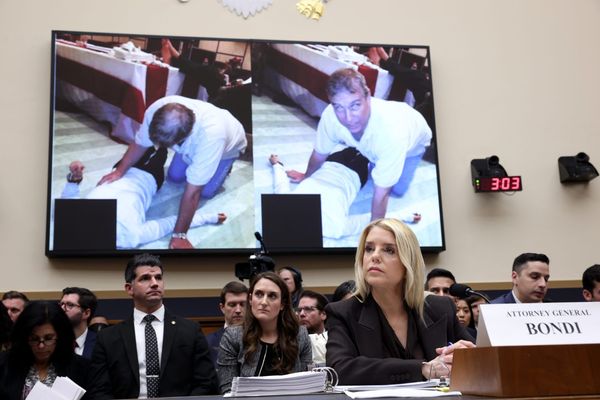
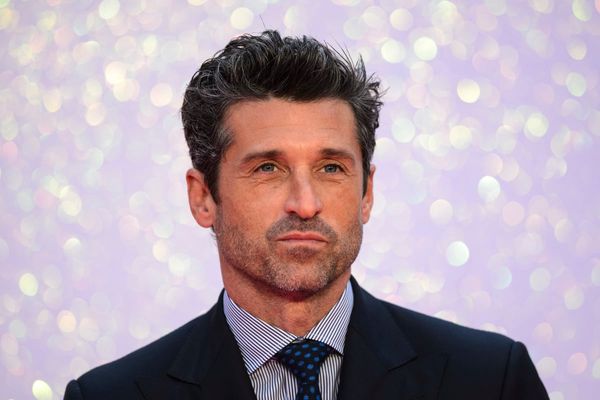
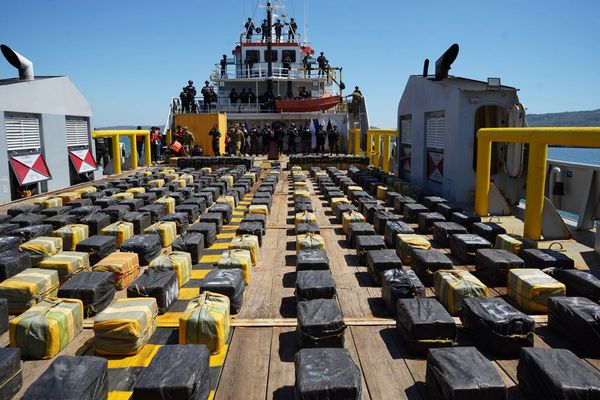
Photos: Communist march in Athens

And finally, here are some photos from tonight’s anti-government demonstration in Athens.
Despite the bad weather, the KKE communist party did manage to rally the troops. It’s a reminder to Alexis Tsipras that he could face larger protests if the public feel let down by his government.
As Helena puts it from Athens:
The demo tonight is a warning shot over the bows of the government that there will be mass protests if it goes too far.


And that, I think, is all for tonight. Thanks for reading and commenting - it’s been a busy few days. Next week probably won’t be any different. Good night! GW
And before the cameras in the cabinet room are switched off, Alexis Tsipras declares:
“The country has come out of this difficult and hard process of real negotiation stronger and more proud.”
Alexis Tsipras may be offering Greece some sugar, before the yuckier medicine prescribed by its creditors.
As our own Helena Smith tweets:
#Greece the new gov is moving quickly to enact feel-good legislation w pm #AlexisTsipras announcing bills 2night. Painful reforms come next
— Helena Smith (@HelenaSmithGDN) February 27, 2015
Tsipras has also promised an investigation into how Greece was forced into its bailouts. Although the question is, how far back to you go?....
And the €-entry presumably? MT @YanniKouts: Greece PM Tsipras says will launch parliamentary probe into the circumstances of Greek bailouts
— Mats Persson (@matsJpersson) February 27, 2015
Tsipras addresses cabinet: the key points
Alexis Tsipras has allowed the TV cameras into the cabinet room in Athens tonight, as he outlines his government’s plans.
He’s pledging to bring legislation to parliament next week to enact some of the reforms announced this week.
Thanks to the magic of Twitter, here are the key points from the invaluable Diane Shugart:
tsipras says greece comes away from talks having regained its dignity & equality. calls it a "bridge-agreement" to talks on debt reduction.
— Diane Shugart (@dianalizia) February 27, 2015
tsipras: what we have before us is an obligation to begin some sweeping reforms.
— Diane Shugart (@dianalizia) February 27, 2015
tsipras says the government's first legislation, to be submitted to parliament monday, will deal with greece's humanitarian crisis.
— Diane Shugart (@dianalizia) February 27, 2015
tsipras says bill will provide for free electricity and food for those in need.
— Diane Shugart (@dianalizia) February 27, 2015
govt will also submit legislation with favorable terms for settling tax debts and arrears to social insurance funds.
— Diane Shugart (@dianalizia) February 27, 2015
tsipras says legislation to be submitted to protect primary residence from foreclosure for homes with objective value up to 300,000 euros
— Diane Shugart (@dianalizia) February 27, 2015
greek public television ert will also be restored but without burdening state budget, says tsipras.
— Diane Shugart (@dianalizia) February 27, 2015
Outside parliament, Greece’s communists are valiantly pressing on with their demonstration despite the inclement weather. No point getting soggy, though:
Lenin would have never sheltered under an umbrella: #Greece's Communist KKE leader rails against govt pic.twitter.com/iEsetjmMF5 via @miltostr
— Damian Mac Con Uladh (@damomac) February 27, 2015
Updated
Alexis Tsipras is holding a cabinet meeting tonight to discuss the government’s next move:
Ξεκίνησε το υπουργικό συμβούλιο - Επί τάπητος οι πρώτες νομοθετικές παρεμβάσεις της κυβέρνησης pic.twitter.com/o9uWN3FY03
— BankingNews.gr (@bankingnewsgr) February 27, 2015
Despite the rain, demonstrators are now massing outside the Greek parliament:
Large turnout at Communist rally outside parliament #Greece pic.twitter.com/pxVB976AO6
— Derek Gatopoulos (@dgatopoulos) February 27, 2015
The chants of KKE communist party protesters are wafting through central Athens, reports Helena Smith, as they march through the city centre on their way up Syntagma square where tonight’s “anti-loan” rally is due to take place.
It has been raining hard in the Greek capital and only the hardiest are expected to attend the demonstration called to denounce the leftist-led government’s climbdown in Brussels last week.
A statement by Greece’s celebrated composer Mikis Theodorakis denouncing the loan accord was to be read out at the rally.
Theodorakis met with Alexis Tsipras earlier this week; clearly he’s not placated....

Updated
Investors are still pricing in a high chance that Greece’s debts will be ‘restructured’:
#Greece's 5yr default probability rises again above 70% despite Piraeus Bank denies reports of cash shortage. pic.twitter.com/0t53LowbYC
— Holger Zschaepitz (@Schuldensuehner) February 27, 2015
The Greek media has been rather taken by what some are describing as the liveliest display of support yet for the crisis plagued country abroad, reports Helena Smith in Athens.
Three bare-chested women - former activists of the Femen group - have caused a bit of commotion outside the Berlin offices of Bild protesting against the mass-selling tabloid’s “no to greedy Greeks” campaign launched earlier this week.
The semi-naked protestors had written Ja (Yes) and “Free Greece” in blue paint across their bodies. They then went on to dance the famous Greek Syrtaki while throwing back copious amounts of ouzo. “We wanted to show another face. Not just to German citizens but to the Greek people,” one was quoted as saying.
Bild, it appears, maybe rowing back after a wave of criticism - including in the Bundestag this morning.
Bild tries to offset negatve publicity ovr 'Nein' to Greece campaign w an editorial: "We empathize w the Greeks!" http://t.co/5N8u3w2Rp3 LOL
— Yannis Koutsomitis (@YanniKouts) February 27, 2015
Meanwhile in Athens, Greek PM Alexis Tsipras has been meeting with one of the new wave of European politicians, German Green MEP Ska Keller.


Greece is being deliberately starved of liquidity in an effort to get its reform plans motoring, according to Reuters this afternoon.
Even though the Bundestag has approved the extension, Greece has little hope of getting any funding until it has satisfied its creditors, they say, quoting Brussels sources.
Here’s a flavour:
Shut out of debt markets and faced with a steep fall in tax revenues, Athens is expected to run out of cash by the middle or end of March. Its finance minister has warned that Greece will struggle to repay creditors starting with a 1.5bn euro IMF loan repayment due in March.
Athens has been looking for quick fixes to tide it through the coming weeks but has not found one yet.
Euro zone officials hope the liquidity squeeze will force Prime Minister Alexis Tsipras’s nascent government to agree reform plans more quickly than the end of April deadline set by creditors, paving the way for bailout funding to be released.
“The liquidity squeeze is being used to push the Greeks to very quickly start discussions on the review and finish that as soon as possible – not even waiting for the end of April,” one euro zone official said.
The day Schaeuble claims that you cannot blackmail in the eurozone, EU official explains offers #Greece can't refuse http://t.co/oEitaLyxXJ
— Yiannis Mouzakis (@YiannisMouzakis) February 27, 2015
Greece hopes to clear this funding crisis by being allowed to issue more short-term debt; but only if the ECB allows it...
This or default MT @Hugodixon I think Greek T-bill limit will ultimately be lifted, but only if Tsipras keeps up reform pace in next few wks
— Yannis Koutsomitis (@YanniKouts) February 27, 2015
Updated
In the US, revised figures showed GDP rose at an annualised rate of 2.2% (revised from 2.6%) in the fourth quarter, down sharply from 5% in the previous quarter. However economists were expecting a slowdown to 2.1%.
Chris Williamson, chief economist at Markit, said:
The slowdown is unlikely to worry Fed policymakers, however, who are likely to ‘keep calm and carry on’ with contemplating an initial rate hike in the summer, possibly as early as June.
One reason for the lack of concern is that the slowdown was due in part to a far smaller than previously estimated inventory build-up, in turn thought to be partly due to port strikes. The weaker stock build-up late last year bodes well for first quarter growth.
There was also better news on investment, with business spending on equipment rising at a 0.9% annualised rate instead of falling 1.9%, as initially thought.
Consumer spending growth meanwhile remained solid, revised down only marginally to still rise at an annualised rate of 4.2%, its fastest since the start of 2006.
In a closely watched auction, Greece plans to sell €875m of six-month treasury bills next Wednesday to refinance a maturing issue. Greek banks use T-bills as collateral to borrow from the ECB’s emergency liquidity line and then invest the money in more T-bills. This helps the government, which is frozen out of the bond markets, to cover its short-term needs.
Foreign investors have shied away from T-bill sales in recent months. They are the only source of commercial borrowing for Tsipras’ government.
Over in Athens, government sources are saying that prime minister Alexis Tsipras will unveil five pieces of legislation to be brought before parliament next week when his cabinet meets at 7:30pm tonight.
Helena Smith reports that the bills will:
- call for the establishment of an investigative committee into the circumstances surrounding Greece’s request to be bailed out from the EU, ECB and IMF
- outline how the leftist-led coalition will crack down on tax evasion
- outline how unpaid tax dues can be settled with a repayment process of up to 100 installments
- legislate against foreclosures including primary homes of indebted Greeks
- legislate the reinstatement of the state-run television channel dismantled by the previous coalition government
As reported earlier, Tsipras will make a televised address to the nation at the start of the cabinet session which will otherwise be closed. Despite dissent within the ranks of his radical left Syriza party, the young prime minister is enjoying unprecedented levels of popularity, according to polls.
So far, the EFSF has handed €141.bn in financial assistance to Greece. The last loan tranche, another €1.8bn, is available through June if the final review is successfully completed.
Updated
It’s official: The European Financial Stability Facility’s board of directors has extended the Greece bailout until June 30, says EFSF chief Klaus Regling. Read the full statement here.
#Greece's economy shrank by 0.4% in last quarter of 2014, revised to be a bigger contraction than the initial -0.2% in GDP via @BBCBusiness
— Linda Yueh (@lindayueh) February 27, 2015
The Greek government may be nervous of exposing splits within Syriza by holding a vote on the bailout extension, but failing to hold a vote will not look great:
Failing to put bailout extension deal to Greek parliament would be unwise and undemocratic #tripras
— Hugo Dixon (@Hugodixon) February 27, 2015
If bailout ext goes to parliament it'll pass by opposition votes. If it doesn't it can be dubbed 'undemocratic'- A test for #Syriza #Greece
— Loukia Gyftopoulou (@loukia_g) February 27, 2015
Another update from Helena Smith in Athens:
Angst over the pending funding gap is VERY real. Government figures show that tax revenues have dropped precipitously (22.5%) as a result of the political turmoil gripping the country. Greeks have simply stopped paying. The country’s former deputy premier Evangelos Venizelos has just made a statement saying rather than conducting real negotiations, the new leftist-led government is waging a “war of impressions,”
“The country is in a strategic vacuum. Just one month after the election everything is in the air. Revenues, cash requirements, fiscal targets. How will the fiscal gap that exists be plugged? Where are we going regarding the debt? Sadly our array of negotiating mistakes has taken us way off from the point we were when the parliament was dissolved,” he said referring to the day snap polls were called in December.
“Everything is being enthusiastically projected as a triumph, but as soon as you scratch the surface, you see that there is no plan, or result, or security or prospect. The country has to find its goals.”
Helena’s also heard that that prime minister Alexis Tsipras will hold a cabinet meeting tonight, from 7.30pm local time, to prepare to bring legislation to parliament next week.
It could be a lively evening in Athens; as the KKE communist party is organising a mass rally outside parliament to protest against the loan agreement.
Updated
#bundestag #grexit merkel's biggest majority on greece.but also biggest rebellion in her ranks while linke votes for syriza pals, also a 1st
— Ian Traynor (@traynorbrussels) February 27, 2015
Apparently 29 CDU/CSU MPs voted against extending Greece’s bailout, the biggest rebellion among Angela Merkel’s bloc yet.
Bundestag Greece vote. The stats are in: 29 CDU/CSU voted no (including a former minister). Up from 13 CDU/CSU no votes over 2nd bailout.
— jeevanvasagar (@jeevanvasagar) February 27, 2015
While Greek bailout extension was passed in Bundestag by record margin for a euro vote, a record number of CDU/CSU MPs, 29, voted against
— Mats Persson (@matsJpersson) February 27, 2015
The FT’s Jeeven Vasagar reckons Angela Merkel has suffered a “substantial rebellion”, with 32 German MPs voting against giving Greece more time.
He writes:
Germany’s chancellor Angela Merkel faced dissent over her eurozone rescue policy on Friday after 32 legislators voted against extending Greece’s bailout.
While the four-month extension passed with a comfortable majority of 542 out of 587 lawmakers in the Bundestag who voted, there was a substantial rebellion within Ms Merkel’s Christian Democratic Union and sister party the Christian Social Union. There were 13 abstentions.
Dissent in the Bundestag has swelled since the vote over the passage of the second Greek bailout in 2012, when 13 members of her Christian Democratic bloc and four members of coalition partners, the Free Democrats, voted against.
Merkel now faces serious dissent from her party over Greece. How will it go in next vote, when stakes are higher? http://t.co/Wglpmo9hf8
— jeevanvasagar (@jeevanvasagar) February 27, 2015
Updated
Greek finance minister: I deployed creative vagueness

Back in Greece, finance minister Yanis Varoufakis has caused quite a stir this morning by revealing that he was deliberately abstruse about targets and numbers in the list of reforms Athens proposed this week (Helena Smith writes).
Varoufakis told Greek television channel ANT I that he was proud his team was so obscure while negotiating their four-month bailout extension.
“I use the term creative vagueness. I want to be the first minister of finance who will never refer to a number if I am not sure that I will attain it.”
And Varoufakis insisted that he had warned his counterparts that he didn’t want to speak of numbers because he didn’t want to be ultimately exposed and contradicted.
The Greek finance minister also lobbed a rhetorical grenade at dissenters in the governing Syriza party.
“If we wanted real freedom from Europe, we would have to exit the euro but that would be catastrophic.”
Updated
A quick explainer:
The Bundestag vote means that Greece now has until the end of June to satisfy its lenders, and receive the final payment from its bailout programme, worth €7.2bn.
That programme was due to expire on Saturday, until the eurogroup and Greece agreed a four-month extension last week.
This vote doesn’t actually unlock any more money, though. Greece must prove that it is implementing reforms that are acceptable to its lenders; the list of reforms submitted to Brussels earlier this week needs to be expanded and fleshed out.
Germany isn’t the only country that has to approve the deal. All eurozone countries have to approve it; Finland did so on Tuesday.
Updated
Our Europe editor sees ructions ahead:
#bundestag #grexit next time it votes on 3rd bailout (+debt forgiveness/repackaging?) will be a bit more interesting
— Ian Traynor (@traynorbrussels) February 27, 2015
Greek PM meets with economics team
Just as the German parliament was voting to extend Greece’s loan agreement, prime minister Alexis Tsipras was convening a meeting of his entire economics team at his office.
From Athens, Helena Smith reports:
Insiders are saying that the “emergency” talks Tsipras has called with his economic team are focusing on two things:
• 1) The financing gap that Greece faces imminently (it has to service IMF loans, which expire in March, of just under €2bn euro and has to redeem short-term debt amounting to €21.8bn by the end of June).
Greek officials are increasingly voicing concerns about how such loans will be financed, amid mounting speculation that Athens may even ask the IMF to delay the repayment
• 2) Whether the Greek government should hold its own vote on the bailout extensions, given the level of dissent since the deal was done. The Government spokesman, Gavriel Sakellarides, suggested this morning that the bill may be debated “article by article.” [to avoid one single debate over the plan]
The fact that Germans approved this deal 542 votes v 32 and syriza cant even agree on whether there shd be a vote in Gr tells you who "won"
— The Dude (@IyerC) February 27, 2015
#Bundestag huge majority extends greek bailout. but 45 against or abstained must almost all have come from merkel cdu/csu ranks
— Ian Traynor (@traynorbrussels) February 27, 2015
This is the biggest majority for any vote on eurozone bailouts since the crisis began, reports Germany’s Spiegel news magazine.
Bundestag's approval of Greek bailout extension passed by largest margin of any eurozone crisis related vote to date (h/t @SPIEGELONLINE)
— Open Europe (@OpenEurope) February 27, 2015
So, a pretty resounding majority in favour of the bailout extension - we don’t yet know who the rebels are, though.
CLOSE. *mops brow* RT @YanniKouts #BREAKING #Germany | Bundestag MPs vote for extension of #Greece's programme with 542 Yes, 32 against.
— Alan Beattie (@alanbeattie) February 27, 2015
Bundestag approves bailout extension
The Bundestag voted overwhelmingly in favour of the four-month extension of the Greek bailout. Of 587 votes cast,
542 - yes
32 - no
13 - abstentions
Meanwhile in Greece, a spoof video clip hailing the charms of their finance minister has caused quite a stir.
Athens correspondent Helena Smith reports:
It got an airing on SKAI’s flagship news programme last night and is doing the rounds of social media like wild-fire. The one person who has NOT commented on it is Yanis Varoufakis himself. Recently the Greek finance minister told me that he didn’t have time to follow what the global media was saying of him.
“I’ve always had a healthy contempt for the media, especially the awful tabloid media, and whether they celebrate or disparage me, it doesn’t matter. I really don’t care. The media pulls you up and then they dump [on] you. The more you rise, the harder the fall but it doesn’t bother me at all. I am ready for it … the star system was always very low in my list of priorities (many might dispute that...).”
Every time we thought we'd reached the top another peak of Yanis was perceived in the distance -- https://t.co/b40I83Ohjp
— David Keohane (@DavidKeo) February 26, 2015
It is not clear when we will get the result. Watch this space.
Voting live in German Parliament on Greek extension follow at http://t.co/pliZymsUQr #Greece pic.twitter.com/H7abr0XxsE
— Derek Gatopoulos (@dgatopoulos) February 27, 2015
They are counting the votes.
The debate is finally over, and MPs are voting right now:
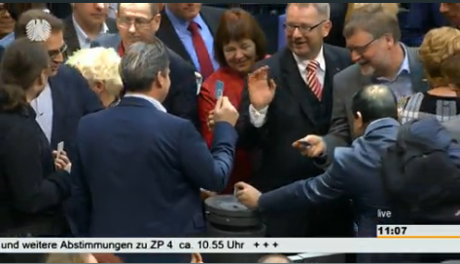
The debate is nearly over. MPs will vote on the Greek bailout extension shortly.
Updated
In a lively debate in the German parliament, Thorsten Frei, of the CDU/CSU, hits back at the previous speakers from his party. He says this is not about approving a new bailout, but about seeing the existing Greek bailout through to its successful conclusion.
As an update, German MPs still debating in the lower house, expecting a vote around 1015GMT...
— RANsquawk (@RANsquawk) February 27, 2015
Klaus-Peter Willsch of the conservative CDS/CSU group is against extending the Greek bailout.
He argues that Greece needs to crack on with reforms. Noting the high rate of youth unemployment, he deplores that labour costs in Greece are still twice as high as in Poland and Slovenia. Would you buy a used car from Tsipras or Varoufakis, he asks.
He ends with a well-known German proverb (Lieber ein Ende mit Schrecken als ein Schrecken ohne Ende):
Better an end with terror than terror without an end.[i.e. It’s best to get unpleasant things over and done with.]
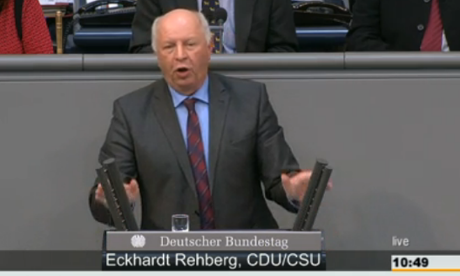
Eckhart Rehberg, also of the CDU/CSU, asserts:
Greece doesn’t need a Marshall plan. Greece [already] has a Marshall plan.
Solidarity is not a one-way street.
Updated
Schäfer calls for mutual understanding, rather than provocative statements (this is partly aimed at his parliamentary colleagues). He stresses
There is no German diktat for Athens. There is a debate.
German MP says Nein to Bild campaign
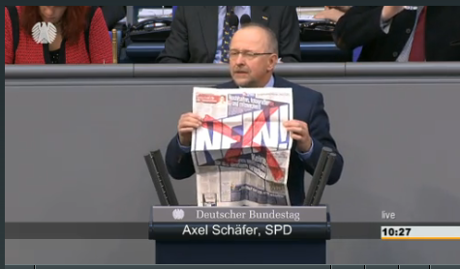
Holding up a copy of mass daily Bild’s “Nein!” page, Axel Schäfer of the SPD says:
We do not support campaigns against other countries.
[Bild yesterday asked readers to send selfies, posing alongside its declaration that “Greedy Greeks” should not get more money]
Schäfer also refers to the London Debt Conference, when Germany’s creditors agreed to write off about half of the country’s debt. That conference began 62 years ago today.
But he also takes issue with Greek prime minister Aleix Tsipras comments “we’ve won a battle but not the war”. He says no one is fighting battles in Europe.
Updated
CSU general secretary Andreas Scheuer calls on Greece “to deliver” (reforms).
The German parliamentary debate continues. Solidarity (in Europe) is today’s watchword.
German debate: the key points
A quick recap from today’s debate on Greece’s aid package, now we’ve heard from all the main German political parties:
Schäuble told MPs that Greece is not getting more money today:
We’re not talking about new billions for Greece, we’re not talking about any changes to this programme - rather it’s about providing or granting extra time to successfully end this programme.
He admitted it wasn’t “an easy decision for any parliament member,” adding “Greece has to do its bit. Solidarity has something to do with reliability”.
Other politicians from across the spectrum have emphasised the importance of avoiding new divisions in Europe. Although there was disagreement about how Greece’s plight came about.
Gregor Gysi of Die Linke party said Greece “kamikaze policy” of austerity must be changed.
Carsten Schneider of SPD said that wealthy Greeks must make a bigger contribution to its finances, and also acknowledged that Greece may need a third bailout:
Schneider: At some point we will have to debate about a new programme for Greece but this is not a matter for today, just the extension
— Open Europe (@OpenEurope) February 27, 2015
For the Greens, Anton Hofreiter called for more solidarity:
This conflict is about the interests of a few super-rich people versus ordinary people in Greeks.
The vote should start soon, and we’re expecting a large majority in favour. But how many CDU/CSU MPs will rebel?...
Updated
Brinkhaus also criticises the Greek government for inconsistency:
Brinkhaus: Not acceptable to sign something in Brussels and then go back to Athens and pretend something completely different has happened
— Open Europe (@OpenEurope) February 27, 2015
“It’s really bad if someone leaves the [euro] project,” he concludes.
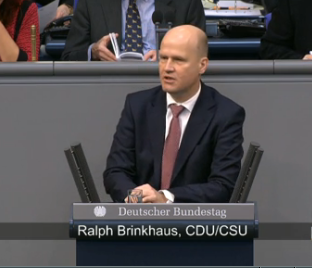
Brinkhaus says five countries received bailouts during the financial crisis, and regards four out of those five a success. Portugal said yesterday it would pay back its loans early.
This shows that it’s worth saying yes sometimes. And even with Greece things didn’t go too badly until December.
He stresses that the vote is not about a new bailout, but extending the old (second) bailout for Greece.
Angela Merkel is also in the chamber, sat alongside economy minister Sigmar Gabriel. He’s next to foreign minister Frank-Walter Steinmeier:

Ralph Brinkhaus of the ruling CDU/CSU (conservatives) is next. He stresses that Greece’s problems were not caused by the troika but date back longer, and that Europe has been very generous in its help.
Updated
Hofreiter, of the Greens, says the litmus test is whether policies are helping ordinary Greeks. He adds that Greece should stay in Europe. If Greece regains some of its wealth there is a bigger chance it will repay its debts.
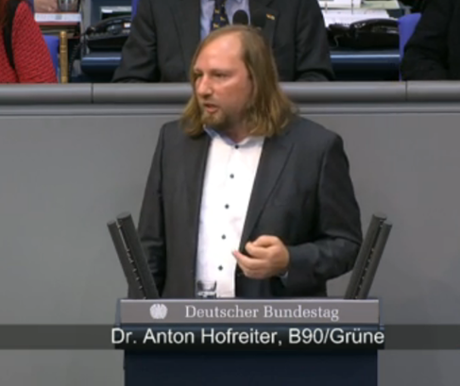
Hofreiter talks about the failure of Angela Merkel’s and Wolfgang Schäuble’s European policies. We need a European policy based on solidarity, he contends. He adds:
This conflict is about the interests of a few super-rich people versus ordinary people in Greeks.
Anton Hofreiter of the Greens is now speaking.
Schneider says:
We support growth, help to self-help and more social justice. But it must be clear that those who who have earned a lot and have wealth in Greece must pay.
He says a return to the drachma is not the answer, because Greece’s debts are denominated in euros. The drachma would most likely plummet and a 50% depreciation would double Greek debts.
He concludes by saying
It’s now up the Greeks themselves, we are extending our hands to them.
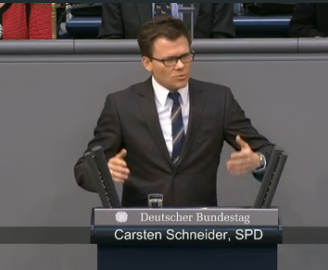
Schneider: We are still paying for the mistake made by Papandreou when he offered a referendum in 2011
— Open Europe (@OpenEurope) February 27, 2015
Greece is not paying interest on its debt any more, Schneider says. [That is true, because of the restructuring.] It is important for the Greeks to realise they can help themselves.
Schneider: The interest rates Greeks pay are lower than in France and Portugal and not much higher than in Germany
— Open Europe (@OpenEurope) February 27, 2015
Updated
Schäuble said earlier that “it’s not easy to make this decision” (on the bailout extension). Schneider of the SPD says he feels similar.
The Bundestag debate is due to last 105 minutes, followed by a vote on the bailout extension until 30 June for Greece. It started on time at 8am GMT.
Carsten Schneider of the SPD (Social Democrats) is next.
The Left party supports the four-month bailout extension for Greece to give the country “breathing space and the chance for a fresh start,” Gysi says, ending his statement.
Gysi: Southern Europe needs a Marshall plan
Gysi of the German Left party contends:
We need a Marshall plan for southern Europe.
Updated
90% of the bailout money is going to French and German banks, Gysi says.
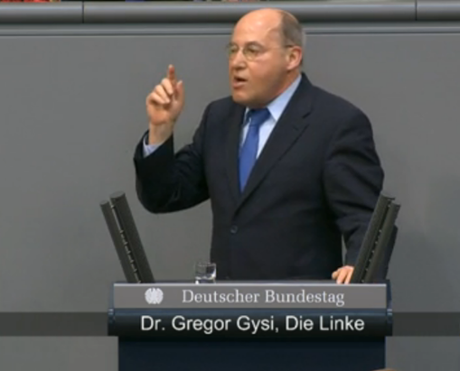
Updated
Here’s Bloomberg’s early take on Schäuble’s speech:
#Germany's Schäuble calls on lawmakers to vote for Greek extension. Says solidarity means everybody must make a contribution. (BBG)
— Holger Zschaepitz (@Schuldensuehner) February 27, 2015
#Schaeuble says new Greek program is not about ‘New Billions’; Current program payments won’t be made without German approval
— Francine Lacqua (@flacqua) February 27, 2015
Updated
Gregor Gysi, who heads up the parliamentary group of the Left party, is up next.
The newly elected left-wing government in Greece has called an end to cuts and austerity, he says. He describes it as a “kamikaze policy,” which led to high youth unemployment and recession. Syriza is the first government in Europe that has challenged neoliberal policies, he asserts.
With this kind of policy debts will never be repaid.
There is no logic. We must help rebuild Greece, so it can repay its debts.
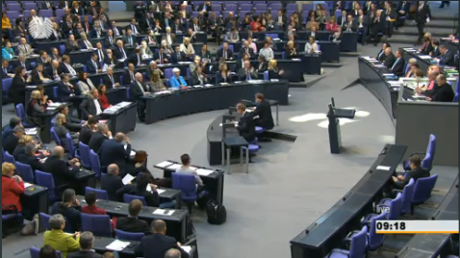
Updated
France has implemented important structural reforms and Italy is on track to make good decisions, the German finance minister says. Greece within Europe cannot decide alone what the right path is. That concludes his statement. There is a lot of applause from MPs.
Updated
But, he says in a veiled dig at the new Greek government:
Solidarity doesn’t mean that you can blackmail each other.
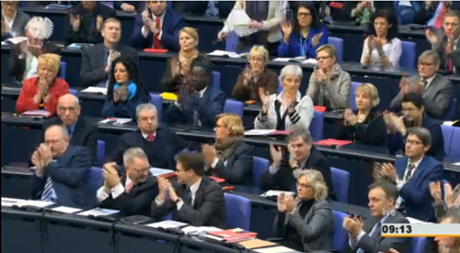
Schäuble: We must keep Europe together
Schäuble says Europe must stand together and makes an oblique reference to WWII. Applause from MPs.
We Germans must do everything to keep Europe together.
Updated
Schäuble says it will take Greece longer than other countries to win back the trust of financial markets. But he adds:
Greece has to do its bit. Solidarity has something to do with reliability.
Updated
- GERMAN FIN MIN SCHAEUBLE SAYS GERMAN PARLIAMENT DOESN’T FACE EASY DECISION ON GREEK BAILOUT EXTENSION
- GERMANY’S SCHAEUBLE SAYS NOT ABOUT MORE MONEY OR CHANGE IN TERMS FOR GREECE, JUST MORE TIME
- SCHAEUBLE SAYS GREECE CAN’T CHANGE THE BAILOUT PROGRAMME WITHOUT AGREEMENT OF IMF, EU AND ECB
Schäuble is explaining that Greece is simply being given more time to complete its bailout measures, and that it cannot change the terms unilaterally.
Schäuble says:
We are all democracies. Greece produced a clear vote [when it elected the Syriza government].
Not much applause from German MPs
Greece has pledged not to take unilateral measures – without agreement of the troika (the IMF, EU and ECB), the German finance minister explains.
Updated
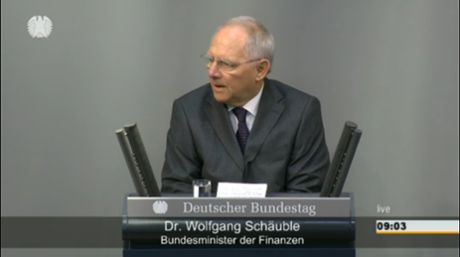
Debate begins
The Bundestag session has started. The finance minister, Wolfgang Schäuble, speaks first. He stresses that the four-month bailout extension is NOT about new billions of euros for Greece or changes to the bailout. Applause from German MPs
Updated
You can watch the Bundestag debate live here. It will start in a few minutes.
A large majority of Germans, across the political spectrum, doubt that Greece will implement its reform programme.
While the Bundestag is about to approve Greek loan extension, almost 3/4 of the Germans doubt reform implementation. pic.twitter.com/SBzhvj3gsU
— Carsten Brzeski (@carstenbrzeski) February 27, 2015
Germany’s opposition Green party has also pledged to support Greece in today’s vote:
@YanniKouts @sven_kindler Almost whole Bundestag will, even most from Left - overwhelming yes-vote, but a no-mood with Christian Democrats.
— Hubertus Volmer (@Hub_Volmer) February 27, 2015
Small clashes in Athens overnight

There was isolated violence in the Greek capital last night, for the first time since last month’s general election.
It occurred after a demonstration by far-left activists in Athens, unhappy with the bailout extension agreed with Greece’s creditors.
The BBC reports:
“Dozens of activists hurled petrol bombs and stones at police and set cars alight after the march.
About 450 far-left protesters took to the streets of Athens on Thursday to voice their anger.
After the march, about 50 demonstrators clashed with riot police. Shop windows and bus stops were also smashed.
It sounds quite small scale:
@graemewearden No clashes. Police kept distance. Six bus stops vandalised, four broken store-bank fronts + 2 cars + 3 trash bins torched
— φ χατζοπουλοσ (@tsahtsah) February 27, 2015
And it’s calm this morning:
@graemewearden @Thalion_1 Was in Exarhia around 8:30,drove near the Polytechnic.Police in the streets but quiet.Don't know abt earlier/later
— Anastasia Kamvysi (@Anastasialadiab) February 27, 2015
Updated
Even Germany’s president Joachim Gauck has waded into the Greece debate and come out in support of the four-month bailout extension. (Like the Queen, the German president traditionally stays above the political fray).
Gauck,75, told radio station MDR: “The parliament is willing to take responsibility and is taking on the issue with great seriousness.”
He said the Bundestag, the German parliament’s lower chamber, has to ask itself what Europe would gain if it were to lose part of its community, German mass daily Bild and other newspapers reported.

The Agenda: German MPs vote on Greek debt deal
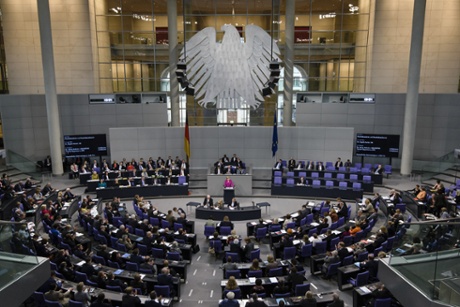
Good morning, and welcome to our rolling coverage of Greece’s debt crisis and other developments across the world economy, the financial markets, the eurozone and business.
German MPs are voting today on whether Greece’s bailout should be extended by four months.
The Bundestag (the lower house of the German parliament), is pretty much certain to approve it, with a decent majority. But today’s debate is also important because it will shine a light on the state of German-Greek relations. They look increasingly strained by the events of recent weeks.
As our Europe editor Ian Traynor explains:
Wolfgang Schäuble, the finance minister, told Merkel’s backbenchers that the new Greek government was manipulating eurozone largesse to “trample all over European solidarity”, Der Spiegel reported.
The Germans expect the Greeks, beneficiaries of a €240bn (£175bn) rescue, to be grateful. Instead they are seen to be impertinent. No sooner was the ink dry on the deal on Tuesday granting Athens a 17-week loan extension than its finance minister, Yanis Varoufakis, upped the ante and demanded the massive debt burden be partly written off.
Schäuble virtually accused the Tsipras team of lying. “The question now is whether one can believe the Greek government’s assurances or not. There’s a lot of doubt in Germany.”
The word in Brussels is that Schäuble and Varoufakis can hardly bear to be in the same room together. The confrontation looks certain to get worse over the next month as Tsipras sets out the fiscal and economic reforms he must enact to win the bailout extension and then, over the summer, a new package of financial aid.
Full story: Greece bailout saga strains German patience
The debate starts at 9am CET in Berlin (8am GMT or 10am EET), and probably lasts for 90 minutes followed by a vote.
Some 22 MPS from Angela Merkel’s CDU/CSU party voted against the extensions at an ‘indicative ballot’ yesterday; a small rebellion that won’t scupper the vote, but which puts pressure on the Chancellor to maintain a tough line with Athens in the months ahead.
We’ll be covering the debate, the results, reaction, and other events through the day....
Updated