Today’s agreement will unlock the first €13bn of bailout cash for Greece, a day before it is due to make a €3.2bn payment to repay a loan to the European Central Bank.
Here’s the Reuters take:
According to a statement released by ESM, the board of governors approved a proposal for a Financial Assistance Facility Agreement (FFA) with Greece, under which the ESM will provide up to €86bn in financial assistance to Greece over a period of three years.
The board also adopted a Memorandum of Understanding (MoU) with Greece, specifying the policy measures that the Greekgovernment has agreed to undertake in order to tackle the main challenges facing its economy, the statement said.
The first tranche under the ESM program will be worth up to €26bn, in which €10bn will be made available immediately for bank recapitalization.
The other €16bn will be disbursed to Greece in several installments, starting with a first disbursement of €13bn by August 20, followed by one or more further disbursements in the autumn.
On that positive note, it’s time to close up for the evening. Thanks for your comments, and we’ll be back tomorrow.
Updated
#ESM publishes Factsheet with key information on Greece ESM/#EFSF programmes http://t.co/6JR6Z1m4eC pic.twitter.com/aq556vuiwX
— ESM (@ESM_Press) August 19, 2015
#ESM Managing Director Klaus #Regling signs the ESM Financial Assistance Facility Agreement for #Greece pic.twitter.com/4IU7oIKuyf
— ESM (@ESM_Press) August 19, 2015
ESM agrees bailout programme
So, after a teleconference call the European Stability Mechanism’s board of governors - who are the eurozone’s finance ministers - have agreed the programme for the €86bn bailout package.
Eurogroup president Jeroen Dijsselbloem said:
Today the countries in the eurozone have mandated the ESM to make to a maximum of €86bn available to finance Greece.
The programme for the coming three years goes with strrict conditions.. aiming at setting right public finances and administration and dealing with the economy and problems in the financial sector.
He said Greek government hds taken credible first steps but a lot of work needed to be done to stabilise the economy in Greece and for the return of confidence in Greece and the eurozone:
But the decisions taken in the last couple of weeks and especially today are a big step in that direction.
The video is here.
So Greece will get its money, as confirmed by European Commission vice president Valdis Dombrovskis:
Stability support for #Greece approved by €zone. Just signed new #MoU on behalf of @EU_Commission and @JunckerEU pic.twitter.com/6a2b0ytng5
— Valdis Dombrovskis (@VDombrovskis) August 19, 2015
Greek authorities have an opportunity to restore financial stability. Implementation of the reforms is what will count at the end #Greece
— Valdis Dombrovskis (@VDombrovskis) August 19, 2015
Updated
Martin Selmayr, European Commssion chief of staff, says:
It's done, after hard work. New stability support4Greece agreed by whole €area. Solidarity4reforms. Now 2bsigned by COM VP @VDombrovskis.
— Martin Selmayr (@MartinSelmayr) August 19, 2015
The request by Greek prime minister Alexis Tsipras for the European Parliament to become involved in the bailout review will be considered at the next conference of presidents, said the EP’s Martin Schulz:
This morning I spoke with PM Tsipras. I confirm he wrote to me asking EP involvement in review process of implementation of loan agreement
— EP President (@EP_President) August 19, 2015
This request will be discussed at the next Conference of Presidents of the European Parliament @tsipras_eu @PrimeministerGR #Greece
— EP President (@EP_President) August 19, 2015

Updated
China will have to wait a little longer before fulfilling its hope of joining the International Monetary Fund’s benchmark currency basket.
The fund said in a statement it was extending the current basket by nine months from the end of December to September 2016. It is set to decide in November whether China’s yuan can join the Special Drawing Rights basket. The IMF said:
The nine-month extension is intended to facilitate the continued smooth functioning of SDR-related operations and responds to feedback from SDR users on the desirability of avoiding changes in the basket at the end of the calendar year.
The extension would also allow users sufficient lead time to adjust in the event that a decision were to be taken to add a new currency to the SDR basket.
Beijing, which devalued the yuan earlier this month, is keen for its currency to have equal weighting with others such as the dollar, pound, euro and yen.
Here’s Reuters on the Dutch vote:
The Dutch parliament on Wednesday voted down a motion calling on the government not to back a third bailout package for Greece, effectively endorsing the rescue of the debt-ridden fellow euro zone country.
The motion was rejected by a margin of 81-52 in the 150-member parliament. One member of Prime Minister Mark Rutte’s own party broke away to oppose the bailout, which is unpopular with Rutte’s conservative voter base.
Rutte said earlier that a parliamentary motion for or against the bailout was unnecessary, as it was the cabinet, not parliament, that makes policy.
Rutte also easily survived a no-confidence vote called by right-wing lawmaker Geert Wilders, who deeply opposes the bailout.

Dutch vote to support Greek bailout
The Dutch parliament has expressed support for the Greek bailout package, Reuters is reporting.
Majority in Dutch Parliament votes to support Greek bailout, rejects anti-Greek bailout motions: 52 for, 81 against (CDA motion)
— Open Europe (@OpenEurope) August 19, 2015
Updated
The FTSE 100 is down around 9.8% since its recent peak of 7103 towards the end of April. So it is close to correction territory, defined as a 10% drop from recent highs.
European markets close sharply lower
A combination of concerns has sent investors scurrying for the exits once more. Fears about the outlook for the Chinese economy - despite a slight recovery in the country’s stock market earlier - set the tone for the day and sent commodities - metals and oil - lower once more.
US inflation figures came in much as expected, and did nothing to suggest the Federal Reserve would shy away from raising interest rates in September, another negative factor for the equity markets. Minutes from the Fed are due later.
Meanwhile news during the afternoon that US crude stocks rose by 2.6m barrels last week instead of falling as expected sent oil sliding even further, with Brent crude now down more that 3.5% at $47 a barrel.
Investors shrugged off the positive news that the Germany parliament had voted to approve the Greek bailout, paving the way for the country to receive much need cash.
The final scores showed:
- The FTSE 100 slumped 122.84 points or 1.88% to 6403.45, its lowest level since 14 January
- Germany’s Dax dropped 2.14 % to 10,682.15
- France’s Cac closed down 1.75% at 4884.10
- Italy’s FTSE MIB fell 1.77% to 22,975.32
- Spain’s Ibex ended 1.06% lower at 10,782.4
- But the Athens market added 0.32% to 675.33
On Wall Street the Dow Jones Industrial Average is currently down 202 points or 1.15%.
Back with the Dutch and the voting has begun:
Dutch Parliament now voting name by name on third Greek bailout pic.twitter.com/nmLHAnX21d
— Open Europe (@OpenEurope) August 19, 2015
And here’s the Alexis Tsipras letter to European Paliament president Martin Shulz:
Tsipras asks @MartinSchulz for active involvement of #EU Parl in the evaluation of #Greece's programme pic.twitter.com/jdosDhnoUR /ht @nasoskook
— Yannis Koutsomitis (@YanniKouts) August 19, 2015
Tsipras asks European Parliament to be involved in bailout reviews
Greek prime minister Alexis Tsipras reportedly wants the European parliament to joint the creditors overseeing the evaluation of its bailout:
Greece's @tsipras_eu writes to @MartinSchulz seeking 'direct & full involvement' of Euro Parl in creditor reviews of bailout implementation.
— NikiKitsantonis (@NikiKitsantonis) August 19, 2015
Greek PM's office says @MartinSchulz responded positively to contents of @tsipras_eu letter & said other groups in Europ Parl have same view
— NikiKitsantonis (@NikiKitsantonis) August 19, 2015
Updated
But as our Europe editor Ian Traynor points out, the German vote was the key one, and that went in favour of the Greek bailout:
but bundestag could have stopped it. dutch vote makes no difference. just a talking shop https://t.co/jGsEWlXPTv
— Ian Traynor (@traynorbrussels) August 19, 2015
That was in reply to this:
#Grèce: #Merkel a fait adopter le 3e plan d'aide sans trop de difficultés au #Bundestrag Néerlandais Mark #Rutte est plus bousculé
— Christian Spillmann (@CSpillmann) August 19, 2015
And we apparently have timings on the Dutch vote:
Dutch MPs to vote on 17:35 CET on motions related to the third Greek bailout package and govt coalition
— Open Europe (@OpenEurope) August 19, 2015
Oil falls as US crude stocks rise
Oil and markets are heading even lower after a surprise rise in US crude stocks last week, indicating once more lack of demand and oversupply.
According to the Energy Information Administration, crude stocks rose by 2.6m barrels compared with analysts’ expectations of a drop of 777,000 barrels.
Brent crude is now down 1.5% at $48 a barrel, while on Wall Street the Dow Jones Industrial Average is now down 189 points or more than 1%.
The FTSE 100 has lost 90 points or 1.3% while Germany’s Dax has dropped 183 points or 1.7%.
Jasper Lawler, market analyst at CMC Markets UK, said:
Oil prices dropped again after a surprise build of 2.6m barrels in US inventories when a decline was expected. It was the biggest build in four months and demonstrates the resilience of US oil output despite the falling price.

Updated
Here’s Reuters’ take on Jeroen Dijsselbloem’s comments about Greek debt in the debate in the Dutch parliament on the bailout deal:
Eurogroup President Jeroen Dijsselbloem said on Wednesday he believes that eurozone countries and the International Monetary Fund will be able to come to an agreement on IMF participation in Greece’s latest bailout package.
Dijsselbloem said that while European governments opposed any nominal writedown of Greek debt, and the IMF believed Greek debt was not sustainable as is, they will be able to find a compromise in the form of lower interest rates and longer repayment terms.
Meanwhile, after Fitch upgraded Greece’s debt by one notch from CC to CCC, the agency has also lifted the ratings for two of the country’s banks:
Fitch Ratings has upgraded the state-guaranteed long-term senior debt ratings of National Bank of Greece and Eurobank Ergasias to CCC from CC. At the same time, Fitch has affirmed Eurobank’s state-guaranteed short-term senior debt rating at C.
Full report here.

Updated
Things now seem to be moving on in the Dutch parliament:
Wilders now reading out his proposed motions: On 3rd Greek bailout,on NL governing majority. Also praises EU referendum campaign geenpeil.nl
— Open Europe (@OpenEurope) August 19, 2015
D66 leader Pechtold "congratulates Wilders with his 20th motion of confidence, a remarkable lustrum",submits motion to support Greek package
— Open Europe (@OpenEurope) August 19, 2015
Dijsselbloem:We agreed w IMF that 15%/GDP debt service is sustainable. Difference is that IMF's worst scenario is more pessimistic than ours
— Open Europe (@OpenEurope) August 19, 2015
Dijsselbloem: IMF respects that Euro states refuse nominal debt relief. I can't confirm that extending for 60 years has been demanded by IMF
— Open Europe (@OpenEurope) August 19, 2015
Updated
Dijsselbloem: EZ and IMF can come to agreement on Greek debt relief, but Netherlands remains opposed to nominal debt haircut
— Live Squawk (@livesquawk) August 19, 2015
And this will not be a comment welcomed by Germany:
Dijsselbloem: We had to accept that IMF couldn't take a decision before October, but I can't guarantee IMF - involvement
— Open Europe (@OpenEurope) August 19, 2015
Germany of course is very keen that the IMF gets involved in this latest bailout.
Dijsselbloem - €86bn is uncertain and depends on state of Greek banks
Jeroen Dijsselbloem has been speaking in the Dutch parliament. The finance minister and head of the Eurogroup is of course defending the bailout, but he admitted that the €86bn figure was “uncertain” and depended on the state of the Greek banks:
Dutch Finance Minister and Eurogroup chair Dijsselbloem now speaking: "Greek deal wasn't an easy trade-off, also not for the Dutch govt
— Open Europe (@OpenEurope) August 19, 2015
Dijsselbloem: Some think conditions are too weak or too strong, not enough money, too much money to Greeks, some want #Grexit to destroy €
— Open Europe (@OpenEurope) August 19, 2015
Dijsselbloem: current Greek govt has decided more measures already now than the previous Greek govt
— Open Europe (@OpenEurope) August 19, 2015
Dijsselbloem: "Greece has seen decades of bad policies and 6 months of complete chaos"
— Open Europe (@OpenEurope) August 19, 2015
Dijsselbloem: Can this programme work? Yes, look at Spain, Ireland, Portugal, and even Greece until January
— Open Europe (@OpenEurope) August 19, 2015
Dijsselbloem: if #ESM gets the green light tonight, it will be able to lend to Greece for three years
— Open Europe (@OpenEurope) August 19, 2015
Dijsselbloem on the figure of €86bn: this amount is uncertain. Much depends on the situation of Greek banks
— Open Europe (@OpenEurope) August 19, 2015
Dijsselbloem on the figure of €86bn vs €92bn (which was cited in German media): €6bn is coming from privatisations
— Open Europe (@OpenEurope) August 19, 2015
Dijsselbloem: IMF was involved in this programme, Lagarde was positive, but in Oct we'll discuss debt sustainability
— Open Europe (@OpenEurope) August 19, 2015
Dijsselbloem: we agreed with IMF to look at debt service. On average until 2030 this is about 12% for Greece, so until 2030 it's sustainable
— Open Europe (@OpenEurope) August 19, 2015

Photograph: Bart Maat/EPA
Updated
Wall Street lower in early trading
The US market has joined in the global sell-off, which is not really a surprise.
Ahead of the minutes of the last Federal Reserve meeting, investors continue to be unsettled by the outlook for China.
The latest US inflation figures did nothing to dampen speculation of a US rate rise in September, adding to the downbeat mood in the market.
The Dow Jones Industrial Average is currently 145 points or 0.8% lower.
Back with the Dutch parliament:
The Dutch debate seems to have moved away from rights and wrongs of bailout and turned into a "Give Rutte a rollocking" session.
— Duncan Robinson (@duncanrobinson) August 19, 2015
Summary
Time for an afternoon summary:
- Greece is well on the way to a third bailout after the German parliament approved the €86bn plan. Some 113 MPs voted against the measures, but only 63 of the rebels were from Angela Merkel’s conservative bloc. Get the complete picture in our latest news story here
- The final hurdle for Greece is the approval of eurozone finance ministers, who are the governors of the currency union’s bailout fund, the European Stability Mechanism. They will be holding a conference call at 7pm CET.
- Recriminations over the bailout deal are causing trouble for the Dutch PM Mark Rutte who is fighting a no-confidence vote. Although Rutte is expected to win, he still had to listen to far-right populist Geert Wilders calling him “the Pinocchio of the Low Countries”.
- Despite all this effort, Capital Economics thinks Greece could still leave the eurozone within a year. And questions are already being asked about the sale of concession rights to run Greek airports, a deal struck this week as part of a vast privatisation programme that is essential to the bailout.
- Away from the eurozone, US inflation increased marginally in July. But the small increase in consumer prices has not dampened expectations of a rate rise in September.
Dutch PM defends broken bailout promise
The Dutch prime minister Mark Rutte has defended his decision to break an election promise by backing another Greek bailout.
While running for election in 2012, Rutte said Greece should not get another cent. Last month, his government backed the latest bailout for Greece, which includes a €5bn contribution from the Netherlands.
Rutte told MPs.
The circumstances in 2012 were different. It is not always possible to keep a promise in politics. You have to take responsibility.
Although Rutte is expected to win the confidence vote, the debate puts the Dutch coalition government - and its majority of one - under strain.
I’ve taken the quote and figure from Dutchnews.nl
Grexit within a year, warns Capital Economics
Greece has almost cleared the final hurdle to its €86bn bailout, but it isn’t time to break out the ouzo yet.
Despite the approval of the German parliament, economics consultancy Capital Economics remains convinced Greece will be forced out of the eurozone in the next year.
Grexit risks have not disappeared and are likely to flare up in the autumn when Greece fails to pass its first review and secure crucial debt restructuring, writes Capital Economics’s senior European economist, Jennifer McKeown.
Greece is still not out of the woods. Remember that it will have to pass regular reviews to be eligible for future aid payments. The requirement for it to run ever rising primary budget surpluses is based on forecasts for GDP to fall by a fairly modest 2.3% this year and then expand by 1.3% in 2016 – the latter assumption seems far too optimistic.
Admittedly, Greece’s debt redemption schedule is considerably lighter over the coming months than it has been of late, so future delays to bailout payments might not be disastrous. But note that a successful first review is also required before the creditors will consider debt restructuring and probably also before the ECB will reinstate the waiver allowing Greeks banks to access cheap loans.
She also notes that Greek prime minister Alexis Tsipras is likely to face a vote of confidence or early elections, while IMF support is far from assured.
Updated
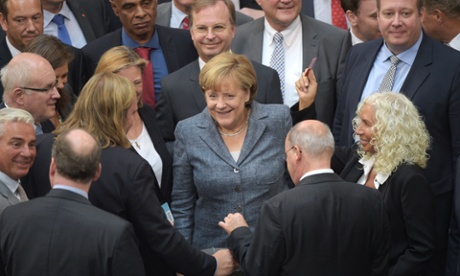
Here is the German chancellor Angela Merkel just ahead of this vote.
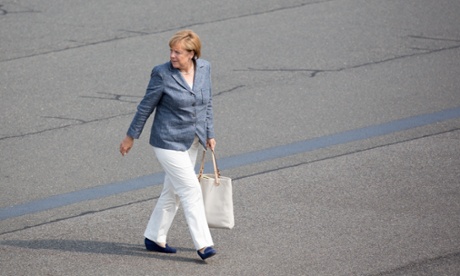
Job done. Now Merkel is jetting off to Brazil for a two-day intergovernmental meeting.
US consumer prices up modestly
US inflation rose slightly in July as a result of marginal increases in the prices of gas (petrol) and food.
Here is a flavour of the wire report from Washington.
The Labor Department said on Wednesday its Consumer Price Index edged up 0.1% last month after advancing 0.3% in June, marking the sixth straight month of increases...
Signs of an ebb in the disinflationary trend, combined with a tightening labor market and strengthening housing sector could give the Federal Reserve confidence that inflation will eventually rise toward its 2 percent target.
The US central is expected to raise its short-term interest rate next month. But given that inflation will likely remain tame because of a strong dollar, renewed weakness in oil and commodity prices, as well as China’s devaluation of the yuan, the pace of monetary policy tightening is likely to be gradual.
Economists polled by Reuters had forecast the CPI rising 0.2 percent from June and gaining 0.2 percent from a year ago.
The so-called core CPI, which strips out food and energy costs, ticked up 0.1 percent last month after rising 0.2 percent in June. Shelter, which recorded its biggest increase in nearly 8-1/2 years, was the main contributor to last month’s rise in the core CPI.
Eurozone records bigger trade surplus in June
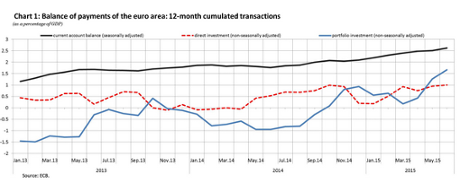
The eurozone’s current account surplus grew sharply in June, according to the latest official data from the European Central Bank.
The current account of the euro area recorded a surplus of €25.4 bn in June 2015, reports the ECB. This reflected surpluses for goods (€27.2 bn), services (€5.7 bn) and primary income (€1.0 bn).
The 12-month cumulated current account for the period ending in June 2015 recorded a surplus of €265.5 billion (2.6% of euro area GDP), compared with a surplus of €177.0 billion (1.8% of euro area GDP) for the 12 months to June 2014.
Aside from the Greek debt saga, market watchers are also pretty excited about the release of the minutes of the US Federal Reserve’s latest policy meeting, due later today.
Economists will be combing through the document for clues on when the Fed will raise interest rates, after nearly a decade of keeping them on hold.
Michael Hewson of CMC Markets reminds us that the minutes, which relate to a policy meeting on 28-9 July, could already be a little out of date.
There is the probability that the minutes are likely to be a little stale given recent events in China, and the volatility seen there, but nonetheless they should still give us an insight into the musings of those on the committee about the effects of overseas events might have on their deliberations.
Furthermore they should be instructive in the context of whether any other members are also leaning in the direction of Atlanta Fed President Dennis Lockhart when he stated earlier this month that the bar to not acting on rates was quite a high one.
For now he is one member leaning in that particular direction, but if others on the committee were to also lean that way we could get a sharp reaction.
Further reading: the BBC’s Robert Peston explains why a rise in US interest rates is still risky.
Updated
Questions about airports privatisation deal
The ink is hardly dry, but doubts are already emerging about a deal to sell management rights to run 14 Greek regional airports to German company Fraport.
According to Kathimerini, the consortium that won the 40-year concession for 14 Greek regional airports is asking for more guarantees and there are doubts whether the government will receive the €1.2 bn euros it was expecting from the project this year.
A decision published in the Government Gazette on Monday indicated that the current coalition is ready to move ahead with the deal, which was struck in 2014 but had been in doubt until recently, the paper writes.
...However, Kathimerini understands that the consortium is asking for more guarantees from the Greek government following the uncertainty of the last few months. The group is also facing greater financing costs due to the higher country risk associated with Greece.
This has raised doubts about whether Greece will able to reach its bailout target of receiving 1.2 billion euros from the agreement by the end of the year.
A Fraport spokesman told Bloomberg on Tuesday.
The Greek government’s decision is not tantamount to the conclusion of a contract but rather offers a basis for the resumption of negotiations.
JR
Updated
D66 leader Pechtold points out his opposition D66 party is needed to approve Greek bailout "as one dissident VVD-PvdA vote could torpedo it"
— Open Europe (@OpenEurope) August 19, 2015
NF
Updated
Mark Harbers, finance spokesman of Rutte’s liberals said all the crucial euro states now supported the bailout and there were no longer any international allies against the deal.
Wilders calls this a weak argument and quotes Gandi: “Only dead fish swim with the stream.” He urges the liberals to use the country’s veto even if it would be isolated.
Harbers says they achieved some of their demands although not everything but “we now want to leave this behind.”
NF
Updated
More unhappiness in the Dutch parliament over the third Greek bailout:
Dutch Christian Union MP Arie Slob: "How is it possible that the same recipes which have failed twice is being tried once more?"
— Open Europe (@OpenEurope) August 19, 2015
Dutch Christian Union MP Slob:"What has remained of the firm Dutch demand that IMF should be involved? Current package not supported by IMF"
— Open Europe (@OpenEurope) August 19, 2015
NF
Updated
Think tank Open Europe is following the Dutch debate:
Wilders: "Today we are here to prevent that Dutch PM Rutte indulges in his favorite hobby: sending money to Greece, this time €5bn"
— Open Europe (@OpenEurope) August 19, 2015
Wilders: "We need this money to protect our borders, but no, Rutte prefers to give it to the Greeks"
— Open Europe (@OpenEurope) August 19, 2015
Wilders: "We need this money to support health care and the elderly. This govt hates Dutch elderly."
— Open Europe (@OpenEurope) August 19, 2015
Now for supporters of the bailout:
Centre-left governing PvdA now speaking: "We think it's in the Dutch interest as a trading nation to keep peace and order on the Continent"
— Open Europe (@OpenEurope) August 19, 2015
PvdA: Cyprus and Spain managed to escape the crisis. We believe that's also possible for Greece, but there are no easy solutions
— Open Europe (@OpenEurope) August 19, 2015
PvdA MP Henk Nijboer: a default would have been disastrous for Greece. Important for Greece to take strucutral reforms
— Open Europe (@OpenEurope) August 19, 2015
But even here, there are digs at the Syriza government:
PvdA MP Nijboer: Greece was on the correct path before the elections, but the current Greek govt created a lot of damage
— Open Europe (@OpenEurope) August 19, 2015
Democrats 66 leader Alexander Pechtold:
Pechtold: "Greece needs to stay in EU. Congrats to Dijsselbloem who had to deal w people like Tsipras and Varoufakis, who's in Paris Match"
— Open Europe (@OpenEurope) August 19, 2015
Pechtold: "We need to have a more capable eurozone, to avoid being hostages of another Tsipras or another True Finn"
— Open Europe (@OpenEurope) August 19, 2015
Pechtold: support for the third Greek bailout in the Dutch Parliament is weak. PM Rutte should discuss this
— Open Europe (@OpenEurope) August 19, 2015
Pechtold: #Grexit would mean a Greek default, with as a result problems for Europe and our economy, so I'll support it
— Open Europe (@OpenEurope) August 19, 2015
Pechtold: We risk bad conseq of a Greek default.Imagine what happens on the Greek island of Kos if border guards' pay would suddenly be cut
— Open Europe (@OpenEurope) August 19, 2015
Not everyone is convinced:
Chr.dem CDA leader Buma (opposition, anti-bailout):Other countries who did reforms (Ireland, Spain, Portugal) are now asked to pay the price
— Open Europe (@OpenEurope) August 19, 2015
Chr.dem CDA leader Buma (opposition, anti-bailout): we have no trust in the Greek govt so we'll vote against
— Open Europe (@OpenEurope) August 19, 2015
Chr.dem CDA leader Buma (opposition, anti-bailout): After Greece, France already stands ready to break the eurozone rules
— Open Europe (@OpenEurope) August 19, 2015
Chr.dem CDA leader Buma (opposition, anti-bailout): We need to say "no" to Greece to give a signal and prevent that France exploits leeway
— Open Europe (@OpenEurope) August 19, 2015
NF
Updated
Dutch parliament debates Greek bailout
Meanwhile the debate in the Dutch parliament is well underway, with prime minister Mark Rutte facing a no-confidence motion from opposition rival Geert Wilders over an earlier pledge not to provide more emergency funding for Greece.
Rutte is expected to survive the motion, while a majority of parliament supports the Greek bailout.
However the debate is already proving lively.
Wilders has called Rutte ‘the Pinocchio of the lowlands” and urged opposition to the bailout for “the European junkie called Greece.”

Nick Fletcher
Updated
66 German conservatives opposed or abstained on Greek bailout
Breaking news: 63 German conservatives voted against the Greek bailout deal and three abstained.
Last month 60 voted no and five abstained in a vote on starting the talks.
So there was no big increase for the rebels among the conservative ranks.
What if the troika went to Berlin
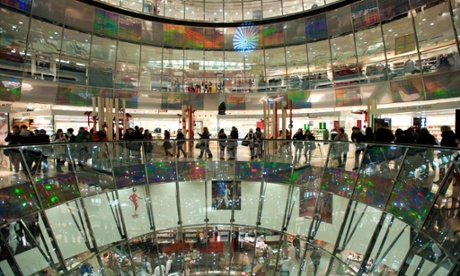
In light of the reforms that are being demanded by Greece, from cutting pensions and liberalising parts of the economy to privatisation of holiday islands and airports, Der Spiegel takes its magnifying glass to Germany’s own economy, and asks, were Germany to face the humiliation of a Troika to oversee how it runs its economy - as Greece, Portugal and Ireland have had to - what might have to change?
Here are the interesting answers:
- The first thing they would focus on would probably be the varied VAT rates, most significantly the reduced VAT rate (7%, compared to the usual 19%) paid by hotels, which the OECD has long advised should be scrapped.
- The burdens placed on the poor and middle class, which are considerably higher than in other industrial countries. It’s widely agreed that the rich are not carrying enough of the load. A troika would likely recommend decreasing labour taxes and increasing property taxes.
- The liberalisation of pharmacies, allowing shops other than pharmacies to sell over-the-counter drugs, a move that has been staunchly resisted by the German pharmacy industry for years.
- A relaxation of the rules governing who can work in skilled manual work. Carpenters, plumbers, hairdressers and electricians are just a few of the jobs where a ‘Meister’ certificate is needed, which ensures quality, but also restricts other EU workers from entering the German labour market.
- A troika could force the government to sell its stakes in former state-run businesses, such as Deutsche Post and Deutsche Telekom.
- Many of Germany’s unprofitable provincial airports might have to close under Troika orders. Greece has just relinquished control of 14 regional airports to the German airport operator Fraport, following the forced re-start of its privatisation programme.
- Obvious social welfare changes would be a reduction in civil servant pensions to the state pension level, as well as scrapping pensions paid to mothers for time spent outside the labour market. Possibly also a reduction in the generous parental money paid to parents for the first 14 months
- Lifting the ban on Sunday trading.
Reuters has a useful take on how the politics of the Greek bailout plays in the Netherlands.
Today’s confidence vote is not only a test for prime minister Mark Rutte, but also for Jeroen Dijsselbloem, his coalition partner and the finance minister, who negotiated the deal.
The debate may also show whether opposition politicians other than Wilders will seek to bring down Rutte’s Cabinet, which is facing a huge challenge in trying to draft a budget for 2016 by next month.
Dijsselbloem’s Labour Party, the junior coalition partner, lost half its seats in the Senate in May after a disastrous performance in provincial elections. Rutte must now find support from at least two major opposition parties to achieve the majority in the Senate he needs to pass any legislation, including the budget.
One potential key ally, the Christian Democrats, said Wednesday it would lobby against granting aid to Greece during the debate.
Rutte’s trump card in the debate and negotiations ahead is the improving Dutch economy. Voter dislike of the austerity-minded Cabinet has waned slightly since March, and Rutte and Dijsselbloem have said they now have room to make concessions to opposition parties willing to cooperate on the budget.
As far as I can tell, we are still waiting for a breakdown on how German MPs voted. But Kate Connolly reports from Berlin that the figure for absences has now been revised down to 46, compared to an initial forecast of 73.
Dutch PM faces no-confidence vote
As the German Bundestag completes its voting, the debate in the Dutch Parliament is just heating up.
Geert Wilders, the far-right populist leader, who is one of the loudest opponents of the eurozone bailout, has compared Greece to a junkie.
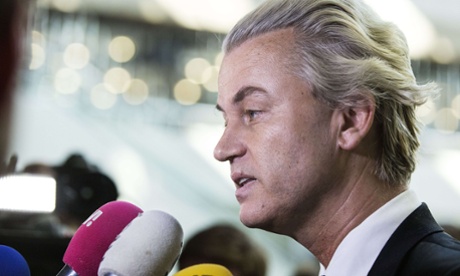
Unlike Spain or Germany, there is no legal obligation for the Dutch parliament to vote on eurozone bailout deals, but MPs have been recalled for their summer holidays for an emergency debate.
The meeting was convened after Wilders called for a no-confidence vote in prime minister Mark Rutte. During his re-election campaign in 2012, Rutte promised that there would be “not one cent more for Greece”. Oops
Updated
It looks like many German MPs stayed away from the vote.
Raoul Ruparel of Open Europe also suggests some members of the radical left party, Die Linke, may have changed how they voted.
The size of the rebellion was slightly smaller than last month, when 119 German lawmakers voted against opening negotiations with Greece on a third bailout.
But we are still waiting to hear how many of Angela Merkel’s CDU/CSU MPs voted against her.
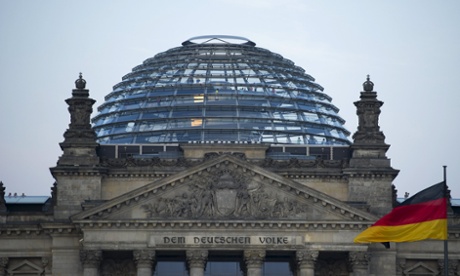
German MPs approve 3rd bailout
Breaking: MPs have approved the Greek bailout package, but a large number of MPs have voted against.
A total of 454 voted in favour, 113 voted against and 18 abstained.
As we wait for the result of the vote, Kate Connolly in Berlin explains the curious pro-Merkel, anti-bailout stance of the German rebels.
The dynamics of this debate are interesting, not least because Merkel’s conservatives, normally such a unified bunch, are so divided on the issue of Greece. The junior coalition partner, the SPD, is currently very divided on many issues - not least on the question of who should be its leading candidate for the 2017 election - but remains unanimously in favour of supporting a third bailout.
So in effect the rebel conservatives can afford to rebel only thanks to the SPD and opposition Greens who are supporting Merkel.
The question is to what extent that makes you a rebel. Yesterday, in a discussion with Klaus-Peter Willsch, one of the more prominent CDU rebels, in one breath he rubbished Merkel’s Euro politics, and in the next, heaped praise on her as a chancellor, saying there was no one else in the party who could hold a candle to her. When asked if the vote today were to be combined with a vote of confidence in the German chancellor, he said he would always vote ‘no’ to the Euro bailout and ‘yes’ to Merkel “every time”.
German MPs vote on 3rd bailout for Greece
And voting is underway...
Here are some scenes from the Bundestag, ahead of the vote.
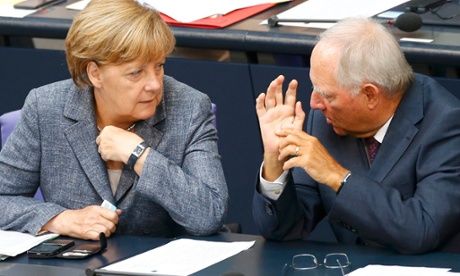
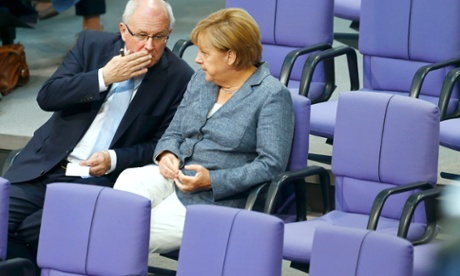
Time for a caption competition?
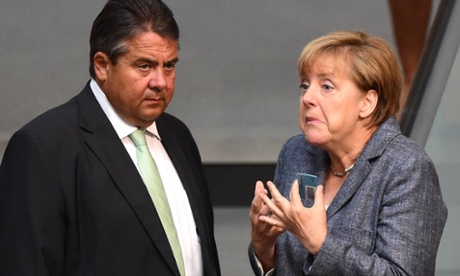
Social Democrat MP Johannes Kahrs is already talking about Greece’s fourth bailout.
Voting is due to start any minute now...
Europe’s man in charge of the euro has promised that eurozone taxpayers will be protected from losses on aid to Greek banks.
Valdis Dombrovskis, a European commission vice president, with responsibility for the euro, said new rules on bank bailouts meant ordinary depositors would not pay the price for losses arising from bailing out Greece’s banks.
In an interview with Bloomberg TV he said the European Commission had insisted there would be no “bail-in” of ordinary bank depositors.
It is not taxpayers that will pay for banking sector problems, but it is shareholders and bondholders of the banks.
He said stress tests of Greek banks would be carried out in a few weeks.
But the commissioner sounded less certain than the German government over whether the International Monetary Fund would contribute to the latest Greek bailout.
The working assumption remains that the IMF would join the programme, he said. But he noted that many eurozone finance ministers oppose debt relief for Greece - one of the conditions the IMF has set for coming on board.
It’s clear that the IMF has its own procedures and will come back to its own programme in the fall... we are working to full participation of the IMF.
A mass rebellion among Angela Merkel’s conservative MPs is looking increasingly unlikely. In the days leading up to the vote, political insiders suggested that up to 120 conservative MPs could vote against the government, compared to around 60 last time.
As flagged earlier, 60 MPs voted against or abstained on the Greek bailout deal in a mock vote on Tuesday.
Perhaps talk of a big rebellion is useful for bringing doubters into line.
MPs from Germany’s radical left party Die Linke have been speaking out against the bailout deal.
Die Linke has been Syriza’s closest ally in the German Bundestag, being the only party in Germany to welcome Greece’s no vote in last month’s referendum on the bailout.
But now Die Linke has parted company with Greek prime minister Alexis Tsipras, although it remains in tune with most Syriza MPs.
Die Linke MPs have also lambasted the deal to privatise Greece’s regional airports, which benefits German company Fraport.
Updated
Eurozone finance ministers to finalise Greek bailout tonight
As forecast, eurozone finance ministers will be holding a conference call tonight to finalise the Greek bailout deal.
Eurozone finance ministers are the governors of the eurozone bailout fund, the European Stability Mechanism, which will be sending a cheque to Athens.
The call will take place at 7pm CET/6pm British summer time.
Schäuble rules out writing-off Greek debt
The Guardian’s Berlin correspondent Kate Connolly has been watching German finance minister Wolfgang Schäuble explain why he is supporting the Greek bailout deal.
As Schäuble made the case for the German government, Angela Merkel looked on.
“The decision for a further rescue package for Greece is no easy one, one has to be honest about that,” he said, blaming the insufficient framework of the currency union. It was interesting to hear this coming from the finance minister who just a few weeks ago was campaigning for a temporary Grexit.
He said that Greece had been “on the right path” with a population willing to undergo reform, before the government of Tsipras took over and then the message was: “Greece can stay in the eurozone without reforming”, and that was just not tenable, particularly within the currency union, he insisted.
Schäuble called for MPs to agree on the €86 bn package, the first tranche of which - €26 bn - is meant be used to pay off the bridging loan issued in July. The ‘institutions’ he said - the International Monetary Fund, the European Central Bank and the European Commission - will make their first inspections in October. “Our goal”, he said, “is that Greece is able to get back on its own feet as quickly as possible”. Measures such as modernisation of the labour market, reform of the administrative service, pension reform and privatisation would be the main contributions to this.
Once again he ruled out a debt ‘haircut’. “Debt sustainability can be reached without a hair cut,” he insisted, adding that the possibilities of changing the time frame within which the credits could be paid back were “limited”.
Bringing his 20 minute appeal to an end, he said: “It would now be irresponsible not to use the opportunity to bring economic recovery to Greece. With complete conviction I now appeal to you to vote in favour of the motion.”
“The chance is there, whether it is taken is only for the Greeks to decide”.
Tsipras yet to decide on early elections
Will Alexis Tsipras call early elections in an attempt to see off opposition within his governing coalition to Greece’s bailout deal?
Since it became clear that the Greek prime minister was relying on opposition parties to get Greece’s latest bailout through Parliament, the consensus held that Tsipras would soon call early elections.
But today Greece’s deputy culture minister Nikos Xydakis played down speculation that Tsipras could go to the polls soon.
Xydakis pinned the timing on the first review of progress under the new bailout, which Greece’s creditors will conduct in October.
He told the state TV channel ERT.
There are two views in order to have a strengthened government - elections either before or after the first bailout review. It is a decision the prime minister will make.
He refuted accusations that Tsipras wants early elections to deal with his own internal rebellion.
What is most important at this phase is that the government serve the interests of the Greek people and not those of the party...Tsipras is the prime minister of 11 million Greeks, not of 30,000 members of the Syriza party.
Source: Reuters
Social Democrat MEP Thomas Oppermann has been addressing the Bundestag.
He is also a supporter of the bailout and as a junior member of Angela Merkel’s coalition backs the government.
Next up is Anton Hofreiter of the Greens, who also support the bailout.
Germans buys rights to run Greek airports
Breaking away from the Bundestag to another Greece-Germany story. The Greek government has agreed to sell to a German company the rights to operate 14 regional airports.
The deal is the first in a wave of privatisations Athens had previously opposed, but agreed to, in order to qualify for bailout loans.
Here are the details of the AFP story that you can read in full here.
The decision, published in the government gazette on Monday night would hand over the airports including several on popular tourist island destinations to Fraport AG, which runs Frankfurt Airport, among others across the world.
The deal, worth €1.23bn euros (£0.9bn/$1.37bn), is the first privatisation decision taken by the government of Alexis Tsipras, who was elected prime minister in January on promises to repeal the conditions of Greece’s previous two bailouts.
Updated
Schäuble has finished his opening statement.
Schäuble is now saying that Germany needs a strong Europe and that requires trust and solidarity.
He reiterates his view that a haircut, a reduction in Greece’s overall debt, is not possible under European law.
Give Greece a chance for a new start - Schäuble
Schäuble says there is a unanimous view among the eurogroup (eurozone finance ministers) that Greece has made a major shift.
He says there is no guarantee that the bailout will work, but that it would be irresponsible not to use the opportunity for a new start.
Via Reuters
Updated
Germany’s finance minister Wolfgang Schäuble is introducing the vote on the bailout debate. He says is a good deal for Greece and Europe.
Bundestag starts Greek bailout debate
The Bundestag debate is underway and is being live-streamed here.
Updated
Greeks should grow their own tomatoes: that is the blunt message to Athens from one of the German MPs who plans to vote against the Greek bailout today.
German Christian Democrat MP Klaus-Peter Willsch has been a vocal opponent of eurozone bailouts since 2011. A slightly longer, more-nuanced summary of his argument is that Greece should leave the euro to boost domestic production.
He sets out several reasons for voting against the Greek bailout deal again, including the question mark hanging over the participation of the International Monetary Fund in the bailout.
We are not sure if we’re voting for a deal involving the IMF or not... But not only that, we only received the documents about the vote last night as a 207-page PDF. Many will be reading it on their way back from holiday, but they’ll hardly have time to check the details.
As the Guardian’s Kate Connolly reports, Willsch was one of 60 rebels in last month’s vote on whether to allow negotiations for a third bailout to proceed. He insists that excluding Greece from the euro would be the best solution for both parties.
Then they can get back on their own feet, grow their own tomatoes and develop domestic produce at a much higher standard than if they were to continue importing tomatoes from Holland at huge cost to feed the tourists.
You can read full story here: German politicians return to Berlin for key bailout vote
Deja vu all over again: Germany MPs to vote on Greek bailout deal
Good morning, and welcome to our rolling coverage of the world economy, the financial markets, the eurozone and the business world.
Greece is now tantalising close to the €86bn (£60bn) bailout it desperately needs to stave off bankruptcy, with German MPs expected to approve the plan today.
After months of brinkmanship that nearly broke up the eurozone, a third bailout for Greece is almost in the bank. On Tuesday the parliaments of Spain and Estonia approved the bailout, as did a special committee of MPs in Austria.
But that was just a warm-up to the main event: a vote in the German Bundestag today. It could also be a dramatic day in Dutch Parliament, where MPs have been summoned back from the beaches for an emergency debate.
A yes vote from the German parliament is not in doubt, although there have been nagging questions for chancellor Angela Merkel about divisions within her own conservative ranks.
But there are some signs that the rebellion could be smaller than previously thought. In a non-binding test ballot on Tuesday, only 60 MPs from the 311-conservative bloc voted against or abstained on the Greek bailout vote - far short of the 120- strong rebellion predicted. But a mock ballot is not a vote.
Once Parliaments approve the bailout deal, the European Stability Mechanism’s board of governors - finance ministers - is expected to hold a conference call to rubber stamp the bailout cheque.
In time-honoured bailout tradition, the money should drop into the Greek government’s account just in time to allow it to make €3.2bn debt repayment to the European Central Bank on 20 August.
And in another smidgeon of good news for Greece, the credit ratings agency Fitch upgraded Greece’s debt one notch to CCC from CC - still deep in junk territory, but a tad more optimistic. The 14 August agreement between Greece and its eurozone creditors had “reduced the risk of Greece defaulting on its private sector obligations”, Fitch said.
But then came the usual disclaimer
The risks to the programme’s success remain high.
I’ll be following all the latest on Greece’s bailout progress and any other interesting news that crops up.