Stronger-than-expected German growth has signalled a winter recovery for the eurozone economies – though some members, including crisis-hit Greece, were left trailing behind.
Official figures showed that GDP across the 19 members of the single currency expanded by 0.3% in the last three months of 2014, led by the export powerhouse Germany, which expanded 0.7%. Germany’s statistics office, Destatis, said domestic demand and exports were strong, helping the economy gather momentum at the end of 2014.
Economists believe growth could accelerate further this year. “The German economy looks set to continue surfing on a wave of economic wellbeing,” predicted Carsten Brzeski of ING, adding “with the strong labour market, wage increases, low energy prices and extremely low interest rates, consumers should continue to spend it”.
Financial markets were cheered by the news, which suggested plunging oil prices may have helped to boost consumer spending. The FTSE 100 closed at a five-month high of 6873.52, while in Germany, the DAX index closed at a new record of 10,963, after breaching 11,000 earlier in the day.
Spain, which was forced to call on its eurozone partners to help rescue its banks in 2012, also experienced healthy GDP growth of 0.7%.
However, the data underscored the stark differences between the fortunes of eurozone states, as the European Central Bank president prepares to unleash quantitative easing (QE), the emergency programme of digital money-creation aimed at preventing the eurozone from sliding into a deflationary slump. Growth in Mario Draghi’s home state of Italy was zero in the first quarter – Europe’s third-largest economy has not recorded any growth since 2011.

France managed a paltry 0.1% growth; Greece, whose government is in the grip of a fraught negotiation over its bailout package, saw its economy shrink by 0.2%. The Finnish economy also contracted, by 0.3% in the first quarter, denting its reputation as part of the eurozone’s strong northern core.
“Cheaper oil may have provided a temporary boost to consumption in some of the stronger economies, but it has done little for the struggling households of France and Italy, let alone Greece,” analysts at the City consultancy Fathom said.
The French economy minister, Michel Sapin, said: “It’s obviously still too weak but conditions are met to allow a more definite upturn in activity in 2015.”
While Germany grew by 1.6% in 2014, France only managed to eke out growth of 0.4%. Its statistics body, INSEE, reported that business investment contracted again while consumer spending slowed.
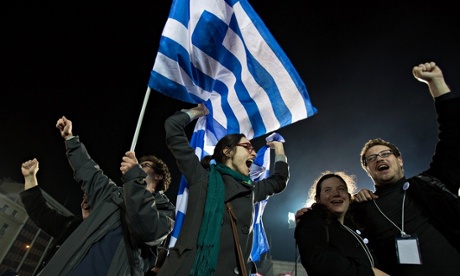
The Greek economy had been recovering through the early part of 2014, but the upturn appears to have petered out as political uncertainty increased in the runup to the election of the radical Syriza-led government last month.
Eurozone policymakers have been deeply divided about whether QE is necessary, and news that the German economy is growing at a relatively strong pace is likely to deepen Berlin’s scepticism about the plan.
Jens Weidmann, the Bundesbank chief who sits on the ECB’s rate-setting governing council, used a speech in London on Thursday night to hit out at QE, saying, “there was no immediate need for this particular measure”.
Germany fears QE could weaken fiscal discipline, by cutting profligate governments’ borrowing costs, and also frets that it could unleash inflation – though most commentators are currently more worried about deflation, with prices falling at an annual rate of 0.6% across the eurozone last month.
However, the stronger-than-expected German performance at the close of 2014 suggests the ECB may be pushing at an open door. Ben Brettell, senior economist at Hargreaves Lansdown, said, “This is the latest in a series of signs that the economic climate might be improving, and the European Central Bank’s quantitative easing programme might therefore benefit from a following wind.”
Across the EU as a whole – including the UK – growth was slightly stronger in the final quarter of 2014, at 0.4%. After outperforming much of the rest of the EU in the early part of 2014, the UK was no longer at the head of the pack in the final three months of the year, with growth of 0.5% putting it behind Germany and Spain.