The backlash has begun. CBI director general John Cridland last week joined the bosses of Next, Whitbread and Wetherspoons in expressing concern about the impact of George Osborne’s “national living wage”, which Cridland described as “a gamble”.
It is a gamble. Churlish Corbynites might complain that the £9 or so which over-25s will have to be paid by 2020 is still well below any realistic estimate of the income required to cover basic needs – rent, food, bills and so on.
But any shift in the labour market that affects up to six million workers – as this will, once its knock-on effects up the pay scale are taken into account – is radical. In some labour-intensive sectors, including hospitality and retail, which have so far been squealing the loudest, it will create a non-trivial increase in the wage bill, the costs of which will have to be met from somewhere.
Whitbread warned that it may have to push up prices in response to the policy; Cridland even said some chief executives he had spoken to were having to rethink their business model.
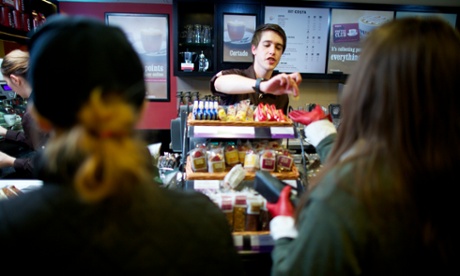
That shouldn’t be surprising. As the Institute for Fiscal Studies pointed out when it first analysed the budget, the increased minimum wage isn’t money for nothing: it will have to be paid for, whether through reduced dividends, a few pence on the price of a skinny latte, or a slightly slower pace of job creation. Most likely a bit of everything.
Academic research on the impact of recent chunky minimum wage increases in some US cities, including San Francisco and Santa Fe, revealed just such an effect. There were modest job losses, and small price increases in consumer-facing businesses such as restaurants, particularly where local customers were rich enough to afford it. There was a reduction in staff turnover, which could meet up to 20% of the costs of the pay rises through savings on recruitment costs.
That echoes the experience of UK firms that have adopted the Living Wage campaign: they often say a better wage boosts loyalty and productivity.
There can be wider economic benefits too: low-income workers tend to spend every penny they earn, and Arin Dube of the University of Massachusetts Amherst has found that higher minimum wages tend to lead to higher consumption, so the benefits ripple out through the local economy.
So don’t expect Osborne to crumble in the face of the chorus of back-to-school whinging from Britain’s boardrooms. Cosiness with business is one of the Tories’ weak points with the voters, and standing firm against stingy bosses will boost the chancellor’s campaign to reposition the Tory party as the friend of the worker – and outflank his arch leadership rival Boris Johnson, longtime supporter of the London Living Wage, in the process. In fact, forcing a rethink on business practices was an avowed part of the chancellor’s motivation for adopting the policy (aside from outmanoeuvring the punch-drunk Labour party).
One explanation advanced for the “productivity puzzle” at the heart of Britain’s lacklustre recovery is that hiring new people or holding on to old employees has been so cheap that as the good times have returned, it has been easier for firms to boost output by increasing manpower, rather than by investing in innovation and training and working more smartly with the staff they have.
Along with the new Apprenticeship Levy, also announced in the budget, which will force large firms to pay into a fund that they can then draw on to pay for staff training, the increase in the minimum wage is intended to make employers think harder about how to get more out of their workforce.
But as the chancellor burnishes his credentials as the friend of downtrodden burger-flippers and pint-pullers, it’s worth remembering how we got here. This “government-mandated pay rise”, as Cridland provocatively calls it, is ultimately the result of a labour market in which workers, particularly at the bottom end of the pay scale, have been progressively stripped of their bargaining power: by the Conservative governments of the 1980s; by the cold winds of globalisation; and by the hangover from the deepest recession in living memory.
And as Osborne proudly displays his generosity, the Conservatives are preparing to strip employees of the last tattered remnants of their right to strike: a weapon without which few of the past century’s seminal advances in pay and conditions would have been won.
If the trade union bill, which will receive its second reading on Monday, becomes law, unions will not only have to meet higher voting thresholds to justify strike action, they will also face a raft of absurdly intrusive constraints.
Want to hold a rally to support your cause? You’ll have to publish details of where it will be, how many people will be involved, whether there will be loudspeakers, props or banners, whether you’ll be using social media and what you’re going to say on it.
Vince Cable, who witnessed the Conservatives’ modus operandi at close hand during the coalition years, described the legislation as “vindictive, counterproductive and ideologically driven”. It is also the precise opposite of the noisy, bottom-up, campaigning approach that was the most inspiring element of Jeremy Corbyn’s leadership campaign.
So don’t be fooled by Osborne’s pose as the workers’ friend. He should be praised for taking the courageous gamble of raising the minimum wage – but woe betide any worker who wants to take the fight for fair pay into their own hands.