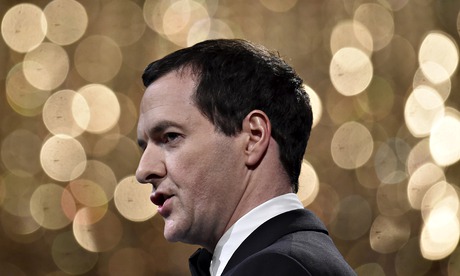
It is no accident that George Osborne and Iain Duncan Smith co-authored an article in the Sunday Times, announcing that £12bn will indeed be cut from welfare in the summer budget on 8 July and in the subsequent spending review. Those who had grown used to the moderating hand of Nick Clegg and the bipartisan “quad” will now learn how very different a fully Conservative government is from a coalition.
Those who had hoped that Duncan Smith might squeeze some compromise from Osborne will also be disappointed. The relationship between the chancellor and the work and pensions secretary has often been fraught – most overtly in 2010 when Osborne announced at the Tory conference that higher-rate taxpayers were to lose child benefit, but neglected to give Duncan Smith advance notice (“I thought we were a team!” IDS wailed to David Cameron). But the relationship has improved. It is by no means perfect: Duncan Smith can occasionally find the chancellor high-handed and one still hears Treasury jokes about IDS’s IQ. But an unlikely partnership has somehow been forged from unpromising materials.
Extra-parliamentary action often signals an intuition that the political class – rather than the governing party alone – is edging towards a consensus. In this sense, the anti-austerity activists who marched in London are on to something. There are still plenty of frontline politicians who oppose the cuts with a passion, of whom Jeremy Corbyn is naturally the most prominent because of his candidacy for the Labour leadership. But the general trend at Westminster is quite otherwise: towards fiscal conservatism as the new orthodoxy.
To understand why, one need look no further than the long-running debt crisis in Greece, and the desperate bid by Alexis Tsipras, the Greek prime minister, to save his country from collapse. Against this geo-economic backdrop, Osborne’s greatest achievement has been to take a statistical abstraction – the deficit – and give it political bite.
It is easy to warn voters that high interest rates will increase their mortgage premiums and depress the value of their homes. Inflation needs no explanation. But the threat of a high structural deficit is harder to capture in a slogan. Indeed, the centre-right on both sides of the Atlantic has a history of sharp division on this very matter.
As HW Brands argues in his fine new biography of Reagan, American conservatives in the 1960s “disliked taxes but disliked deficits even more”. But Reagan’s presidency dramatised the argument, as those who favoured stability fought with those who demanded the stimulus of tax cuts. “If I have to be criticised,” the president wrote in his diary on 22 January 1982, “I’d rather be criticised for a deficit than for backing away from our economic programme.”
Margaret Thatcher, in contrast to her transatlantic ally, was a fiscal conservative by temperament – though the extent to which she practised what she preached remains a matter of controversy among her followers. Those who call themselves Thatcherite today prefer the swashbuckling tax cut to the dull virtue of calm economic waters.
Cameron and Osborne are children of Black Wednesday. Their fiscal conservatism was seared into them by formative experience rather than ideology. Both share an uncomplicated belief in balancing the books and the virtue of stability. It is true that they have failed to pay down Britain’s spectacular debt or to clear the deficit as quickly as they initially pledged. What they have achieved is to change the terms of trade and to reframe political discourse.
Before 2010, it was an unchallenged orthodoxy that increased public spending was hard to trump. Yes, it was legitimate to ask whether the sums could be afforded; whether they would be well spent, on properly reformed public services; and whether the specific expenditure reflected sound priorities. But it was a sackable offence for Tories to call for sweeping cuts: Oliver Letwin went to ground during the 2001 election campaign, having allegedly disclosed plans for £20bn tax cuts to the Financial Times – an allegation he firmly denied – while Howard Flight was sacked as Tory deputy chairman and deselected as an MP in 2005 for declaring in private that the party would make greater cuts than it was admitting in public. And let us not forget that Cameron himself committed his party to match Labour spending plans up to 2010-11, until November 2008 when he claimed that Britain had “maxed out its credit card” and ditched the commitment.
The cross-party notion that public spending is inherently virtuous remains powerful. It is entrenched in the Tories’ ring-fencing of the NHS, schools and international development, and in the pressure to which the government has been subject to commit 2% of GDP to defence spending. But this all-important premise is no longer unchallenged. Osborne’s most remarkable accomplishment has been to change our political culture and the governing assumptions of political debate.
This has harsh implications for Labour. Chuka Umunna – no longer, sadly, a candidate in the party’s leadership contest – has expressed the problem of perception now facing his defeated party most pithily: “to be running a deficit in 2007, after 15 years of economic growth, was … a mistake. My party’s failure to acknowledge that mistake compromised our ability to rebuild trust in 2010 and in 2015. If a government can’t run a surplus in the 15th year of an economic expansion, when can it run one?”
Other than Corbyn, the contenders for the Labour leadership accept to a greater or lesser extent that Ed Miliband’s successor must at least tip his or her cap to the notion that Gordon Brown’s government was spending too much. Of course, when expenditure is disaggregated into health, transport, education and so on, the voters will always tell pollsters that they support higher spending. But that does not necessarily translate into support for higher spending overall. In a treacherous world, fiscal stability has acquired the aura of economic Ready Brek.
It is often said that New Labour was Thatcher’s greatest achievement. To reform one party is hard; to reform two is historic. Cameron and Osborne have not yet converted Labour fully to fiscal conservatism. But the seed has been sown. Like those in the US who lobby for a balanced budget amendment to the constitution, the chancellor now proposes to bind future governments to maintain a budget surplus in “normal” times. The symbolism of this legislation is much more important than its prospective statutory force. It will enshrine a dramatic change in the practice of politics. “We are all Keynesians now”: it was Richard Nixon who said that in 1971, or something close to it. How long before we are all fiscal conservatives?