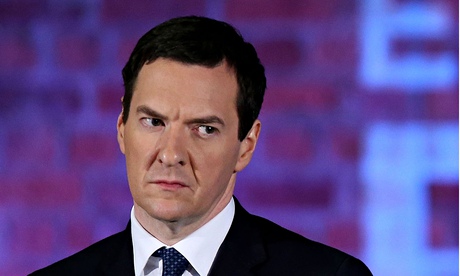
A future Tory government would use part of a planned £23bn budget surplus by the end of the decade to fund the £7bn in tax cuts announced by David Cameron at last year’s Tory conference, George Osborne has confirmed.
In a move to counter Labour claims that the Tories are pledging unfunded tax cuts, the chancellor said his planned budget surplus would allow him to cut Britain’s national debt and to reduce the tax burden.
Speaking at a joint economic event in Manchester with Cameron, the chancellor said he completely agreed with Michael Gove, who said that a Tory government would have £23bn “spare” by 2020 – part of which could be used to fund tax cuts.
Osborne said: “What Michael Gove is saying – and I completely agree with him – is the spending plans we have set out show you can deliver a surplus. The forecast surplus is £23bn by the end of this decade. Those spending plans deliver economic security and by having a surplus you can not only eliminate your deficit but you can start to get your debt down.”
The chancellor added: “I think it is perfectly consistent to have spending plans that deliver the surplus, that reduce the national debt and to deliver those tax cuts that we have promised the British people because they are all part of the long-term economic plan.”
The chancellor used slightly more cautious language than Gove, who said that Osborne’s plans to balance the overall budget by 2018 – and then to build a £23bn surplus by 2020 – had given him room for tax cuts.
The £23bn figure was an estimate by the Office for Budget of Responsibility of the impact of Osborne’s fiscal plans in his autumn statement, which are designed to balance the overall budget by 2018.
The chief whip told BBC Newsnight this week: “If you’ve got £23bn spare, left over, you can get out of that £7bn for tax cuts.”
The chancellor sought to portray the planned tax cuts as part of an overall fiscal package to use the budget surplus to help pay down Britain’s national debt and to incentivise work by cutting income tax.
Osborne said: “It is a sensible approach to say we put economic security and stability first. Without that none of this economic plan would work. And we can get our debts down. Consistent with that and at the same time we can also deliver tax cuts for working people. This is not a bolt-on to our plan. This is also central to our plans so that in this country you are incentivised to work, you are rewarded for your hard work.”
The prime minister faced strong criticism after he outlined plans at the Tory conference for further spending cuts in the next parliament that would then be followed towards the end of the decade by a series of tax cuts. These included raising the threshold at which the 40% tax rate is paid from £41,900 to £50,000.
The chancellor, who was also attacked after his autumn statement for outlining spending cuts that would take government spending as a share of national income down to levels last seen in the 1930s, insisted that the dual ambition of cutting debt and cutting taxes in time of surplus was a prudent approach.
Osborne said: “Our national debt is too high. It went up a lot in the economic crisis because we had a high deficit and we kept adding to that debt. That leaves the UK exposed to the next shock. We don’t know what the next economic shock is going to be out there in the world. We can see there are plenty of risks – what’s going on in Russia, what’s happening for example in the eurozone.
“In this parliament we have managed to achieve £9bn of income tax reductions by increasing the tax free personal allowance whilst cutting the deficit in half and delivering economic stability again to our country.
“We have shown you can do it, we have got the spending plans that show you can manage the public finances and deliver that surplus.”
Osborne said his plans contrasted with those of Labour, which he said had failed to learn the lessons of the past after declining to accept his deficit-reduction plans. Labour says it would cut the deficit but would not set an arbitrary date by which it should be eliminated to avoid sucking demand out of the economy. It would also aim to balance the current budget but would allow borrowing to continue to fund capital investment.
The chancellor said: “The contrast of course with our political opponents is that they don’t actually want to reduce our debt. They say they will run a deficit forever.
“I say that is repeating the mistakes of the past, that is borrowing against our country’s future and our children’s future. It leaves our country exposed, as it was when the financial crash happened.
“We must learn the lesson that you should fix the roof when the sun is shining. The economy will, by the latter part of this decade, have been growing for seven or eight years. If you are not using that period to be paying down your debts when are you paying down your debts?”