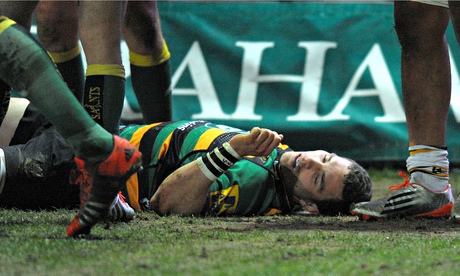
George North will not resume his career after suffering three concussions in less than five months until he is given the all-clear by a neurologist. The Northampton and Wales wing has been ruled out until next month after suffering the latest blow to his head three weeks ago. Medical experts say players who suffer two or more concussions in a year are at greater risk of further brain injury and slower recovery.
The Welsh Rugby Union’s medical team is in constant touch with their counterparts at Northampton over North who was concussed playing for Wales against New Zealand in November and again in the opening match of the Six Nations against England. He saw a neurosurgeon after the third one against Wasps and was told to rest for a month before returning for another examination.
“Concussion is incredibly serious and demands the attention of all governing bodies,” said Prav Mathema, the WRU’s national medical manager. “The stance we take has to be conservative in nature: players will be managed by healthcare professionals like neurologists or sports physicians with expertise in concussion management. Those who suffer multiple concussions within a year are given medical attention by practitioners specialising in concussion management before returning to play. The most appropriate way to manage players is on an individual, case-by-case basis.”
Mathema, along with the WRU’s national team sports physician Geoff Davies, gave a two-hour presentation to the media on Tuesday about concussion and how it is dealt with in Wales at elite and community levels. His medical team was criticised after the match against England when North, who had earlier been taken from the field for a head injury assessment that revealed he had not suffered concussion after suffering a blow to the face, remained on the field despite appearing to pass out momentarily following a clash of heads with his team-mate Richard Hibbard.
“That incident revealed a gap in our management plan which we immediately dealt with,”Mathema said. “If we had seen that George had been knocked out, he would have been removed on the spot. We have since then used a medical spotter for away matches who watches video footage and we have three at our home matches.
“If somebody is concussed or we suspect they are concussed, they are off the pitch. That is unequivocal and it is a medical decision. Players who go off the field for head injury assessment, and it is important to note that not every blow to the head results in concussion, have to pass a series of tests and even if they do the doctor can still remove them from the field of play.”
Mathemas said he was concerned players were being advised to wear headguards to reduce their chances of suffering concussion. He said research showed that far from helping reduce the number of cases in what is the most common injury in elite rugby, it sometimes had the opposite effect because players felt emboldened.
“We don’t think it would be useful for headguards to become mandatory,” he said. “They are there to deal with lacerations and cauliflower ears. There is no evidence to show headguards will reduce concussive episodes but there is research that headguards may increase them. We have to learn the lessons from boxing where they have banned headguards for that reason.
“Players are being educated about concussion and they understand it is a serious issue. They undergo base line tests before the start of every season and we use those when making head injury assessments. It is medical teams who determine whether a player remains on the field,not coaches, because we are the ones carrying out the tests and if a player fails one part of it, he or she stays off.”