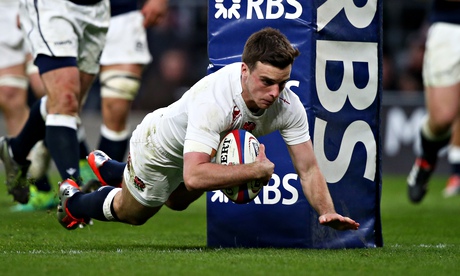
It was a simple finish. Mike Brown’s run down the left had pulled three Scottish tacklers over to that side of the field, and even between the bunch of them they couldn’t bring him down or stop him offloading to Ben Youngs, lurking just behind. Youngs flicked the ball on to Chris Robshaw who, as he so often seems to, did the simple thing he needed to do so quickly and well that his work went almost unnoticed. Robshaw took the ball, spun on his heels so his back was facing the on-rushing Blair Cowan and tossed a fast pass to George Ford. There were five men lined up to Ford’s right, waiting. He stepped their way and shaped to pass. But he’d already spotted that the two defenders in front of him, Euan Murray and Rob Harley, were standing a touch too wide apart. A gap. By the time Murray and Harley turned their heads, Ford was already through. And by the time they’d moved to try and catch him, he was diving over the line.
It was Ford’s first try for England. “We just try to play what we see,” Ford said afterwards. So easy to say, but so hard to play that way, as anyone who has watched much of England in the last few years will know all too well. With Ford at fly-half, they are doing a better job of it than they have at any time in a long time. And as infuriated as England’s players were with the number of opportunities they squandered against Scotland, they were right to be pleased by the fact that they created the chances in the first place. A lot of the credit for that has to go to Ford.
The man-of-the-match award went to Ben Youngs, but it could just as easily have been given to Ford. The try was only the most conspicuous contribution. He had a telling hand in England’s other two, too. He set up Jonathan Joseph with a cunning little delayed pass, delivered just as Harley had committed to tackling him. The pause tugged open a sliver of a gap in Scotland’s line, wide enough for Joseph to slip through. Though to call it an assist – as the stats sheets did – seems a little generous given how difficult Joseph’s superb step around Stuart Hogg was to pull off. Seventy minutes later, Ford was at it again. This time he threw a fine, flat pass straight past Luther Burrell and Courtney Lawes and out to Jack Nowell on the touchline. Nowell took it without breaking stride and had time and space enough to find the line.
It has been a year since Ford made his debut for England, when Stuart Lancaster brought him on for the final two minutes of England’s 29-18 victory over Wales in the 2014 Six Nations, and only four months since he made his first start against Samoa in the autumn. In that short space of time he has surely played his way into England’s first XV for the World Cup, fitness allowing. A late switch this, one the England coach did not seem to see coming. For the best part of the last three years, Lancaster has been building his backline around Owen Farrell, which was one reason why he was so keen to play him in the autumn, when he had only just come back from an injury. Until Farrell was first shifted out to centre then dropped altogether last autumn, he would surely have been one of the men – along with Robshaw and Mike Brown – who Lancaster saw starting against Wales in England’s first game of the tournament.
Since that Samoa game, Ford has played every minute of every match but one. Lancaster swapped him for Danny Cipriani when there were 18 minutes to play against Italy, when England were already 25 points up. The fact that Cipriani is getting so little game time infuriates some, who suspect that Lancaster just does not trust him. And it is true there may yet come a time when the coach rues the fact that he has not given Cipriani more of an opportunity to settle into the side. But Lancaster’s thinking seems to be that having delayed Ford’s introduction to the team for so long, he needs to allow him the benefit of every possible minute of match experience between now and the World Cup.
Cipriani and Farrell both have their qualities. Farrell is a more reliable goal-kicker and a more imposing presence in defence. Cipriani is a dangerous runner. Like Ford, he has a good eye for a break, a threatening step followed by surprising speed over the first few metres, and a wide range of passes. But neither of them has Ford’s ability to control a game with his kicking from hand or, more important still, his ability to switch between styles of play. “You have to learn to play a few ways,” Ford said afterwards. “As a 10 you’ve got to be able to play a variety of ways.” Whereas Farrell and Cipriani fall on opposite sides of the old divide between the Roundheads and the Cavaliers, Ford could yet grow into one of the rare players who is able to straddle the line between the two.