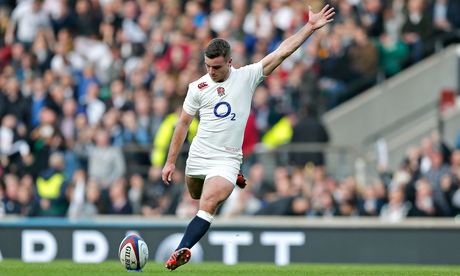
Battered, bruised, and aching, England’s players gathered together one final time on Monday morning, to talk over the last four weeks. A few things have changed since they first met up at the beginning of the autumn. Their style of play is a little different now. “We have learned a lot,” said George Ford. “We have simplified things, we have stripped them down a bit to our strengths.” And so it is for the starting XV. There have been three key changes, right across the axis at No8, No9, and No10. Out went Billy Vunipola, Danny Care and Owen Farrell, in came Ben Morgan, Ben Youngs and, of course, Ford himself. England were better for it. And it seems likely – Stuart Lancaster certainly hinted as much – that, fitness permitting, those three will start again against Wales on 6 February.
So England have a new No10, for now at least. As Lancaster says: “I’m sure Owen will have something to say about that in the next five or six weeks. There are four European games and four Premiership games until we meet again and Owen will want to get that shirt back.” Lancaster has tried seven different men at fly-half since he took charge of the team back in 2012, but he has always come back to Farrell – who has played in 29 of England’s 34 matches in that time. The decision to drop him was a difficult one. That was clear from the fact that Lancaster insisted on picking him out of position at inside-centre against Samoa, and kept him on the bench for the match against Australia, whereas he felt able to boot Care and Vunipola right out of the match squad. Farrell is a man Lancaster wants in his team.
You guess that Lancaster has always envisioned that Farrell would start at fly-half in the World Cup. He has shown such loyalty to him that he ended up picking him for the match against New Zealand even though he had only played 80 minutes for Saracens in the six weeks before the match. Which was a mistake. Farrell was rusty, and it showed. Lancaster has said since he just didn’t feel that Ford “really had the understanding of the mechanics of the team to throw him straight into that New Zealand game.” But he always planned to start him against Samoa, and after the last two matches, it’s clear that those two old friends, Farrell and Ford, are going to spend the next few months competing against each other for the right to start in the World Cup.
There’s an old tendency, in English rugby especially, to split fly-halves into two types: the cavaliers, who love to run, and the roundheads, who love to kick. But the division between Farrell and Ford isn’t nearly so clear-cut as all that. There’s no doubt that Ford, as he has proven at Bath, has a stronger all-round game, a keener eye for a break, and a sharper step. But Bath are set up to play that way. England are not. Lancaster is not necessarily looking for a fancy, fleet-footed fly-half. If he was, he wouldn’t have spent the last two years building his team around Farrell. Five weeks ago, in the buildup to the match against the All Blacks, Lancaster told his team that “to be the best, it’s not about the flash stuff, it’s actually about skill execution, and getting everything done at a high level.”
So the idea that, with Ford installed, England’s backline is about to start playing with the kind of dash and panache that Australia showed on Saturday is wide of the mark. Especially while they have Brad Barritt at outside centre. Instead, Lancaster wanted Ford to prove he could do a better job than Farrell of orchestrating the team, helping them to play to their strengths up front. Which Ford did. It was his game-management that stood out against Australia, especially the variety and accuracy of his kicking from hand.
“The 9 and 10 are the real generals of the team,” Lancaster said. “And they decide if we drive, kick for goal, go off the top and what play we use.”
And in that regard, he added, England’s half-backs were “much, much better” than they had been in previous weeks.
Ford himself said that England’s backs owed the forwards after the first three Tests of the autumn. “There’s no hiding from that. We said it in the week. We can’t have the forwards playing like that and us letting them down,” he said. “We tried to pay them back a little bit by being a bit smarter and managing the game a bit more, and I thought we did that.” Ford has a reputation for flair, but what mattered here was that he got his tactics right. “The way we kicked the ball, the way we chased. We got good field position, and we allowed the forwards to get on the front foot and get the ball in front of them, which they like.”
It would be fair to ask whether England will need more than that when they come up against teams who can match them up front. Ford may yet prove he can do that too. But for now, it seems, we can expect them to carry on playing in this style. “Wales away on a Friday night is going to be a game where it is about doing the basics really well,” Ford says. “Letting the forwards do what they do, and grinding and building the score that way.”