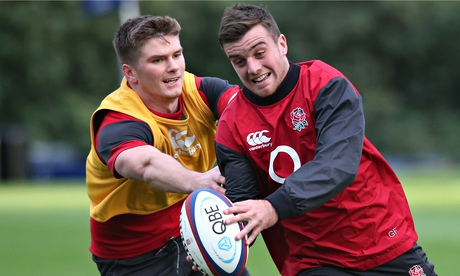
Finally, after a season of trying and even longer thinking about it, Stuart Lancaster has announced a side with George Ford and Owen Farrell starting alongside each other. In the saga of England’s troublesome midfield it is the latest attempt by the coach to give England’s backs a bit of ambition and fluency but in fact he is merely repeating an exercise first conducted when Ford was aged 15 and Farrell 16.
Last spring, when Ford joined Farrell in the dying moments of the Six Nations in Rome, Lancaster must have glimpsed a rosy future when Ford put his captain Chris Robshaw away for the last of England’s tries. It was an exercise which certainly would have been given more time in New Zealand last summer had surgeons not found five holes in Ford’s shoulder ligaments.
Then again the two alongside each other provided a cameo against the All Blacks, something Lancaster says he would have tried against the Springboks last weekend but for Farrell cramping up just as Ford was leaving the replacements’ bench.
On Wednesday though, Lancaster got his way. However, he is a long way short of being the first England coach to get excited at a Ford-Farrell, 10-12 pairing. The honour went to John Fletcher, who was looking after the England Under-16s side when Ford was only 15, and repeated it in the next England age grouping before finally, at the 2011 junior World Cup, Rob Hunter reshuffled his back line for the final.
Will it work again? Hunter was left with mixed feelings but others have no doubt Ford can do the job. Notably two of his Bath team-mates, Dave Attwood, who plays alongside Ford on Saturday, and Peter Stringer, the 98 times capped Ireland scrum-half who has had a ringside seat since moving to the Rec two seasons ago. Both are particularly impressed by Ford’s communication skills.
“If you looked at him in the street you’d ID him for a packet of fags but to hear him speak in a meeting and command everyone on the field, you’d think he was a 35-year-old veteran,” Attwood says. “He is exceptionally good at communicating on the field and he’s not afraid to put you in your place regardless of how senior you are.”
Stringer says he was impressed from the moment he met the then 19-year-old Ford, who had made the difficult decision to switch from Leicester – where he was understudying for the England fly-half Toby Flood – and move to the club where his father Mike was coaching and soon to be head coach.
“My experience of guys at that age – 19, 20 – is that they are just out of the academy setup, on the fringes, shy and quiet, but George was like someone who had been a professional for years,” Stringer says. “He had the confidence and knowledge of the game not to be afraid to speak. The rest of the team takes massive confidence from that, knowing this guy is behind the forwards orchestrating things.
“I was in a similar situation when I first came on the scene with Munster. I was behind a pack with guys like [Anthony] Foley, [David] Wallace and [Peter] Clohessy. You have no option other than to assert yourself, because if you’re quiet they simply will not respect you as a player.”
With Munster and Ireland, Stringer played most of his rugby inside Ronan O’Gara and sees similarities between Ford and the fly-half who played for Ireland 128 times, as well as three times for the Lions.
“They are quite similar,” Stringer says. “Their ability to read the game and do the right thing at the right time is massive. George’s ability to play flat on the gain line is something I like personally. It’s what I had with Ronan over the years, the way he was willing to attack [it]. And George is so good at pulling guys out of the line. Then he shows and goes. It’s what he has, he’s really quick and not afraid to carry the ball.”
It clearly works for Bath, whose young team are third in the table and scoring eye-opening tries but what about with England who seem unable to fashion anything against sides such as New Zealand and South Africa? Geordan Murphy, the former Ireland international who spent three years alongside Ford at Leicester, sees no reason for doubt. “He was fantastic here and he’s improved,” Murphy says. “We would have loved to keep him, he was such a natural player. He broke into our side at 16 and was so composed – a great personality and he plays like that.”
George’s father, Mike, a former England defence coach before going to Bath, is even more certain. “Yes definitely,” he says. “They are on the same wavelength. Both can play first receiver, both can play second. They both understand the game but give you different kicking options. They bring the very best out of each other – and they get on very well.”
Ford Sr also reveals George and Owen go back even further than under-16 level for England. They were playing rugby league against each other back when George was 12. And the link goes on, Mike being the coach at Saracens when Owen’s father, Andy – now a key part of Lancaster’s coaching team – switched codes. “We ended up living on the same street so they all went to school together, my two boys – Joe and George – and Owen,” says Ford Sr who is convinced the old schoolboy understanding will help England out of their rut.
“Owen’s very physical, can defend very well and pass. George is more a guy who can make the break, see the line and put guys through gaps,” he says. “I’m not saying Owen can’t do it, but George does it every day with Bath rugby. Saracens don’t play that way so it’s difficult for Owen.”