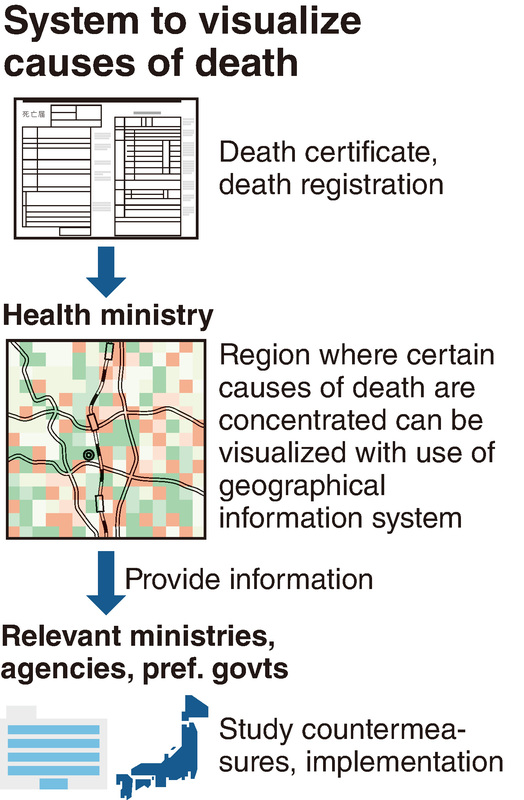
The government will launch a system to map the distribution of people's deaths by causes, such as diseases and accidents. By understanding mortality trends on a regional basis and carefully analyzing the causes, the government aims to come up with effective measures in the field of preventive care and improve public health. The mapping system is expected to start by the end of this fiscal year.
The government will utilize such information as the cause and time of death, and place of residence, which is included on death certificates written by doctors or death registrations submitted to local governments. The central government has already compiled statistics on causes of death that allows it to make a comparison of certain types of diseases on a municipal basis. However, there has been no system available to analyze causes on a regional basis.
The government plans to utilize the geographical information system to visualize the causes by region on a map. In an effort to prevent personal information from being identified, the map will be represented as a gridded area of 1-kilometer squares. The recording of data for times of death will make it possible to determine the hours in which most people tend to die.
Using the system, it will be possible to identify areas where a large number of people have died from heat stroke, which has killed an increasing number of people recently following bouts of extreme weather. The government will combine this data with weather information such as temperature and humidity and then study effective ways to prevent deaths. In cases of such diseases as cancer, cardiac infarct and stroke, the government will examine causal connections with regional climate, culture, diet and other factors. Analysis of time of death is also expected to find specific times when suicides tend to occur more frequently, enabling the government to come up with countermeasures.
The Health, Labor and Welfare Ministry will analyze data and then provide preventive information to relevant ministries, agencies and prefectural governments, calling on them to take countermeasures while taking into account the actual situation in each area. By accumulating such data over several decades, the government will be able to understand changes in the number of deaths and examine the effectiveness of the system.
The health ministry will discuss specific details, such as what types of diseases should be included on the map with geographical information.
The government aims to expedite the system's full-scale operation while reinforcing procedures by increasing the number of medical examiners who establish causes of death.
The system will enable quick detection of the causes of death and analysis of trends linked to where and when people die. It is also expected to help quickly identify details about future occurrences of similar incidents.
In 2006, 21 people died of carbon monoxide poisoning caused by Paloma Industries Ltd.'s gas water heaters. At the time, the cause of the victims' deaths were initially mistaken as illness, which caused a delay in handling the problem.
Read more from The Japan News at https://japannews.yomiuri.co.jp/