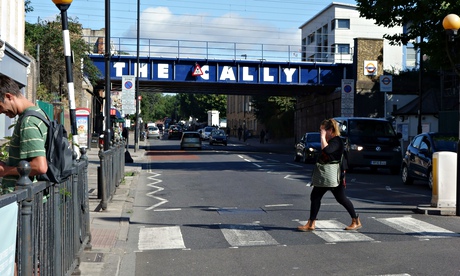
The article on the Caledonian Road (“Murder of teenage boy on London street exposes city’s great wealth divide”, In Focus) is disingenuous, suggesting that the twin engines of the redevelopment of King’s Cross and the gentrification of Barnsbury, to the east of the road, are somehow linked to the senseless murder of Alan Cartwright.
It’s a lack of social facilities for young people, coupled with the alienation of many from mainstream society, that lead to these gangs of youths roaming streets like the Cally. It should be remembered that the people arrested for Alan’s murder came from some distance away.
The Bemerton estate, to the east of the Cally, has always been a magnet for youths marauding from other areas.
I am perplexed by the comment by a local living to the west of the Cally that she feels intimidated when she crosses the road into Barnsbury.
This perception, I suggest, says more about the people themselves than the reality. There may be pretty terraces of early Victorian houses in Barnsbury, as in much of Islington, but about 50 % of the dwellings in Barnsbury are purpose-built flats or maisonettes. Social housing accounts for about 47% of the housing; of this about 22% is council-owned.
A walk around the streets of Barnsbury reveals people of every colour and class going about their business.
E Wood
London N1
Greed degrades us as a nation
Armando Iannucci is devastatingly correct about the money-monotheism which now rules our society and our politics (“Politics was once about beliefs and society. Now it’s a worship of money”, Comment). A problem for Iannucci and the rest of us who perceive this as degradation is the smug vanity of its proponents and their disciples, who take pleasure in such criticism, calling it the bleating stupidities of the economically illiterate.
Accordingly, another point has to be made. Closely watching this new priesthood, I have had to conclude that they are – greed apart – mediocre of mind, dull of imagination, chilled of heart. This is no mere insolence. I have methodically watched and read interviews, books, articles, and reports over long periods from these blinkered souls – blinkered in that nothing, as Iannucci so well describes, can affect their tiny perceptions of what human life is all about.
We should not forget that Britain has been the country of Jane Austen, the Brontës, Dickens, Chaucer, Newton, Darwin, Shakespeare, Watt, Burns, the Mabinogion texts, Turner, Constable, Keats, and dozens more women and men who worked not for cash but for fulfilment and who could not possibly have emerged in the money-dictatorship aspired to in Britain today.
The mediocrity and mind-poverty of these national accountants could finally mean the end of British inspiration after so many centuries of uncosted genius. Can we, in the very deepest sense, afford that?
Ian Flintoff
Oxford
More wind, less solar, please
I am delighted to hear that Labour will create interest-earning bonds for investment in green technologies (“Labour pledges green premium bond bonanza”, News). If we put our collective government and corporate minds to it, the UK could become a world leader in sustainable energy technology rather than going “all out for (subsidised) fracking” as this government does. Doing so would also generate many jobs and exports.
There is, however, one thing I am concerned about, which relates to solar panels.
Here in southern England I am seeing hundreds of acres of good arable and grazing land disappearing under solar arrays.
Given that we now produce only about half of the food we eat, and that climate change is already producing massive crop failures in many parts of the world, it might seem sensible to find other places for them.
In the most densely populated country in the EU (England), and with a still fast-growing population, food security is as least as important as energy security.
I’d go for onshore wind power too. I quite like windmills.
Dr Brian Curwain
Christchurch
Dorset
No way to conduct bus fares
Further to Ella Marks’s letter , may I point out that we are now in a ridiculous situation where it is impossible to buy a London bus ticket with cash. Those of us who do not live in London are expected to know that fares must be paid in advance and how to do this. I’ve been caught out twice recently; it is not only extremely inconvenient, it is embarrassing as one is so publicly thrown off the bus, not because one is unwilling or unable to pay but because the driver refuses to take payment with money.
And having been thrown off, one has to find another means of reaching one’s destination – a situation made worse by the fact that large areas of London are served only by buses. If it’s bad for me, what is it like for tourists and other visitors to London? Who thought up this ludicrous scheme?
Sara Neill
Tunbridge Wells
Kent