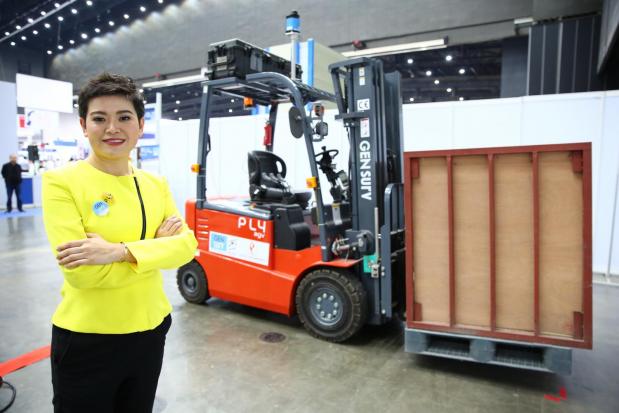
Thai robotics startup GenSurv Co is ready to tap into the country's rising market for robotics and automation with its first autonomous commercial forklift.
GenSurv introduced the forklift, the Ply AGV, in the last few weeks. It's the first Thai forklift brand to compete with international brands in the local market.
Managing director Wareemon Purapati said the company expects to record 50 million baht in sales from the product in 2019.
"We are aiming for 2 billion baht in revenue within five years, including our future products," she said.
GenSurv was founded six years ago for R&D of robotics and automation systems. It received a co-investment budget from the Thailand Research Fund for a total value of about 7 million baht.
Ms Wareemon said the company is a collaboration of seven experts in marine and land robotics engineering working with Chulalongkorn University and the Institute of Field Robotics at King Mongkut's University of Technology Thonburi.
"We modified features of forklifts such as control and software before selling them commercially," she said.
Ms Wareemon said the autonomous forklift is not GenSurv's first R&D product. The company built an autonomous boat and an unmanned surface vehicle, which are used for hydrographic surveys for river mapping, inspecting reservoirs for volume capacity and inspecting underwater structures for oil and gas.
The company has also constructed remotely operated underwater robots for inspection, autonomous all-terrain vehicles and a mobile robot.
GenSurv has an assembly plant in Phra Pradaeng district, Samut Prakan province.
"We modified the forklift to become an automated guided vehicle, with mostly imported components and sensors," Ms Wareemon said. "But the know-how in mechanics, electrical components, controls, programming and software are from Thai engineers."
GenSurv can produce autonomous forklifts for 2-7 million baht, depending on the size, making them 30% cheaper than imported forklifts.
Ms Wareemon said the target customers of autonomous forklifts are companies that use traditional forklifts with drivers in warehouses or factories.
These companies are looking for more efficient solutions in their operations.
"The autonomous forklift helps because there is a driver shortage and it decreases other mistakes and damage that forklift drivers can cause," Ms Wareemon said.
She said the forklift supports every size of goods, including hazardous materials.
Many companies turn to expatriates to operate forklifts, but the driving licence test is in Thai and can be complicated for them to pass.
GenSurv also provides a robot solution provider that is fast and efficient, delivering the real-time status of goods and transport information to warehouses and production systems.
Ms Wareemon said demand for robotic and automation systems in the Thai market is growing quickly, but most manufacturers and service providers come from overseas, making their price tags unaffordable for some Thai businesses.
Moreover, the government offers full incentives and privileges for investment in locally made robotics and automation systems.
The government also supports Thai companies entering this sector, Ms Wareemon said.