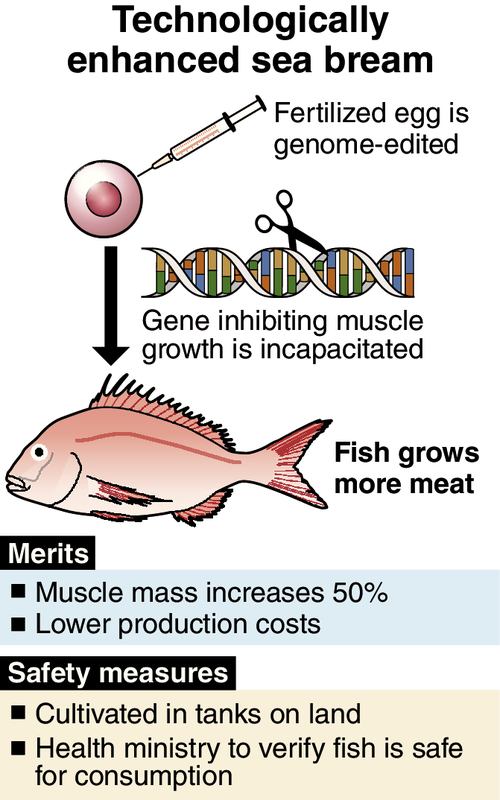
Genome-edited red sea bream with up to 50% more edible flesh could receive government approval as early as September, allowing the fish to be sold on the market
If approved, red sea bream would be the first genome-edited fish sold for public consumption in Japan.
Kyoto University and Kindai University are among the entities that jointly developed the meatier sea bream using genome-editing technology, which incapacitates specific genes. Myostatin, a gene that restricts muscle growth, was incapacitated, enabling the fish to grow more muscle mass.
A sea bream fed the conventional amount of food can grow about 50% more edible flesh using this method, which is expected to lower the cost of the prized fish.
Each genome-edited sea bream is tagged for individual identification and cultivated in tanks on land, eliminating the chance of crossbreeding with fish in the wild.
A Health, Labor and Welfare Ministry expert subcommittee and other bodies will confirm, among other items, that new genes have not been inserted into the fish and whether the modified fish produces new allergens. The ministry will approve sale of the fish if no problems are detected.
However, when the fish will hit the market remains undecided.
According to Fisheries Agency data, the average annual volume of seafood consumed by each person worldwide has increased about 10% over the past decade, especially in Asia.
The cost of food used for farmed fish has soared, and aquaculturists struggling to stay afloat are hoping the technology will be a boon to business.
Kyoto University and other entities are researching genome-edited fugu, and a group including Kyushu University is considering applying the technology to mackerel.
In 2020, genome-edited tomatoes containing higher levels of the amino acid GABA, which helps lower blood pressure, became the first genome-edited food approved by the ministry for distribution in Japan.
Genome editing incapacitates a targeted gene or genes, so these foods are said to be no different from food produced via conventional breeding.
By contrast, genetic modification introduces a new gene or genes that alter the food, and doing so requires rigorous checks to ensure such foods are safe to eat and will not have a negative impact on the environment.
Genome-edited foods must get government clearance before being sold on the market.
Read more from The Japan News at https://japannews.yomiuri.co.jp/