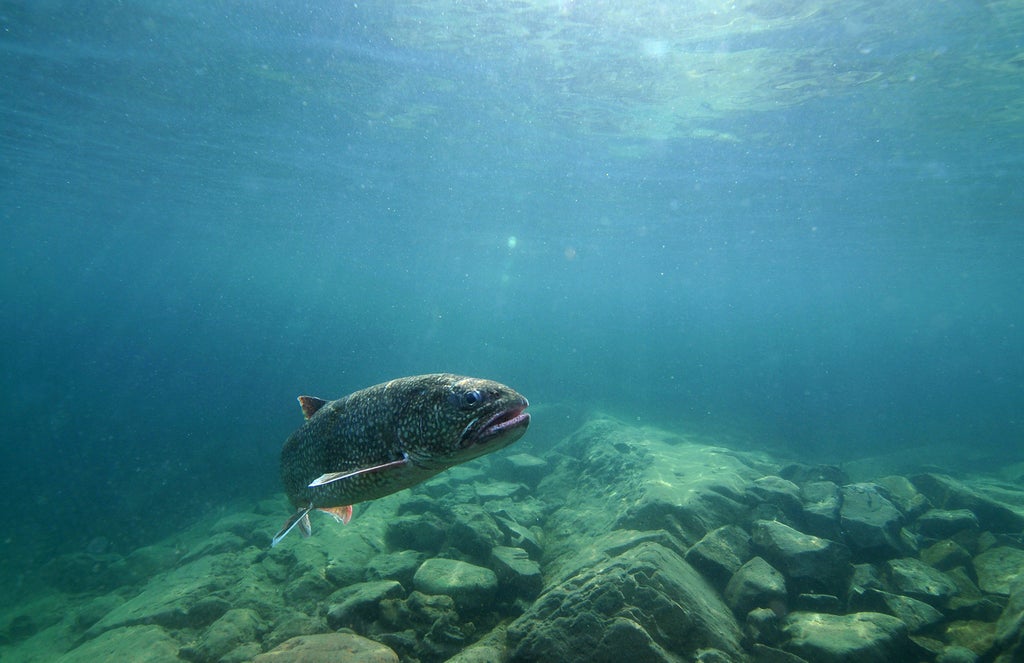
Scientists have traced the genetic makeup of lake trout, a feat that should boost efforts to rebuild populations of the prized fish in the Great Lakes and other North American waters where they've been hammered by invasive species, overfishing and pollution, officials said Tuesday.
U.S. and Canadian researchers completed a reference genome, or digital genetic map, for lake trout. It will help explain characteristics that enabled the species to evolve and spread across its vast range, with certain types becoming better suited to particular locations and depths.
The data also will provide vital information for managers of programs that stock lakes with young trout to supplement natural reproduction, said Marc Gaden, spokesman for the Great Lakes Fishery Commission.
“Lake trout are widely distributed across North America, and there are huge variations in habitat use, shape, size, body mass, color," Gaden said. “We need to understand why they look the way they do, why some types are more successful in some habitats than others, why some types in hatcheries do better than others.”
The team of experts with several U.S. and Canadian universities and government agencies published their genome report Aug. 5 in the journal Molecular Ecology Resources. William Taylor chairman of the fishery commission and a Michigan State University fisheries ecologist, described it as “a vital missing link in our efforts to restore lake trout.”
Lake trout long dominated the Great Lakes as a predator fish and are common in other large North American lakes. They sustained aboriginal tribes for generations and were a primary target of post-settlement commercial fishing operations.
Their numbers in the Great Lakes plummeted in the last century with the invasion of sea lamprey, an eel-like parasite that attaches to fish and sucks their bodily fluids. Researchers eventually developed a poison that is applied to tributary rivers where the lamprey spawn, keeping them in check.
But habitat loss, overfishing, pollution and other invaders have hampered efforts to bring back the lake trout. Although they can live for decades, it takes about seven years for them to become sexually mature — and many don't survive long enough to reproduce.
Agencies continue to stock them in all the Great Lakes except Lake Superior where the species has recovered well, Gaden said.
Development of the reference genome should help managers fine-tune those efforts.
“The more you can understand what makes this organism tick, the more you can do to take steps to rehabilitate it,” he said.
Genomes of salmonids, a family that includes lake trout, are harder to compile than those of many other animals, the research team said.
“Having a publicly available map of the lake trout genome removes most of the initial hurdles associated with doing conservation-oriented genomic research, makes it significantly easier to compare results across studies, and will hopefully quicken the pace of scientific discovery,” said Seth Smith of Michigan State University, the study's lead author.
Shawn Sitar, a fisheries research biologist with the Michigan Department of Natural Resources who wasn’t involved with the study, said returning lake trout to their historically influential role in the Great Lakes will require understanding differences between their types at the sub-species level -- which the genome research will support.
“We see them in different habitats, functioning in ecologically different ways, living differently,” Sitar said. “If you want to restore a forest ecosystem, you don’t put in one just one tree. You want to restore the integrity of what the ecosystem was originally.”