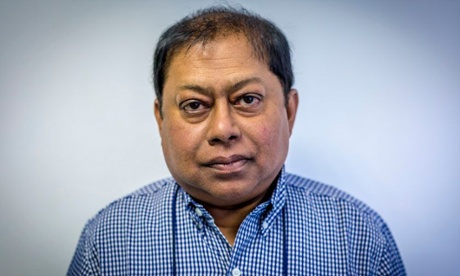
Sustainable development relies on an efficient and fully-used workforce – which means making sure that the role of women and girls is not just acknowledged but fully accounted for. With the advent of the Sustainable Development Goals, gender work is a clear priority. So it’s very handy that Crown Agents’ Director of Debt and Public Financial Management Dev Useree isn’t just a 30-year veteran of PFM but is also a champion for optimising the roles and potential of women in development and its financing.
Dev will be part of the Crown Agents’ delegation at the Financing for Development conference being held in Ethiopia this month, and will be a panellist at our side event at the conference, entitled Gender and Public Finance – Turning Rhetoric into Reality. Ahead of his trip, we asked him for a few of his thoughts.
When and why did work on gender become one of your focuses?
Subconsciously, gender’s been on my radar since my academic studies in the 1980s, when I first witnessed the prevailing cultural differences and challenges involving the roles and contributions of women and girls in society.
Professionally though, it was when the MDGs started focusing attention on the inequalities and suffering of large groups in society and the specific actions needed to overcome their plight. I was working with countries to manage their debt burdens and it became a priority to ensure that the savings made by governments for their cancelled debt should fund different types of poverty reduction programmes; particularly for women and girls.
Was this only about funding gender programmes by debt relief – or more?
Well, there was more to come. At that time, I was with the Commonwealth Secretariat and they tasked me with looking at a new initiative of trying to bring a gender perspective in the midst of government borrowing and the wider management of development resources.
We developed a framework for mainstreaming gender in debt and development resources management, then tested and showcased it in several workshops organised in Africa, the Caribbean, Asia and the Pacific. The findings were subsequently published by the Commonwealth Secretariat; a publication that remains useful for practitioners in the field.
You wouldn’t ordinarily think about gender when talking about PFM. What’s its relevance to that?
Correct. And at Crown Agents we would like to change that perception. My fellow PFM colleagues and I provide integrated PFM solutions – covering revenue enhancement, expenditure management, debt and cash management among other intervention – but it is unfortunate that gender considerations do not have a higher billing from donors and governments explicitly within that framework.
Some countries have embraced gender budgeting but putting gender at the heart of policy design and implementation requires greater work. To illustrate, governments use the Public Expenditure and Financial Accountability (PEFA) tool to assess how well they are embracing good practice in PFM. This tool then leads to comprehensive reform plans for countries – very often supported by donor funding – yet, there’s hardly any reference to the gender dimension in that comprehensive assessment. That needs to change among many other things.
You’ve said that the gender issue should not be a concern of only gender experts or specialist gender units in governments – it needs to be more mainstreamed than that?
We need all sorts of specialist skills and capacity in government, including gender specialists, but before that we need to increase the recognition of the need for scaling up gender issues among those working in PFM and related fields. Often when a gender specialist or unit in government is saddled with a specific gender work, the rest of the organisation switches off and never makes the required attempt to embrace the problem themselves.
The same scenario may happen among “providers of expertise” whereby gender issues are considered specialist requirements and not something we should all routinely consider when we advise on basic policy design and assist with project implementation.
Building gender considerations into development work is not just about empowering women, is it? It’s just as important to work on it with men?
Absolutely right. Though the MDG and SDG targets talk more about women and girls, gender is equally about men. How do we all – men, women, children – join the bandwagon of resolutely addressing inequality, access to opportunities, and more, without artificial barriers caused by wrong perceptions about gender? That’s the way forward.
What are the challenges of making gender an automatic consideration in development work?
There aren’t enough column inches to cover it! But I would like to say that we must continue breaking the cultural barriers that suggest that half the population of the world should be treated differently. It’s widely acknowledged that gender inequality prohibits countries’ potential to achieve greater expansion and development, so we must refocus the economic model to make this easier to achieve. And what better place to think about it than the budgetary and PFM framework!
What do you hope that Crown Agents’ gender-focused discussion panel at the Financing for Development conference will achieve?
Our objective is simple: let’s make use of the whole suite of PFM and integrate gender considerations into all aspects of that framework. How can we use the PFM structure, including the budgets that already exist in all governments, to upscale gender issues until they become natural ingredients of government policy design and implementation?
We will suggest how gender budgeting can be more forcefully used to that effect and look at how upscaling gender audit across all aspects of PFM can drive the gender objective being promoted by the SDGs to greater success in different types of economies.
In a nutshell, how can we stop being spectators and become fans of gender in whatever we do; whether in policy-making, governance, scrutiny, tax administration, budget implementation, spending ministries, etc?
Hopefully, there will be funding channelled to the work of mainstreaming gender in all tiers of government as we say goodbye to the MDGS and get ready to embrace the SDGs.
Content on this page is paid for and provided by Crown Agents, a sponsor of the Guardian Global Development Professionals Network.