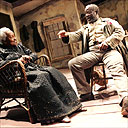
August Wilson's 10-play cycle on 20th-century black history is a titanic achievement. But it would be idle to pretend that all the plays are of equal merit. Gem of the Ocean, the ninth to be written but chronologically the earliest, exists somewhere in the middle ranks of the Wilson canon: strong in its social observation, suspect in its visual and emotional rhetoric.
Wilson's setting is Pittsburgh's run-down Hill District- his own birthplace - in 1904: a period when slavery was officially over but most African- Americans still lived in economic servitude. Wilson's focus is on one particular house presided over by Aunt Ester who claims to be 285 years old, and who clearly symbolises spiritual indomitability. Among the visitors to her sanctuary are a tough old southerner, Solly Two Kings, and his young fellow-Alabamian, Citizen Barlow, who has allowed another man to die for a crime he has committed. What we witness is the latter's expiation of his sin and acceptance of the role of militant freedom-fighter.
As a historical portrait, the play is fascinating. We learn that Citizen, attempting to find a job in the local mill, is offered slave wages that barely cover the costs of his slum lodgings. From the sister of the itinerant Solly, who peddles dog shit, we hear that people in the South are "having a hard time with freedom". But Wilson also, through the riveting figure of the local lawman, shows how certain African-Americans swapped sides and embraced the entrepreneurial ethic of their white oppressors.
My problems stem from the pivotal figure of the antique Aunt Ester. Although feistily played by Carmen Munroe, she too patently symbolises the survivalist, revivalist instinct, and one particular scene, where she cleanses the young Citizen's soul by taking him on an imaginary re-enactment of a slave-ship journey, strikes me as hocus-pocus. If anything, Aunt Ester with her Bible-punching folk wisdom is a reactionary figure in a play devoted to the idea of radical progress.
Paulette Randall's vivid production, the second in the Tricycle's African-American season, shows the benefits of ensemble casting. As in Walk Hard-Talk Loud, Kobna Holdbrook-Smith impressively shows the maturation of a young hero espousing the cause of freedom. Joseph Marcell as the gritty, post-bellum old-timer and Jenny Jules as the sanctuary's cook and laundress are outstanding. And Patrick Robinson, fresh to the team, is brilliantly brutal as the law-enforcing Caesar. There may be greater Wilson plays than this, but a crack company is gradually forming in Kilburn.
· Until February 11. Box office: 020-7328 1000.