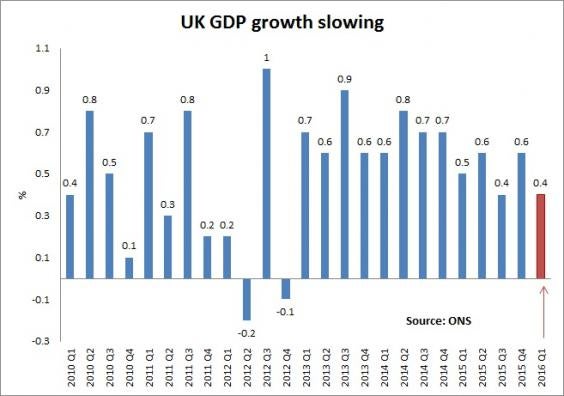
The British economy slowed down sharply in the first quarter of 2016.
GDP, which means the total value of all the goods and services produced in the UK, expanded by 0.4 per cent in the first three months of the year according to the the Office for National Statistics. That's down from 0.6 per cent growth in the final quarter of 2015.
The ONS said the latest data showed the continued heavy reliance of the UK economy on the services industry for growth, confirming that George Osborne's promises of an economic rebalancing towards manufacturing are still not being delivered.
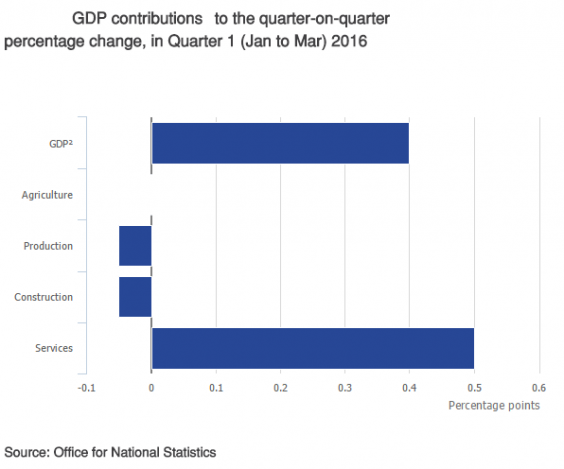
The services sector (which accounts for almost 80 per cent of the economy) grew by 0.6 per cent but industrial production (which includes manufacturing) fell by 0.4 per cent and construction output contracted by 0.9 per cent.
That meant all the GDP growth in the first quarter came from services:
"Today’s figures suggest growth has slowed as compared with the pace up to the middle of last year. Services continue to underpin the economy but other sectors have shown falling output this quarter" said the ONS chief economist Joe Grice.
The main reason for the overall GDP slowdown was a weakening in growth in "business services and finances" which slowed from a 0.7 per cent expansion in the final quarter of last year to just 0.3 per cent in the latest period. Those industries constitute 40 per cent of the services sector and 30 per cent of the overall economy.
Some economists said worse was likely to come in the second quarter of the year as concerns about the possibility of Brexit hit consumer and business confidence.
"We expect GDP growth to be limited to 0.3 per cent in the second quarter, amid heightened uncertainty in the run-up to the 23 June referendum on EU membership" said Howard Archer of IHS Global Insight.
"Referendum wobbles could make themselves felt in the coming months, highlighting the continuing downside risks for the economy this year" said Lee Hopley of EEF, the manufacturers' organisation.
In last month's Budget the Chancellor spoke of a "dangerous cocktail of risks" facing the global economy and warned that "Britain is not immune to slowdowns and shocks".
Today he said that the worsening GDP figures underlined the need for Britain to vote to remain in the EU.
"There are warnings today that the threat of leaving the EU is weighing on our economy. Investments and building are being delayed, and another group of international experts, the OECD, confirms British families would be worse off if we leave the EU. Let's not put the strong economy we're building at risk, and vote to Remain on June 23” he said.
But the ONS said that it had no evidence that the slowdown was linked to uncertainty around the referendum.
The level of output in manufacturing and construction still remains well below where it was when the UK went into recession in 2008. The latest statistics show that construction is 4 per cent lower and manufacturing is 7 per cent lower. Services output is 13 per cent higher. Overall GDP is up 7 per cent over that same period.
Last week, in part due to weaker growth, the Chancellor missed his 2015-16 borrowing target by £1.8bn, putting his plan of running an absolute Budget surplus in 2019-20 in further jeopardy.
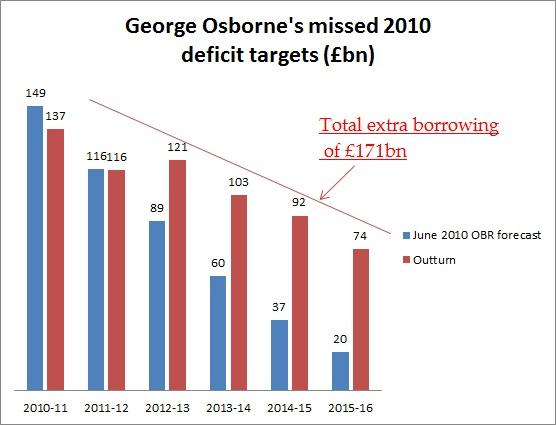
The ONS report showed that Mr Osborne has borrowed £171bn more than he originally intended in his 2010 plans as the economy has significantly underperformed expectations six years ago: