Summary
With the results out, the analysis in and hundreds of thousands of teenagers considering their next moves, it’s sadly now time to wrap up this live blog for today. Before I go here is a summary of the key points:
- The proportion of students passing with A* and A grades has slipped for the fourth year in a row, even as the overall A* to C pass rate has risen.
- Northern Ireland was top of the class again, with pupils from the province massively outperforming their peers in England and Wales. Overall in the province, 78.7% of pupils got the top four grades, compared with the England and Wales result of 69%.
- The Russell Group raised the alarm after results showed a significant fall in the numbers of GCSE students taking foreign languages. “Languages are vitally important to the UK if it is to be fully engaged with the world,” said Dr Wendy Piatt, director general of the group of leading universities.
- There was, however, a rise in the number of students doing computing. Prof Alan Smithers, one of Britain’s top educationalists, speculated that this was because the government recognises it as a core subject in its English baccalaureate.
- Britain’s biggest teaching union, the NUT, called for the government to ditch the EBacc. Christine Blower, general secretary, said it was narrowing and distorting the curriculum on offer to young people.
- That criticism was echoed by Phillip Pullman, the author, who warned that an excessive focus on what the government has identified as core subjects was pushing out the arts. He called the government “Philistines and barbarians”.
Well that’s it from me. I’d like to say a big thank you to everyone who has contributed to today’s coverage through GuardianWitness and WhatsApp. And congratulations to everyone who collected GCSE results today, whatever your grades. It’s a big milestone.
The writer Philip Pullman has defended the study of the arts, slamming the government’s focus on just few subjects as the work of “philistines and barbarians”. What follows is the work of my colleague Alison Flood:

As it becomes compulsory from September for secondary school children to study the English Baccalaureate (EBacc) core subjects of English, maths, science, a language and history or geography, Pullman insisted that arts subjects are also essential to education. “The arts are beyond price, they’re beyond value. They’re of incalculable worth in what it means to be a human being,” the author of His Dark Materials told Sky News.
Sky said that between 2010 and 2015, the number of pupils continuing with art and design at A-level dropped by 3%, while drama was down by 20% and music down 22%. Last year, education secretary Nicky Morgan said that in previous decades, “if you wanted to do something, or even if you didn’t know what you wanted to do, then the arts and humanities were what you chose because they were useful for all kinds of jobs”, but that “we know now that couldn’t be further from the truth – that the subjects that keep young people’s options open and unlock the door to all sorts of careers are the STEM subjects (science, technology, engineering and maths)”.
“Every government secretary of state or minister should jolly well go to the theatre, go to a concert, go to an art gallery, go to a museum, become somehow interested in these things,” Pullman told Sky News. “If they’re not interested, they shouldn’t be in government, full stop. You’re lacking a human dimension of some sort if you’re not interested in the arts. And I think it’s a terrible fate to be ruled by philistines and barbarians as we seem to be at the moment.”
Updated
Prof Alan Smithers, one of Britain’s top educationalists, has contributed some analysis on this year’s GCSE results. The thrust of his piece is that it’s actually remarkable that results are so stable compared to last year, given that courses have changed so much.
Smithers, who is the director of the Centre for Education and Employment Research at the University of Buckingham, also identifies a shift in the pattern of entrants. Here’s an excerpt:
Overall GCSE results this year are little changed. That is because Ofqual, the qualifications watchdog, intends it to be so. Through the exam boards, Ofqual smoothes out the pass rates, adjusting for differences between candidate cohorts to give the appearance of a period of stability between two decades of inflation and the upheaval that awaits.
But within subjects, there are indications of turmoil beneath the surface. The good news for pupils and schools is that the A*-C pass rate has gone up in English and maths.
In English, it dropped last year. This year English bounced back, apparently improving by twice as much as it fell last year. A higher percentage passed maths last year and this year showed a further improvement. But these changes could reflect the cohort taking the exams rather than any general educational lift.
The mix of candidates has changed. There are fewer younger entrants because schools no longer gain an advantage by entering them early. But there are many more 17-year-olds because of the requirement for pupils to re-sit English and maths up to age 18 until they pass at least at grade C. Data shows that many schools have reacted strategically to the changes of recent years by switching to IGCSEs, or International GCSEs. They are based on the GCE O-Level, are equivalent to GCSEs and are studied in more than 120 countries. All of the changes could have contributed to the reported rises.
My colleague James Walsh has been manning WhatsApp today, taking in reports from people celebrating the GCSE results.
Tallulah Self, Hellesdon High School, Norwich, Norfolk, told him:
I’m super-delighted with my results: 9 A*s and an A. After being told I’m not capable of achieving by my previous school, by moving schools, the help of some inspiring, supportive teachers and self-belief I have done what I may have thought impossible a couple of years ago! Time to celebrate now!
Mark McGaw, who didn’t give his location, failed maths but is nonetheless delighted with a string of other good results. He said:
I have received my GCSE results today and am delighted to announce I received 2xA’s 2xB’s 3xC’s 1xD, unfortunately I did not pass my Maths but hoping to make a success of myself regardless #mcdonaldshereIcome #wouldyoulikefrieswiththat.
Well done to you both! And don’t worry about the maths, Mark. You can always become a journalist...
You can share your stories, photos and videos with the Guardian via WhatsApp by adding the contact +44 (0) 7867 825056 - please include ‘GCSEs’ in the caption.
I blogged earlier about research which claimed the price of a straight A* student is £593 and an iPhone. But Joanna Moorhead, one parent facing GCSE results today, insists she won’t get her daughter a new mobile, no matter how well she does.
Good grades, she writes in her Comment is Free article, are their own reward:
I’m certainly not one of the eight in 10 parents we’re told are now incentivising their kids’ results – according to a survey out this week, youngsters are being promised all sorts, from cash to new laptops and mobile phones to downpayments on cars. I’m astonished the number is so high, because the simple truth is that these incentives don’t work, as the Education Endowment Foundation discovered last year.
But we parents shouldn’t need research to tell us what, in our hearts, we know. The fact is that we are raising them to be independent, to be running their lives on their own terms and for themselves.
So I tell Miranda, my 16-year-old, who would love some cash or a new laptop that whatever exam results she gets today they are not for me. Nor are they for her dad, or for her sisters, even though we all care about her and hope she’ll do well. Those exams are for her alone, and for her future. She must own her own successes and bear the brunt of her own failures, because this is what growing up is.
Hear, hear Joanna. On behalf of cash-strapped parents up and down the country, I salute you.
Updated
Okay, now we’ve seen some pretty wide grins so far today, but this one would make the Cheshire cat feel inadequate. Congratulations to Grace Brumder and Sayeeda Nur, both of Portsmouth High School, who each got five A*s and five As.

Portsmouth High School GDST - 95% received A*-B grades
Grace Brumder and Sayeeda Nur, both achieving 5 A*s and 5 As
More happy kids! Remember you can still get your stories in to GuardianWitness by clicking the blue button at the top of the blog.

The moment when you realise that you have 35 A*/As between you!
Fulham College Boys' School students can't quite believe how many A*/A grades they have achieved. Overall, 67% of students achieved at least 1, with 8 students achieving 5 or more.
The Royal Geographical Society is pleased after today’s results showed the number of students studying geography has risen for the fourth consecutive year.
Nearly 230,000 students sat a geography GCSE in England, Wales and Northern Ireland this year, the data from the Joint Council of Qualifications shows. That makes it the eighth most popular GCSE.
Geography is of course one of the core academic subjects that the government has included in its English Baccalaureate syllabus. Dr Rita Gardner, director of the Royal Geographical Society, said:
The Society would like to congratulate all the students who received their GCSE geography results today.
The sustained growth in popularity of GCSE geography over recent years is due to the subject’s relevance to students’ lives and its value to further study and the world of work. It also reflects the hard work of students and their teachers.
Geography is benefitting from its position as an Ebacc subject and growing recognition of the specialist understanding and skills it equips students with as a bridge between the natural and social sciences.
One teenager’s response to getting her grades today has sparked concern from her sister
my sister just got her GCSE results and now she's digging a massive hole in our garden I hope she's okay pic.twitter.com/nO0sjHpOWk
— Ellesia Coomber (@Miss_Coomber) August 20, 2015
The Engineering Employers Federation, which represents UK manufacturers, has hailed the increases in good passes in English and maths. But now it is asking pupils to consider an apprenticeship rather than taking the academic route to university.
Tim Thomas, Head of Employment Policy at EEF, said:
Increases in English and maths attainment is exactly the news employers want to hear. Numeracy and literacy skills are vital for any path a young person may follow after secondary education.
Many employers will want those who have excelled today to consider an apprenticeship rather than going down the conventional route to University. Manufacturers are ready to recruit an army of apprentices with two-thirds planning to recruit an engineering apprentice in the next 12 months. They will be looking for those with top marks today to step forward and take up these posts.
A third of English and maths re-sits passed at grades A* to C
A third of students over 17 re-sitting their English and maths GCSEs this summer have achieved A* to C grades, according to the Association of Colleges.
The National Association of Headteachers earlier drew attention to an 18% increase in the numbers of 17-year-olds re-sitting exams this year and Nicky Morgan, the education secretary, this morning said anyone who fails English and maths must do them again.
Commenting on the results, Martin Doel, chief executive of the Association of Colleges (AoC), said:
Colleges supported an increased number of young people re-sitting GCSE English and maths this year with a third of students over 17-years-old achieving an A* to C grade. This is a great result for those thousands of students who’ve spent time re-sitting these exams.
It is important for everyone to achieve a good standard of spoken and written English and the ability to do simple calculations but GCSEs aren’t suitable for everyone. We would urge the Government to work with closely with employers and colleges to ensure maths and English qualifications reflect the workplace and everyday life.
Congratulations to all students who received their GCSE results today and whatever the grades, there are a host of options open to them and they should calmly assess their personal situation, look at what they want to achieve and decide on the best route for them.
Updated
The Russell Group of leading universities has issued some advice for school leavers trying to decide what to do at A-level.
Dr Wendy Piatt, director general of the group, said the most important thing is to choose what are these days being called “facilitating subjects” and is pointing pupils towards their Informed Choices student guide, which offers advice on the best subject combinations for a wide range of university courses.
We believe it is really important for all young people — especially those whose parents didn’t go to university — to have clear information about how the subjects that they choose to study in the sixth form or at college can affect their options at university and their chances in life.
Piatt also raises the alarm over the fall in the numbers of students taking sciences and modern languages.
We are concerned by a fall in the number of students studying modern foreign languages at GCSE – languages are vitally important to the UK if it is to be fully engaged with the world.
We note that numbers of students taking separate science GCSEs have fallen again this year – albeit at a slower rate and with more taking the Further Additional Science qualification. We know, from previous years, that pupils who take separate science GCSEs are more likely to take and excel at STEM subjects at A-level. We hope the increase in Further Additional Science also results in more students taking science A-Levels in future. It would be a cause for concern if it does not.
I’m promise I’m going to get back into hard analysis in a minute. But first a massive congratulations to Twitter user @aadibah_, who I gather is a law student at the University of Birmingham.
Her tweets speak for themselves:
After 4years, 5 maths tutors, 6 retakes. I finally passed my maths GCSE 😭😭😭😭😭😭😭😭 oh my godddddddddddddd pic.twitter.com/6Z8fOKqFOW
— ❁❁❁ (@aadibah_) August 20, 2015
My certificate is gonna go up on the wall I don't even care. This is the best day of my life
— ❁❁❁ (@aadibah_) August 20, 2015
Birmingham uni were asking me for my Maths as well😭😭😭😭😭 ahhhhhhgshmahsjsgssjksbs
— ❁❁❁ (@aadibah_) August 20, 2015
I worked so hard for university, I worked so hard to get my Maths this year and i passed everything😭. I'm so so proud of myself.
— ❁❁❁ (@aadibah_) August 20, 2015
Updated
A big thank you to all those who have been sending in contributions via GuardianWitness. Here are some of the best as chosen by our community team. There are lots of happy faces, well done to you all.

Altrincham Grammar School for Girls - Amazing results
I am assistant vice principal of Altrincham Grammar School for Girls. This photo celebrates our incredible GCSE results. 100% of students gained at least 5 subjects at A*-C, including English and Mathematics. A wonderful 98% of examinations taken were graded from A*-B, 84% were graded A*-A and a staggering 50% of all examinations were graded A*. As you might expect, we're extremely happy.

Delighted with their results!
Two students from St Wilfrid's C of E Academy in Blackburn celebrating their fantastic GCSE results.
Richard Rose Morton Academy Celebrates Breakthrough GCSE Results
Students and staff at Richard Rose Morton Academy are celebrating their best ever results today. 51% of students achieved five or more A* to C grades including English and maths – up from 37% last year. The academy has also seen a significant increase in the number of A* and A grades achieved.

NOVA HREOD CELEBRATES GCSE SUCCESS
~ Number of students achieving 5 or more A*-C grades including English and maths has doubled ~
Students and staff at Nova Hreod Academy are celebrating a fantastic set of GCSE results today.
The number of students achieving five or more A* to C grades including English and maths has doubled since last summer, rising to 60% from 31%.
You can share your stories by clicking on the blue ‘contribute’ button. You can also use the Guardian app and search for “GuardianWitness assignments”. We’d like to see photos too – and do make sure you include important details, like the name of the school, in the description box.
You can also share your stories, photos and videos with the Guardian via WhatsApp by adding the contact +44 (0) 7867 825056 - please include ‘GCSEs’ in the caption.
Though we’d like to hear from all GCSE students, unfortunately we can’t publish contributions from anyone under the age of 16 without parents’ permission.
Updated
Well done to pupils at the Royal Academy of Dance, who are today celebrating a 100% pass rate at grades A* to C.
Exactly half the intake earned A* or A grades, revealed the school, which is the only provider of GCSE Dance on a private open entry basis in London.
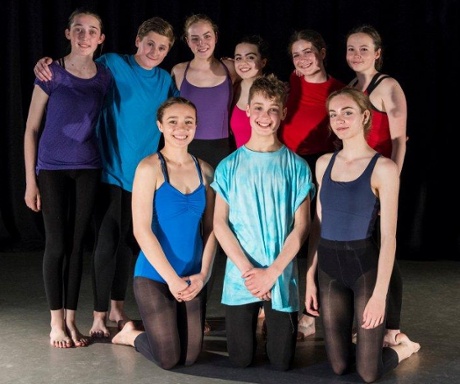
RAD Chief Executive, Luke Rittner said:
I am thrilled with this year’s results, which coupled with last week’s A level results, show that the Royal Academy of Dance’s education programmes for 14-19 year olds are going from strength to strength.
Two sets of twins at the private Solihull School are celebrating a phenomenal 35 A* grades between them in their GCSE results.
Lily and Kashee Mistry, and Isabel and Eleanor Gaffney, made a healthy contribution towards the West Midlands school’s overall 73% A* to A grade pass rate. Well done girls!
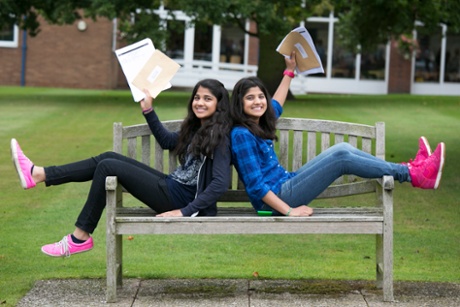
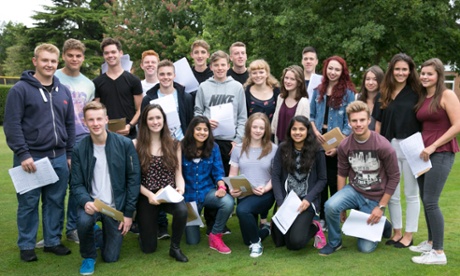
Forty-four pupils at the 455-year-old independent co-educational school for 7 to 18 year olds achieved 10 or more A* to A grades.
Success comes at a price, however. It will cost you £3,848 a term if you want to send your child to Solihull School this September.
You can share your stories by clicking on the blue “contribute” button at the top of the blog. You can also use the Guardian app and search for “GuardianWitness assignments”. We’d like to see photos, too – and do make sure you include important details, like the name of the school, in the description box.
You can also share your stories, photos and videos with the Guardian via WhatsApp by adding the contact +44 (0) 7867 825056 – please include “GCSEs” in the caption.
Though we’d like to hear from all GCSE students, unfortunately we can’t publish contributions from anyone under the age of 16 without their parents’ permission.
Updated
Maths and English students must retake GCSEs if they fail, says Nicky Morgan
Nicky Morgan, the education secretary, has said key subjects English and Maths must be retaken if GCSE students fail to achieve a C grade or higher.
Speaking on Good Morning Britain as hundreds of thousands of students picked up their results, Morgan also addressed the shortage of maths teachers which was identified in a Times article today.
The National Association of Headteachers is drawing attention to the 18% increase in the numbers of 17-year-olds resitting GCSE exams this year.
The union warns that “obsessive tinkering” with the education system over the years has vastly increased the pressure on teachers and is calling on the government to make sure the resources are available to reverse the trend. Russell Hobby, NAHT general secretary, said:
We welcome the increase in the number of students getting A* to C grades, which is testament to the hard work of both students and teachers. However, the 18 per cent increase in 17 year olds taking GCSEs does point to an increase in the number of students resitting exams. The government needs to make sure that school leaders are supported to address this trend, ensuring that resourcing is appropriate to offer the courses needed.
There are still unanswered questions about the impact that the increase in entries for IGCSE English have had on the overall picture. This highlights the problems caused by the exclusion of IGCSE results from the overall figures.
Much has been written this week about whether GCSEs are the right method of assessment now that the school leaving age is 18. What’s important is that the debate doesn’t overshadow the achievements of so many young people today.
The secondary sector is crying out for some vision from government. Instead, obsessive tinkering over many years has short-changed students and created unnecessary pressure on education professionals.
Secondary education is where a child’s preparation for real life gets serious. For the students heading into A Level study next week, the future is uncertain. The government is coasting on this issue. These young people deserve better.
A* and A grades slip for the fourth consecutive year
The proportion of students getting the top grades in their GCSEs has fallen for the fourth year in a row, an analysis of results by the exam board regulator shows.
According to Ofqual, for all students across the UK, the proportion achieving A* is down 0.1 percentage points to 6.6% and the proportion achieving A* and A is down 0.1 percentage points to 21.2%.
The drop in top grades comes amid an overall rise of 0.2 percentage points in the number achieving grades A* to C, to 69%.
However, Ofqual cautions against paying too much attention to year-on-year changes. It says:
Although the overall entry numbers appear to be stable, in some subjects there has been considerable change in entry patterns. This is likely to be due to schools changing their approaches to teaching and exam entry in response to policy changes, such as changes to performance tables to count only the first entry, and the requirement for students who do not achieve a grade C in English or mathematics to continue to study those subjects. As a result, making comparisons between overall results in summer 2015 and results in summer 2014 is of limited value.
Pupils turning up to collect their results from Freeston academy in Normanton, Yorkshire, have been turned away because their school is on fire.
West Yorkshire fire and rescue say they have 10 pumps now tackling the massive blaze at the school, which broke out just after 9am this morning.
@looknorthBBC Freeston Academy pic.twitter.com/D0rPQvLWtE
— Gavin Budby (@GavBudby) August 20, 2015
The fire service are now using ten pumps for the fire at Freeston Academy and say no-one is hurt. #Wakefield pic.twitter.com/jPvv0pSkeQ
— Radio Aire News (@radioairenews) August 20, 2015
“We have five large jets in operation, two hose reels, four breathing apparatus and three positive pressure ventilation fans,” the fire service said in a statement.
No one has been hurt and GCSE students are unaffected, the fire service said. Neighbours are advised to keep their windows shut.
Let’s hope it wasn’t a results day prank gone wrong.
Updated
This blog is looking a bit wordy, so here’s a results day gallery. Well done to everyone getting their results today.


Updated
Where you live has an impact on how well you do in your GCSEs. London, Gloucester, Cambridge and York led the country in the numbers of pupils achieving more than five A* to C grades, including maths and English, this map from the Centre for Cities shows.
The data is from last year, but it highlights what the centre says is a big overlooked issue: the disparity of attainment between different cities.

Within cities too, pupils from disadvantaged backgrounds do less well in their GCSEs than their peers, researchers found.
They produced this graph to illustrate the disparities.

Brian Semple, a spokesman for the Centre for Cities, said:
Not only do GCSE results reflect the economic strengths or weaknesses of a city, it also entrenches the economic disparities between different places. For example, cities with low educational outcomes tend to have high rates of youth unemployment and also struggle when it comes to entrepreneurship and productivity. Addressing poor educational performance in cities is not only vital for improving their young people’s prospects in life – it’s also crucial for boosting the local economies of struggling places.
Updated
The National Union of Teachers (NUT) has warned of an excessive focus on the “traditional” subjects that make up the Ebacc qualification.
Christine Blower, the general secretary, is calling on the government to ditch the Ebacc, which she says distorts and narrows the educational opportunities on offer to young people. She said:
Today’s GCSE results are a reflection of the hard work of pupils and their teachers throughout their study programme.
The increased takeup of certain subjects needs to be looked at and considered carefully in the context of medium- and long-term trends. Measures such as the Ebacc are bound to have an effect on entries, but it is vital that the uptake of the ‘academic’ subjects they represent isn’t at the expense of learner choice. Students must have the freedom to study areas which they find rewarding and in which they can excel.
Most importantly, it is vital that we do not send the message to learners that areas such as performing and creative arts, design and technology, PE or vocational subjects are of lesser importance than the EBacc subjects. All of those areas contribute to a rounded education. For many young people non-Ebacc subjects can form the basis of future learning and valid and rewarding career opportunities in sectors which contribute substantially to the UK economy.
The NUT urges the government to remove the Ebacc and other accountability measures which narrow and distort the curriculum on offer to young people.
Updated
A*-C pass rates in Wales match last year's record high
Two out of every three Welsh teenagers taking their GCSEs this year passed at grades A*-C – matching a record high last year.
Huw Lewis, the Welsh education minister, congratulated teachers and pupils on their achievements. The overall pass rate was close to 99% and nearly one in five passes was at grade A or above.
The Welsh government hailed improvements in key subjects, including:
- Performance at English language A*- C for 16-year-olds increasing from 62.6% in 2014 to 64.0% in 2015.
- Welsh first language A*-C increasing from 72.7% in 2014 to 73.9% in 2015.
- Welsh second language A*-C increasing from 77.7% in 2014 to 79.4% in 2015.
- Maths A*-C for 16-year-olds increasing by 1.2% with a result of 62.8% for the 2014/15 academic year compared to 61.6% for the 2013/14 academic year.
- Overall science A*-C increasing from 55.8% in 2014 to 57.5% in 2015.
Welsh baccalaureate results show:
- Over 13,000 learners being awarded a Welsh baccalaureate diploma.
- A 4% increase on the number of learners completing their Welsh bacc at intermediate level compared to 2014 levels.
- 11, 767 learners achieving the full intermediate diploma.
Commenting on the results, Lewis said:
This year’s GCSE results show another strong performance, with over two thirds of our learners achieving at least A*-C. This is the result of hard work and sustained effort by both our learners and their teachers and I wholeheartedly congratulate everyone involved on this success.
I am particularly pleased we have seen such a strong performance at key subjects including English, maths, Welsh and science.
Our Welsh baccalaureate performance is also cause for celebration and means that 13,000-plus learners now have an additional string to their bows and are equipped with skills and experiences that give them a definite edge in an increasingly competitive world.
I have no doubt that our focus on raising standards is delivering for learners in Wales and look forward to an even higher A*-C pass rate once the full year’s results are published later this year.
Updated
The cost of getting a student to produce straight A*s is thought to be £593 and an iPhone, research claims.
A survey of 1,500 parents carried out for Currys/PC World found that parents are prepared to go to extraordinary lengths of bribery to encourage their offspring to spend a few minutes revising.
Bizarrely, it found that parents were even handing out cash for an F. Parents in the north-east of England are most likely to reward their children for good grades (94%), the survey found. Parents in the south-east are least likely (81%).
Updated
The Department for Education’s official press statement is trumpeting a rise in the number of pupils taking Stem (science, technology, engineering and maths) subjects.
The department points out that compared with 2014, today’s figures showed GCSE entries rose in:
- Maths – up 24,827 (3.4%).
- Computer science – up 18,641 (111.1%).
- Science – up 20,523 (5.5%).
- Engineering – up 1,882 (37.4%).
It’s all as per the government’s plan. Nicky Morgan, the education secretary, said:
Today marks the culmination of years of hard work for pupils, teachers and parents and I want to congratulate them on their achievements.
Thanks to our reforms focused on extending opportunity, a generation of young people from all backgrounds are now securing the GCSEs that help give them the widest range of options later in life – whether looking for a rewarding job or a top apprenticeship.
This not only benefits the students involved, it means our workforce for the future is properly trained to compete in a global economy.
Updated
Slump in foreign languages and rise in computing
The number of GCSE students taking modern foreign languages dropped significantly this year, writes Aisha Gani.
A total of 302,500 took a language GCSE, compared with 321,000 last year and around 332,000 in 2013.
Entries for French were down 6.2%, German down 9.2% and Spanish down 2.4%. Grades for languages have improved, however, perhaps because brighter candidates are studying the subject. Since 2005, French is down 42%, German plunged by 49% but Spanish is up – by 45.3%.
The number of students taking computing and ICT has grown significantly. This year 35,000 students sat a computing GCSE, compared with 17,000 last year, and 65% achieved A*-C grades. The number of pupils taking ICT increased by 15% to nearly 112,000, 68% of whom got at least a C.
Updated
Aeons ago, when I picked up my GCSE results, you would make a quick call home, compare them with your closest friends, and maybe tell a trusted teacher.
Kids these days can share their grades with the world. Here’s just a few of the thousands of tweets going out from pupils opening their envelopes this morning:
3 A's, 4 B's and a distinction star ☺️ couldn't be happier #gcseresults
— Lauren Bell (@Lozzieee98) August 20, 2015
Da iawn, Tomos Wyn Jones! With 9A*s 3As he's now looking forward to returning to do his A-levels. #tgau #gcseresults pic.twitter.com/YeiqkwXZXR
— Ysgol Morgan Llwyd (@YsgMorganLlwyd) August 20, 2015
Congrats to my daughter on her GCSE results. A*, 2x A, 2x B, 5x C and a Dist* *Proud Dad* #gcseresults
— Andy Hipkiss (@Ennabran) August 20, 2015
GCSE RESULTS pic.twitter.com/xnKB8iLOgu
— James DF (@yyknip) August 20, 2015
Northern Ireland is top of the class again
Northern Irish GCSE pupils continue to outperform their counterparts in England and Wales according to today’s exam results, writes Henry McDonald.
The number of students in Northern Ireland who obtained A*-C grades rose by almost 1% this year. Overall in the province, 78.7% of pupils got the top four grades, compared with the England and Wales result of 69%.
More Northern Irish students than ever before achieved the A* star grade – 28.6%.
Justin Edwards, chief executive of Northern Ireland’s awarding organisation, the Council for the Curriculum, Examinations and Assessment (CCEA), said:
This year’s results show a steady improvement in A*-C grades. Importantly, the grades in English and mathematics have continued to build on the good performance of recent years.
The general pattern of growth in Stem subjects that emerged last week at A-level is repeated in today’s GCSE figures. This is underpinned by notable growth in mathematics and ICT.
It’s also encouraging to see the improved performance of males this year, closing the gender gap at grades A*-C.
Updated
Now for some super-high achievers. Twin sisters Amarachi and Onyinyechi Orie from south London scooped up 16 A* and A grades at GCSE between them, as well as two Bs. Amarachi got two A*s, six As and a B, while Onyinyechi got one A*, seven As and a B.

Both sisters have been students at Ark’s Evelyn Grace academy in Brixton since 2010. Onyinyechi wants to study medicine and become a doctor and Amarachi is planning to study English at university and go into journalism or PR. Amarachi said:
We both aimed for the highest grades and we really spurred each other on. There was a bit of competition, but it was more about helping and supporting each other.
Getting the top grades at GCSE means that all that hard work has paid off and it will make us work even harder at A-level. We know that our GCSEs mean we’re one step closer to achieving our goals.
Updated
Noel Fabros from Blessed Hugh Faringdon Catholic school in Reading, Berkshire, has sent us our first results day selfie through GuardianWitness.
And he’s going to be celebrating today. “I passed it all except for one subject, one A*, one A, four Bs, and four Cs,” he said.
Well done Noel, you smashed it!

Just got my envelope
You can caption it "Noel Fabros from Blessed hugh faringdon catholic school is very happy after collecting his envelope"
Remember, you can share your stories by clicking on the blue “contribute” button. You can also use the Guardian app and search for “GuardianWitness assignments”. We’d like to see photos, too – and do make sure you include important details, like the name of the school, in the description box.
You can also share your stories, photos and videos with the Guardian via WhatsApp by adding the contact +44 (0) 7867 825056 – please include “GCSEs” in the caption.
Though we’d like to hear from all GCSE students, unfortunately we can’t publish contributions from anyone under the age of 16 without their parents’ permission.
Updated
Here’s another graphic to illustrate the trends in today’s results. Across all subjects, nearly seven out of 10 (68.8%) entries were awarded A*-C, up 0.2 percentage points on 2014.
However, there was a slight decline in top grades with 21.2% getting an A* or A and 6.6% getting an A* – both one percentage point down on 2014’s results.
Updated
Today’s pupils are the lucky ones, as the national assessment system is due for an overhaul that will complicate things in years to come, a senior educator has said.
Dr Kevin Stannard, director of innovation & learning at the Girls’ Day School Trust, has issued the warning over plans to change the way courses are graded and constituted. He says:
In many ways today’s students are the lucky ones. Those starting their GCSE courses in September will emerge with a mixed bag of qualifications, some with letter grades, some with numbers. In this transition period, some GCSEs will be harder than others while maths will be considerably bigger in terms of content.
A low C, the current standard required for a minimum ‘good’ pass, may be seen as a failure in future years. It’s all change without any guarantee of the quality or consistency of marking and grading. This is much more damaging than grade inflation in causing a loss of confidence in the qualification.
Updated
Jack Whitehall, the comedian, has surprised pupils at Greenwood academy in Birmingham by handing out their results on live television.
He described his own results as “mixed”, before presenting three students with sealed envelopes containing their grades, PA reports.
Whitehall admitted he had “bombed in drama” at school, but added “hopefully these guys will do better”. He told the students: “I remember being very nervous but you just need to keep telling yourself it’s not the end of the world if you mess up.”
Pupils from Birmingham with their #gcseresults after @jackwhitehall kindly delivered them this morning pic.twitter.com/oupR2KVogN
— BBC Breakfast (@BBCBreakfast) August 20, 2015
Thanks @jackwhitehall for delivering pupils like Jordan and Khari @GW_Academy their #gcseresults #bbcbreakfast pic.twitter.com/78H8cwcE3Z
— BBC Breakfast (@BBCBreakfast) August 20, 2015
As Connor, one of the Greenwood pupils, opened his results live on BBC news – including a pass in maths, media and merit in construction – Whitehall exclaimed that he had “smashed it out the park”.
Harry French, the headteacher, has overseen the transformation of the Birmingham school from a failing performing arts college to one of the fastest improving in the country. He said he was “really delighted with the journey we have made to this point”.
He added: “The kids here worked so incredibly hard this year. They have turned it around. They have worked so hard to make sure they succeed.”
Updated
English pass rate rises thanks to jump in A*-C grades
The proportion of GCSE passes rose again this year, spurred by a significant jump in the numbers achieving at least a grade C in English, writes Richard Adams.
Reversing last year’s fall in the English pass rate, there was a nearly four percentage point rise in those obtaining a C or above in English language this year, coupled with a slight improvement in those awarded A grades. The rise counteracted a slight fall in those awarded passes in English literature.
Across all subjects, almost seven in 10 (68.8%) entries were awarded A*-C, up 0.2 percentage points on 2014.
But there was a 0.1 percentage point drop in A* grades – the fourth year running that there has been a fall – with 6.6% of entries given the highest mark this year.
The national figures, published by the Joint Council for Qualifications (JCQ) also show that the gender gap has narrowed slightly this summer, with 73.1% of girls’ entries awarded at least a C grade, compared to 64.7% of boys’.
This is a gap of 8.4 percentage points, compared to 8.8 percentage points last summer.
Updated
I’ve been focusing on the pupils so far, but they’re not the only people with a massive investment in the outcome of GCSE results day. It’s the acid test for teachers, too, and their professional reputations are riding on the achievements of their young charges.
English teacher Lucy Reynolds has shared her experiences with the Guardian’s Teacher Network. As she points out, it’s not just 16-year-olds waking up with the jitters this morning:
It starts 24 hours before, with a niggling knot in your stomach and a sense of doom that will not shift. Your appetite fades. You feel anxious and uptight. In bed, unable to sleep, you toss and turn, haunted by memories of exam halls and the scratching of pen on paper. In a few hours, a set of grades will determine your future. If this is how you feel, god only knows what’s going through the minds of your students.
Results day: when the sword of Damocles is swinging so close that it could give you a shave to make seasoned barbers jealous. It is, of course, a day of heightened tension: students will finally find out if their hard work has paid off or, in some cases, whether that last-minute revision made up for two years of never actually opening a book [spoiler alert: it didn’t]. It is a day of joy for some, whose smiling faces and excitement will make you remember why you became a teacher. For others, it means disappointment and regret.
Updated
If you do get a bad grade in your GCSE results today, how will it affect you? The Guardian has asked a panel of writers to remember their worst result and the impact it had on their lives. I’m particularly keen on this contribution from Joel Golby:
You haven’t known the dark futility of the universe until you’ve got a U in A-level general studies. Because – do you know how hard you have to mess up to get a U? Essentially, you have to die mid-exam, misspell your own name on the front of the test, or just not turn up at all. I did none of those things. I actually tried, I actually did the exam. I just tested so badly an AQA representative deemed it unworthy of a grade.
Thing is, on results day, a lot of adults who turned out all right despite getting a U in general studies or similar are going to tell you, ‘Hey, I turned out all right despite getting a U in general studies’ and, ‘Hey, you’ll turn out all right, despite your U in general studies’ and, ‘Hey, your U in general studies isn’t the end of the world’. But they are wrong. It is the end of the world.
The life you had where a U in general studies matters just ended, and the person you were there was slaughtered. You now live in a much more real, horrible world, where a U in general studies is irrelevant – yes, entirely irrelevant, the most irrelevant thing ever conceived – but also now everything else is sharply very relevant, and you have to, like, get a job, and pay rent, and know vaguely how much a water bill costs, and actually watch the news sometimes. Sounds horrible, doesn’t it?
Like, who gets a U in general studies?
Updated
As a grownup, it’s easy to scoff at the difficulties the young face with their exams. “Pah!” you might think. “If 16-year-olds can do them, they must be easy.”
Well the Guardian has brought you a couple of reality checks. Have a crack at our two GCSE quizzes to see if you would pass if you took your exams today.
Updated
As the time for opening envelopes approaches, remember that exam marking is an art, not a science. When A-level results were released last week, the Guardian published this anonymous contribution from a senior examiner who warned that grades could easily be wrong.
Perhaps you picture genteel examiners sitting in Oxbridge common rooms, languidly resting on armchairs as they earnestly discuss whether Chloe’s essay merits an A* or merely an A. Maybe you imagine seasoned professionals kindly donating their holidays to mark in the garden over Earl Grey tea and lemon drizzle cake? Wise up. Examining is a ruthless multimillion-pound business. There are two types of examiners: the quick and the dead. The faster we mark, the more we get paid. If we’re slow, we fall foul of exam cheat No 1: the exam board.
It doesn’t matter whether you teach economics with XXX board or further maths with YYY, they are as rotten as each other. My board asks for two qualifications from their examiners: they are alive and they need the cash.
Mr Simpson turns up year after year marking different papers in my subject because the exam board doesn’t cross-reference sackings with recruitment. Think of him as a zombie – we declare them dead, but they reappear. Simpson is ‘aberrant’, in examiner parlance. This means that when we look at his marking, some scores are too generous, some are too mean and there is no pattern. Fancy having him mark your students’ papers? Ms Griffin, however, is merely a ‘lingering doubt’. These markers make big mistakes, but there is a consistent generosity or meanness that we can correct.
Speaking of consistency, here’s exam cheat No 2: Ofqual. The quango is charged with ensuring compatibility between the exam boards but its heavy-handed, ruthlessly statistical approach makes everything much worse. Unless exam boards give 80% of their marks to Ofqual by early July, they face severe sanctions, including public naming and shaming. Senior examiners therefore have to apply the thumbscrews to their juniors, with predictable consequences for accuracy.
In a recent report, exam boards confessed to ‘guesstimating’ grades. The only shock for me was that they admitted it. I’ve seen a chief examiner [top of the tree in exam terms] take a set of papers from an aberrant marker and come back minutes later with new grades. Usain Bolt couldn’t have moved at that speed. The examiner had clearly just looked up the school’s predicted grades and scribbled them on top of the papers. The moral of the story is to check the grades your centre sends to the board. They are used more than you think.
The moral of the story? ‘If in doubt about a result, always go for a re-mark.’
Updated
The tension is building on Twitter as pupils get ready to receive their results. Here’s a flavour of the kinds of things young people are posting under the hashtag #GCSEresults.
Im gonna need the dramatic part of justin bieber's believe playing while i open my results #gcseresults
— Graycé✨ (@avonsweetdream) August 20, 2015
#GCSE #gcseresults terrified. 😰
— Carolina Morais (@carolinaVmorais) August 20, 2015
Feeling a bit sick #gcseresults
— Corinne :p (@Corinne_bailey) August 20, 2015
Where's the nearest cliff? #GCSEresults
— H⚓️ (@HSanchor94) August 20, 2015
You can also share your stories, photos and videos with the Guardian via WhatsApp by adding the contact +44 (0) 7867 825056 – please include “GCSEs” in the caption.
Though we’d like to hear from all GCSE students, unfortunately we can’t publish contributions from anyone under the age of 16 without their parents’ permission.
Girls are excelling at GCSE physics yet lack the confidence to study the traditionally male subject into A level, a prominent headteacher has said.
Richard Cairns, of independent school Brighton college, says schools need to address the issue of girls ditching physics after the age of 16, despite typically doing well in the subject.
The Institute of Physics found that only 20% of pupils taking A-level physics were girls despite roughly equal success rates at GCSE between girls and boys. Cairns said:
Girls do brilliantly in physics. At Brighton college, nearly every girl took GCSE physics and 100% got an A* or A in the subject. Nationally, too, girls are doing just as well as boys in this traditionally male subject, but hardly any of them will opt for the subject at A-level. Last year, only 8,000 girls nationally took that bold step, compared to 29,000 boys.
Our economy cannot afford for so much potential to go unmined and I believe it is only sensible for the country’s educators to try and work out how we can right the imbalance.
Updated
Apprehensive about your results? Worried if those revision all-nighters actually made things worse? Well GCSEs aren’t everything.
Gemma Cairney has never forgotten the E she got in GCSE maths. But, she says, it didn’t hold her back – now she’s a BBC Radio 1 DJ.
Updated
Most ethnic minority groups are now achieving GCSE results that are as good or better than their peers from white British backgrounds, Richard Adams reports.
Research by Prof Steve Strand of Oxford University looked at GCSE results between 1991 and 2013 and found that children from Indian and Chinese ethnic backgrounds outperformed all other groups.
GCSE grades among students from Bangladeshi and black African backgrounds also improved so that they did better than pupils from white British backgrounds overall.
Black Caribbean and mixed white and black Caribbean students were also seen to have substantially closed the gap in academic attainment with white British students, despite a higher proportion coming from disadvantaged backgrounds.
In 2004, only 24% of black Caribbean pupils achieved C grades or better in five or more GCSE subjects, including English and maths. But the proportion had more than doubled to 53% by 2013, compared with 60% for white British students.
Strand said that in the late 1980s, children from well-off backgrounds were seven times more likely to get good grades than those from disadvantaged backgrounds but were now only three times as likely to do so.
“The gap is still too large but the data shows it is possible to reduce the seemingly intractable social and economic divide,” Strand said. “We have to hope that redistributive funding, such as the pupil premium grant, can bring more progress in closing gaps that still exist.”
Updated
Good morning and welcome to GSCE results day.
There will be scenes of desperation and jubilation as about 600,000 pupils in England will get their GCSE results on Thursday. The national exams, usually taken at 16, are a key determinant of the educational and vocational future of candidates.
Unlike previous years, this year there is a degree of uncertainty about how pupils will do, caused by a widespread boycott of key stage two assessments five years ago.
GCSE grades are linked to how the same cohort of pupils performed in their key stage two exams at the end of primary school – but about a quarter of this year’s GCSE entrants missed the exams in 2010 due to the boycott.
Like the A-level results last week, the big picture is expected to show a continued shift towards a narrower range of academic subjects including history, geography, languages and sciences.
I will be covering all the developments throughout the day, but of course the results themselves don’t show the full story. We want teachers, pupils and parents to tell us about the stories behind the grades. If you’re a teacher, it may be that your school has improved dramatically in one subject year on year, or individual pupils have exceeded expectations.
And if you’re a student, have you achieved the results you needed – or better? If you haven’t done as well as you hoped, let us know how you’ve changed your plans.
You can share your stories by clicking on the blue “contribute” button. You can also use the Guardian app and search for “GuardianWitness assignments”. We’d like to see photos, too – and do make sure you include important details, like the name of the school, in the description box.
You can also share your stories, photos and videos with the Guardian via WhatsApp by adding the contact +44 (0) 7867 825056 – please include “GCSEs” in the caption.
Though we’d like to hear from all GCSE students, unfortunately we can’t publish contributions from anyone under the age of 16 without their parents’ permission.